具身智能之心

Search documents
阿里新研究:一统VLA和世界模型
具身智能之心· 2025-10-31 00:04
Core Insights - The article discusses the development of WorldVLA, a unified framework that integrates Visual Language Action models (VLA) with world models, aimed at enhancing AI's understanding of the world [2][5]. Group 1: Framework and Model Integration - WorldVLA demonstrates significant performance improvements over independent action and world models, showcasing a mutual enhancement effect [3][20]. - The framework combines the capabilities of action models and world models to predict future images and generate actions, addressing the limitations of each model when used separately [5][6]. Group 2: Model Architecture and Training - WorldVLA utilizes three independent tokenizers for encoding images, text, and actions, with a compression ratio of 16 and a codebook size of 8192 [9]. - The model employs a novel attention mask for action generation, allowing for parallel generation of multiple actions while maintaining the integrity of the generated sequence [12][13]. Group 3: Performance Metrics and Results - Benchmark tests indicate that WorldVLA outperforms discrete action models, even without pre-training, with notable improvements in various performance metrics [20][22]. - The model's performance is positively correlated with image resolution, with 512×512 pixel resolution yielding significant enhancements over 256×256 resolution [22][24]. Group 4: Mutual Benefits of Model Types - The integration of world models enhances action models by providing a deeper understanding of environmental physics, which is crucial for tasks requiring precision [26][27]. - Conversely, action models improve the visual understanding capabilities of world models, leading to more effective action generation [18][31].



ICCV 2025 | Mamba-3VL:单一模型攻克18类异构任务,重新定义具身智能大模型能力边界
具身智能之心· 2025-10-30 10:00
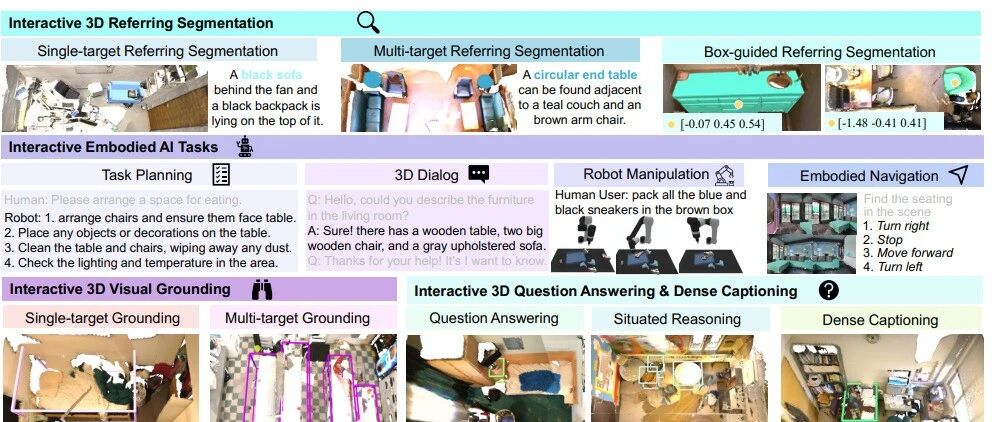
Core Insights - The article discusses the Mamba-3VL model, which integrates state space modeling into 3D vision-language learning, addressing the challenge of task adaptability in embodied intelligence [2][3][18] - Mamba-3VL demonstrates the capability to handle 18 heterogeneous tasks across various domains, marking a significant advancement in the field of embodied intelligence [3][11][17] Summary by Sections 1. Core Method Innovations - Mamba-3VL introduces three key technological breakthroughs to overcome the limitations of traditional embodied models, particularly those based on Transformer architecture [3][5] - The model utilizes a multi-modal Mamba Mixer module to efficiently fuse 3D point clouds, visual data, and language inputs, enhancing spatial relationship modeling [5][6] - A dynamic position encoding mechanism, IDPA, combines geometric priors and semantic modulation to adapt to varying task precision requirements [6][9] - The unified query decoding framework allows for flexible output across multiple tasks without the need for module reconstruction [6][10] 2. Comprehensive Task Coverage - Mamba-3VL supports 18 distinct tasks categorized into four major dimensions, showcasing its versatility in both foundational and advanced embodied interactions [11][12] - The tasks include basic 3D perception, language reasoning, instance segmentation, and advanced interaction and planning tasks [11][14] 3. Performance and Generalization - The model sets new performance records on key benchmarks, demonstrating superior capabilities in handling large-scale 3D data with linear computational complexity [15][16] - Mamba-3VL achieves state-of-the-art results in various tasks, including dense description generation and robotic operations, indicating strong generalization abilities [15][17] 4. Research Significance - The advancements presented by Mamba-3VL redefine the direction of general embodied intelligence, suggesting applications in robotics, autonomous driving, virtual reality, and smart home control [17][18] - The model's ability to adapt to 18 heterogeneous tasks without extensive retraining paves the way for future developments in multi-task embodied intelligence [20]
具身智能之心交流群成立来!VLA/RL/导航/数采等多个方向
具身智能之心· 2025-10-30 10:00
Group 1 - The establishment of a technical exchange group focused on embodied intelligence technology, inviting participation from various subfields [1] - The group encompasses nearly 20 sub-directions, including humanoid robots, quadrupeds, robotic arms, and areas such as vla, large models, vln, reinforcement learning, mobile operation, multimodal perception, simulation, and data collection [1] - The invitation encourages collaboration and discussion on technology and industry developments among participants [1]

能部署ACT和pi0,专为具身领域打造的高性价比机械臂来啦!
具身智能之心· 2025-10-30 03:43
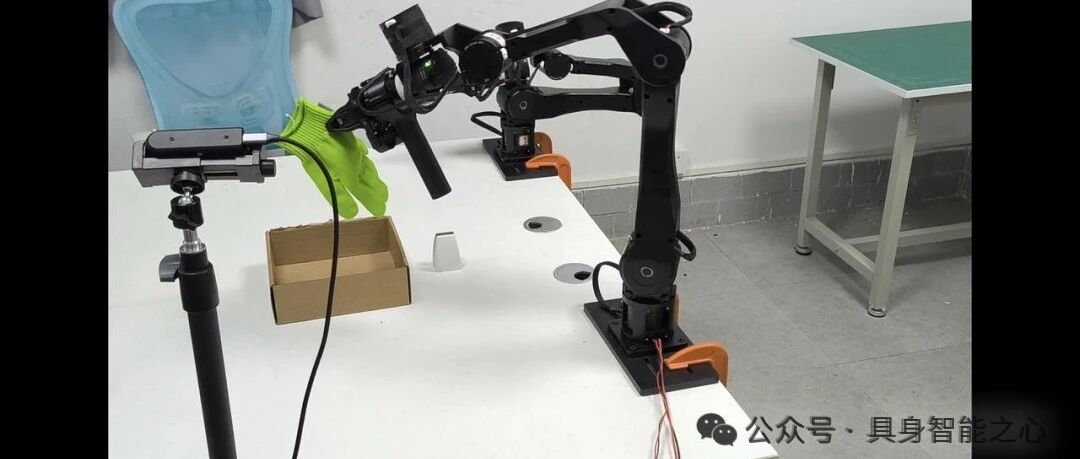
Core Viewpoint - Imeta-Y1 is a lightweight, cost-effective robotic arm designed specifically for beginners and researchers in the field of embodied intelligence, enabling low-cost and efficient algorithm validation and project development [2][5]. Group 1: Product Features - The robotic arm offers a complete open-source toolchain and code examples, facilitating a seamless process from data collection to model deployment [3][17]. - It supports dual-language interfaces in Python and C++, allowing users to quickly get started regardless of their programming background [3][18]. - Compatibility with ROS1 and ROS2 is provided, along with URDF models for smooth transitions between simulation and real-world applications [3][19]. - The arm features high-precision motion control, low power consumption, and an open hardware architecture, supporting seamless integration from simulation to real machine [5][6]. Group 2: Technical Specifications - The robotic arm has a weight of 4.2 kg, a rated load of 3 kg, and 6 degrees of freedom, with a working radius of 612.5 mm and a repeat positioning accuracy of ±0.1 mm [8][19]. - It operates at a supply voltage of 24V and communicates via CAN, with external interfaces for power and CAN connections [8][19]. - The arm's joint motion range and maximum speeds are specified, ensuring versatility in various applications [8][19]. Group 3: Development and Support - A comprehensive open-source SDK is provided, including drivers, API interfaces, sample code, and documentation, supporting rapid application development [26][29]. - The product supports multi-modal data fusion, compatible with mainstream frameworks like TensorFlow and PyTorch, enabling end-to-end implementation of intelligent algorithms [29][32]. - The company offers 24-hour quick response for after-sales support, ensuring users receive timely assistance [3][19]. Group 4: Testing and Reliability - Rigorous hardware testing processes, including precision calibration, durability, load performance, and stability verification, ensure the robotic arm's reliability and safety across various application scenarios [35][39].
近500页史上最全扩散模型修炼宝典,一书覆盖三大主流视角
具身智能之心· 2025-10-30 00:03
Core Insights - The article discusses the comprehensive guide on diffusion models, which have significantly reshaped the landscape of generative AI across various domains such as images, audio, video, and 3D environments [3][5][6] - It emphasizes the need for a structured understanding of diffusion models, as researchers often struggle to piece together concepts from numerous papers [4][10] Summary by Sections Introduction to Diffusion Models - Diffusion models are framed as a gradual transformation process over time, contrasting with traditional generative models that directly learn mappings from noise to data [12] - The development of diffusion models is explored through three main perspectives: variational methods, score-based methods, and flow-based methods, which provide complementary frameworks for understanding and implementing diffusion modeling [12][13] Fundamental Principles of Diffusion Models - The origins of diffusion models are traced back, linking them to foundational perspectives such as Variational Autoencoders (VAE), score-based methods, and normalizing flows [14][15] - The chapter illustrates how these methods can be unified under a continuous time framework, highlighting their mathematical equivalence [17] Core Perspectives on Diffusion Models - The article outlines the core perspectives on diffusion models, including the forward process of adding noise and the reverse process of denoising [22] - Each perspective is detailed: - Variational view focuses on learning denoising processes through variational objectives [23] - Score-based view emphasizes learning score functions to guide denoising [23] - Flow-based view describes the generation process as a continuous transformation from a simple prior distribution to the data distribution [23][24] Sampling from Diffusion Models - The sampling process in diffusion models is characterized by a unique refinement from coarse to fine details, which presents a trade-off between performance and efficiency [27][28] - Techniques for improving sampling efficiency and quality are discussed, including classifier guidance and numerical solvers [29] Learning Fast Generative Models - The article explores methods for directly learning fast generative models that approximate the diffusion process, enhancing speed and scalability [30] - Distillation-based methods are highlighted, where a student model mimics a slower teacher model to achieve faster sampling [30][31] Conclusion - The book aims to establish a lasting theoretical framework for diffusion models, focusing on continuous time dynamical systems that connect simple prior distributions to data distributions [33] - It emphasizes the importance of understanding the underlying principles and connections between different methods to design and improve next-generation generative models [36]

ROSCon 2025 -《具身智能训练场》 Workshop 论坛安排
具身智能之心· 2025-10-30 00:03
以下文章来源于古月居 ,作者ROSConChina 组委 古月居 . 专业的ROS机器人知识社区和产业服务平台 作者丨 ROSConChina 组委 编辑丨古月居 点击下方 卡片 ,关注" 具身智能之心 "公众号 >> 点击进入→ 具身 智能之心 技术交流群 更多干货,欢迎加入国内首个具身智能全栈学习社区 : 具身智能之心知识星球 (戳我) , 这里包含所有你想要的。 方式二:扫描下方二维码 RROOSSCCononChCinhaina 2025 Wo r k s h op " 具身智能训练场 (Embodied Intelligence Playground) 联合主办方: 刻行时空 × 穹彻智能 时间: 2025年11月1日(周六)10:00 – 12:30 地点: 上海虹桥新华联索菲特大酒店B1加百利会议室 方式一:点击下方小程序进入购票页面 | 时间 | 内容 | 嘉宾 | 单位 | | --- | --- | --- | --- | | 10:00-10:10 | 开场致辞 | 主持人 | 刻行时空 × 穹彻智能 | | 10:10-10:30 | 主题演讲1:物理AI仿真系统,加速具身机器人 | ...

具身智能领域最新世界模型综述:250篇paper带大家梳理主流框架与任务
具身智能之心· 2025-10-30 00:03
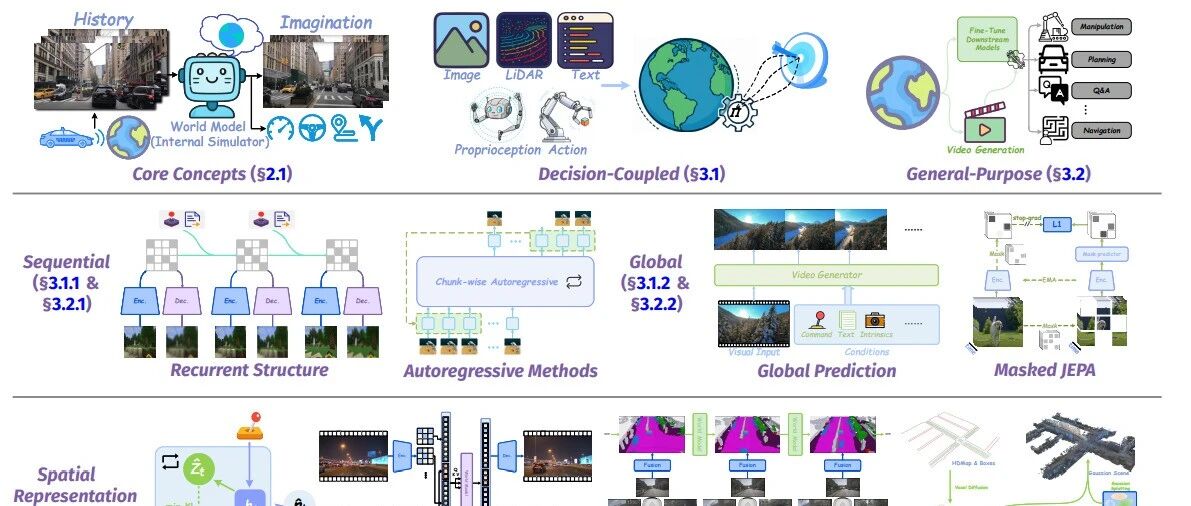
Core Insights - The article discusses the concept of world models in embodied AI, emphasizing their role as internal simulators that help agents perceive environments, take actions, and predict future states [1][2]. Group 1: World Models Overview - The research on world models has seen unprecedented growth due to the explosion of generative models, leading to a complex array of architectures and techniques lacking a unified framework [2]. - A novel three-axis classification method is proposed to categorize existing world models based on their functionality, temporal modeling, and spatial representation [6]. Group 2: Mathematical Principles - World models are typically modeled as partially observable Markov decision processes (POMDPs), focusing on learning compact latent states from partial observations and the transition dynamics between states [4]. - The training paradigm for world models often employs a "reconstruction-regularization" approach, which encourages the model to reconstruct observations from latent states while aligning posterior inference with prior predictions [9]. Group 3: Functional Positioning - World models can be categorized into decision-coupled and general-purpose types, with the former optimized for specific decision tasks and the latter serving as task-agnostic simulators [6][15][16]. - Decision-coupled models, like the Dreamer series, excel in task performance but may struggle with generalization due to their task-specific representations [15]. - General-purpose models aim for broader predictive capabilities and transferability across tasks, though they face challenges in computational complexity and real-time inference [16]. Group 4: Temporal Modeling - Temporal modeling can be divided into sequential reasoning and global prediction, with the former focusing on step-by-step simulation and the latter predicting entire future sequences in parallel [20][23]. - Sequential reasoning is beneficial for closed-loop control but may suffer from error accumulation over long predictions [20]. - Global prediction enhances computational efficiency and reduces error accumulation but may lack detailed local dynamics [23]. Group 5: Spatial Representation - Various strategies for spatial representation include global latent vectors, token feature sequences, spatial latent grids, and decomposed rendering representations [25][28][34][35]. - Global latent vectors compress scene states into low-dimensional variables, facilitating real-time control but potentially losing fine-grained spatial information [28]. - Token feature sequences allow for detailed representation of complex scenes but require extensive data and computational resources [29]. - Spatial latent grids maintain local topology and are prevalent in autonomous driving, while decomposed rendering supports high-fidelity image generation but struggles with dynamic scenes [34][35]. Group 6: Data Resources and Evaluation Metrics - Data resources for embodied AI can be categorized into simulation platforms, interactive benchmarks, offline datasets, and real robot platforms, each serving distinct purposes in training and evaluating world models [37]. - Evaluation metrics focus on pixel-level generation quality, state/semantic consistency, and task performance, with recent trends emphasizing physical compliance and causal consistency [40].
大家的秋招都有结果了吗?
具身智能之心· 2025-10-30 00:03
Core Insights - The article highlights the successful job placements of community members in various leading companies and emphasizes the importance of choosing top-tier firms or unique tech unicorns for career advancement [1] - The community aims to foster talent in the field of embodied intelligence through various initiatives, including technical sharing, job referrals, and industry engagement [1][2][5] Group 1: Community Initiatives - Continuous live sharing sessions are organized to discuss the latest developments and unresolved issues in the embodied intelligence industry [2] - A comprehensive technical roadmap has been developed for beginners, providing a structured approach to entering the field [3] - Valuable industry frameworks and project proposals are offered to those already engaged in related research [5] Group 2: Job Referral and Networking - The community has established a job referral mechanism with multiple embodied intelligence companies, facilitating direct connections between job seekers and employers [7] - Members can access a wealth of resources, including open-source projects, datasets, and industry reports, to enhance their learning and research capabilities [9][12][18] Group 3: Educational Resources - The community provides a compilation of over 40 open-source projects and nearly 60 datasets related to embodied intelligence, significantly reducing the time needed for research [9][31] - Various learning paths are outlined for different aspects of embodied intelligence, including perception, interaction, and reinforcement learning [10][38] Group 4: Expert Engagement - The community invites numerous industry experts to participate in discussions, providing members with opportunities to ask questions and gain insights from leading figures in the field [9] - Members can engage in discussions about academic progress and industrial applications, fostering a collaborative learning environment [13][68]
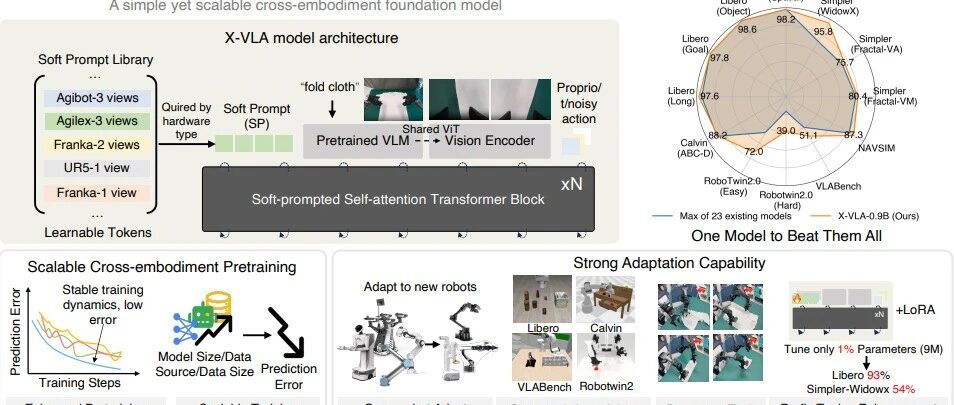
IROS 2025-Challenge冠军方案:X-VLA重磅开源,全面刷新机器人基准性能记录
具身智能之心· 2025-10-29 04:07
Core Insights - The article discusses the launch of the X-VLA model, a groundbreaking open-source model in the field of embodied intelligence, achieving significant performance improvements with only 0.9 billion parameters [2][7]. Competition Highlights - The AGIBOT World Challenge 2025 attracted 431 teams from 23 countries, with 11 teams competing in the final event held in Hangzhou, China, focusing on real-world physical tasks [4][5]. Performance Breakthroughs - X-VLA achieved state-of-the-art (SOTA) performance across five authoritative simulation benchmarks, demonstrating exceptional efficiency and effectiveness in long-duration tasks like autonomous clothing folding [7][24]. Innovative Techniques - The model employs a Soft-Prompt mechanism to enhance adaptability across different robotic platforms, and a multi-modal encoding strategy to optimize resource allocation while maintaining information integrity [16][21]. - A flow-matching generative action decoder is utilized to improve the smoothness and robustness of action trajectories in uncertain environments [17]. Data Preprocessing and Training - The model incorporates a balanced data sampling strategy and a rigorous data cleaning pipeline to ensure high-quality training data, which is crucial for learning meaningful behavior knowledge [21][22]. - The training process includes a customized post-training workflow that allows for efficient adaptation to specific tasks using smaller datasets [23][26]. Real-World Testing - X-VLA demonstrated strong performance in real robotic platforms, successfully completing complex tasks such as infinite-duration autonomous clothing folding, showcasing its capability in handling intricate long-range tasks [27].
招募几位具身世界模型相关方向的大佬!
具身智能之心· 2025-10-29 04:00
Group 1 - The article discusses the rising interest in embodied world models, highlighting their industrial and research value [1] - The company is recruiting two lecturers to help develop courses or tutoring content related to world models [2] - There is an emphasis on collaboration with individuals who have a strong background in the field, specifically those with a PhD or higher who have published at least one paper in a CCF-A level conference [5] Group 2 - The compensation offered for the positions is above industry standards, and the roles can be part-time [6] - Interested individuals are encouraged to contact the responsible person via WeChat for further communication [6]