SMIC(00981)

Search documents
港股收盘(12.30) | 恒指收涨0.86% 百度集团-SW(09888)涨近9%领跑蓝筹 机器人概念午后拉升
智通财经网· 2025-12-30 08:40
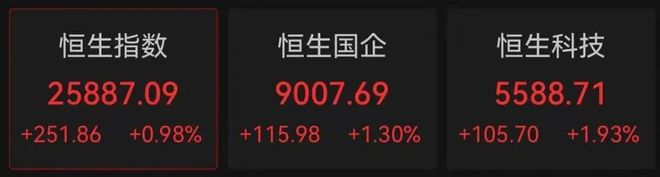
Market Overview - The Hong Kong stock market indices collectively rose, with the Hang Seng Index increasing by 0.86% to close at 25,854.6 points, and a total trading volume of HKD 199.77 billion [1] - The Hang Seng Tech Index rose by 1.74%, while the Hang Seng China Enterprises Index increased by 1.12% [1] - Overall profitability in the Hong Kong market remains strong, with sectors like internet, new consumption, and innovative pharmaceuticals being relatively scarce [1] Blue-Chip Stocks Performance - Baidu Group-SW (09888) led blue-chip stocks, rising by 8.9% to HKD 129.7, contributing 20.99 points to the Hang Seng Index [2] - Other notable blue-chip performers included SMIC (00981) up 4.24% and CNOOC (00883) up 3.97% [2] - Budweiser APAC (01876) and Chow Tai Fook (01929) saw declines of 1.67% and 1.51%, respectively, negatively impacting the index [2] Sector Highlights Robotics Sector - The robotics sector saw significant gains, with stocks like Yujian (02432) and Sanhua Intelligent Control (02050) rising by 13.45% and 12.53%, respectively [3] - Anticipation around Tesla's Optimus project and the establishment of a humanoid robot standardization committee in China are driving interest in this sector [3][4] Semiconductor Sector - The semiconductor sector performed well, with InnoSilicon (02577) rising by 15.35% and SMIC (00981) up 4.24% [4] - Nvidia's shift to an 800V direct current architecture marks a significant advancement in AI data centers, benefiting companies like InnoSilicon [4] Oil Sector - Oil stocks generally rose, with CNOOC (00883) increasing by 3.97% and PetroChina (00857) by 2.42% [6] - The ongoing geopolitical tensions in Ukraine are influencing oil prices, with international crude futures rising over 2% [6] Non-Ferrous Metals Sector - Non-ferrous metal stocks rebounded, with China Aluminum (02600) up 5.27% and Zijin Mining (02899) up 3.63% [6][7] - Factors such as insufficient capital expenditure and strong AI demand are reshaping resource pricing dynamics globally [7] Notable Stock Movements - Several newly listed stocks on the Hong Kong Stock Exchange saw significant gains, including InnoSilicon (03696) up 24.66% and Wuyi Vision (06651) up 29.9% [8] - The AI sector is gaining traction, with companies like Meta acquiring AI startups, positively impacting related stocks [9] - Ganfeng Lithium (01772) faced pressure, declining by 0.36% amid legal issues related to insider trading allegations [11]



沪指10连阳,AI概念爆发,十余股涨停,港股科网股集体拉升,百度大涨8%
21世纪经济报道· 2025-12-30 07:40
Market Overview - The A-share market experienced a strong upward trend, with the Shanghai Composite Index closing with a 10-day winning streak, while the Shenzhen Component Index and the ChiNext Index rose by 0.49% and 0.63% respectively [1] - The total trading volume in the Shanghai and Shenzhen markets exceeded 2 trillion yuan for the third consecutive trading day, increasing by 3.8 billion yuan compared to the previous trading day [2] Sector Performance - The robotics sector saw significant gains, with multiple stocks hitting the daily limit, including Fenglong Co. with five consecutive limit-ups and Tianqi Co. with four consecutive limit-ups [3] - The AI glasses concept also showed strong performance, with stocks like New Xiang Micro rising nearly 10% and Yingpais rising over 7% [3] - AI-related stocks collectively surged, with over ten stocks in the AI, AI agents, and AIGC sectors hitting the daily limit, including Kute Intelligent and Baijia Qiancheng [3] Hong Kong Market - The Hong Kong stock market also showed strength, with the Hang Seng Index rising over 1% and the Hang Seng Tech Index increasing by more than 2% [5] International Markets - The Japanese and South Korean stock markets closed early due to the New Year's holiday, with the Nikkei 225 Index down 0.37% but showing a strong annual performance, gaining over 10,000 points and up 26.18% for the year [7]



欲406亿元拿下中芯北方49%股权,中芯国际强化晶圆代工布局
Huan Qiu Lao Hu Cai Jing· 2025-12-30 07:11
Group 1 - The core point of the article is that SMIC plans to acquire 49% of the shares of SMIC North for a total transaction price of 40.601 billion yuan, which will increase its ownership from 51% to 100%, making SMIC North a wholly-owned subsidiary [1][2] - The share issuance price is set at 74.20 yuan per share, with approximately 547 million shares to be issued, accounting for 6.40% of the total share capital post-issuance [1] - The transaction involves five shareholders, including the National Integrated Circuit Fund and Beijing Industrial Investment [1] Group 2 - SMIC North, previously a subsidiary, specializes in 12-inch integrated circuit wafer foundry services and has two production lines with a monthly capacity of 35,000 wafers each [3] - Financial performance of SMIC North shows significant revenue growth, with revenues of 11.576 billion yuan, 12.979 billion yuan, and 9.012 billion yuan from 2023 to August 2025, and net profits of 0.585 billion yuan, 1.682 billion yuan, and 1.544 billion yuan during the same period [3] - As of August 2023, the assessed value of 100% equity in SMIC North is 82.859 billion yuan, reflecting an increase of 41.051 billion yuan, or 98.19% over its book net assets [3] Group 3 - In conjunction with the acquisition announcement, SMIC also revealed a capital increase plan, introducing new investors to SMIC South, which will receive a cash injection of 7.778 billion USD [3] - SMIC South is positioned as the core operational platform for advanced processes, providing 14nm FinFET and below technology [3] - The capital increase aims to reduce SMIC South's debt ratio and strengthen the overall financial structure of the group [3] Group 4 - The backdrop of these capital movements is the upward cycle of the domestic semiconductor market, with increasing local chip procurement [4] - SMIC's third-quarter capacity utilization rate reached 95.8%, nearing full production capacity, with 8-inch standard logic monthly production capacity increasing to 1.023 million pieces [4] - The strong demand has positively impacted SMIC's performance, with a significant net profit increase of 41.1% to 3.818 billion yuan in the first three quarters of 2023, alongside an 18.2% revenue growth to 49.51 billion yuan [4]

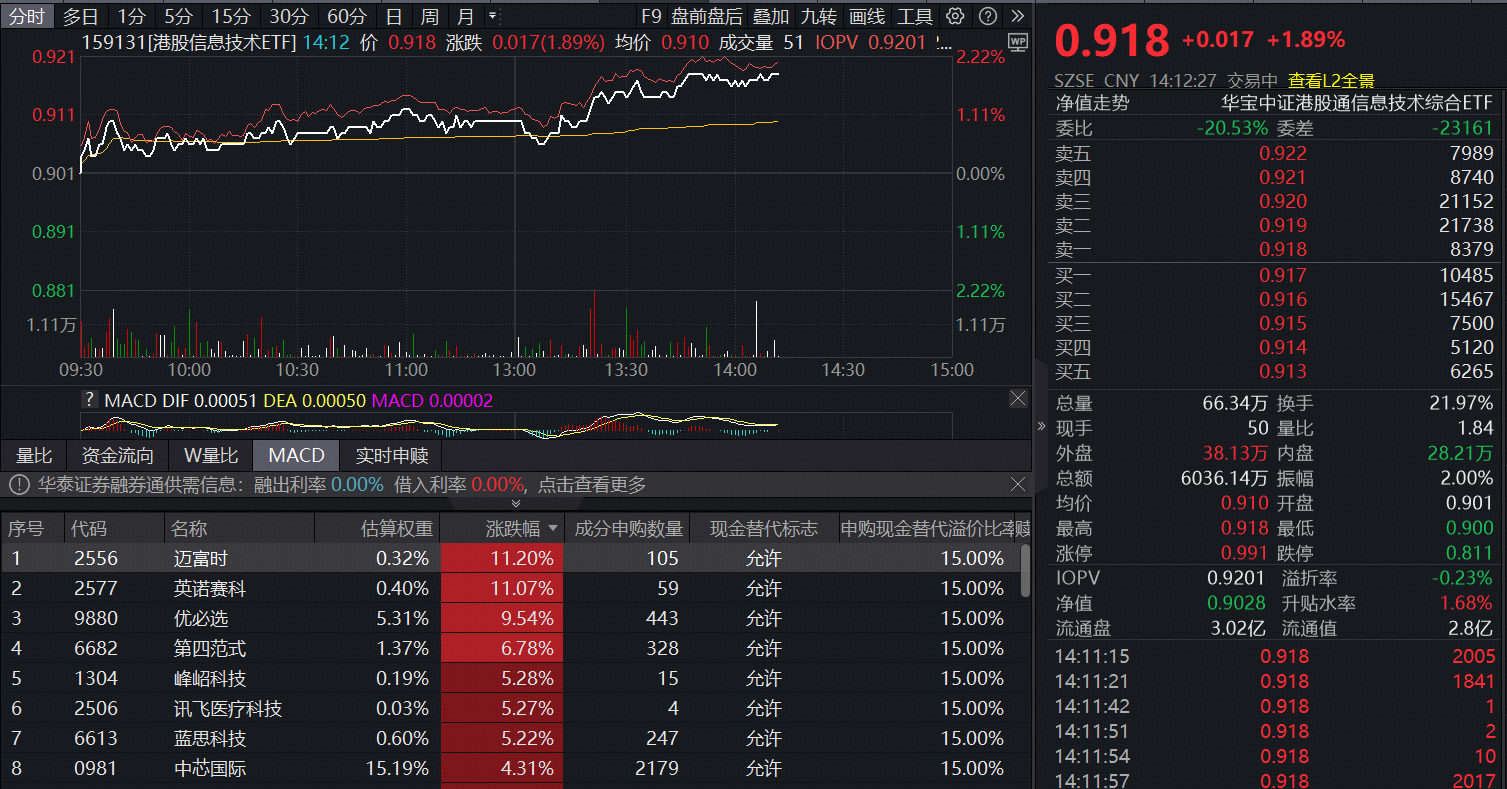
ETF盘中资讯|中芯国际大动作!首只聚焦“港股芯片链”的港股信息技术ETF(159131)放量上涨1.89%
Jin Rong Jie· 2025-12-30 07:02
Core Viewpoint - The Hong Kong stock market is witnessing a rise in hard technology stocks, particularly in the semiconductor sector, with significant gains from companies like Mai Fushi and InnoCare, indicating a potential bullish trend in the industry [1][4]. Group 1: Market Performance - Hard technology stocks in Hong Kong are performing well, with Mai Fushi and InnoCare both rising over 11%, and other companies like UBTECH and Fourth Paradigm also showing notable increases [1]. - The first Hong Kong ETF focused on the semiconductor industry, tracking the "Hong Kong Chip" sector, has seen a rise of 1.89% with a trading volume exceeding 57 million yuan [1]. Group 2: Company Developments - Semiconductor Manufacturing International Corporation (SMIC) is making significant moves by acquiring 49% of its subsidiary, North Semiconductor, from five shareholders, which will result in SMIC owning 100% of North Semiconductor [3]. - SMIC's subsidiary, South Semiconductor, has entered into new partnership contracts and capital expansion agreements, securing a total cash injection of $7.778 billion [3]. Group 3: Industry Outlook - Industry experts believe that SMIC's capital operations may present new opportunities for domestic chip development, particularly in semiconductor equipment and AI infrastructure [4]. - The newly launched ETF focuses on a composition of 70% hardware and 30% software, heavily investing in semiconductor, electronics, and computer software sectors, with SMIC holding a weight of 20.48% in the ETF [4].
中芯国际406亿全资控股中芯北方!科创50ETF(588000)涨1.55%,半导体链全线活跃
Mei Ri Jing Ji Xin Wen· 2025-12-30 06:50
Group 1 - The A-share market saw all three major indices turn positive, with the Kweichow Moutai ETF (588000) experiencing a maximum increase of 1.55% in the afternoon session [1] - The semiconductor industry chain was notably active, with stocks such as Cambricon Technologies rising by 5.41%, Chipone Technology by 4.56%, and others showing significant gains [1] - SMIC announced plans to issue 547 million shares to acquire 49% equity in SMIC North, with a transaction value of 40.601 billion yuan, resulting in SMIC owning 100% of SMIC North post-transaction [1] Group 2 - The Kweichow Moutai ETF (588000) tracks the Sci-Tech 50 Index, with 69.39% of its holdings in the electronics sector and 4.88% in the computer sector, aligning well with the development of cutting-edge industries like AI and robotics [2] - The ETF also covers various sub-sectors including semiconductors, medical devices, software development, and photovoltaic equipment, indicating a strong focus on high-tech industries [2]
ETF盘中资讯 中芯国际大动作!首只聚焦“港股芯片链”的港股信息技术ETF(159131)放量上涨1.89%
Jin Rong Jie· 2025-12-30 06:37
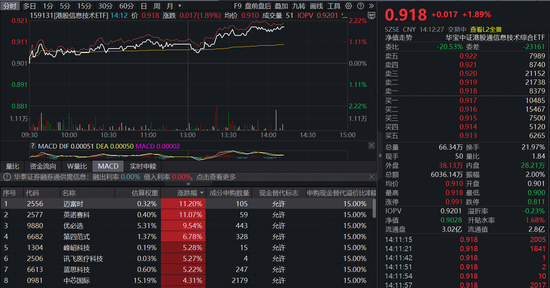
数据来源:中证指数公司,沪深交易所。 12月30日午后,港股硬科技逆市走高,迈富时、英诺赛科涨超11%,优必选涨超9%,第四范式涨超 6%,中芯国际大涨超4%。全市场首只聚焦"港股芯片"产业链的港股信息技术ETF(159131)午后震荡 走高,现涨1.89%,实时成交额超5700万元。 | | | 分时 $日 1分 5分 15分 30分 60分 日 周 月 * | | | | F9 盘前盘后 最加 九和 画线 工具 (2 ) | | | | | | | --- | --- | --- | --- | --- | --- | --- | --- | --- | --- | --- | --- | | 0.92 | | | | 159131[悲股德奥技术ETF] 14:12 价 0.918 涨跌 0.017(1.89%) 均价: 0.910 成交量: 51 IOPV 0.9201 1. | | | | | | 0 91 8 +0.017 +1.89% | | | | | | | | A . A | | | | | SZSE CNY 14:12:27 交易中 查看L2全覆 | | | 0911 | | | | | ...
中芯国际406亿全资收购!12英寸晶圆代工龙头整合,半导体设备材料需求引爆?
Jin Rong Jie· 2025-12-30 06:37
Core Viewpoint - The semiconductor industry is experiencing significant activity, particularly in the areas of computing chips and wafer foundry, with notable developments such as SMIC's acquisition of a 49% stake in SMIC North from its shareholders for approximately 40.6 billion yuan, enhancing its control over the 12-inch wafer foundry market [1][2]. Group 1: Company Developments - SMIC announced plans to acquire a 49% stake in SMIC North for about 40.6 billion yuan, which will result in SMIC fully controlling SMIC North, a company specializing in 12-inch wafer foundry services [1][2]. - The valuation of 100% of SMIC North's equity was assessed at approximately 82.86 billion yuan as of August 31, 2025, indicating a strong market position [1]. - The acquisition is expected to improve SMIC's asset quality and business synergy, promoting long-term development [1]. Group 2: Industry Trends - Recent reports highlight a growing interest in the semiconductor supply chain, with companies like Nvidia acquiring assets to enhance their computing chip architecture [2]. - The domestic semiconductor equipment industry is benefiting from both technological cycles and domestic substitution demands, extending beyond equipment to chip design and wafer manufacturing [2]. - The integration and potential expansion of wafer manufacturing capacity are expected to drive demand for essential manufacturing equipment and materials, such as photolithography machines and silicon wafers [3]. Group 3: Market Implications - The consolidation of wafer manufacturing capacity is likely to stabilize or increase demand for upstream equipment and materials, providing reliable capacity assurance for downstream chip design companies [2][3]. - The collaboration between domestic foundries like SMIC and chip design firms is crucial for the development of AI computing chips, communication chips, and various specialized processors, fostering innovation and commercialization [3].
百度大涨近8%,中芯国际涨超4%
Di Yi Cai Jing Zi Xun· 2025-12-30 06:23
Group 1 - The Hong Kong stock market saw an upward trend, with the Hang Seng Technology Index rising nearly 2% and the Hang Seng Index increasing by almost 1% [1] - Technology stocks experienced significant gains, with Baidu surging nearly 8%, Horizon Robotics rising over 5%, and SMIC increasing by more than 4% [3][4] - Other notable performers included NIO, SenseTime, Xiaomi Group, and NetEase, all of which also saw positive movements in their stock prices [3][4] Group 2 - Oil stocks led the gains, with China National Offshore Oil Corporation rising over 4% and China Petroleum & Chemical Corporation increasing by more than 3% [5] - Other oil-related stocks such as Sinopec and Kunlun Energy also showed positive performance, with gains of 2.83% and 0.54% respectively [5]
中芯国际大动作!首只聚焦“港股芯片链”的港股信息技术ETF(159131)放量上涨1.89%
Xin Lang Cai Jing· 2025-12-30 06:20
12月30日午后,港股硬科技逆市走高,迈富时、英诺赛科涨超11%,优必选涨超9%,第四范式涨超 6%,中芯国际大涨超4%。全市场首只聚焦"港股芯片"产业链的港股信息技术ETF(159131)午后震荡 走高,现涨1.89%,实时成交额超5700万元。 数据来源:中证指数公司,沪深交易所。 注:"全市场首只"是指首只跟踪中证港股通信息技术综合指数的ETF。中证港股通信息技术综合指数设 置单个样本权重上限为15%,伴随个股市值波动权重占比会产生相应变化,可能会出现超过15%的情 形。指数样本每半年调整一次,届时单个样本权重上限一般会平衡至15%。近期市场波动可能较大,短 期涨跌幅不预示未来表现。请投资者务必根据自身的资金状况和风险承受能力理性投资,高度注意仓位 和风险管理。 风险提示:港股通信息技术ETF被动跟踪中证港股通信息技术综合指数,该指数基日为2014.11.14,发 布于2017.6.23。材料中指数成份股仅作展示,个股描述不作为任何形式的投资建议,也不代表管理人旗 下任何基金的持仓信息和交易动向。本产品由华宝基金发行与管理,代销机构不承担产品的投资、兑付 和风险管理责任。投资人应当认真阅读《基金合同》、 ...
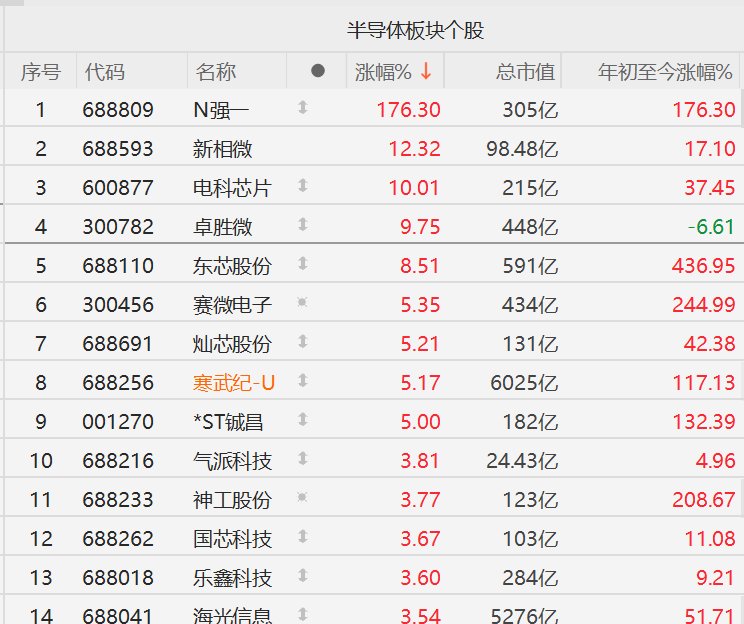
芯片概念股走强,寒武纪涨超5%
Ge Long Hui· 2025-12-30 05:53
Core Viewpoint - The semiconductor sector in the A-share market has shown strong performance, with several key stocks experiencing significant gains following the announcement of a major acquisition by SMIC [1] Group 1: Stock Performance - New Semiconductor stocks such as Xinxiangwei rose over 12%, while Electric Science Chip hit a 10% limit up, Zhuosheng Micro increased nearly 10%, and Dongxin Co. rose over 8% [1] - Other notable gains include Saiwei Electronics, Canxin Co., and Cambricon-U, each rising over 5% [1] - The overall performance of semiconductor stocks reflects a positive trend, with year-to-date increases for several companies, such as Dongxin Co. with a 436.95% rise [2] Group 2: Acquisition Announcement - SMIC announced plans to acquire a 49% stake in Northern Integrated Circuit from the National Integrated Circuit Fund and other parties for 40.6 billion yuan, which will result in full ownership of this key 12-inch wafer foundry [1] - This acquisition is expected to strengthen SMIC's position in the semiconductor industry and enhance its operational capabilities [1]