SMIC(00981)

Search documents
湾芯展:执棋破局,筑就中国集成电路全球引领新标杆
半导体行业观察· 2026-03-23 02:10
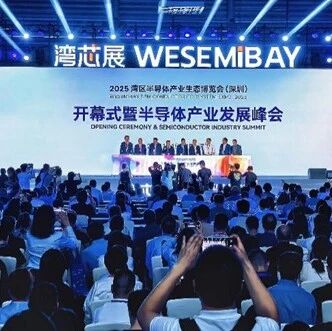
Core Viewpoint - The article emphasizes the strategic importance of the semiconductor industry in the context of global technological competition and highlights China's efforts to enhance its semiconductor capabilities through the "14th Five-Year Plan" and the upcoming Bay Area Semiconductor Industry Expo (Bay Chip Expo) [1][12]. Group 1: Market Overview - The global semiconductor market is projected to reach $980 billion by 2026, with a year-on-year growth rate of 27% [1]. - The Guangdong-Hong Kong-Macao Greater Bay Area has become a significant growth engine for China's semiconductor industry, housing over 12,000 industry-related enterprises [1]. Group 2: Bay Chip Expo Achievements - In 2025, the Bay Chip Expo covered over 60,000 square meters, featured more than 600 global exhibitors, and attracted 112,300 professional visitors, marking it as a focal point in the industry [5]. - The event received extensive media coverage, with over 1 billion online exposures, and introduced the "Bay Chip Award," which engaged nearly 4 million professional votes [5]. Group 3: Industry Collaboration - The Bay Chip Expo aims to break down barriers across the semiconductor supply chain, creating a collaborative platform that encompasses chip design, wafer manufacturing, compound semiconductors, and advanced packaging [3]. - The expo facilitates efficient connections between global semiconductor resources, promoting both "bringing in" and "going out" strategies [7]. Group 4: Future Developments - The 2026 Bay Chip Expo is set to take place from October 14-16 in Shenzhen, with an exhibition area exceeding 70,000 square meters and over 800 exhibitors expected [12]. - The event will focus on key areas such as AI chips, RISC-V ecosystems, and advanced packaging, aligning with industry upgrade needs [14]. Group 5: International Strategy - The expo plans to enhance its international strategy by targeting semiconductor core regions in Japan, South Korea, and Southeast Asia, aiming to increase overseas participation significantly [9]. - It will invite top global semiconductor experts and executives to discuss industry trends and share insights on advanced technologies [10].





A股低开,黄金板块大跌
第一财经· 2026-03-23 01:42
Market Overview - The A-share market opened lower with all three major indices declining: the Shanghai Composite Index fell by 1.32% to 3904.95 points, the Shenzhen Component Index dropped by 1.78% to 13619.94 points, and the ChiNext Index decreased by 1.54% to 3300.56 points [4][5]. - The market saw significant declines in sectors such as gold and basic metals, with the computing hardware industry chain, including storage and CPO sectors, leading the losses [6]. Company Movements - *ST Bosen resumed trading with a limit-up, as the company's controlling shareholder is set to change to Yan Feng Digital [7]. - Xuelang Environment also resumed trading with a limit-up after signing a restructuring investment agreement, which will result in Helixing Wanlian becoming the controlling shareholder post-restructuring [8]. Commodity Performance - The main contract for liquefied petroleum gas (LPG) hit the limit-up with an increase of 11%, reaching 7281 yuan per ton [9]. Hong Kong Market - The Hong Kong market opened lower, with the Hang Seng Index down by 1.93% to 24789.14 points and the Hang Seng Tech Index falling by 1.90% to 4780.04 points. Notable declines included NIO down over 7%, Zijin Mining down over 5%, and Baidu down over 4% [10][11].



芯片,涨价潮!
半导体行业观察· 2026-03-22 02:42
Core Viewpoint - The global semiconductor industry is experiencing a significant price increase driven by supply-demand imbalances and rising costs, with major companies like Texas Instruments, Infineon, and NXP leading the charge [2][3][4]. Group 1: Price Increases by Major Companies - Texas Instruments (TI) announced a price increase of 15%-85% across all product lines, with the highest increases in industrial control and automotive electronics, reflecting tight capacity and rising costs [3]. - Infineon is raising prices for power switches and related chips due to surging demand from AI data centers, with increases expected to be 5%-15% for mainstream models and potentially higher for premium products [4][5]. - NXP is also adjusting prices due to significant cost increases across the supply chain, although specific product categories and price ranges have not been disclosed [6]. Group 2: Broader Industry Trends - Other companies such as ON Semiconductor, Analog Devices, and Vishay are joining the price increase trend, indicating a widespread adjustment across the semiconductor sector [6][7]. - The price adjustments are largely attributed to rising costs of raw materials, energy, and logistics, which are affecting all players in the industry [8][12]. Group 3: Cost Pressures and Supply Chain Dynamics - The surge in prices is primarily driven by skyrocketing costs of key raw materials, particularly precious metals, which are essential for semiconductor manufacturing [12][13]. - The semiconductor industry is facing a structural shift in demand, particularly from AI servers and electric vehicles, which is exacerbating supply constraints and allowing manufacturers to raise prices [15][16]. Group 4: Impact of Foundry Price Increases - The collective price increases from wafer foundries are further pressuring chip manufacturers to adjust their pricing strategies, as foundries raise their rates due to increased operational costs [18][19]. - Major foundries like TSMC and Samsung are shifting focus to advanced processes, leading to a reduction in capacity for older nodes, which is tightening supply for essential components [21][22]. Group 5: Domestic Market Response - Domestic semiconductor companies in China are also raising prices in response to global trends, with many following suit to address rising costs and maintain profitability [9][10]. - The price adjustments among domestic firms reflect a shift from a price war to a value-driven approach, indicating a potential recovery in profit margins [11][24].




产业经济周报:社零增速超预期,全球晶圆代工保持高景气-20260319
Tebon Securities· 2026-03-19 10:19
Consumption Sector - In January-February 2026, the total retail sales of consumer goods reached 86,079 billion yuan, with a year-on-year growth of 2.8%, the highest increase since October 2025[6] - The retail sales of essential goods, such as tobacco and alcohol, grew by 19.1%, significantly higher than the overall retail sales growth[11] - Automotive retail sales saw a decline of 7.3% year-on-year, marking five consecutive months of negative growth, primarily due to the impact of the Spring Festival holiday and policy adjustments[12] Health Sector - On March 13, 2026, the National Medical Products Administration approved the registration of the first invasive brain-machine interface medical device, marking a significant milestone in clinical applications[14] - The domestic brain-machine interface market is projected to grow, with a forecasted market size of 3.83 billion yuan in 2025, reflecting a year-on-year growth of 20%[20] Hard Technology Sector - The global wafer foundry industry is expected to generate approximately 169.5 billion USD in revenue in 2025, a year-on-year increase of 26.3%[25] - TSMC's revenue is projected to reach 122.54 billion USD in 2025, with a year-on-year growth of 36.1%, increasing its market share from 64.4% to 69.9%[26] High-end Manufacturing Sector - In February 2026, a total of 17,226 excavators were sold, a year-on-year decrease of 10.6%, with domestic sales down by 42%[32] - For January-February 2026, total excavator sales reached 35,934 units, showing a year-on-year growth of 13.1%, driven by strong export performance[32]


华尔街大空头罕见看多,中东王爷来救场,恒生科技可以布局了吗?
私募排排网· 2026-03-19 03:33
Core Viewpoint - The article discusses the recent performance of the Hang Seng Technology Index, highlighting significant adjustments and the potential for investment opportunities amidst market volatility [2][4]. Group 1: Recent Adjustments - The Hang Seng Technology Index has experienced two major adjustments since October 2025, with a maximum cumulative drawdown exceeding 25% [2][8]. - The first adjustment occurred from October 2, 2025, to November 21, 2025, driven by factors such as the U.S. government shutdown, hawkish signals from the Federal Reserve, and concerns over the profitability of AI cloud services [8]. - The second adjustment in February 2026 was attributed to intensified competition in internet consumption and regulatory pressures, impacting major tech platforms [8]. Group 2: Valuation Insights - As of March 17, 2026, the rolling price-to-earnings ratio (PE-TTM) of the Hang Seng Technology Index has dropped to approximately 20.93 times, indicating it is cheaper than 85% of the time since its inception [11][12]. - Comparatively, the dynamic PE of the ChiNext Index is around 41 times, and the NASDAQ is about 39 times, showing that the Hang Seng Technology Index is significantly undervalued [12]. - Michael Burry, known as the "big short" investor, suggests that the index's decline is more a result of sentiment and valuation compression rather than a collapse in the underlying fundamentals [14]. Group 3: Capital Flows - Domestic investors have been increasingly buying into the Hong Kong stock market, with net inflows from mainland investors reaching 1,298.6 billion RMB in 2025, significantly higher than the 747 billion RMB in 2024 [16][18]. - Since the October 2025 adjustment, mainland funds have predominantly been net buyers, with a record single-day net purchase of over 32.8 billion RMB on March 9, 2026 [18]. - International investors, influenced by geopolitical tensions, are also seeking refuge in Hong Kong stocks, enhancing market liquidity [20]. Group 4: AI Narrative - The Hang Seng Technology Index comprises 30 stocks across various sectors, including semiconductors, electric vehicles, and internet giants, which are facing both risks and opportunities from the AI narrative [22][25]. - Recent advancements in AI applications are prompting a reassessment of traditional internet companies, as they transition from high spending to monetization of AI technologies [25]. Group 5: Market Concerns - Despite positive indicators, there are concerns regarding profit pressures on companies like Meituan and Alibaba due to competition, which may impact their earnings [26]. - The rise of non-index giants like ByteDance is diverting user engagement and advertising revenue from traditional internet companies, posing growth challenges [27]. - Geopolitical issues, particularly in the Middle East, could affect global liquidity and inflation, impacting the performance of Hong Kong stocks [28]. Group 6: Investment Strategies - Given the current valuation, capital flow dynamics, and industry expectations, the Hang Seng Technology Index presents a favorable risk-reward profile for investors [29]. - For those unfamiliar with the Hong Kong market, investing through mutual funds that focus on Hong Kong stocks may be a viable strategy [29][30].




晶圆涨、封测涨、芯片涨...涨价的野火烧到哪了?
芯世相· 2026-03-18 08:58
Core Viewpoint - The recent price increase trend in electronic components is becoming more pronounced, affecting various segments of the semiconductor industry, including passive components, power devices, and more, as companies across the supply chain respond to rising costs and market demand [4][38][163]. Price Increases in the Supply Chain - Major manufacturers like Murata and NXP are initiating price hikes for their products, with Murata's increase for high-end MLCC products ranging from 15% to 35% effective April 1, 2026 [4][38]. - Mitsubishi Gas Chemical announced a 30% price increase for its entire range of electronic materials starting April 1, 2026 [9]. - Taiwan's foundries, including UMC and TSMC, are expected to raise prices by up to 10% or more for their wafer fabrication services [18][22][23]. Passive Components - The market for MLCCs is seeing a significant price increase, with current spot prices rising by 10% to 20% due to high demand from AI and automotive sectors [43][38]. - Companies like KEMET and AVX are also raising prices for tantalum capacitors and other passive components by 15% to 30% due to increased raw material costs [39][42]. Power Devices - Onsemi and other power device manufacturers are implementing price adjustments due to rising costs in materials and manufacturing, with increases expected to be effective from April 1, 2026 [57][62]. - Taiwanese manufacturers are also discussing price hikes, with some products seeing increases of up to 20% [62][63]. Storage Chips - Samsung has announced significant price increases for DRAM and NAND Flash products, with some prices expected to rise by over 100% in the first quarter of 2026 [28][30]. - Micron and other storage manufacturers are also raising prices by 20% to 30% across various product lines [30][31]. Market Impact - The price increases are expected to impact end-user markets significantly, with mobile devices and PCs facing the most pressure, leading to price hikes of 10% to 30% [163]. - The automotive sector is also affected, with increased memory costs adding approximately 1,000 to 3,000 RMB to the cost of each vehicle [163].

腾讯、百度、阿里,集体下跌
第一财经· 2026-03-18 01:38
Market Overview - On March 18, the Hong Kong Hang Seng Index opened up by 0.21% at 25,923.03, while the Hang Seng Tech Index increased by 0.1% to 5,112.97 [1][2]. Sector Performance - The biotechnology sector showed a slight increase, with the Hang Seng Biotechnology Index rising by 0.16% to 14,472.25 [2]. - The Hang Seng China Enterprises Index also saw a minor gain of 0.08%, reaching 8,833.95 [2]. Stock Movements - Mixed performance was observed among tech stocks, with Bilibili and Hua Hong Semiconductor both rising over 2% [2]. - Tencent Music experienced a significant drop of 15%, closing at 48.620, while XPeng Motors fell by 3.45% to 75.500 [3]. - Other notable declines included Tencent Holdings down by 0.64% to 546.500, Baidu Group down by 0.25% to 118.900, and Alibaba down by 0.15% to 134.400 [3]. Semiconductor Sector - The semiconductor sector rebounded, with notable gains from companies such as Lanqi Technology and Zhaoyi Innovation, which rose over 3% [2]. - Specific stock performances included Lanqi Technology up by 3.74% to 186.000 and Zhaoyi Innovation up by 3.12% to 416.000 [4].


国产先进制程芯片的最新突围
财富FORTUNE· 2026-03-17 13:08
Core Viewpoint - Huang Renxun's speech at the 2026 GPU Technology Conference presents a new worldview where artificial intelligence is seen as the driving force behind the next industrial revolution, rather than just a tool [1] Group 1: Market Demand and Projections - By 2027, Nvidia's procurement orders for AI chips from the Blackwell and Vera Rubin series are expected to reach $1 trillion or more [1] - The burgeoning AI industry in China shows an unprecedented demand for advanced process chips, raising concerns that Chinese companies may fall behind in global competition due to restrictive U.S. regulations [3][1] Group 2: Technological Developments - The advanced process chip manufacturing technology is often referred to as "bottleneck technology." The U.S. has imposed strict measures preventing domestic chip companies from selling related products to Chinese firms, which has driven China to pursue self-sufficiency in chip design and production [3] - China’s Huahong Group has reportedly developed advanced process technology for AI chip production, with its subsidiary, Huahong Grace Semiconductor Manufacturing Corporation, preparing to produce 7nm chips in Shanghai [4][5] Group 3: Industry Standards and Challenges - Current industry standards classify 14nm, 28nm, 40nm, and 90nm as mature processes, while 7nm and below are considered advanced processes. SMIC has achieved 7nm equivalent technology through DUV multi-patterning techniques [6] - The standard method for manufacturing 7nm and below chips involves EUV lithography, but due to U.S. export restrictions, Chinese manufacturers like SMIC and Huahong must rely on DUV technology, which limits their production capabilities [7][8] Group 4: Future Implications - If Huahong can achieve initial production capacity of several thousand chips per month by the end of 2026, it will provide a dual support system for domestic advanced process chips alongside SMIC, fostering a stronger independent and self-sufficient environment in the face of U.S. export controls [8] - The Chinese government has prioritized the development of a new generation of intelligent manufacturing, with integrated circuits (chips) as a foundational support for this emerging pillar industry [8]

中芯国际稳坐世界第三!
国芯网· 2026-03-16 11:52
Core Viewpoint - The article discusses the current state and future outlook of the global semiconductor foundry industry, highlighting the dominance of TSMC and the competitive landscape among major players like Samsung and SMIC [2][4][5]. Group 1: Market Overview - According to TrendForce, the global foundry market is projected to reach $169.5 billion in 2025, representing a year-on-year growth of 26.3% [2]. - TSMC holds a commanding market share of 70%, with revenue expected to exceed $122.54 billion, increasing from 64.4% in 2024 to 69.9% in 2025 [4]. - The foundry industry faces potential challenges in the second half of the year due to rising memory chip prices, which may lead to decreased demand [2]. Group 2: Company Performance - TSMC remains the leader in advanced process technologies, particularly in 3nm and 2nm nodes, with significant demand for mobile and AI chips [4]. - Samsung ranks second with a revenue of $12.634 billion, accounting for 7.2% of the market, but its position has declined compared to 2024 [4]. - SMIC, in third place, reported a revenue of $9.33 billion, marking a 16.2% increase year-on-year, driven by rising domestic demand for semiconductor alternatives [5]. Group 3: Competitive Landscape - The article notes that the foundry market is highly concentrated, with TSMC, Samsung, and SMIC being the primary players, while other companies are mainly from mainland China and Taiwan [5]. - There is a potential for SMIC to surpass Samsung in the coming years, contingent on its ability to scale up advanced production capacity [5].
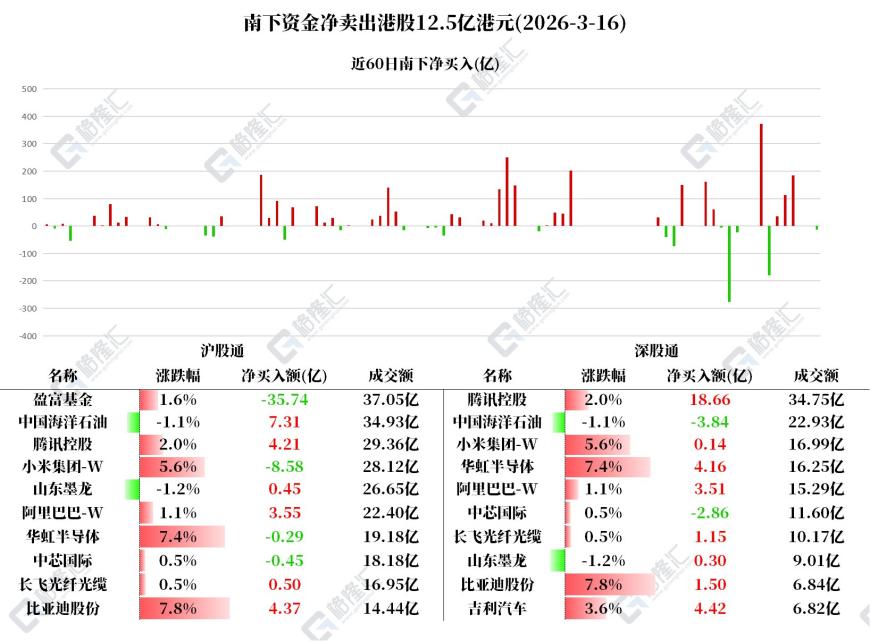
南下资金净买入腾讯、阿里和比亚迪
Ge Long Hui· 2026-03-16 10:34
Group 1 - Southbound funds recorded a net sell of HKD 1.25 billion in Hong Kong stocks on March 16, with notable net purchases in Tencent Holdings (HKD 2.287 billion), Alibaba-W (HKD 706 million), BYD Company (HKD 586 million), and Geely Automobile (HKD 442 million) [1] - The net sell was primarily driven by the iShares Asia 50 ETF, which saw a net sell of HKD 3.574 billion, and Xiaomi Group-W with HKD 844 million [1][3] - Southbound funds have consistently net bought China National Offshore Oil Corporation (CNOOC) for four consecutive days, totaling HKD 3.38424 billion [1] Group 2 - Tencent Holdings experienced a price increase of 2.0% with a net buy of HKD 4.21 billion, while Alibaba-W saw a 1.1% increase with a net buy of HKD 3.55 billion [3] - BYD Company had a significant price increase of 7.8% with a net buy of HKD 4.37 billion, and Geely Automobile increased by 3.6% with a net buy of HKD 4.42 billion [3] - The overall trading volume for the stocks mentioned indicates a mixed performance, with some stocks like Xiaomi Group-W and SMIC showing negative net buy figures [3]