SMIC(00981)

Search documents
半导体走强,英诺赛科一度大涨超12%大幅领先,中芯国际涨超3%
Ge Long Hui· 2025-12-30 05:38
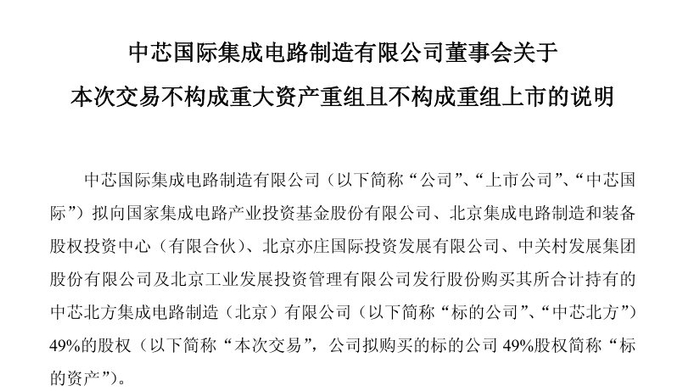
Core Viewpoint - The semiconductor stocks in Hong Kong have surged, driven by Nvidia's leadership in a significant power architecture revolution for global data centers, transitioning from traditional AC power to 800V DC power, which is igniting an upgrade wave in AI computing infrastructure [1] Industry Summary - The demand for computing power is experiencing exponential growth due to the rise of generative artificial intelligence, leading to a flourishing AI chip sector [1] - Analysts from Dongxing Securities recommend focusing on three key areas within the semiconductor industry: semiconductor storage, semiconductor testing equipment, and magnetic components, in line with the AI innovation cycle [1] Company Summary - Semiconductor industry leader SMIC announced plans to acquire a 49.00% stake in Northern SMIC for a transaction price of 40.6 billion yuan, which is expected to enhance the asset quality and business synergy of the listed company, promoting long-term development [1] - The main business scope of the listed company will remain unchanged before and after the transaction [1]

A股芯片概念股走强,寒武纪涨超5%
Ge Long Hui· 2025-12-30 05:28
Group 1 - The core viewpoint of the article highlights the strong performance of chip concept stocks in the A-share market, with significant gains observed in several companies [1] - Xinxiang Microelectronics saw an increase of over 12%, while Electric Science Chip reached a 10% limit up, indicating robust investor interest [1] - Other notable performers included Zhuosheng Microelectronics with a nearly 10% rise, Dongxin Co. with over 8%, and both Saiwei Electronics and Canxin Co. with gains exceeding 5% [1] Group 2 - The news also reports that SMIC (Semiconductor Manufacturing International Corporation) plans to issue shares worth 40.6 billion yuan to acquire a 49% stake in Zhongxin North, which is held by the National Integrated Circuit Fund and four other parties [1] - Upon completion of this transaction, SMIC will gain full control over this key 12-inch wafer foundry enterprise, enhancing its market position [1]




中芯国际406亿收购中芯北方+增资中芯南方!科创创业人工智能ETF易方达(159140)上涨近1%
Ge Long Hui A P P· 2025-12-30 04:09
Group 1 - The semiconductor sector showed active performance with notable stock increases, including a 1.49% rise in SMIC and a 10% increase in Zhaosheng Microelectronics [1] - On December 29, SMIC announced plans to issue 547 million shares to acquire 49% equity in SMIC North, with a transaction price of 40.601 billion yuan [1] - SMIC plans to significantly increase its stake in SMIC South to 41% through a large capital increase with major shareholders, indicating a strategic move to enhance control over core manufacturing [1] Group 2 - The semiconductor equipment ETF E Fund (159558) tracks an index where semiconductor equipment constitutes 62%, showing resilience in the context of domestic substitution trends [2] - The Xinchuan ETF E Fund (159540) focuses on digital chip design, which makes up 41% of its index, potentially benefiting from the rising demand for domestic AI infrastructure [2] - The Sci-Tech Innovation and Entrepreneurship AI ETF E Fund (159140) targets domestic chips and optical modules, serving as an effective investment tool amid the growing certainty in AI hardware construction [2]
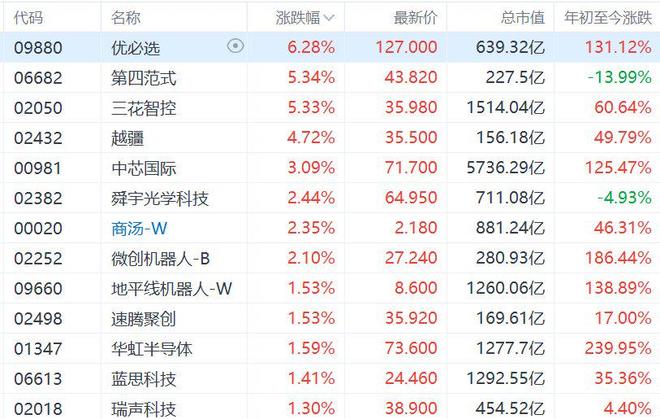
港股异动丨机器人概念股集体走强,优必选涨超6%
Ge Long Hui· 2025-12-30 03:52
Group 1 - The robotics sector in the Hong Kong stock market has seen a collective surge, with notable increases in stock prices for several companies [1] - UBTECH Robotics experienced a rise of over 6%, while Fourth Paradigm and Sanhua Intelligent Control both increased by over 5% [1] - Other companies such as Yujing and MicroPort Robotics also saw gains, with Yujing rising nearly 5% and MicroPort Robotics increasing by over 2% [1] Group 2 - Yushutech announced the opening of its first offline store in collaboration with JD.com, set to launch on December 31 in Beijing [1] - The store will prominently feature several flagship products, including the Yushutech Go2 quadruped robot and the G1 humanoid robot [1] Group 3 - The stock performance data shows UBTECH with a current price of 127.000 and a year-to-date increase of 131.12% [2] - Fourth Paradigm's latest price is 43.820, with a year-to-date decline of 13.99% [2] - Sanhua Intelligent Control has a current price of 35.980 and a year-to-date increase of 60.64% [2]



半导体走强 英诺赛科一度大涨超12%大幅领先 中芯国际涨超3%
Ge Long Hui· 2025-12-30 03:07
港股频道更多独家策划、专家专栏,免费查阅>>责任编辑:栎树 此外,行业龙头中芯国际昨日晚间公告,拟购买中芯北方49.00%股权,交易价格406亿元。本次交易有 利于进一步提高上市公司资产质量、增强业务上的协同性,促进上市公司的长远发展。交易前后上市公 司的主营业务范围不会发生变化。 | 成份股 | | | 查看更多 | | --- | --- | --- | --- | | 代码 | 名称 | 最新价 | 涨跌幅 √ | | 02577 | 英诺赛科 | 73.500 | 8.49% | | 02166 | 芯智控股 | 2.030 | 4.10% | | 00981 | 中芯国际 | 71.600 | 2.95% | | 01304 | FORTIOR | 128.500 | 2.72% | | 02878 | 晶门半导体 | 0.435 | 2.35% | | 01347 | 华虹半导体 | 73.800 | 1.86% | | 00595 | AV CONCEPT F | 0.410 | 1.23% | | 00400 | 硬蛋创新 | 3.000 | 1.01% | | 00085 | 中电华大科技 ...
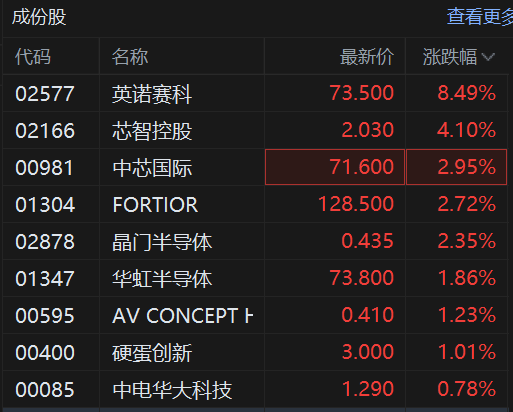
港股半导体走强 英诺赛科一度大涨超12%大幅领先 中芯国际涨超3%
Jin Rong Jie· 2025-12-30 02:59
本文源自:金融界AI电报 港股半导体股拉升走强,其中,英诺赛科一度大涨超12%大幅领先,芯智控股涨超4%,中芯国际涨超 3%,晶门半导体涨2.35%,华虹半导体涨近2%。 ...
中芯国际拟406亿收购中芯北方49%股权,中芯南方注册资本增至100.773亿美元
Cai Jing Wang· 2025-12-30 02:49
Group 1 - The core point of the article is that SMIC plans to acquire a 49% stake in SMIC North for 40.6 billion yuan, which will result in SMIC holding 100% of SMIC North after the transaction [1][2] - The acquisition is expected to enhance the asset quality of the listed company and improve business synergy, promoting long-term development [1] - The main business scope of the listed company will remain unchanged before and after the transaction [1] Group 2 - SMIC also announced a new joint venture agreement and capital increase agreement with the National Integrated Circuit Fund and its second phase, increasing the registered capital of SMIC South from 6.5 billion USD to 10.0773 billion USD [2] - Various stakeholders will hold specific percentages of equity in SMIC South, including SMIC Holdings at 41.561%, National Integrated Circuit Fund at 9.392%, and others [2]
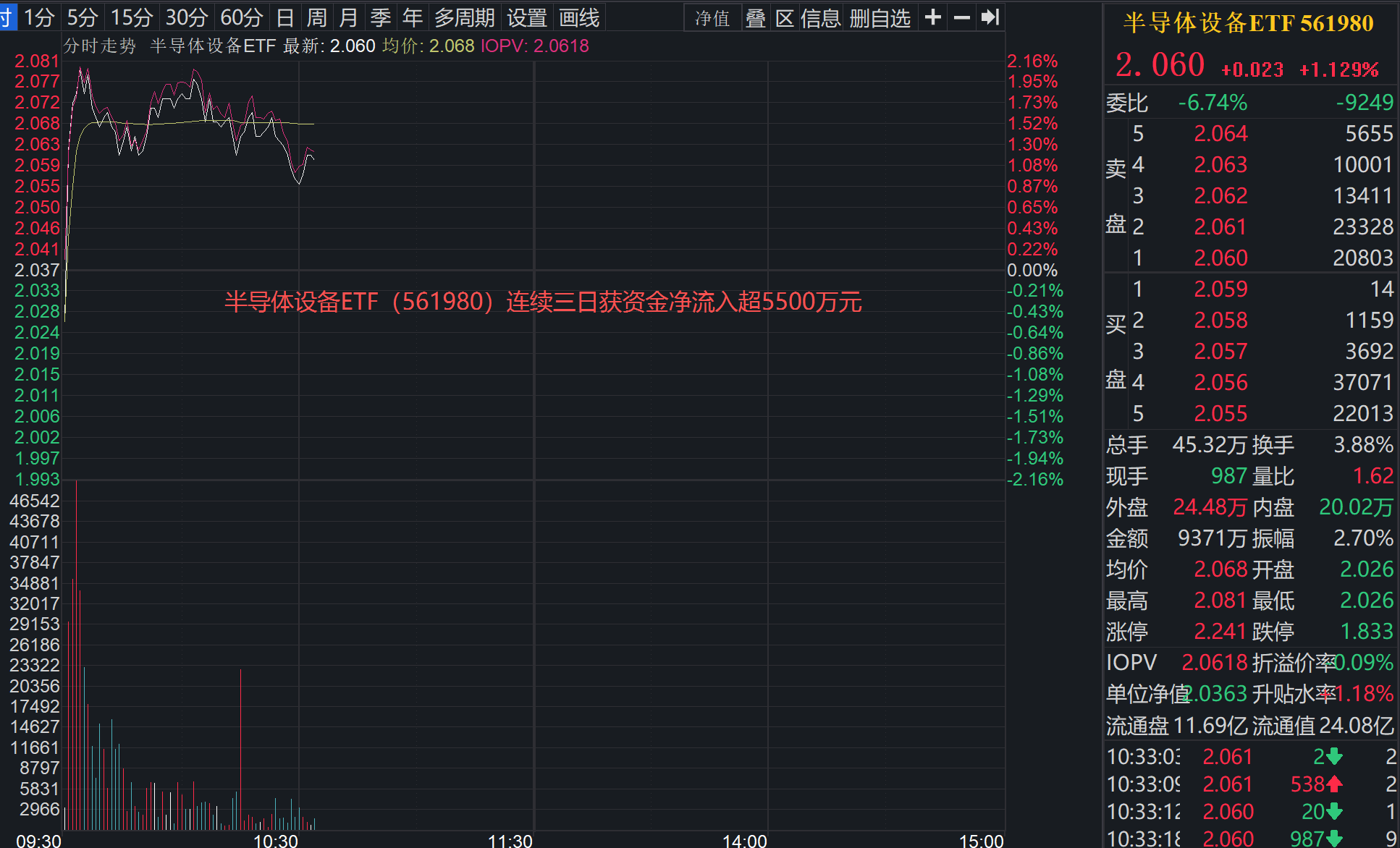
AI需求重塑芯片产业,存储、晶圆厂涨价超预期,半导体设备ETF(561980)持续吸金!
Sou Hu Cai Jing· 2025-12-30 02:46
Core Viewpoint - The semiconductor industry is experiencing a price surge driven by increased demand from AI applications and supply constraints, particularly in the storage and wafer sectors [3][6]. Group 1: Semiconductor Price Trends - The NAND flash wafer prices increased by over 10% in December, while SSD prices rose by 15%-20% [3]. - Major international storage suppliers have raised HBM3E prices by nearly 20% for 2026 [3]. - The current price uptrend is attributed to high demand for high-bandwidth memory (HBM) and large-capacity storage, coupled with a structural shift in production towards high-end products [3][6]. Group 2: Semiconductor Equipment Market - The global semiconductor equipment market is projected to reach $133 billion by 2025, with a year-on-year growth of 13.7%, and is expected to continue growing to $145 billion in 2026 and $156 billion in 2027 [6][11]. - The semiconductor equipment ETF (561980) has seen significant inflows, indicating strong investor interest in the sector [1][12]. - The ETF focuses on companies with high exposure to semiconductor equipment, materials, and integrated circuit design, with nearly 60% of its index comprising equipment [12]. Group 3: Domestic Semiconductor Development - The domestic semiconductor equipment sector is expected to accelerate growth in orders by 2026, driven by the expansion of storage and advanced processes [8]. - The domestic semiconductor equipment industry has achieved significant progress in replacing mature processes with local alternatives since 2019 [11]. - The focus on domestic substitution is not only in equipment but also in chip design and manufacturing processes [8][11].
港股异动丨半导体走强 英诺赛科一度大涨超12%大幅领先 中芯国际涨超3%
Ge Long Hui· 2025-12-30 02:38
Group 1 - Semiconductor stocks in Hong Kong have strengthened, with InnoCare rising over 12%, ChipMOS increasing by over 4%, SMIC up by over 3%, and GlobalWafers gaining 2.35% [1] - NVIDIA is leading a significant transformation in global data centers by shifting the voltage standard from traditional AC to 800V DC, igniting an upgrade wave in AI computing infrastructure [1] - Eastmoney Securities highlights that the demand for computing power is growing exponentially due to the rise of generative AI, suggesting investments in semiconductor storage, testing equipment, and magnetic components as key sectors [1] Group 2 - SMIC announced plans to acquire a 49% stake in Northern SMIC for a transaction price of 40.6 billion yuan, which is expected to enhance asset quality and business synergy for the listed company [1]
【立方早知道】多家公司回应商业航天业务情况/锂矿龙头被移送起诉/12连板大牛股停牌核查
Sou Hu Cai Jing· 2025-12-30 02:33
Group 1: Tariff Adjustments - The State Council's Tariff Commission announced a tariff adjustment plan for 2026, effective from January 1, 2026, which includes a temporary import tariff rate lower than the most-favored-nation rate for 935 items to enhance the linkage between domestic and international markets [1] - The plan continues to grant zero tariff treatment on 100% of products to 43 least developed countries with which China has diplomatic relations, promoting economic cooperation [1] Group 2: Commercial Aerospace Developments - Multiple A-share listed companies have disclosed their involvement in the commercial aerospace sector, with Zai Sheng Technology indicating that its aerospace products currently contribute a minimal portion to overall revenue [3] - Aerospace Intelligent Equipment reported long-term collaborations with several aerospace enterprises on its space chip products [4] - China Aviation Heavy Industry has established a supply capability for key forgings to multiple commercial rocket companies, forming a dedicated supply system for commercial aerospace [4] Group 3: Financial Performance of State-Owned Enterprises - From January to November 2025, the total operating revenue of state-owned and state-controlled enterprises increased by 1.0% year-on-year, while total profits decreased by 3.1% [9] - The tax payable by these enterprises reached 52,803.0 billion yuan, reflecting a slight increase of 0.2% year-on-year [9] Group 4: Precious Metals Market - On December 29, international precious metals experienced significant declines, with gold dropping by $205 to around $4,320, a decrease of 4.52%, and silver falling by over 10% [10] - Analysts suggest that gold prices are likely to fluctuate in 2026, influenced by U.S. Federal Reserve policies and economic conditions [10] Group 5: Corporate Actions and Investments - Longyan Group announced plans to introduce seven strategic investors through a capital increase of 2 billion yuan for its subsidiary [19] - Ganfeng Lithium reported that it is under investigation for insider trading, but its operations remain normal [20][21] - *ST Panda has been placed under investigation by the China Securities Regulatory Commission for information disclosure violations [23] Group 6: Mergers and Acquisitions - Unigroup Guowei is planning to acquire controlling or full ownership of Ruineng Semiconductor Technology through a share issuance and cash payment [24][25] - Minmetals Development intends to purchase equity stakes in Minmetals Mining and Luzhong Mining, with the transaction expected to constitute a major asset restructuring [27] - Semiconductor manufacturer SMIC plans to acquire a 49% stake in SMIC North for approximately 40.6 billion yuan [29][30]