SMIC(00981)

Search documents
通信行业周报:旭创发布业绩快报,关注3月GTC大会
SINOLINK SECURITIES· 2026-03-01 10:45
Investment Rating - The report indicates a positive outlook for the industry, suggesting a "Buy" rating based on expected growth exceeding the market by over 15% in the next 3-6 months [63]. Core Insights - NVIDIA reported a strong Q4 2025 performance with earnings per share of $1.62, surpassing analyst expectations by 5.81%, and revenue of $68.127 billion, exceeding forecasts by 3.22% [2]. - AMD has made significant strides in AI chip competition, signing a multi-year agreement with Meta to provide up to 6GW of AI computing power, potentially worth over $60 billion [2][60]. - OpenRouter data shows that during the week of February 9-15, 2026, the token usage of Chinese models surpassed that of U.S. models for the first time, indicating a growing demand for domestic AI capabilities [3][52]. Summary by Sections Company Performance - NVIDIA's Q4 2025 revenue was $68.127 billion, a year-on-year increase of 73.21%, with a guidance of $78 billion for Q1 2026, exceeding analyst expectations [2]. - Xuchuang reported a full-year revenue of 38.24 billion yuan for 2025, with a Q4 revenue of 13.235 billion yuan, reflecting a robust year-on-year growth of 102% [2][10]. Market Trends - The server index increased by 3.65% this week, driven by AMD's agreement with Meta, highlighting the rising global demand for AI computing power [3][7]. - The optical module index rose by 4.84% this week, with NVIDIA's performance and guidance contributing to positive market sentiment despite concerns over competition [3][10]. Industry Developments - The IDC index increased by 2.41% this week, with significant growth in AI model usage in China, indicating a shift in the global AI landscape [3][13]. - The telecommunications sector saw a cumulative revenue of 1.75 trillion yuan in 2025, with a year-on-year growth of 0.7%, reflecting steady demand in the industry [4][16]. Future Outlook - The upcoming NVIDIA GTC conference is expected to unveil the next-generation Feynman chip, which will utilize a groundbreaking 1.6nm process technology, potentially catalyzing advancements in optical communication [2][10]. - The report suggests that 2026 may be a pivotal year for domestic AI capabilities, with local chip manufacturers aiming to significantly increase production using advanced technology [3][50].




通信行业周报:旭创发布业绩快报,关注3月GTC大会-20260301
SINOLINK SECURITIES· 2026-03-01 10:22
Investment Rating - The report indicates a positive outlook for the industry, suggesting a "Buy" rating based on expected growth exceeding the market by over 15% in the next 3-6 months [63]. Core Insights - NVIDIA reported a strong Q4 2025 performance with earnings per share of $1.62, surpassing analyst expectations by 5.81%, and revenue of $68.127 billion, exceeding forecasts by 3.22% [2]. - The company provided optimistic guidance for Q1 2026, projecting revenue of $78 billion, which is above analyst expectations [2]. - AMD has made significant strides in AI chip competition by signing a multi-year agreement with Meta to provide up to 6GW of AI computing power, indicating a growing global demand for computing power [2][7]. - OpenRouter data shows that during the week of February 9-15, 2026, the token usage of Chinese models surpassed that of U.S. models for the first time, highlighting the rapid growth of AI capabilities in China [3][52]. Summary by Sections Server Sector - The server index increased by 3.65% this week and 3.39% for the month, driven by AMD's agreement with Meta for AI computing power [3][7]. Optical Modules - The optical module index rose by 4.84% this week and 4.14% for the month, with NVIDIA's performance and guidance exceeding expectations, although market reactions were muted due to competitive concerns [3][10]. IDC (Internet Data Center) - The IDC index increased by 2.41% this week and 2.44% for the month, with significant growth in token usage for Chinese AI models, indicating a robust demand for domestic AI infrastructure [3][13]. Telecommunications - Telecommunications revenue reached 1.75 trillion yuan in 2025, showing a year-on-year growth of 0.7%, with a notable increase in capital expenditures from major tech companies [4][16]. Investment Opportunities - The report suggests focusing on sectors such as servers and IDC driven by domestic AI development, as well as optical modules benefiting from overseas AI advancements [5].

电子行业点评报告:SK海力士打响存储扩产第一枪,3月看好设备+耗材扩产链
KAIYUAN SECURITIES· 2026-03-01 10:16
Investment Rating - The industry investment rating is "Overweight" (maintained) [1] Core Insights - The report highlights that SK Hynix has announced a significant investment of 21.6 trillion KRW (approximately 150.7 billion USD) to build its first factory and cleanroom facilities, with production expected to accelerate due to tight supply conditions in the DRAM and NAND markets [3] - The domestic advanced logic expansion is expected to exceed expectations, driven by the booming AI industry and increasing demand for advanced process foundry services [4] - The report emphasizes the trend of domestic semiconductor equipment localization, with over 55% of new production line investments in domestic wafer fabs expected to be in domestic equipment by 2025 [4] - NVIDIA's introduction of the Feynman chip with 3D packaging and hybrid bonding is anticipated to create significant growth opportunities for advanced packaging and hybrid bonding equipment [5] Summary by Sections SK Hynix Investment - SK Hynix's investment is a clear signal for global storage expansion, responding to AI-driven demand and supply constraints [3] Domestic Advanced Logic Expansion - The report notes that major domestic players are accelerating high-end manufacturing layouts, with a strong demand for advanced logic foundry services [4] Semiconductor Equipment Localization - The report discusses the impact of export controls on Japanese entities, leading to a shift towards domestic semiconductor equipment, particularly in critical processes like etching and cleaning [4] Advanced Packaging Trends - NVIDIA's advancements in 3D packaging are expected to drive growth in the advanced packaging sector, with domestic companies positioning themselves to benefit from this trend [5]

中芯国际:产业链迭代带动增长,预测全年营业收入751.11~812.80亿元
Xin Lang Cai Jing· 2026-02-27 15:05
Core Viewpoint - SMIC is expected to report annual revenue between 751.11 billion to 812.80 billion yuan and a net profit between 50.53 billion to 74.49 billion yuan by February 27, 2026, with attention on whether future financial disclosures will exceed expectations [1] Business Performance - In Q4 2025, SMIC demonstrated a strong sales trend despite the seasonal downturn, achieving sales revenue of 2.489 billion USD, a 4.5% increase quarter-on-quarter [2] - The company's capacity utilization rate remains high at 95.7%, with 8-inch and 12-inch capacities nearing full load, benefiting from the restructuring effects of the industry's shift towards localization [2][3] - SMIC has a technological advantage in various segments including BCD, analog, storage, MCU, and mid-to-high-end display drivers, accelerating validation and capacity expansion [2][3] Capital Expenditure and Revenue Growth - The capital expenditure for 2025 is projected at 8.1 billion USD, exceeding expectations to meet customer demand and adapt to external environmental changes [2][3] - For 2026, SMIC anticipates revenue growth to surpass the industry average, with capital expenditure expected to remain roughly the same as in 2025 [2][3]
2月27日南向资金追踪:盈富基金、恒生中国企业、南方恒生科技净买入额居前,分别为83.85亿港元、24.82亿港元、20.39亿港元





Jin Rong Jie· 2026-02-27 13:25
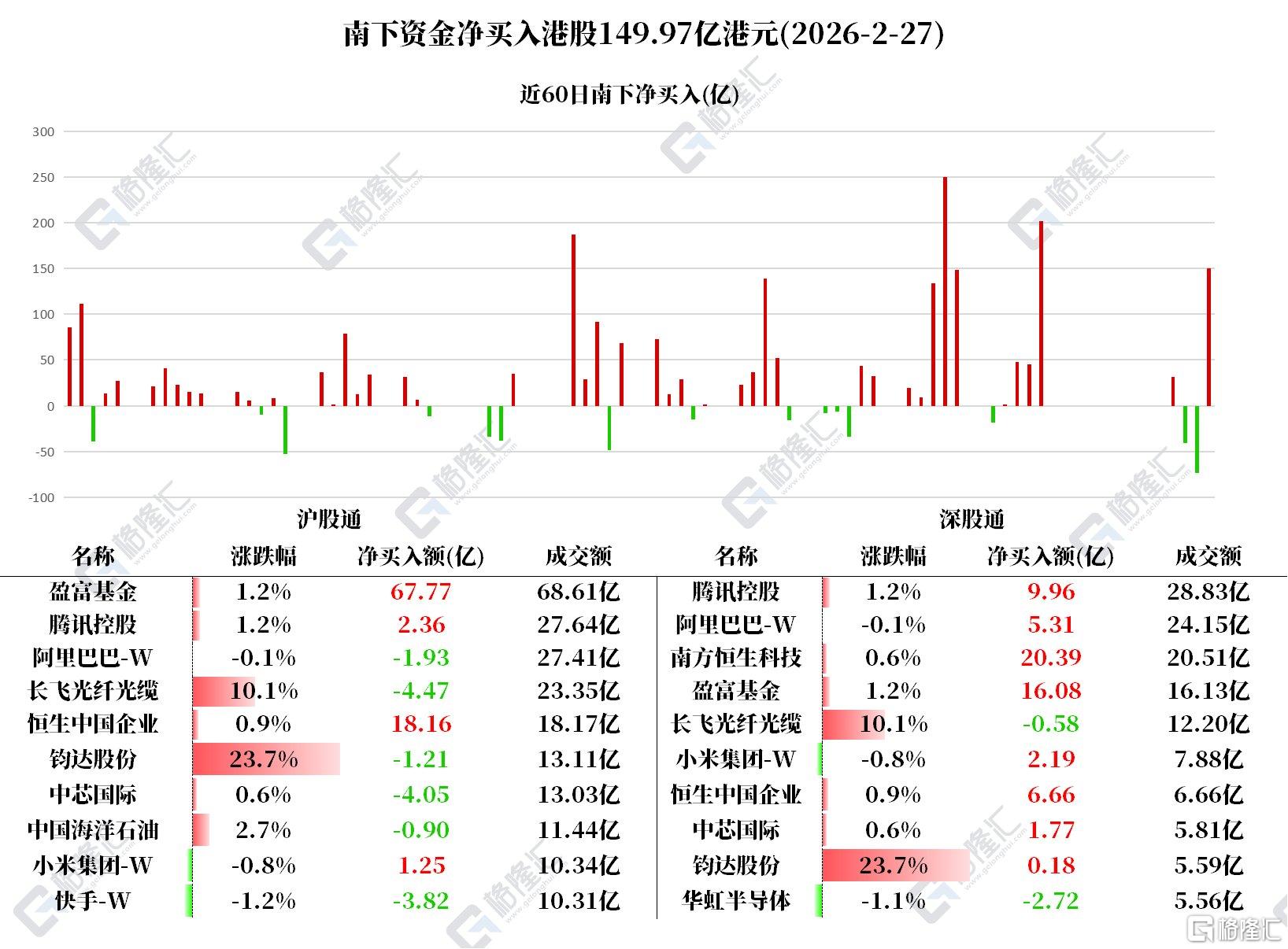
Market Overview - The Hang Seng Index increased by 0.95%, closing at 26,630.54 points, with a total market turnover of 288.42 billion HKD [1] Southbound Trading Data - The net purchases in southbound trading included: - Tracker Fund of Hong Kong (盈富基金) with a net buy of 8.385 billion HKD - Hang Seng China Enterprises Index (恒生中国企业) with a net buy of 2.482 billion HKD - Southern Hang Seng Technology Index (南方恒生科技) with a net buy of 2.039 billion HKD [1][2] - The net sales in southbound trading included: - Yangtze Optical Fibre and Cable (长飞光纤光缆) with a net sell of 0.505 billion HKD - Kuaishou Technology (快手-W) with a net sell of 0.382 billion HKD - Hua Hong Semiconductor (华虹半导体) with a net sell of 0.272 billion HKD [1][2] Individual Stock Performance - Key stocks with significant net buy amounts: - Tracker Fund of Hong Kong: 8.474 billion HKD, closing price at 26.90 HKD, with a change of +1.20% - Hang Seng China Enterprises: 8.282 billion HKD, closing price at 90.92 HKD, with a change of +0.87% - Southern Hang Seng Technology: 8.051 billion HKD, closing price at 5.03 HKD, with a change of +0.60% [2] - Key stocks with significant net sell amounts: - Yangtze Optical Fibre and Cable: 5.556 billion HKD, closing price at 148.80 HKD, with a change of +10.06% - Kuaishou Technology: 3.031 billion HKD, closing price at 62.85 HKD, with a change of -1.18% - Hua Hong Semiconductor: 1.475 billion HKD, closing price at 96.75 HKD, with a change of -1.12% [2]
资金动向 | 北水连续6日净买入小米,抛售快手、中芯国际
Ge Long Hui A P P· 2026-02-27 12:28
Group 1: Market Movements - Net purchases included 8.385 billion in Yingfu Fund, 2.482 billion in Hang Seng China Enterprises, 2.039 billion in Southern Hang Seng Technology, 1.232 billion in Tencent Holdings, 0.343 billion in Xiaomi Group-W, and 0.338 billion in Alibaba-W [1] - Net sales included 0.505 billion in Changfei Optical Fiber, 0.381 billion in Kuaishou-W, 0.272 billion in Huahong Semiconductor, 0.228 billion in SMIC, and 0.103 billion in Junda Co. [1] - Southbound funds have recorded net purchases in Xiaomi for six consecutive days, totaling 3.56896 billion HKD [1] Group 2: Stock Performance - Yingfu Changjin saw a 1.2% increase with a net purchase of 6.777 billion, while Tencent Holdings also increased by 1.2% with a net purchase of 0.236 billion [4] - Alibaba-W experienced a slight decrease of 0.1% with a net sale of 0.193 billion, while Southern Hang Seng Technology had a net purchase of 1.816 billion with a 0.9% increase [4] - Changfei Optical Fiber saw a significant increase of 10.1% despite a net sale of 0.447 billion [4] Group 3: Company Developments - Alibaba-W's AI assistant "Qianwen" is entering the AI hardware market, planning to launch various AI hardware products globally, including AI glasses at the 2026 Mobile World Congress [5] - Kuaishou-W reported record high daily active users (DAU) during the 2026 Spring Festival, driven by activities like "Shake the Fortune Tree" [6] - Xiaomi Group-W repurchased 2.832 million B shares for approximately 99.997 million HKD [7] - SMIC is expected to maintain high capital expenditure in 2026, with optimistic revenue growth guidance and a Q1 sales revenue forecast to remain stable [7][8]

2月净流入约905亿元 频现单日百亿流入逆势抄底科网股
Xin Lang Cai Jing· 2026-02-27 11:10
Core Viewpoint - In February, southbound capital inflow into Hong Kong stocks reached approximately 90.575 billion HKD, marking a three-month high despite a volatile market, indicating strong investor interest in certain sectors [2][4]. Group 1: Capital Inflow Data - Southbound capital recorded a net inflow of about 90.575 billion HKD in February, with an average daily inflow of 6.469 billion HKD, a nearly 90% increase compared to January [2]. - There were five trading days where the net buying exceeded 10 billion HKD, setting new records [4]. - The technology sector attracted the most capital, with a net inflow of 39.372 billion HKD, while the non-essential consumer sector saw 21.196 billion HKD [5][6]. Group 2: Sector Performance - The technology sector has seen a cumulative inflow of over 66 billion HKD in the first two months of the year, despite the Hang Seng Technology Index declining nearly 7% [6]. - Non-essential consumer goods also received significant attention, with a total inflow exceeding 38 billion HKD in the first two months [6]. - The materials sector, particularly non-ferrous resources, faced continuous selling pressure, with a cumulative outflow of nearly 20 billion HKD over the past two months [6]. Group 3: Individual Stock Performance - Tencent Holdings (0700.HK) was the top net buyer with 24.453 billion HKD, followed by Xiaomi Group (1810.HK) with 7.337 billion HKD and Alibaba (9988.HK) with 3.473 billion HKD [7][9]. - Conversely, Zijin Mining (2899.HK) experienced the largest net sell-off at 3.520 billion HKD, followed by SMIC (981.HK) at 2.867 billion HKD [8][9]. - Notable trends include continued inflows into Meituan (3690.HK) and Xiaomi Group despite their respective declines of 16.51% and 1.69% in February [9].




恒生指数上涨0.95% 恒生科技指数上涨0.56%
Xin Lang Cai Jing· 2026-02-27 11:07
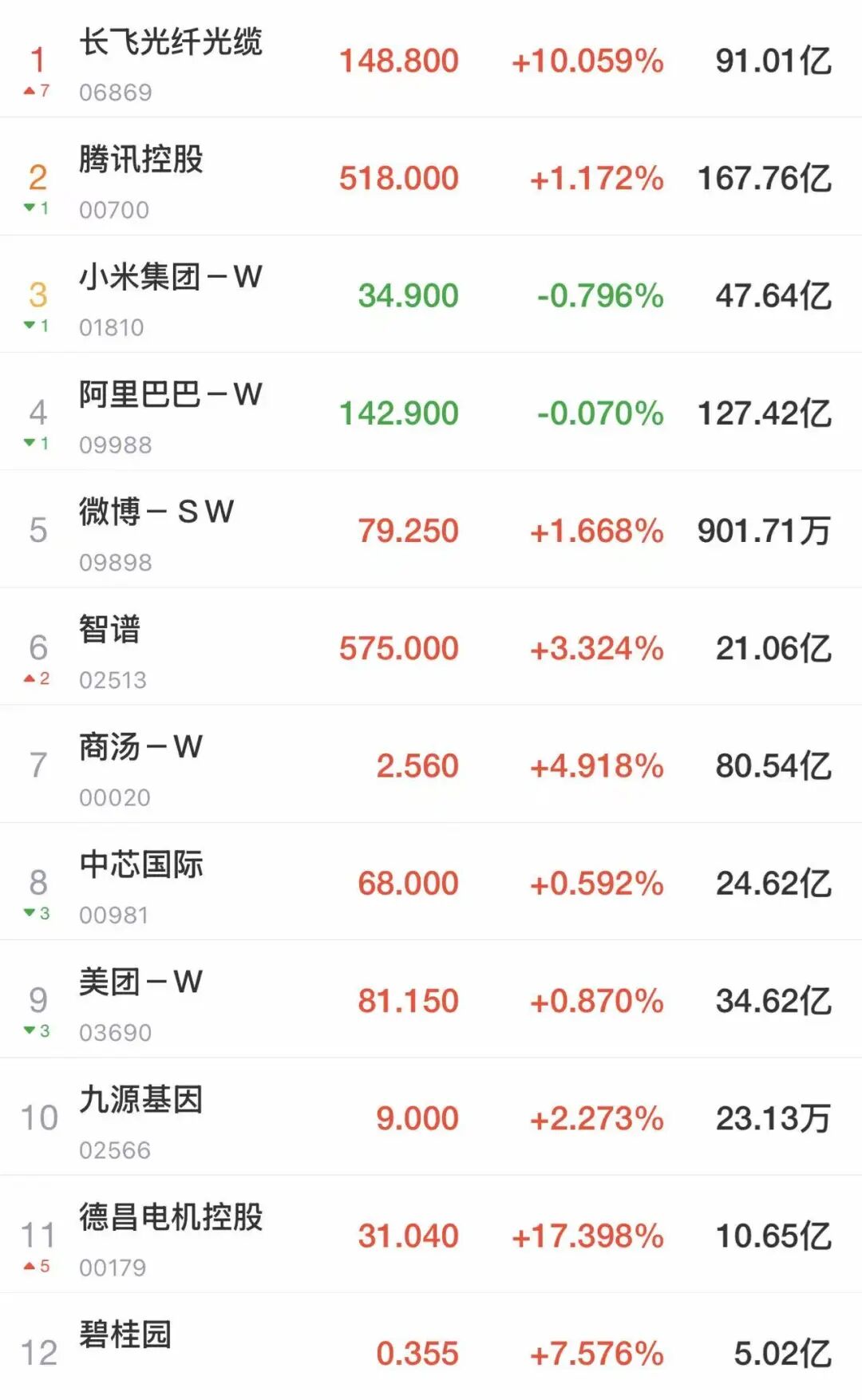
Market Performance - The Hang Seng Index rose by 0.95% to close at 26,630.54 points, while the Hang Seng Tech Index increased by 0.56% to 5,137.84 points, and the National Enterprises Index gained 0.51% to 8,859.49 points [1] - The main board recorded a trading volume exceeding 288.4 billion HKD, with a net inflow of over 14.9 billion HKD in the southbound trading of Stock Connect [1] Sector Performance - Sectors such as gold, biomedicine, technology, coal, high-speed rail infrastructure, oil and gas, and telecommunications generally saw gains, while sectors like non-ferrous metals, commercial aerospace, banking, and real estate experienced mixed results [1] - New consumption, chips, new energy vehicle companies, brokerages, and aerospace sectors mostly faced declines [1] Individual Stock Movements - Notable stock movements included Xiaomi Group down by 0.80%, China Ping An up by 0.22%, SenseTime up by 4.92%, and SMIC up by 0.59% [1] - Tencent Holdings rose by 1.17% with a trading volume exceeding 16.7 billion HKD, while Alibaba fell by 0.07% with a trading volume over 12.7 billion HKD [2] - Longi Green Energy surged by 10.06% with a trading volume of 9.1 billion HKD [2]


智通港股通活跃成交|2月27日


智通财经网· 2026-02-27 11:02
Core Insights - On February 27, 2026, the top three stocks by trading volume in the Southbound Stock Connect were Yingfu Fund (02800), Tencent Holdings (00700), and Alibaba-W (09988), with trading volumes of 6.861 billion, 2.764 billion, and 2.741 billion respectively [1] - In the Southbound Stock Connect of the Shenzhen-Hong Kong Stock Connect, Tencent Holdings (00700), Alibaba-W (09988), and Southern Hang Seng Technology (03033) were the top three stocks, with trading volumes of 2.883 billion, 2.415 billion, and 2.051 billion respectively [1] Southbound Stock Connect (Hong Kong) - The top active stocks by trading volume included: - Yingfu Fund (02800) with a trading amount of 6.861 billion and a net buying amount of +6.777 billion - Tencent Holdings (00700) with a trading amount of 2.764 billion and a net buying amount of +0.236 billion - Alibaba-W (09988) with a trading amount of 2.741 billion and a net selling amount of -0.193 billion - Other notable stocks included Changfei Optical Fiber (06869) and Hang Seng China Enterprises (02828) with trading amounts of 2.335 billion and 1.817 billion respectively [2] Southbound Stock Connect (Shenzhen) - The top active stocks by trading volume included: - Tencent Holdings (00700) with a trading amount of 2.883 billion and a net buying amount of +0.996 billion - Alibaba-W (09988) with a trading amount of 2.415 billion and a net buying amount of +0.531 billion - Southern Hang Seng Technology (03033) with a trading amount of 2.051 billion and a net buying amount of +2.039 billion - Other notable stocks included Yingfu Fund (02800) and Changfei Optical Fiber (06869) with trading amounts of 1.613 billion and 1.220 billion respectively [2]
三大指数全红,腾讯、美团、百度等齐涨,碧桂园涨超7%,南向资金净流入超140亿港元!后市怎么走?丨港股收盘
Mei Ri Jing Ji Xin Wen· 2026-02-27 08:53
Market Performance - The Hang Seng Index closed up 0.95%, the Hang Seng Tech Index rose 0.56%, and the State-Owned Enterprises Index increased by 0.51% on February 27 [1] - Southbound capital saw a net inflow exceeding 14 billion HKD [1] Stock Movements - Major tech companies such as Tencent rose over 1%, while Meituan, JD.com, and Baidu also experienced gains; Alibaba initially increased by over 1.7% but fell back towards the end of trading [1] - Specific sectors like optical communication, steel, non-ferrous metals, rare earths, and innovative pharmaceuticals saw significant increases, with Longi Green Energy rising nearly 10%, Maanshan Iron & Steel up 6.6%, and Kweichow Moutai increasing by 6% [1] IPO Market Outlook - Multiple institutions express optimism regarding the Hong Kong IPO market for 2026, with UBS predicting a financing scale exceeding 300 billion HKD and around 150-200 listings [3] - Huatai Securities estimates the main board IPO financing scale at approximately 310 billion HKD with about 100 new companies [3] - Deloitte forecasts around 160 new listings in the Hong Kong market with a financing amount not less than 300 billion HKD [3] - PwC anticipates about 150 new listings with total fundraising between 320 billion to 350 billion HKD, potentially ranking among the top three globally [3] Technology Sector Valuation - Analysts from China Merchants Securities indicate that the current valuation of the Hong Kong tech sector has dropped to historical lows, suggesting that the sector is significantly undervalued in the context of the AI development and technology-driven national strategy [3]