
SINO BIOPHARM(01177)

Search documents
美银证券:中国生物制药两款药物进度积极 重申“买入”评级
Zhi Tong Cai Jing· 2026-02-12 08:35
Group 1 - The core viewpoint of the article is that China Biologic Products (01177) has completed the enrollment of subjects for the Phase III clinical trials of two drugs, TQB2102 and LM302 [1] - LM302 is noted as the world's first CLDN18.2 antibody drug complex to complete subject enrollment in Phase III registration clinical trials, potentially providing new treatment options for patients [1] - Bank of America Securities has set a target price of HKD 8.6 and reiterated a "Buy" rating for the company [1]

美银证券:中国生物制药(01177)两款药物进度积极 重申“买入”评级
智通财经网· 2026-02-12 08:32
Core Viewpoint - Bank of America Securities reports that China Biologic Products (01177) has completed patient enrollment for Phase III clinical trials of two drugs, TQB2102 and LM302, with LM302 being the first CLDN18.2 antibody drug conjugate to complete such enrollment globally, potentially offering new treatment options for patients [1] Group 1 - China Biologic Products has completed patient enrollment for Phase III clinical trials of TQB2102 and LM302 [1] - LM302 is noted as the world's first CLDN18.2 antibody drug conjugate to finish Phase III registration clinical trial enrollment [1] - Bank of America Securities sets a target price of HKD 8.6 and maintains a "Buy" rating for the stock [1]
大行评级丨美银:中国生物制药两款药物进展积极,重申“买入”评级
Ge Long Hui· 2026-02-12 08:28
Core Viewpoint - Bank of America Securities reports that two drugs from a Chinese biopharmaceutical company, TQB2102 and LM302, have recently completed patient enrollment for Phase III clinical trials, with LM302 being the first CLDN18.2 antibody-drug conjugate to complete this phase globally, potentially offering new treatment options for patients [1] Group 1 - The two drugs, TQB2102 and LM302, have completed patient enrollment for Phase III clinical trials [1] - LM302 is noted as the world's first CLDN18.2 antibody-drug conjugate to complete Phase III registration clinical trial enrollment [1] - The target price for the company is set at HKD 8.6, with a reiterated "Buy" rating [1]
国联民生证券:小核酸重构减肥逻辑 INHBE与ALK7靶点初步验证
智通财经网· 2026-02-12 06:43
Core Viewpoint - The report from Guolian Minsheng Securities highlights the synergistic effects of small nucleic acid drugs and GLP-1 class drugs in the weight loss sector, suggesting they could become a "golden duo" for weight management [1][4]. Group 1: Drug Efficacy and Development - Arrowhead has reported promising initial weight loss results from two small nucleic acid drugs targeting INHBE and ALK7, with ARO-INHBE showing an average fat reduction of 9.9% and liver fat reduction of up to 38.6%, alongside a 3.6% increase in lean tissue [1]. - ARO-ALK7 demonstrated a dose-dependent average reduction of ALK7 mRNA by 88%, confirming the TRiM platform's ability to inhibit fat cell gene expression [1]. - Wave Life's WVE-007 targeting liver INHBE showed a 9.4% reduction in visceral fat and a 4.5% overall fat reduction after three months, with a 3.2% increase in lean body mass [3]. Group 2: Market Trends and Collaborations - Major pharmaceutical companies are increasingly investing in small nucleic acid drugs, with Eli Lilly committing $1.2 billion in collaboration with Saint Inbiotech for RNAi candidate drug development for metabolic diseases [3]. - Eli Lilly also invested $1 billion in HAYA's lncRNA platform for obesity and related metabolic disease treatments, while Novo Nordisk partnered with Replicate Bioscience for a $550 million project targeting obesity and type 2 diabetes [3]. - The speed of Chinese pharmaceutical companies in developing small nucleic acid drugs for weight loss is nearly on par with international counterparts, with several companies like Hengrui Medicine and Innovent Biologics actively pursuing this area [5]. Group 3: Investment Recommendations - The report suggests focusing on companies involved in small nucleic acid weight loss targets, including Hengrui Medicine, Chengdu Xian Dao, China National Pharmaceutical Group, East China Pharmaceutical, and others [6].



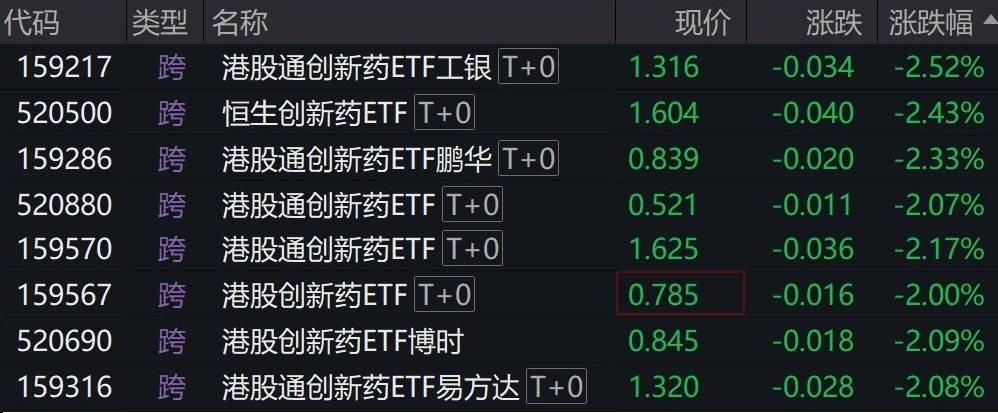
港股创新药概念股走低,相关ETF跌超2%
Sou Hu Cai Jing· 2026-02-12 03:16
Group 1 - The Hong Kong innovative drug concept stocks have declined, with companies such as 3SBio, Kelun-Botai Biopharmaceuticals falling over 3%, and CSPC Pharmaceutical Group, China Biologic Products, and Hansoh Pharmaceutical dropping over 2% [1] - The Hong Kong innovative drug-related ETFs have also seen a decline of over 2% [1] Group 2 - Current analysis indicates that the healthcare sector presents multiple investment opportunities, with the CXO industry experiencing sustained improvement due to a recovery in overseas orders and domestic capacity reduction, while still having room for valuation recovery [2] - The medical device sector is benefiting from domestic equipment upgrade policies and overseas market expansion, with continuous catalysts in cutting-edge areas such as brain-computer interfaces and AI imaging [2] - Internet healthcare is seeing improved operational efficiency in the context of deepening medical insurance payment reforms, leading to a clearer profit growth trajectory [2]


小核酸风口之上系列:小核酸重构减肥逻辑,INHBE和ALK7靶点初步验证
Guolian Minsheng Securities· 2026-02-12 00:25
Investment Rating - The report maintains a "Recommended" rating for companies involved in the small nucleic acid drug sector targeting obesity [4]. Core Insights - The obesity treatment market is gaining significant attention, with GLP-1 drugs demonstrating efficacy in weight loss, but they also have high rebound rates post-treatment and associated muscle loss. Small nucleic acid drugs offer a different approach by targeting fat metabolism at the genetic level [12][21]. - Arrowhead and Wave Life have shown promising initial results for their small nucleic acid drugs ARO-INHBE and WVE-007, respectively, indicating effective fat reduction without muscle loss [22][38]. - The collaboration between major pharmaceutical companies and small nucleic acid drug developers is intensifying, with significant investments aimed at advancing RNAi therapies for metabolic diseases [49]. Summary by Sections 1. Unmet Needs in Obesity Treatment - The report highlights the unmet demand in obesity treatment, emphasizing that small nucleic acid drugs could provide solutions by directly intervening in fat metabolism [12][16]. 2. Initial Efficacy of Small Nucleic Acid Drugs - Arrowhead's ARO-INHBE demonstrated an average fat reduction of 9.9% and a liver fat reduction of 38.6%, while also increasing lean tissue by 3.6% [22][27]. - Wave Life's WVE-007 showed a 9.4% reduction in visceral fat and a 4.5% reduction in total fat after three months, with a 3.2% increase in lean body mass [38][49]. 3. Investment Recommendations - The report suggests focusing on companies developing small nucleic acid drugs for obesity, including HengRui Medicine, Chengdu XianDao, China Biopharmaceutical, and others [50].



中国创新药BD交易进入“后签约时代” 争议解决或成行业必修课
2 1 Shi Ji Jing Ji Bao Dao· 2026-02-10 23:15
Core Insights - The Chinese innovative drug industry is entering a new decade of development in 2025, with a significant increase in business development (BD) transactions, reaching a total value of $135.655 billion and 157 transactions, both setting historical records, indicating the growing global appeal of Chinese innovative drugs [1] - Milestone payments from previously established collaborations are beginning to materialize, providing cash flow relief for companies and marking substantial progress in global development [1] - However, potential risks associated with BD collaborations are emerging, including the premature termination of agreements and disputes leading to arbitration or litigation, signaling a need for caution in the industry [1] Industry Trends - The surge in BD transactions in 2025 is driven by the long-accumulated innovative potential of China's biopharmaceutical sector, with expectations for continued growth in cross-border transactions between China and the US/Europe [2] - The BD trend began in 2022, but many companies have not yet experienced the full lifecycle of BD transactions, leading to potential undisclosed issues in long-term performance [2] - The period from 2026 to 2028 may see an increase in BD disputes, as the industry transitions from rapid growth to a more regulated and mature phase [2] Financial Highlights - In May 2025, a record-breaking upfront payment of $12.5 billion was secured by a collaboration between Sangamo Therapeutics and Pfizer, with potential total payments reaching $48 billion [3] - In July 2025, China National Pharmaceutical Group announced a $300 million milestone payment from Merck for a collaboration on a PD-1/VEGF dual antibody [3] - In October 2025, a $250 million milestone payment was triggered for a collaboration between SystImmune and Bristol-Myers Squibb, marking the largest single milestone payment for an ADC asset disclosed in China [3] Payment Structures - The "upfront payment + milestone + sales royalty" model remains the dominant approach for Chinese companies in BD transactions, but only 22% of biopharmaceutical companies achieved milestone events by mid-2025, a decrease from previous years [4] - Among 128 transactions with at least one milestone node, 45% did not generate any revenue, highlighting the uncertainty of milestone payment realizations [4] - Increasing the proportion of upfront payments to secure immediate cash flow has become a consensus among companies to mitigate risks [4] Contractual Strategies - Companies are advised to enhance negotiation strategies by creating competitive environments and optimizing milestone payment terms to reduce ambiguity and disputes [5][6] - Specific, quantifiable conditions for milestone payments should be established to minimize subjective interpretations and risks of disputes [5] - The interrelation of contractual terms should be considered to avoid imbalances in rights and obligations, which could lead to significant disagreements during project execution [6] Legal Considerations - The potential for a wave of litigation in the BD sector is rising, driven by long-term contracts and various uncertainties affecting performance [7] - Companies often prioritize commercial negotiations to resolve disputes, but if unsuccessful, they must rely on the agreed dispute resolution mechanisms, emphasizing the importance of precise contract language [7][8] - Early identification of dispute trajectories and effective crisis management can significantly influence the outcome of legal proceedings [8] Future Outlook - As of January 2026, 17 BD transactions have occurred, totaling $133.61 billion, with significant projects continuing to emerge [9] - The ADC sector, small nucleic acid drugs, and in vivo CAR-T therapies are expected to be key areas for BD transactions in the next 1-2 years, with a shift in focus towards clinical data validation [10] - The industry is moving towards a more mature and regulated phase, with an emphasis on risk awareness and compliance as essential elements for successful cross-border BD initiatives [10]
开年就爆,全球创新药企争抢中国小核酸
3 6 Ke· 2026-02-10 00:42
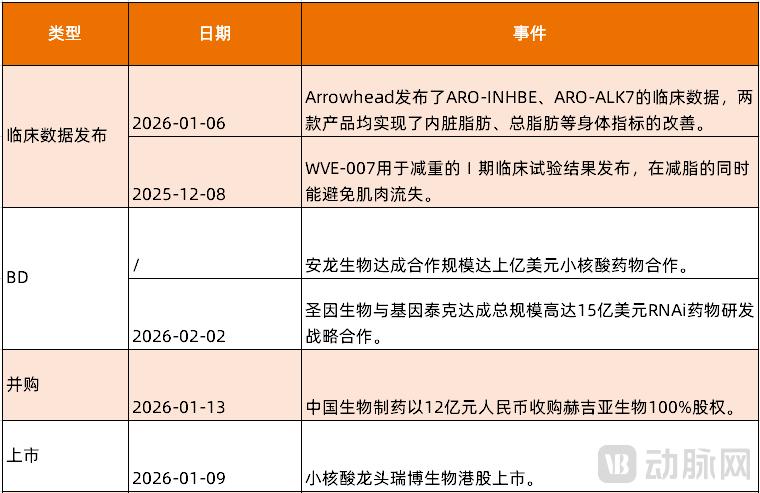
Core Insights - The small nucleic acid sector is experiencing a significant commercialization phase, driven by technological breakthroughs and successful clinical data releases in the weight loss domain [1][3][6] - Major transactions, including a billion-level acquisition by China Biologic and the Hong Kong listing of Rebio, indicate that capital exit channels are now open [1][5][6] Group 1: Clinical Data Releases - Arrowhead Pharmaceuticals announced clinical data for two siRNA obesity candidates, ARO-INHBE and ARO-ALK7, showing improvements in visceral fat and total fat in obese patients with type 2 diabetes, leading to a 10.9% stock price increase [3] - Wave Life Sciences reported that its siRNA drug WVE-007 achieved a 4.0% weight reduction and a 0.9% muscle gain in a Phase I trial, resulting in a 147.3% stock price surge [4] - The clinical data from these small nucleic acid drugs suggest potential for use either alone or in combination with GLP-1 drugs to reduce fat while preserving muscle [4][7] Group 2: Business Development Transactions - In early 2026, Anlong Bio secured an international strategic cooperation agreement in the small nucleic acid drug field worth over $100 million, marking a significant breakthrough in international business development [5] - China Biologic announced a 1.2 billion RMB acquisition of Hejiya Bio, enhancing its small nucleic acid portfolio and leveraging Hejiya's unique long-acting delivery platform [5][6] - Saintin Bio has engaged in multiple business development deals, including a strategic collaboration with Genentech worth up to $15 billion for RNAi drug development [17] Group 3: Market Trends and Future Outlook - The small nucleic acid sector is increasingly recognized as a core area for innovative drug development, with expectations for more significant events in the future [2][6] - The weight loss market is identified as a potential area for major transactions, driven by the large market size and the growing recognition of clinical efficacy for small nucleic acid drugs [7][19] - Major pharmaceutical companies are actively exploring collaborations in the small nucleic acid space, particularly in conjunction with GLP-1 drugs to enhance therapeutic outcomes [18][20]

华源晨会精粹20260209-20260210
Hua Yuan Zheng Quan· 2026-02-09 23:30
Group 1: Pharmaceutical Industry - The pharmaceutical index increased by 0.14%, outperforming the CSI 300 index by 1.47% during the week [2][6] - The report highlights the potential of molecular glue technology to target "undruggable" proteins, expanding the scope for innovative drug development [8][9] - Recommended stocks in the innovative drug sector include Heng Rui Medicine, China Biologic Products, and Yuan Dong Biology, among others [11][9] Group 2: Construction and Building Materials - Major engineering projects are identified as a key focus for the "14th Five-Year Plan," with significant investments planned across various provinces [13][14] - The report notes that infrastructure projects will dominate investment, with substantial funding allocated to transportation, municipal, and energy sectors [14] - The issuance of special bonds has increased significantly, with a total of 5,164.55 billion yuan issued as of February 8, 2026, marking a year-on-year increase of 125.35% [15] Group 3: Real Estate - The Shanghai government has initiated the acquisition of second-hand homes for rental housing projects, indicating a strategic move to stabilize the real estate market [19][21] - New home sales in 42 key cities totaled 1.48 million square meters, a slight decrease of 0.1% week-on-week, while second-hand home sales fell by 3.0% [20][19] - The report suggests that the real estate market is entering a phase of structural differentiation, with high-quality housing expected to see increased demand [23] Group 4: Overseas and Education Research - The first round of negotiations between the US and Iran concluded, with market sentiment shifting towards risk assets, particularly in AI and commercial aerospace sectors [26][30] - Bloom Energy reported better-than-expected earnings, with Q4 2025 revenue reaching $777.8 million, a year-on-year increase of 35.9% [26] - The quantum computing sector is gaining attention, with NERSC announcing a call for proposals utilizing neutral atom quantum processors [28]


中国生物制药(01177.HK):TQB2102“HER2双抗ADC”HER2低表达乳腺癌III期临床试验完成受试者入组
Ge Long Hui· 2026-02-09 22:43
TQB2102是集团自主研发的新一代HER2双表位双特异性抗体偶联药物(ADC),通过三项核心技术创 新,实现疗效与安全性的优化平衡:1. 双表位靶向设计:抗体端采用非对称型结构设计,同时结合 HER2的ECD II/IV结构域,可显著提升对肿瘤细胞的选择性及药物内吞效率,从而增强抗肿瘤活性。2. 可裂解连接子:采用酶裂解型连接子,能够高效裂解释放毒素,并具备"旁观者效应",清除周边异质性 肿瘤细胞,扩大杀伤范围。3. 优化的药物抗体比(DAR):DAR值稳定控制在5.8-6.0,搭配拓扑异构酶I (Topo I)抑制剂毒素,在提升疗效的同时降低毒副作用。以上核心技术的结合,突破了传统HER2单抗及 单靶点ADC的局限,使TQB2102在HER2低表达肿瘤治疗中展现出显著潜力。 格隆汇2月10日丨中国生物制药(01177.HK)发布公告,集团自主研发的国家1类创新药TQB2102"HER2双 抗ADC"正在开展一项"评价注射用TQB2102对比研究者选择的化疗在HER2低表达复发╱转移性乳腺癌 中有效性和安全性的随机、开放、平行对照的III期临床试验(TQB2102-III-01)",近期已完成全部受试者 入 ...