SINO BIOPHARM(01177)

Search documents
2026医疗展望:百家公司港股排队,医疗板块能否再创「神话」
3 6 Ke· 2026-02-25 00:02
精锋医疗、北芯生命等医疗器械股接连上市,涨势颇佳;脑机接口引发一二级市场集体狂欢,博睿康、强脑科技冲刺IPO,上海另一家侵入式脑机创业公司 估值也超过45亿元。 如今,超百家医疗公司在港股排队,IPO政策即将收紧的风声广为流传,甚至有行业人士认为"新股破发30%会成为常态"。那么,2026年医疗公司上市的窗 口和机遇究竟如何?拟IPO公司正如何聪明地应对行情风险? 去年创新药板块创造了许多财富神话:6000倍打新"认购王"、百余家公司年内股价翻倍等。2026年,更多基石和早期投资人会相继解禁,情绪与浮华褪去, 还得靠硬实力撑住长期市值。BD交易的规模和结构,仍是市场判断药企和新药分子质地的关键。 历经一年洗礼,资本市场对于创新药License-out(对外授权)的反应愈发理性,"BD拉不动股价"也时有发生。2026年MNC对中国新药资产的热情不减,除 了已然拥挤的肿瘤赛道,哪些新方向正成为大药企竞逐的热点? 新药BD授权的玩家中,AI native的生物医药公司已然不容小觑。近一个多月,英矽智能、华深智药等频获BD交易,国内某AI制药明星创业公司估值拉至30 亿美金。新药老炮儿们如何看待"AI科学家"在药物开 ...


港股收盘(02.24) | 恒指收跌1.82% AI模型“双雄”逆市上涨 存储概念、油气股走强
智通财经网· 2026-02-24 08:43
Market Overview - On the first trading day after the resumption of Northbound trading, Hong Kong's three major indices collectively declined, with the Hang Seng Index falling below the 27,000 mark, closing down 1.82% or 491.59 points at 26,590.32 points, with a total turnover of HKD 250.99 billion [1] - The Hang Seng China Enterprises Index dropped 2.06% to 9,007.86 points, while the Hang Seng Tech Index fell 2.13% to 5,270.70 points [1] Sector Performance - The technology sector remains a long-term investment focus, with valuation pressure easing after recent pullbacks, and potential for rebound driven by accelerated AI model updates and applications [1] - The energy and precious metals sectors are expected to rise amid heightened geopolitical risks in the Middle East and adjustments in U.S. tariff policies [1] - The consumer sector, currently undervalued, is anticipated to have upward potential as consumption policies are strengthened [1] Blue-Chip Stocks - WH Group (00288) led blue-chip gains, rising 4.42% to HKD 10.39, contributing 5.87 points to the Hang Seng Index [2] - Other notable blue-chip performers included Henderson Land (00012) up 2.08% and China Resources Beer (00291) up 2.02% [2] - China Biologic Products (01177) fell 6.58%, negatively impacting the index by 7.48 points [2] Hot Sectors - Major tech stocks faced pressure, with Tencent down over 3% and Alibaba down over 2% [3] - Storage concepts saw significant gains, with Zhaoyi Innovation (03986) up 11.91% and Longsys Technology (06809) up 4.92% [3] - Oil and gas stocks rose amid concerns over escalating tensions in Iran, with Shandong Molong (00568) up 11.41% [4] AI and Technology - The AI sector continues to show promise, with significant growth in token usage, particularly in Chinese models, which account for 61% of the total token volume [5] - The market anticipates ongoing rapid growth in AI applications and commercial viability [5] Film Sector - The film sector faced challenges, with the 2026 Spring Festival box office down approximately 40% year-on-year, indicating a need for improved content quality [6] - Major film stocks like Maoyan Entertainment (01896) and Huayi Brothers (01003) saw declines of 8.18% and 5.26%, respectively [6] Notable Stock Movements - Kwan Hung Holdings (01888) surged 12.37% following a profit forecast indicating a 165% increase in net profit for the fiscal year ending December 2025 [7] - Weichai Power (02338) rose 7.29% after a report highlighted its emergency generator's use in a major data center [8] - China Shipbuilding Defense (00317) reached a new high, up 5.37%, following a significant shipbuilding contract announcement [9] - Standard Chartered (02888) saw a 3.07% increase after reporting a 6% rise in operating income for the fiscal year 2025 [10] - China Duty Free Group (01880) faced a 10.51% drop due to losing some operating rights at major airports [11]



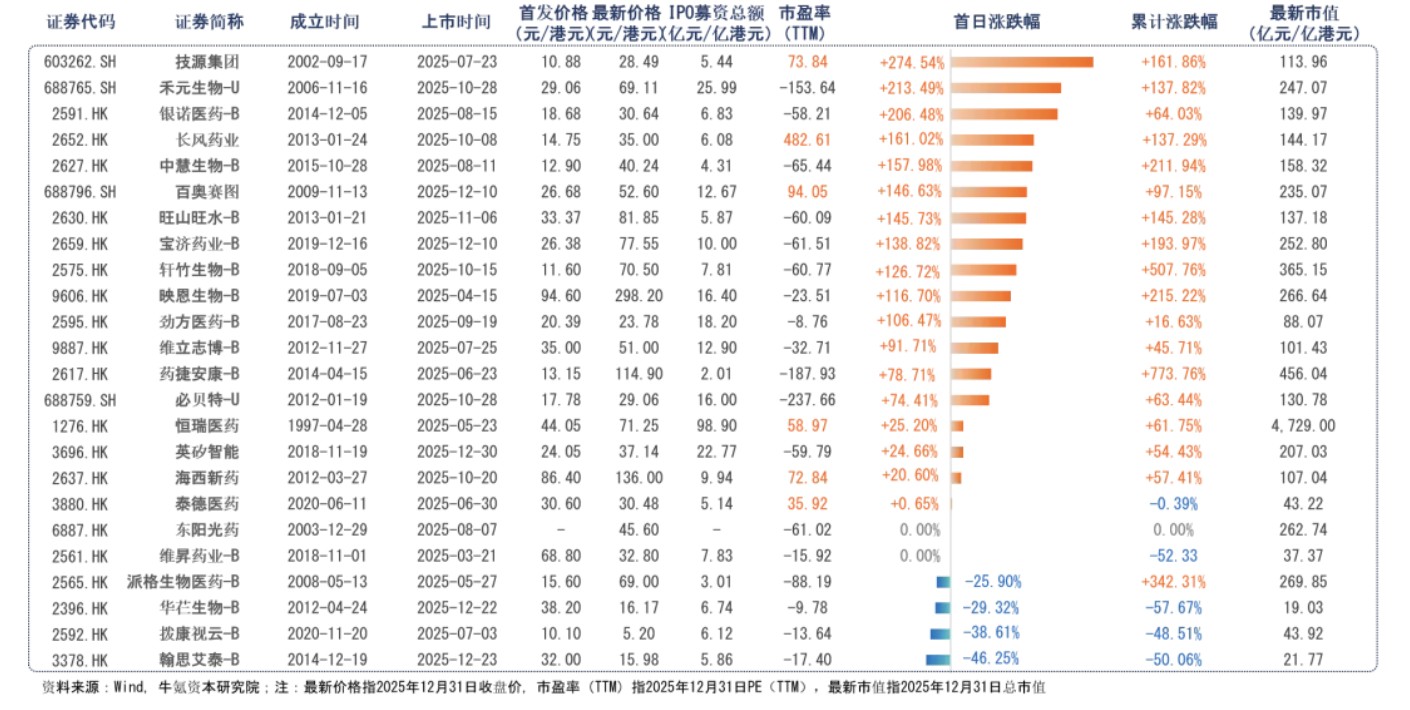
未知机构:国泰海通医药创新药推荐观点更新进一步推荐具备价值重估空间的pharma以-20260224
未知机构· 2026-02-24 03:00
Summary of Key Points from the Conference Call Industry Overview - The focus is on the **Pharmaceutical (Pharma)** and **Biopharmaceutical/Biotech** sectors, highlighting companies with potential for value re-evaluation and those entering a performance ramp-up phase [1][2]. Core Insights and Arguments 1. **Value Re-evaluation of Pharma Companies**: - There is a recommendation to further support Pharma companies that have the potential for value re-evaluation, particularly emphasizing key marginal changes. The BD (Business Development) revenue for Pharma is expected to normalize, which will drive an upward shift in the valuation framework [1][2]. 2. **Performance Ramp-up in Biopharma/Biotech**: - Continuous recommendation for Biopharma/Biotech companies that are entering a performance ramp-up phase and have pipelines that are consistently delivering results. The expectation is that by 2026, leading Biopharma/Biotech companies will enter a period of accelerated performance [2]. 3. **Key Marginal Changes**: - The core marginal change driving the value re-evaluation logic for Pharma companies is the normalization of BD revenue. This is supported by two main factors: - Leading Pharma companies have a more comprehensive technology platform and pipeline layout, enhancing their ability to continuously produce BD assets [2]. - External transactions are evolving from sporadic single-asset licensing to a more platform-based and series-based licensing model, making upfront payments, milestones, and revenue sharing more replicable and predictable. Recent collaborations, such as the partnership between **Shiyao** and **AstraZeneca** for a long-acting weight loss drug (total package of $18.5 billion) and **Innovent** with **Eli Lilly** in oncology and immunology (total package of $8.9 billion), exemplify this trend [2]. Recommendations - Specific companies recommended for investment include: - **Hengrui Medicine** - **Hansoh Pharmaceutical** - **Shiyao Group** (new addition in February) - **China National Pharmaceutical Group** - **Sinopharm** (new addition in February) - **Haisco** [2]. Additional Important Insights - The oncology, metabolism, and autoimmune sectors are expected to see a concentration of critical data releases. The integration of new technology platforms such as small nucleic acids, bispecific/trispecific antibodies, next-generation ADCs, and PROTAC/molecular glue is anticipated to provide significant valuation elasticity for leading companies at key data points, potentially opening up overseas BD opportunities [3].




未知机构:国泰海通医药春节期间创新药领域重点新闻梳理全球BD根据医药-20260224
未知机构· 2026-02-24 02:45
Summary of Key Points from Conference Call Industry Overview - The conference call discusses the global business development (BD) activities in the pharmaceutical sector during the Chinese New Year period from February 13 to February 23, 2026, highlighting a total of 18 BD transactions globally [1] Core Insights and Arguments - **Key Transactions**: - Qinhai Bio licensed its MAT2A inhibitor (GH31), which has received IND approval in China and the US and is currently in Phase I clinical trials, to Gilead. Qinhai will receive an upfront payment of $80 million, $1.45 billion in milestone payments, and a tiered double-digit percentage royalty based on net sales [1] - Other notable transactions include: - Novartis partnered with Unnatural Products to develop macrocyclic peptide drugs, focusing on cardiovascular applications, with Unnatural Products receiving an upfront payment of $100 million and potential milestone payments of $1.7 billion [1] - Eli Lilly acquired global rights for the IL6 monoclonal antibody clazakizumab from CSL for all indications except end-stage renal disease, with CSL receiving an upfront payment of $100 million [1] - Merck collaborated with Mayo Clinic to integrate clinical and genomic data, focusing on early research translation in inflammatory bowel disease, skin diseases, and neurology [1] - **Year-to-Date Transactions**: - From January 1 to February 23, 2026, there have been 36 BD transactions involving Chinese companies, with 13 of these transactions involving multinational corporations (MNCs) [1] Additional Important Insights - **Comparison with Previous Year**: - In comparison, there were 26 BD transactions during the same period in 2025, with only 3 involving MNCs [2] - **Future Outlook**: - The analysis indicates that MNCs have increased their focus on Chinese BD teams and asset searches since the second half of 2025, suggesting a positive outlook for more BD transactions involving Chinese assets and MNCs in 2026 [2]


中国生物制药(01177.HK):贝莫苏拜单抗注射液非小细胞肺癌放化疗后维持适应症获批上市
Ge Long Hui· 2026-02-15 23:31
Core Viewpoint - China National Pharmaceutical Group (01177.HK) has received approval from the National Medical Products Administration (NMPA) for its self-developed Class 1 innovative drug, Bemosituzumab (brand name: Andevate®), for a new indication in treating patients with unresectable stage III non-small cell lung cancer (NSCLC) who do not have known epidermal growth factor receptor (EGFR) sensitive mutations or anaplastic lymphoma kinase (ALK) rearrangements after platinum-based chemoradiotherapy without disease progression [1]. Group 1 - The drug Bemosituzumab has been approved for a specific patient population, which includes those with unresectable stage III NSCLC [1]. - The approval is significant as it addresses a critical need for treatment options in patients who have not progressed after receiving platinum-based therapies [1]. - The indication specifically targets patients without known EGFR sensitive mutations or ALK rearrangements, highlighting a niche market for the drug [1].
中国生物制药:贝莫苏拜单抗注射液非小细胞肺癌放化疗后维持适应症获批上市
Zhi Tong Cai Jing· 2026-02-15 22:45
Core Viewpoint - China National Pharmaceutical Group's innovative drug Bemosituzumab (brand name: Andevate) has received approval from the National Medical Products Administration (NMPA) for a new indication in treating unresectable stage III non-small cell lung cancer (NSCLC) patients who have not progressed after platinum-based chemotherapy [1] Group 1 - The approval is based on positive results from the R-ALPS study, which was presented at the 2025 American Society of Clinical Oncology (ASCO) annual meeting [1] - The study included patients with locally advanced or unresectable stage III NSCLC who had not progressed after synchronous/sequential chemoradiotherapy, comparing Bemosituzumab to a placebo [1] Group 2 - The median follow-up time was 19.4 months, with a median progression-free survival (PFS) of 9.69 months for the Bemosituzumab group compared to 4.17 months for the placebo group (HR=0.53, 95% CI 0.39-0.72, p<0.0001), indicating a 47% reduction in the risk of disease progression or death [2] - Subgroup analyses showed consistent benefit trends across various groups, demonstrating the broad applicability of this treatment [2] - Overall survival (OS) data is not yet mature, with median OS not reached, but a trend towards OS benefit was observed (HR=0.76, 95% CI 0.50-1.14) [2] Group 3 - The incidence of grade 3 or higher treatment-related adverse events (TRAEs) was 29.4% in the Bemosituzumab group compared to 19.7% in the placebo group [2] - Bemosituzumab is the third PD-L1 inhibitor approved in China for consolidation therapy after radical chemoradiotherapy for locally advanced or unresectable NSCLC [2] - The company aims to continue focusing on innovation in lung cancer treatment, developing a pipeline that covers multiple molecular subtypes and treatment scenarios to enhance patient survival benefits [2]
中国生物制药(01177):贝莫苏拜单抗注射液非小细胞肺癌放化疗后维持适应症获批上市
智通财经网· 2026-02-15 22:42
Core Viewpoint - China National Pharmaceutical Group's innovative drug Bemosituzumab (brand name: Andevate®) has received approval from the National Medical Products Administration (NMPA) for a new indication in treating unresectable stage III non-small cell lung cancer (NSCLC) patients who have not experienced disease progression after platinum-based chemoradiotherapy [1] Group 1 - The approval is based on positive results from the R-ALPS study, which was presented at the 2025 American Society of Clinical Oncology (ASCO) annual meeting [1] - The study included patients with locally advanced or unresectable stage III NSCLC who received either Bemosituzumab or a placebo as consolidation treatment until disease progression, with the primary endpoint being progression-free survival (PFS) assessed by blinded independent central review (BICR) [1] Group 2 - The median follow-up time was 19.4 months, with a median PFS of 9.69 months for the Bemosituzumab group compared to 4.17 months for the placebo group (HR=0.53, 95% CI 0.39-0.72, p<0.0001), indicating a 47% reduction in the risk of disease progression or death [2] - Subgroup analyses showed consistent benefit trends across various groups, demonstrating the broad applicability of this treatment [2] - Overall survival (OS) data is not yet mature, with median OS not reached, but a trend towards OS benefit was observed (HR=0.76, 95% CI 0.50-1.14) [2] Group 3 - The incidence of grade 3 or higher treatment-related adverse events (TRAEs) was 29.4% in the Bemosituzumab group compared to 19.7% in the placebo group [2] - Bemosituzumab is the third PD-L1 inhibitor approved in China for consolidation treatment after radical chemoradiotherapy for locally advanced or unresectable NSCLC [2] - The company aims to continue focusing on innovation in lung cancer treatment, developing a pipeline that covers multiple molecular subtypes and treatment scenarios to enhance patient survival benefits [2]
中国生物制药(01177) - 自愿公告 - 贝莫苏拜单抗注射液非小细胞肺癌放化疗后维持适应症获批上...
2026-02-15 22:35
香港交易及結算所有限公司及香港聯合交易所有限公司對本公告的內容概不負責,對其準確性或完 整性亦不發表任何聲明,並明確表示,概不對因本公告全部或任何部份內容而產生或因倚賴該等內 容而引致的任何損失承擔任何責任。 (於開曼群島註冊成立之有限公司) 網站:www.sinobiopharm.com (股份編號:1177) 自願公告 • 中位隨訪時間19.4個月,貝莫蘇拜單抗組中位PFS為9.69個月,安慰劑組為4.17個月(HR=0.53, 95% CI 0.39-0.72, p<0.0001 ),患者疾病進展或死亡風險降低47%; • 預設的亞組分析(是否吸煙、前序治療方式為同步╱序貫)結果顯示,各亞組與意向性治療(ITT) 人群獲益趨勢一致,展現出該治療方案的廣泛適用性; 貝莫蘇拜單抗注射液非小細胞肺癌放化療後維持適應症獲批上市 中國生物製藥有限公司(「本公司」,連同其附屬公司統稱「本集團」)董事會(「董事會」)宣佈,本集團自 主研發的國家1類創新藥貝莫蘇拜單抗(商品名:安得衛® )新適應症已獲得中國國家藥品監督管理局 (NMPA)的上市批准,用於在接受鉑類藥物為基礎的同步或序貫放化療後未出現疾病進展的未攜帶已 ...
大健康风向标〡跨越千亿美元门槛:中国分子站在全球化起点
Jing Ji Guan Cha Wang· 2026-02-13 07:06
Core Viewpoint - The keyword for the stock market in 2025 is expected to be "innovative drugs," with significant stock price increases driven by the potential of in-development innovative drugs and BD (business development) transactions rather than traditional revenue from already marketed drugs [1] Group 1: BD Transactions - In 2025, China's innovative drug BD transaction total exceeded $100 billion, with notable orders reaching $10 billion, and upfront payments from multinational pharmaceutical companies reaching a new high of $1.25 billion [1] - Landmark transactions include a $13 billion collaboration between Qihuang Dejian and Biohaven/AimedBio in January, marking a milestone for China's ADC technology [2] - In May, 3SBio's deal with Pfizer exceeded $6 billion, setting a record for upfront payments in China at $1.25 billion, highlighting the value of both first-in-class and fast-follow drugs [2] - In July, a $12 billion strategic partnership between Hengrui Medicine and GlaxoSmithKline showcased the depth of early-stage pipelines in leading Chinese pharmaceutical companies [2] - In October, Innovent Biologics and Takeda's collaboration worth $11.4 billion included a cost-sharing model for global R&D, enhancing operational capabilities for future international ventures [2] Group 2: Milestone Payments and Emerging Fields - Several past BD transactions reached milestone payments in 2025, including a $300 million payment to China National Pharmaceutical's subsidiary from Merck and a $250 million payment to Bairui Tianheng from Bristol-Myers Squibb [3] - The focus of BD transactions is shifting from oncology to other therapeutic areas, with autoimmune diseases, metabolism, and central nervous system disorders emerging as new hot fields [3] - Notable deals include the global rights licensing of BTK inhibitor Orelabrutinib for multiple sclerosis by Nocera Biopharma, with a potential total transaction value exceeding $2 billion [3] - The metabolic field is gaining traction, driven by global weight loss trends, with several companies entering into licensing agreements for GLP-1 targeted drugs [3] Group 3: Independent Clinical Trials and Regulatory Approvals - Numerous innovative drug companies in China are advancing their own overseas clinical trials, achieving significant progress [4] - In early 2025, Dize Pharmaceutical's lung cancer targeted drug received priority review from the FDA and was approved in July, becoming the first globally innovative drug independently developed in China to gain approval in the U.S. [4] - Other advancements include breakthrough therapy designations for CS0159 by Kexi Kedi and a Phase III trial approval for a recombinant human albumin injection by Heyuan Biopharma [4] - These developments indicate that the Chinese innovative drug industry is becoming a significant force in global innovation, transitioning from fast-following to original innovation and integrating deeply into the global value chain [4]

2026医疗展望:百家公司港股排队,医疗板块能否再创「神话」
36氪· 2026-02-12 10:18
Core Viewpoint - The medical sector is experiencing both "explosive growth" and "cooling" simultaneously, with over 100 medical companies queued for IPOs in Hong Kong, while tightening IPO policies are anticipated [4][5]. Group 1: IPO Trends and Market Dynamics - The performance of new drug IPOs in 2026 is expected to be significantly differentiated, with over 400 companies currently in the queue for IPOs in Hong Kong [8]. - Investors are becoming more mature and demanding higher standards for IPO projects, focusing on companies with successful overseas BD cases and clear product sales expectations [8][9]. - Many companies are considering Pre-IPO financing to hedge against tightening regulations and market risks, with valuations typically in the range of $300 million to $500 million [9][10]. Group 2: BD Transactions and Market Sentiment - The enthusiasm for BD transactions from multinational corporations (MNCs) towards Chinese new drug assets remains high, with China accounting for 50% of global BD transaction volume last year [12]. - However, the perception of Chinese new drugs as "value for money" is diminishing, leading to a potential slowdown in the growth rate of BD transactions [12][13]. - The focus of BD transactions is shifting from oncology to autoimmune and cardiovascular treatments, with a growing interest in complementary pipelines [14][15]. Group 3: AI in Drug Development and Healthcare - AI-driven pharmaceutical companies are gaining traction, with significant funding and BD opportunities expected in 2026, although the market is becoming increasingly competitive [20][21]. - The application of AI in consumer medical devices and digital therapies is anticipated to unlock new opportunities, particularly in home healthcare products [23][24]. - AI's role in enhancing clinical decision-making and patient management is expected to revolutionize healthcare delivery, making medical information more accessible [24][25]. Group 4: Medical Device Market Outlook - The investment landscape for innovative medical devices is currently at a low point but is expected to gradually improve, with structural investment opportunities emerging [33][34]. - The challenges of international expansion for medical devices are greater than for new drugs, but there are signs of improvement as leading Chinese manufacturers enhance their product capabilities [37][38]. - The future of medical device exports is shifting towards local production and direct sales networks, moving away from simple product exports [38][39].