PSBC(01658)

Search documents
上市银行半年报“成绩” 亮眼 金融业对实体经济支持稳步提升
Yang Shi Wang· 2025-09-02 05:57
下半年多家银行将增加重点领域信贷投放 央视网消息:截至八月底,上市银行半年报已经披露完毕,记者梳理42家上市银行业绩发现,上半年各家银行在自身稳健发展的同时,对 实体经济的支持稳步提升。 半年报数据显示,42家A股上市银行上半年共实现营业收入超2.9万亿元,同比增长超过1%;实现归母净利润1.1万亿元,同比增长0.8%。 其中工行、建行、农行、中行上半年净利润均超过千亿元,六大商业银行的不良贷款率都保持在低位。, 银行的信贷投向对下半年经济增长有着重要的推动作用。那么,上半年各大银行重点支持了哪些领域呢?中国银行行长张辉表示,全力支 持实体经济高质量发展。6月末,投向制造业的贷款比上年末增长12.99%,战略性新兴产业贷款增长22.92%。消费品"以旧换新"贷款较上年全 年增长近3倍,科技金融融资增幅跑赢同业。 记者梳理发现,今年以来,与新质生产力相关的科技领域成为多家银行的重点支持方向,投放力度显著提升。截至6月末,工商银行科技 贷款余额6万亿元,较年初增长超1万亿元;建设银行科技贷款余额5.15万亿元,较上年末增长16.81%;农业银行科技贷款余额4.7万亿元,上 半年新增超过8000亿元,增速超20%。 ...



六大国有行日赚38亿!最新披露
Nan Fang Du Shi Bao· 2025-09-02 04:53
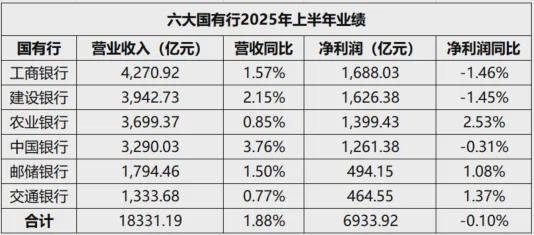
Core Insights - The six major state-owned banks in China reported mixed performance in their mid-year results for 2025, with total assets exceeding 200 trillion yuan and a combined net profit of 693.9 billion yuan, averaging a daily profit of 3.8 billion yuan [1][4]. Financial Performance - All six banks achieved revenue growth year-on-year, with China Bank leading at 3.76% and Construction Bank following at 2.15%, while net profit showed a "three up, three down" trend [2][3]. - Agricultural Bank recorded the highest net profit growth at 2.53%, while Industrial and Commercial Bank, Construction Bank, and China Bank experienced declines in net profit ranging from -1% to -2% [2][3]. Asset Quality and Risk Management - By the end of June 2025, the non-performing loan (NPL) ratio for the six banks decreased, with Postal Savings Bank being the only bank to see an increase, maintaining the lowest NPL ratio at 0.92% [9][10]. - The provision coverage ratio for non-performing loans varied, with China Bank's ratio falling below 200%, while Agricultural Bank maintained the highest at 295% [11][12]. Capital Adequacy and Dividends - The core Tier 1 capital adequacy ratio showed mixed results, with three banks increasing their ratios and three decreasing, while all banks maintained a ratio above 10% [12][13]. - The six banks proposed a total interim dividend of 204.66 billion yuan, with each bank distributing 30% of their net profit as cash dividends [12][14]. Interest Margin and Fee Income - The net interest margin continued to decline across the banks, with Postal Savings Bank having the highest margin at 1.7%, despite a year-on-year decrease [5][6]. - Fee and commission income showed growth for four banks, with Postal Savings Bank leading at an increase of 11.59%, while Industrial and Commercial Bank and Construction Bank saw declines [7].

港股午评|恒生指数早盘跌0.61% 内银股集体走高
智通财经网· 2025-09-02 04:05
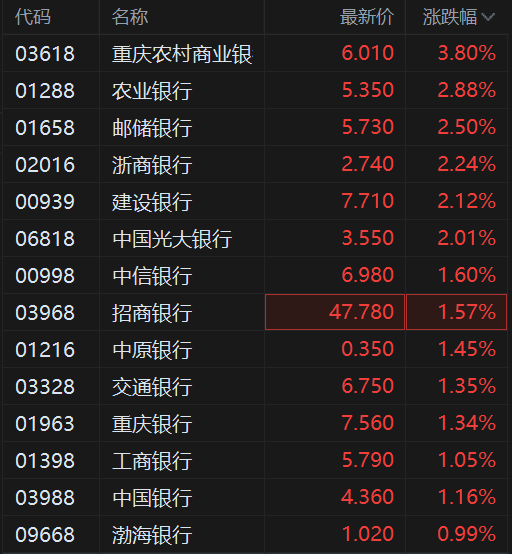
Group 1: Market Overview - The Hang Seng Index fell by 0.61%, down 157 points, closing at 25,460 points, while the Hang Seng Tech Index dropped by 1.78% [1] - The early trading volume in the Hong Kong stock market reached HKD 183.6 billion [1] Group 2: Banking Sector Performance - Chinese banks showed a significant recovery in performance for the first half of the year, attracting insurance capital inflows amid asset scarcity [1] - Chongqing Rural Commercial Bank rose by 4.15%, Agricultural Bank of China increased by 3.65%, and Postal Savings Bank of China gained 2.50% [1] Group 3: Notable Stock Movements - Haotian International Investment surged over 11% as its subsidiary plans to apply for virtual asset trading services [1] - Yunfeng Financial increased by over 8% following a strategic cooperation agreement with Ant Group and investment in Pharos blockchain [1] - China Nonferrous Mining rose over 4% due to rising copper prices improving mid-term performance [1] - Saint Noble Pharmaceutical-B saw a mid-day increase of over 10%, with a 91% year-on-year reduction in shareholder losses [1] - Hualing Pharmaceutical-B gained 2.67%, achieving its first profit in the first half of the year [1] Group 4: Declining Stocks - Chenming Paper Industry fell over 5% due to ongoing production line maintenance, reporting a loss exceeding CNY 3.8 billion for the first half [2] - ZTE Corporation dropped over 8% as its mid-term gross margin significantly declined, with analysts suggesting market optimism was excessive [2] - JS Global Life fell over 8%, reporting a shareholder loss of USD 5,924.2 million and a decrease in gross margin from third-party sales [3] - New Quality Digital plummeted over 11%, with its stock price halved in three trading days due to forced sale of shares by an executive [4]
港股异动丨内银股逆势上涨 农行涨近3% 浙商银行涨超2% 四大行上半年净利超千亿
Ge Long Hui· 2025-09-02 03:22
Core Viewpoint - Hong Kong banking stocks have risen against the trend, with several banks showing significant gains, indicating a positive market sentiment towards the banking sector amid stable financial performance [1] Group 1: Stock Performance - Agricultural Bank and Postal Savings Bank rose nearly 3%, while China Everbright Bank, China Construction Bank, and Zhejiang Commercial Bank increased over 2% [1] - Other banks such as CITIC Bank and China Merchants Bank saw a rise of 1.6%, with several others including Bank of Communications, Bank of China, and Industrial and Commercial Bank of China increasing by over 1% [1] Group 2: Financial Performance - As of the end of August, 42 listed banks have reported their semi-annual results, showing a steady increase in support for the real economy [1] - The 42 A-share listed banks achieved a total operating income exceeding 2.9 trillion yuan, representing a year-on-year growth of over 1% [1] - The net profit attributable to shareholders reached 1.1 trillion yuan, with a year-on-year increase of 0.8% [1] - Major banks such as ICBC, CCB, ABC, and BOC reported net profits exceeding 100 billion yuan, while the non-performing loan ratio for the six major commercial banks remained low [1]


港股异动 | 内银股集体走高 上半年银行业绩明显回暖 资产荒下板块有望持续吸引险资流入
Zhi Tong Cai Jing· 2025-09-02 03:21
Group 1 - The core viewpoint is that the banking sector in Hong Kong is experiencing a significant recovery in performance, with major banks showing positive growth in revenue and net profit for the first half of the year [1] - Major banks such as Chongqing Rural Commercial Bank, Agricultural Bank of China, Postal Savings Bank of China, and China Construction Bank have seen their stock prices rise, indicating investor confidence [1] - The overall operating income and net profit attributable to shareholders of listed banks have improved, with year-on-year growth rates shifting from negative in Q1 to positive in H1, specifically 1.0% and 0.8% respectively [1] Group 2 - The low interest rate environment is expected to continue the "asset shortage" phenomenon, leading insurance companies to seek stable, high-yield assets for long-term investment [2] - The banking sector offers an attractive dividend yield of approximately 4%, which is among the highest in the industry, making it appealing for insurance capital inflow [2] - With the implementation of new accounting standards for small and medium-sized insurance companies starting January 2026, there is potential for increased capital inflow into the banking sector [2]

六大行推出超2046亿元大手笔分红计划
Jin Rong Shi Bao· 2025-09-02 03:06
Core Viewpoint - The six major state-owned banks in China announced their mid-term dividend plans for 2025, with a total cash dividend amounting to 204.657 billion yuan, reflecting strong financial performance and a commitment to shareholder returns [1][2]. Group 1: Dividend Announcements - Industrial and Commercial Bank of China (ICBC) plans to distribute 1.414 yuan per share (including tax), totaling approximately 50.396 billion yuan, leading the dividend payouts among listed banks [1]. - Agricultural Bank of China, Bank of China, China Construction Bank, Bank of Communications, and Postal Savings Bank of China have proposed mid-term dividend amounts of 41.823 billion yuan, 35.25 billion yuan, 48.605 billion yuan, 13.811 billion yuan, and 14.772 billion yuan, respectively [1]. - Postal Savings Bank has maintained a stable dividend payout ratio of 30% since 2018, with cumulative dividends exceeding 170 billion yuan since its H-share listing [2]. Group 2: Market Performance and Investor Sentiment - The stock prices of listed banks have generally reached new highs this year, followed by some fluctuations. As of August 29, 2025, ICBC's stock has increased by 11.18%, while Agricultural Bank's stock has surged by 37.37% [3]. - Market sentiment has improved due to favorable policies, shifting investor preference from defensive sectors to growth sectors, indicating a potential for renewed interest in bank stocks [3][4]. - Experts believe that the stable dividend payout ratios around 30% reflect the banks' confidence in their profitability and capital adequacy, which is supported by a capital adequacy ratio above 13% for the six major banks [4]. Group 3: Implications for Future Investments - The high dividend payouts are seen as a strategy to attract long-term investments from insurance funds and pension funds, positioning bank stocks as scarce "safe-haven assets" in a low-interest-rate environment [4]. - The mid-term dividend plans are viewed as a response to policy guidance and a means to enhance investor confidence, which could positively impact stock prices [4].

六大行上半年经营业绩稳健
Jin Rong Shi Bao· 2025-09-02 03:06
Core Insights - The six major state-owned banks in China reported a combined net profit of 682.5 billion yuan for the first half of 2025, with total assets exceeding 214 trillion yuan as of June 30 [1][2] - The banks demonstrated steady growth in asset quality and capital adequacy, with non-performing loan ratios remaining low [4][6] Group 1: Financial Performance - The six banks collectively achieved over 1.8 trillion yuan in operating income, with core indicators such as annualized return on assets (ROA) and return on equity (ROE) showing positive trends [2] - Agricultural Bank, Postal Savings Bank, and Transportation Bank reported positive growth in both operating income and net profit, with net profit growth rates exceeding 1% [2] - Industrial and Commercial Bank achieved operating income of 409.08 billion yuan and net profit of 168.80 billion yuan, with ROA and ROE at 0.67% and 8.82% respectively [2] Group 2: Fee and Commission Income - China Bank and Construction Bank saw significant increases in fee and commission income, with China Bank's net fee income growing by 9.17% year-on-year [3] - Construction Bank reported operating income of 385.90 billion yuan, with net fee and commission income increasing by 4.02% [3] Group 3: Asset Quality - The non-performing loan ratios for the six banks remained low, with Industrial and Commercial Bank and Construction Bank both at 1.33%, showing a year-on-year decrease [4] - Capital adequacy ratios for the banks were robust, with Industrial and Commercial Bank at 19.54% and Agricultural Bank at 17.45% [4] Group 4: Risk Management - The banks have strengthened credit risk management, particularly in real estate and personal loan sectors, while also enhancing their risk control measures [5][6] - The provision coverage ratios were substantial, with Industrial and Commercial Bank at 217.71%, indicating strong risk absorption capacity [6] Group 5: Support for the Real Economy - The banks continued to support the real economy with reasonable credit allocation, focusing on key areas and sectors [7][8] - Agricultural Bank reported significant growth in loans for rural industries and construction, with balances of 2.70 trillion yuan and 2.44 trillion yuan respectively [7] - China Bank's loans for strategic emerging industries grew by 22.92%, while Construction Bank supported technology innovation with loans increasing by 16.81% [8]
六大行非息收入贡献提升 带动营收回暖
Jin Rong Shi Bao· 2025-09-02 03:06
Core Viewpoint - The performance of major state-owned banks in China showed improvement in the first half of 2025, with total operating income exceeding 1.8 trillion yuan and net profit reaching 682.5 billion yuan, indicating a positive trend in revenue growth [1] Group 1: Revenue Performance - The six major state-owned banks achieved a year-on-year increase in operating income, with non-interest income becoming increasingly significant in their revenue structure [1] - China Bank reported an operating income of 329 billion yuan, a year-on-year growth of 3.76%, with non-interest income growing by 26.43%, which was a key driver for its revenue increase [1] Group 2: Non-Interest Income Contributions - Non-interest income accounted for over 30% of total operating income, with contributions steadily increasing [2] - China Bank's non-interest income growth was attributed to wealth management, stable fee income, and financial market opportunities, with significant increases in various fee categories [2] - Construction Bank's non-interest net income reached 99.2 billion yuan, a year-on-year increase of 25.93%, with non-interest income making up 25.7% of total operating income [3] Group 3: Other Major Banks' Performance - Agricultural Bank's non-interest income grew by 12.1% to 87.3 billion yuan, with fee income increasing by 10.1% [4] - Postal Savings Bank's intermediary business income returned to double-digit growth at 11.59%, with significant contributions from non-interest income [4] - Industrial and Commercial Bank reported an operating income of 409.1 billion yuan, a 1.8% increase, with non-interest income contributing positively despite a slight decline in interest income [5]
邮储银行(601658):息差有望企稳,拨备维持高位
Tianfeng Securities· 2025-09-02 01:14
Investment Rating - The report maintains a "Buy" rating for Postal Savings Bank of China (601658) with a target price yet to be specified [9] Core Views - The bank's revenue shows signs of improvement, with a year-on-year increase of 1.50% in H1 2025, and a sequential growth acceleration of 1.57 percentage points from Q1 2025 [2][14] - Net interest margin is expected to stabilize, recorded at 1.7% in H1 2025, slightly down from Q1 2025 [2][16] - The bank's non-interest income has significantly increased, with net fee and commission income rising by 11.59% year-on-year [3][24] Financial Performance Summary - Revenue for H1 2025 reached approximately 1794.46 billion yuan, with net interest income at 1390.58 billion yuan, accounting for 77.49% of total revenue [2][14] - Non-interest income for H1 2025 was 403.88 billion yuan, showing a year-on-year growth of 19.09% [3][24] - The bank's total interest-earning assets amounted to 17.95 trillion yuan, a year-on-year increase of 10.83% [4][24] - The non-performing loan (NPL) ratio stood at 0.92%, with a provision coverage ratio of 260% [5][29] Asset and Liability Analysis - As of H1 2025, the bank's interest-bearing liabilities totaled 16.92 trillion yuan, reflecting a year-on-year growth of 10.59% [4][28] - The structure of liabilities shows that deposits accounted for 95.21% of total interest-bearing liabilities, with a year-on-year increase of 8.35% [4][28] - The bank's loan portfolio has seen significant growth, particularly in corporate loans, which increased by 18.62% year-on-year [24][25] Provisioning and Asset Quality - The bank maintains a high level of provisioning, with a loan provision rate of 2.39% and a coverage ratio of 260.4% [5][29] - The overall NPL rate for corporate loans improved to 0.49%, while retail loans saw a slight increase to 1.53% [30][31]

直击消费贷款贴息落地首日
财联社· 2025-09-01 23:54
Core Viewpoint - The implementation of the personal consumption loan interest subsidy policy aims to stimulate consumer spending and support the retail credit market, with banks actively participating in the program and developing systems to facilitate the process [1][2][6]. Group 1: Policy Implementation - The personal consumption loan interest subsidy policy officially started on September 1, with participating banks accepting applications for the subsidy [1]. - The subsidy covers consumption loans under 50,000 yuan and key areas such as home purchases, elderly care, and education [1]. - Different banks have varying operational details regarding application channels and eligibility criteria, including whether existing loans prior to September 1 qualify for the subsidy [1][5]. Group 2: Technical Integration - Banks are utilizing technology to streamline the subsidy process, with some institutions directly deducting the subsidy from loan interest payments [2][5]. - The maximum cumulative subsidy for each borrower is set at 3,000 yuan, corresponding to a total consumption amount of 300,000 yuan during the policy period [2]. Group 3: Market Impact - Bank executives express optimism about the positive impact of the subsidy policy on retail credit growth, with expectations of stable growth in personal consumption and business loans [6]. - The subsidy is anticipated to enhance the leverage effect of funds, potentially increasing the lending capacity of state-owned and joint-stock banks [6]. Group 4: Risk Considerations - Credit card installment plans are explicitly excluded from the subsidy program [7]. - Concerns regarding rising risks in retail credit are noted, with banks monitoring credit card risk as a leading indicator for overall retail credit risk [8]. - Banks have issued warnings against misuse of personal consumption loans, stating that violations may result in the denial or recovery of subsidies [8].