
PSBC(01658)

Search documents
2375亿!17家上市银行中期分红大手笔
Shen Zhen Shang Bao· 2025-09-01 16:41
Core Viewpoint - The listed banks in China have shown strong performance in the first half of the year and are preparing to reward investors with significant mid-term dividends, reflecting their profitability and commitment to shareholder returns [2][4]. Group 1: Dividend Distribution - Among the 42 listed banks in A-shares, nearly half will implement mid-term dividends for 2025, with 17 banks already disclosing their plans, totaling 237.54 billion yuan [2]. - The six major state-owned banks lead in dividend distribution, with Industrial and Commercial Bank of China (ICBC) at the forefront, distributing 50.396 billion yuan, followed by China Construction Bank and Agricultural Bank of China with 48.605 billion yuan and 41.823 billion yuan respectively [2]. - The total dividends from the six major state-owned banks account for 86% of the total dividends announced by the 17 banks [2]. Group 2: Specific Bank Plans - Among joint-stock banks, CITIC Bank, Minsheng Bank, Ping An Bank, and Huaxia Bank have announced their mid-term dividend plans, with CITIC Bank proposing a total of 10.461 billion yuan [3]. - In the city and rural commercial banks, seven banks have announced mid-term dividends, including Ningbo Bank and Shanghai Bank, with Shanghai Bank proposing a cash dividend of 3 yuan per 10 shares [3]. - Four banks have a dividend payout ratio exceeding 30%, including Shanghai Bank and Postal Savings Bank, indicating a strong commitment to returning value to shareholders [3]. Group 3: Market Implications - The expansion of banks implementing mid-term dividends and their willingness to distribute reflects the resilience of the banking sector's profitability and a positive response to shareholder return demands [4]. - This trend indicates improved cash flow and capital management capabilities among certain banks, which may help boost market confidence and attract long-term value investors [4].






邮储银行半年报:净息差1.70%行业领先,对公贷款增长15%
Cai Jing Wang· 2025-09-01 15:30
Core Viewpoint - Postal Savings Bank of China (PSBC) demonstrates strong financial performance with a net interest margin of 1.70% and a five-year average ROE of 11.26%, exceeding industry averages, indicating robust operational efficiency and growth potential [1][7]. Financial Performance - As of June 2025, PSBC's total assets reached 18.19 trillion yuan, a 6.47% increase from the previous year, while total liabilities grew by 6.21% to 17.05 trillion yuan [4]. - The bank reported operating income of 1794.46 billion yuan, a year-on-year increase of 1.50%, and net profit of 494.15 billion yuan, up 1.08% [1]. - Public loans increased by 5410.98 billion yuan, representing a growth of 14.83%, with a year-on-year increase of 2229.24 billion yuan [4]. Net Interest Margin - PSBC's net interest margin for the first half of 2025 was 1.70%, a decrease of 17 basis points from 2024, primarily due to one-time factors affecting loan yields [2]. - The bank's self-operated deposits increased by 1300 billion yuan year-on-year, with the interest rate on these deposits declining to approximately 1.1% [3]. Loan Growth and Quality - The bank's credit growth rate of 10.1% in the first half of 2025 outpaced the industry average of 7.1%, with a focus on maintaining a balanced approach to loan volume and pricing [5]. - The overall non-performing loan ratio stood at 0.49%, a decrease of 5 basis points from the previous year [5]. Strategic Initiatives - PSBC aims to enhance capital efficiency and diversify income sources, with non-interest income increasing by 10 percentage points over the past five years [7]. - The bank is implementing a centralized approval process for retail loans to improve risk management and operational efficiency [8]. Operational Efficiency - The bank has initiated ten projects to promote a modern, centralized operational model, with five already implemented nationwide, significantly reducing operational costs [9]. - The cost-to-income ratio decreased by 5.15% in the first half of 2025, reflecting improved management efficiency [9].

信银金投望“落子”广州,是否入局AIC银行仍存分歧
Feng Huang Wang· 2025-09-01 12:59
Core Viewpoint - The establishment of Asset Investment Companies (AIC) is gaining momentum among Chinese banks, with notable developments from banks like CITIC Bank and Postal Savings Bank, indicating a shift in the banking sector towards new investment opportunities and strategies [1][3][5]. Group 1: Developments in AIC Establishment - In March 2025, regulatory authorities announced further support for national banks to establish AICs, leading to responses from several banks including CITIC Bank and Industrial Bank [1]. - CITIC Bank announced plans to fully establish a financial asset investment subsidiary, receiving approval from the National Financial Supervision Administration for the establishment of Xinyin Financial Asset Investment Co., with a registered capital of RMB 10 billion [1]. - The headquarters of Xinyin Financial Asset Investment Co. is expected to be in Guangzhou, chosen for its significance in the Guangdong-Hong Kong-Macao Greater Bay Area and its vibrant tech enterprise ecosystem [1]. Group 2: Differing Attitudes Among Banks - There is a divide among banks regarding the establishment of AICs, with some banks like CITIC, Industrial, and China Merchants Bank officially moving forward, while others remain cautious and are observing the outcomes of these early adopters [3][4]. - Postal Savings Bank is actively pursuing the establishment of its own AIC, planning to invest RMB 10 billion, but has not yet received approval for its establishment [3][4]. Group 3: Market Sentiment and Challenges - The market generally views the expansion of AIC licenses from state-owned banks to joint-stock banks positively, anticipating new business opportunities distinct from traditional lending [5]. - Despite optimism, banks with existing AIC licenses are prioritizing stability and risk management, facing challenges such as limited exit channels for equity investments [5][6]. - The current IPO environment poses difficulties for banks seeking to realize returns on equity investments, leading to a cautious approach among smaller banks regarding AIC establishment [6].

详细拆解国有大型银行(六家)2025年中报:业绩增速改善,资产质量较优,资本实力夯实
ZHONGTAI SECURITIES· 2025-09-01 11:37
Investment Rating - The report maintains an "Overweight" rating for the banking sector [6] Core Insights - The overall performance of state-owned banks in the first half of 2025 shows improved revenue and profit growth, driven by significant increases in non-interest income and cost reductions. The net interest income growth has also shown a marginal upward trend [8][14] - The asset quality of state-owned banks remains strong, with non-performing loan ratios stable or declining, and the provision coverage ratio increasing, enhancing the banks' risk resilience [8][14] - The investment logic for bank stocks has shifted from "pro-cyclical" to "weak-cyclical," indicating that during periods of economic stagnation, high dividend yields from bank stocks will be attractive [8][14] Summary by Sections 1. Revenue and Profit Performance - In 1H25, the overall revenue of state-owned banks increased by 1.5% year-on-year, with a turnaround from negative to positive growth compared to the previous quarter [11][13] - The net profit for the same period decreased by 0.1% year-on-year, with the decline narrowing compared to the previous quarter [14][15] 2. Income Breakdown - Net interest income showed a year-on-year decline of 2.4%, while non-interest income grew by 15.5%, with both metrics improving quarter-on-quarter [18][19] - The growth in net interest income was supported by an increase in interest-earning assets, which rose by 10.4% year-on-year [18][19] 3. Asset Quality - The non-performing loan ratio remained stable at 1.27%, with a slight improvement in the attention loan ratio [8][14] - The provision coverage ratio increased by 1.04 percentage points to 237.50%, further enhancing the safety margin [8][14] 4. Other Financial Indicators - The cost-to-income ratio decreased year-on-year, while the capital adequacy ratio for major banks improved, indicating a solid capital position [8][14] - The report highlights two main investment themes: regional banks with strong advantages and high dividend yields from large banks [8][14]

【财经分析】国有六大行2025中报透视:营收破1.83万亿元,非息收入占比提升构筑新增长极
Zhong Guo Jin Rong Xin Xi Wang· 2025-09-01 10:59
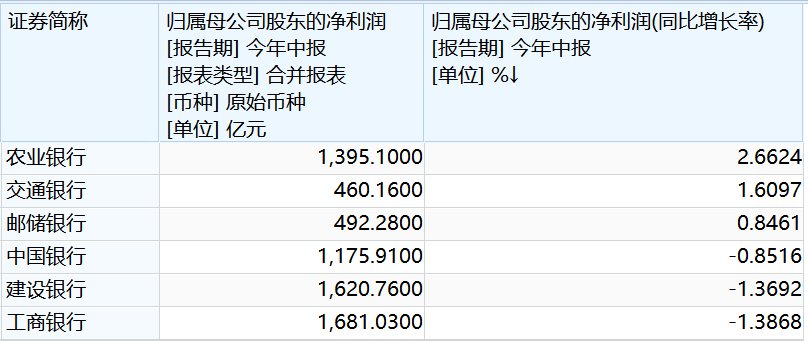
Core Insights - The six major state-owned banks in China demonstrated strong operational resilience amid the pressure of narrowing net interest margins, achieving a steady expansion in asset scale and a significant increase in non-interest income during the first half of 2025 [1][2]. Financial Performance - The total assets of the six banks increased, with Industrial and Commercial Bank of China (ICBC) leading at 52.32 trillion yuan, a 7.2% increase year-on-year [2]. - Agricultural Bank of China (ABC) followed with 46.86 trillion yuan, up 8.37%, and China Construction Bank (CCB) at 44.43 trillion yuan, up 9.52% [2]. - In terms of revenue, all six banks reported year-on-year growth, with China Bank leading at a 3.76% increase, while the others had growth rates ranging from 0.77% to 2.15% [3]. Profitability - Agricultural Bank of China reported the fastest profit growth with a net profit of 139.51 billion yuan, up 2.66% year-on-year [3][4]. - In contrast, ICBC, CCB, and China Bank experienced declines in net profit, with ICBC's net profit at 168.10 billion yuan, down 1.39% [3][4]. Asset Quality - The overall asset quality remained stable, with ICBC and CCB reporting a non-performing loan (NPL) ratio of 1.33%, a slight decrease from the previous year [7]. - Postal Savings Bank had the lowest NPL ratio at 0.92%, although it increased by 0.02 percentage points [7][8]. Non-Interest Income - The banks actively adjusted their business structures to enhance non-interest income, with significant growth observed across most banks [9][10]. - China Bank's non-interest income rose by 26.43% to 114.19 billion yuan, increasing its share of total revenue from 28.48% to 34.71% [9][10]. Future Outlook - The banks expressed cautious optimism regarding the future trajectory of net interest margins, with strategies in place to optimize asset-liability structures and enhance high-yield asset proportions [12][13]. - A total dividend plan exceeding 200 billion yuan was announced, reflecting confidence in future performance despite ongoing challenges [13].
美银证券:升邮储银行(01658)目标价至4.86港元 评级“跑输大市”
智通财经网· 2025-09-01 08:33
美银证券发布研报称,邮储银行(01658,601658.SH)上半年净利润同比增长0.8%,较该行预期低0.9%。 拨备前利润同比增长14.6%,高于首季的6.2%,较预期高出8.3%,主要得益于员工成本同比下降7%。 股东权益回报率(ROE)同比下跌1.5个百分点至9.5%。一级资本充足率按季升131个基点至10.52%,因有 注资支持。受股权稀释影响,中期股息同比跌16.7%至0.123元人民币。该行微调2025至27年盈利预测, 分别下调1%至上调4%;目标价上调4%,H股目标价升至4.86港元,维持"跑输大市"评级;A股目标价升至 5.86元人民币,维持"中性"评级。 ...
美银证券:升邮储银行目标价至4.86港元 评级“跑输大市”
Zhi Tong Cai Jing· 2025-09-01 08:29
美银证券发布研报称,邮储银行(601658)(01658,601658.SH)上半年净利润同比增长0.8%,较该行预 期低0.9%。拨备前利润同比增长14.6%,高于首季的6.2%,较预期高出8.3%,主要得益于员工成本同比 下降7%。股东权益回报率(ROE)同比下跌1.5个百分点至9.5%。一级资本充足率按季升131个基点至 10.52%,因有注资支持。受股权稀释影响,中期股息同比跌16.7%至0.123元人民币。该行微调2025至27 年盈利预测,分别下调1%至上调4%;目标价上调4%,H股目标价升至4.86港元,维持"跑输大市"评级;A 股目标价升至5.86元人民币,维持"中性"评级。 ...
大行评级|美银:上调邮储银行AH股目标价 微调2025至27年盈利预测
Ge Long Hui· 2025-09-01 08:07
Core Viewpoint - Bank of America Securities reports that Postal Savings Bank's net profit for the first half of the year grew by 0.8% year-on-year, which is 0.9% lower than the bank's expectations [1] Financial Performance - Pre-provision profit increased by 14.6% year-on-year, surpassing the first quarter's growth of 6.2% and exceeding expectations by 8.3%, primarily due to a 7% year-on-year decrease in employee costs [1] - Return on equity (ROE) declined by 1.5 percentage points to 9.5% year-on-year [1] - The Tier 1 capital adequacy ratio increased by 131 basis points quarter-on-quarter to 10.52%, supported by capital injections [1] Dividend and Stock Price Adjustments - Due to equity dilution, the interim dividend decreased by 16.7% year-on-year to 0.123 yuan [1] - The bank has adjusted its earnings forecasts for 2025 to 2027, with a downward revision of 1% and an upward revision of 4% [1] - The target price for H-shares has been raised to 4.86 HKD, maintaining an "underperform" rating, while the target price for A-shares has been increased to 5.86 yuan, maintaining a "neutral" rating [1]
今年上半年邮储银行营收、净利润均实现正增长
Xin Lang Cai Jing· 2025-09-01 05:57
(来源:经济日报) 转自:经济日报 "今年上半年,邮储银行实现营业收入1795.25亿元,同比增长1.47%,归母净利润492.28亿元,同比增 长0.85%,双双实现正增长。"中国邮政储蓄银行行长刘建军8月29日在该行2025年中期业绩发布会上表 示,与此同时,该行总资产、总负债均站上新台阶,分别突破18万亿元、17万亿元。 "成绩背后,是我们转型发展呈现出的韧性与活力,通过持续精耕细作,整体上实现了结构优化、均衡 稳健、风险可控、资本充足的高质量发展。"刘建军说。 具体来看,一是收入结构持续优化。在利息净收入方面,面对LPR(贷款市场报价利率)、存量房贷利 率下调的持续影响,邮储银行通过信贷规模增长和结构优化,以及负债成本管控,改善了利息净收入表 现,其中,公司贷款利息收入实现逆势正增,上半年同比增速达2.08%。在中间收入方面,该行夯实零 售中收的压舱石地位,发挥公司、资金板块中收的强补位作用,在"报行合一"后重回两位数增长,同比 增速达11.59%,在营收中的占比提高0.85个百分点。"特别值得一提的是,我们持续推进能力建设,银 团贷款、财务顾问、债券承销等方面均取得了突破式发展,公司板块中收同比增速 ...
邮储银行 总资产突破18万亿元
Jin Rong Shi Bao· 2025-09-01 01:59
Core Insights - Postal Savings Bank of China reported total assets of 18.19 trillion yuan as of June 30, 2025, a year-on-year increase of 6.47% [1] - Total liabilities reached 17.05 trillion yuan, up 6.21% from the end of the previous year [1] - Operating income was 179.446 billion yuan, reflecting a 1.50% year-on-year growth [1] - Net profit stood at 49.415 billion yuan, an increase of 1.08% compared to the previous year [1] Financial Performance - The bank's net interest margin was 1.70%, maintaining a leading position in the industry [1] - Total customer loans amounted to 9.54 trillion yuan, a growth of 6.99% year-on-year [1] - Customer deposits reached 16.11 trillion yuan, increasing by 5.37% from the previous year [1] Revenue Breakdown - Interest income contributed 139.058 billion yuan to the total operating income [1] - Non-interest income showed significant growth, with intermediary business income at 16.918 billion yuan, up 11.59% [1] - Other non-interest income was 23.470 billion yuan, reflecting a 25.16% increase [1] - The proportion of intermediary and other non-interest income in total operating income increased by 0.85 and 2.47 percentage points, respectively [1] Capital and Risk Management - Capital adequacy ratio was 14.57%, and core tier 1 capital adequacy ratio was 10.52%, both showing improvements from the previous year [2] - Non-performing loan ratio remained low at 0.92%, indicating strong asset quality [2] - Provision coverage ratio was 260.35%, demonstrating sufficient risk mitigation capacity [2]