PSBC(01658)

Search documents
邮储银行获中国平安增持1433.6万股
Ge Long Hui· 2025-09-01 00:12
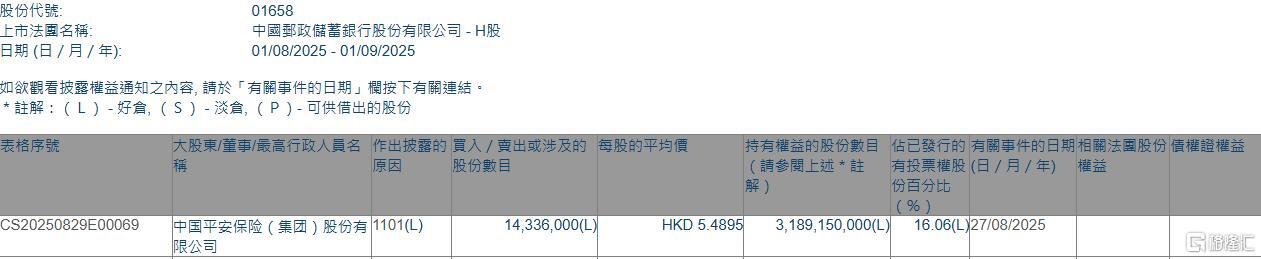
格隆汇9月1日丨根据联交所最新权益披露资料显示,2025年8月27日,邮储银行(01658.HK)获中国平安保险(集团)股份有限公司在场内以每股均价5.4895 港元增持1433.6万股,涉资约7869.75万港元。 | 股份代號: | 01658 | | --- | --- | | 上市法國名稱: | 中國郵政儲蓄銀行股份有限公司 - H股 | | 日期 (日 / 月 / 年): | 01/08/2025 - 01/09/2025 | | 表格序號 | 大股東/董事/最高行政人員名 作出披露的 買入 / 費出或涉及的 每股的平均價 | | | 持有權益的股份數目 佔已發行的 有關事件的日期相關 | | --- | --- | --- | --- | --- | | | 原因 | 股份數目 | 描、炭上配的照。 | 有投票權股(日 / 月 / 年) 權 | | | | | | 份自分比 | | | | | | 96 1 | | CS20250829E00069 | 中国平安保险(集团)股份有 1101(L) 14,336,000(L) | | HKD 5.4895 | 3,189,150,000(L) 16. ...



金融中报观|超17家银行将派发2375亿“红包”,国有大行成绝对主力
Bei Jing Shang Bao· 2025-08-31 13:55
Core Viewpoint - The mid-term profit distribution plans of listed banks in A-shares for 2025 are gradually being revealed, with a total mid-term dividend amount reaching 237.54 billion yuan, indicating a clear differentiation in the dividend distribution landscape among banks [1][3][4]. Group 1: Dividend Distribution Overview - Among 42 listed banks, 17 have announced their mid-term dividend plans for 2025, with state-owned banks leading the distribution [3][4]. - The six major state-owned banks have a combined dividend amount of 204.66 billion yuan, accounting for 86% of the total mid-term dividends announced by the 17 banks [3][4]. - Industrial and Commercial Bank of China leads with a dividend of 50.40 billion yuan, followed by China Construction Bank and Agricultural Bank of China with 48.61 billion yuan and 41.82 billion yuan respectively [3][4]. Group 2: Factors Influencing Dividend Decisions - The ability of state-owned banks to distribute dividends is supported by their strong capital strength, stable profitability, and ample cash flow, allowing them to actively pursue dividend plans [4][9]. - The dividend decisions of banks are influenced by a combination of capital adequacy ratios, business expansion needs, regulatory requirements, and shareholder return expectations [1][8]. - Some banks, such as China Merchants Bank and Nanjing Bank, are in the process of finalizing their mid-term dividend plans, while others like Shanghai Pudong Development Bank and Zhengzhou Bank have explicitly stated they will not distribute dividends for the first half of 2025 [6][7]. Group 3: Emerging Trends and Future Outlook - The new "National Nine Articles" policy encourages listed companies to increase dividend distributions, leading to a noticeable rise in mid-term and quarterly dividends among listed banks [3][4]. - Smaller banks are showing a clear divide in their dividend policies, with some opting not to distribute dividends due to performance pressures and urgent capital replenishment needs [7][8]. - The balance between short-term investor returns and long-term operational stability is crucial for banks when deciding on dividend distributions, with a focus on maintaining adequate capital for future growth [9].




拆解大行半年报:息差降幅边际收窄,非息收入贡献大增
Di Yi Cai Jing· 2025-08-31 11:29
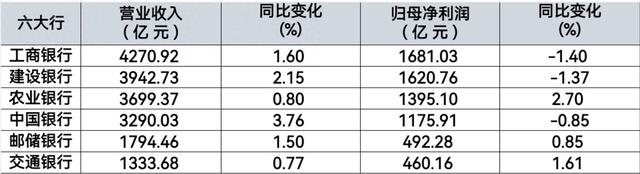
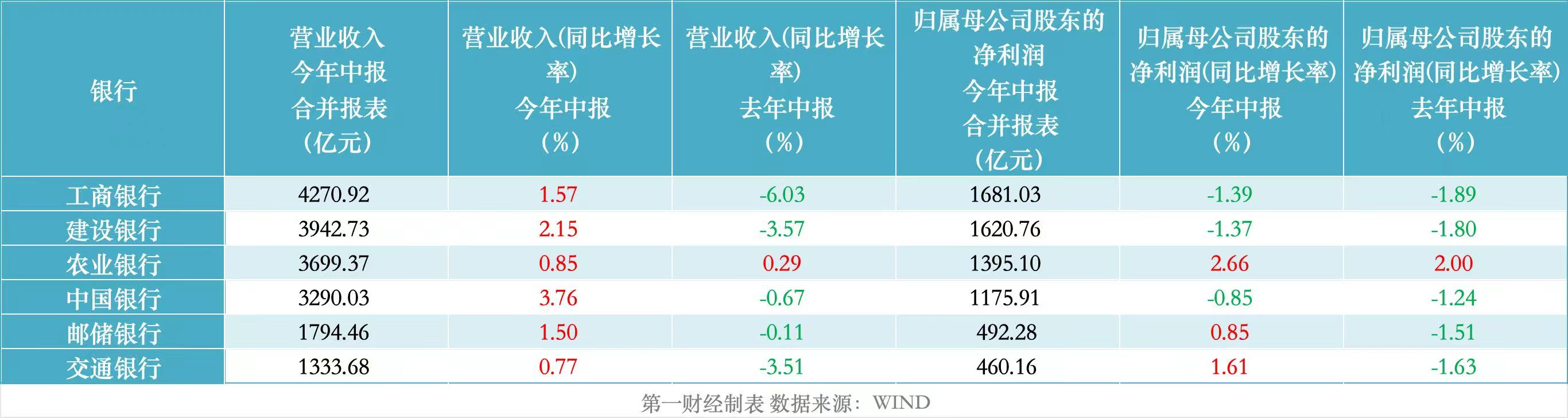
Core Viewpoint - The performance of major state-owned banks in China has shown signs of improvement in the first half of the year, with a notable increase in investment income and non-interest income, despite ongoing pressure on net interest margins [1][2]. Group 1: Financial Performance - The six major banks reported a total operating income of 1.83 trillion yuan, a slight increase from approximately 1.8 trillion yuan in the same period last year [1]. - The net profit attributable to shareholders reached 682.52 billion yuan, compared to about 683.39 billion yuan in the previous year, indicating mixed results with three banks showing positive growth and three negative [1][2]. - The operating income of all six banks experienced year-on-year growth, with China Bank leading at 3.76%, followed by Construction Bank at 2.15% and Industrial and Commercial Bank at 1.57% [2][3]. Group 2: Interest Income and Net Interest Margin - The net interest income for the six banks totaled 1.32 trillion yuan, reflecting a decline of approximately 2% compared to the previous year [3][4]. - The decline in interest income is primarily attributed to a decrease in loan yields, which outweighed the positive impact of lower deposit interest rates [4]. - The net interest margin continued to decline, with five banks experiencing a drop of over 10 basis points compared to the previous year, although the rate of decline has shown signs of slowing [12][13]. Group 3: Provisioning and Impairment Losses - The total provision for impairment losses across the six banks was approximately 422.7 billion yuan, an increase of about 22 billion yuan year-on-year [5][6]. - Notably, Construction Bank and Postal Savings Bank increased their provisioning efforts significantly, with year-on-year increases of 22.85% and 34.62%, respectively [5][7]. Group 4: Investment Income and Non-Interest Income - Investment income has become a key support factor for bank performance, with significant growth in bond investment income, although this was partially offset by declining bond market yields [8][10]. - Non-interest income, particularly from investment gains, saw substantial increases, with some banks reporting growth rates exceeding 50% [9][10]. - The recovery in fee and commission income was also notable, with four banks reporting positive year-on-year growth, particularly Postal Savings Bank and Agricultural Bank, which both exceeded 10% [11]. Group 5: Outlook on Net Interest Margin - Management from various banks expressed optimism regarding the stabilization of net interest margins in the second half of the year, despite ongoing downward pressures from market conditions [12][14]. - Factors such as the adjustment of loan pricing and the gradual impact of deposit rate reductions are expected to contribute to a narrowing of the decline in net interest margins [15].
邮储银行中期业绩会:挖掘“市场缝隙” 有信心保持优秀息差水平
Zheng Quan Ri Bao Zhi Sheng· 2025-08-31 10:42
Core Viewpoint - Postal Savings Bank of China (PSBC) is focusing on maintaining a balanced approach to credit issuance while enhancing its profitability and risk management strategies, alongside a commitment to stable dividend policies and innovative financial services [1][2][3][4][5][6]. Group 1: Financial Performance - In the first half of the year, PSBC's deposits exceeded 16 trillion yuan, reaching 16.11 trillion yuan, a growth of 5.37%, with corporate deposits increasing by 229.62 billion yuan, or 13.86% [3]. - The bank's net interest margin stood at 1.70%, maintaining a leading position in the industry [3]. - PSBC's credit growth rate was 10.1%, outperforming the industry average of 7.1%, attributed to enhanced service capabilities and targeted marketing strategies [3]. Group 2: Risk Management and Credit Strategy - The bank emphasizes a balanced approach to credit issuance, focusing on both quantity and quality, while addressing challenges in retail loans through improved risk control standards [4]. - PSBC has halted high-interest auto loan products, prioritizing risk-adjusted returns on capital (RAROC) for various loan types [4]. - The bank is leveraging its strengths in county markets to support local industries and agricultural enterprises [3]. Group 3: Dividend Policy - PSBC has maintained a stable dividend payout ratio of 30% since 2018, with total dividends exceeding 170 billion yuan since its H-share listing [5]. - For the current year, the bank plans to distribute a mid-year dividend of 14.772 billion yuan (including tax), with a commitment to a sustainable dividend policy [5]. Group 4: Consumer Loan Services - The introduction of a fiscal subsidy policy for personal consumption loans is expected to positively impact the bank's consumer loan business, reducing credit costs for residents [6]. - PSBC is enhancing its operational capabilities to provide rapid loan approvals, aiming to meet real housing loan demands and expand its consumer loan offerings [7]. - The bank plans to focus on high-potential urban areas and quality channels for housing loans while improving customer acquisition for non-housing consumer loans [7].

邮储银行(601658):2025年中报点评:注资落地和代理费率调整注入活力
Guotou Securities· 2025-08-31 07:32
Investment Rating - The investment rating for Postal Savings Bank is "Buy-A" with a target price of 7.03 CNY for the next six months [7]. Core Views - The report highlights that the bank's performance in the first half of 2025 showed a revenue growth of 1.50% year-on-year, with a pre-provision profit growth of 14.62% and a net profit growth of 0.85%. The growth was supported by cost reduction and expansion of interest-earning assets, although tax increases and narrowing net interest margins posed challenges [2][14]. - The bank's total assets grew by 10.83% year-on-year, with a significant increase in loans, particularly in corporate lending, which grew by 17.74% year-on-year. Retail lending showed resilience, primarily driven by small personal loans [3][4][12]. - The bank's net non-interest income increased by 23.83% year-on-year, driven by a significant rise in fees and commissions, as well as investment income [13]. Summary by Sections Financial Performance - In the first half of 2025, the bank's total assets increased by 10.83% year-on-year, with a net increase of 501.1 billion CNY in total assets [2]. - The bank's net interest margin for the first half of 2025 was 1.70%, showing a decline of 21 basis points year-on-year, but remained competitive within the industry [12]. - The bank's non-performing loan ratio was 0.92% at the end of the first half of 2025, indicating stable asset quality [14]. Loan and Deposit Growth - Corporate loans increased by 17.74% year-on-year, with significant contributions from general corporate loans and infrastructure projects [3]. - Retail loans grew by 3.69% year-on-year, with a focus on rural revitalization and support for small businesses [3][4]. - Total liabilities grew by 10.66% year-on-year, with deposits increasing by 8.37% [4]. Cost and Income Structure - The cost-to-income ratio improved to 52.76%, a decrease of 7.79 percentage points year-on-year, reflecting better operational efficiency [13]. - The bank's interest-earning asset yield was 2.95%, with a slight decline, but showed resilience due to effective credit management [12]. Capital and Future Outlook - The bank successfully completed a 130 billion CNY capital increase, alleviating capital constraints and allowing for further asset expansion [13]. - The report forecasts a revenue growth of 1.43% and a net profit growth of 2.65% for 2025, supported by strategic lending and cost management initiatives [14].
邮储银行(601658):非息收入贡献增强,营收盈利增速双升
EBSCN· 2025-08-31 03:40
Investment Rating - The report maintains a "Buy" rating for both A-shares and H-shares of Postal Savings Bank, with current prices at 6.04 CNY and 5.41 HKD respectively [1]. Core Insights - The report highlights an increase in non-interest income contribution, with total revenue and net profit growth observed in the first half of 2025. Total revenue reached 179.4 billion CNY, a year-on-year increase of 1.5%, while net profit attributable to shareholders was 49.2 billion CNY, up 0.9% year-on-year [3][4]. Revenue and Profitability - Revenue growth improved sequentially, with non-interest income's share rising to 22.5%. The year-on-year growth rates for revenue, pre-provision operating profit (PPOP), and net profit attributable to shareholders were 1.5%, 14.6%, and 0.9% respectively, showing improvements from the first quarter [4]. - Interest income decreased by 2.7% year-on-year, while non-interest income grew by 19.1%, indicating a shift towards more diversified income sources [4][9]. Loan and Asset Management - As of the end of Q2, the bank's interest-earning assets and loans grew by 10.7% and 10.1% year-on-year, respectively, with a notable increase in loan issuance [5]. - The loan structure showed significant growth in corporate loans, particularly in sectors like water conservancy and public facilities, which accounted for 19.1% of the total increase [6]. Liability and Deposit Management - The growth rate of interest-bearing liabilities increased to 10.6%, with total deposits growing by 8.4% year-on-year. The bank has optimized its deposit management strategy to enhance low-cost funding [7]. Interest Margin and Cost Management - The net interest margin slightly narrowed to 1.7%, with asset yields declining due to lower interest rates on new loans and existing loan repricing [8]. - The bank's proactive cost management strategies have led to a reduction in funding costs, benefiting from lower deposit rates [8]. Non-Interest Income Growth - Non-interest income saw a substantial increase of 19.1% year-on-year, driven by growth in fees and commissions as well as other non-interest income sources [9]. Asset Quality - The non-performing loan (NPL) ratio remained low at 0.92%, with a slight increase from the previous quarter. The bank's asset quality indicators, including the NPL generation rate, showed stability [10][29]. Capital Adequacy - The bank successfully completed a 130 billion CNY A-share placement, enhancing its capital base. As of Q2, the core Tier 1 capital adequacy ratio improved to 10.52% [11]. Earnings Forecast and Valuation - The report maintains earnings per share (EPS) forecasts for 2025-2027 at 0.74, 0.75, and 0.78 CNY, with corresponding price-to-book (PB) ratios for A-shares at 0.79, 0.74, and 0.70 [12][33].
突发!胡塞武装行政机构负责人被以军打死;上海多家银行新增房贷利率不再区分首套、二套;刘强东现身“苏超”现场观赛丨每经早参
Mei Ri Jing Ji Xin Wen· 2025-08-31 01:10
Group 1 - The Houthis announced the death of their administrative head, Ahmed Rahawi, due to an Israeli airstrike in Sana'a, Yemen on August 28 [2][9] - Israeli Defense Minister confirmed the airstrike targeting Houthi officials [2][9] - The airstrike is part of ongoing military actions in the region, with Israel also targeting Hamas personnel in Gaza [9] Group 2 - Multiple banks in Shanghai have adjusted their housing loan interest rate mechanisms following the "825 New Policy," no longer distinguishing between first and second homes [7] - The specific interest rates for housing loans will now be determined based on the Shanghai market interest rate pricing self-discipline mechanism and other factors [7] Group 3 - The Chinese Ministry of Commerce held discussions with U.S. officials regarding U.S.-China trade relations and emphasized the need for mutual respect and cooperation [4] - The Ministry expressed opposition to the U.S. decision to revoke the "validated end-user" status of three semiconductor companies in China, citing potential negative impacts on the global semiconductor supply chain [5] Group 4 - Central Huijin increased its holdings in 12 ETF products, spending over 210 billion yuan, indicating strong confidence in the market [10] - The six major state-owned banks in China announced a total cash dividend of approximately 204.66 billion yuan for the first half of 2025, reflecting their robust financial health [11] Group 5 - Huawei's executive revealed details about its collaboration with SAIC Motor, emphasizing trust and commitment despite resource constraints [12] - Huawei's rotating chairman discussed the current state of the HarmonyOS ecosystem, highlighting its ongoing development and the need for broader participation from developers and manufacturers [14] Group 6 - Ping An Life has increased its stake in Agricultural Bank of China, marking its third acquisition of shares within a year, indicating confidence in the bank's future [15]


260万银行人,半年平均薪酬“曝光”,5家月薪超4.5万
中国基金报· 2025-08-30 12:39
Core Viewpoint - The average salary of bank employees in China has slightly increased in the first half of 2025 compared to the same period in 2024, with a notable number of banks experiencing salary increases while others saw declines [2][4]. Salary Overview - The average salary for 2.6 million bank employees in the first half of 2025 is approximately 181,000 yuan, translating to an average monthly salary of 30,200 yuan, which is an increase of about 1,300 yuan from the previous year [5]. - The average salary for the first half of 2024 was lower, with a decrease of over 5,000 yuan compared to the first half of 2023 [4]. Leading Banks in Salary - Joint-stock banks and city commercial banks lead in average salary levels, with several banks reporting average monthly salaries exceeding 45,000 yuan in the first half of 2025 [3]. - Specific banks with high average monthly salaries include: - China Merchants Bank: 50,500 yuan - Nanjing Bank: 48,200 yuan - Ningbo Bank: 45,400 yuan - Industrial Bank: 45,400 yuan - Beijing Bank: 45,200 yuan [5][6]. State-Owned Banks Salary Comparison - Among the six major state-owned banks, the average monthly salaries are significantly lower, with: - Bank of China: 28,200 yuan - Bank of Communications: 27,500 yuan - Industrial and Commercial Bank of China: 26,300 yuan - China Construction Bank: 26,200 yuan - Agricultural Bank of China: 25,200 yuan - Postal Savings Bank: 24,900 yuan [7][8]. Salary Policy Trends - Major state-owned banks are focusing on salary policies that favor grassroots employees, aiming to enhance talent development in county-level branches and improve employee engagement [10][11].




国有大行“期中考”答卷: 扩规模、稳息差、向中间收入要效益
经济观察报· 2025-08-30 12:17
Core Viewpoint - The six major state-owned banks in China reported growth in asset scale but showed a divergence in operational indicators, with three banks experiencing a decline in net profit [2][7]. Group 1: Asset Scale Growth - All six major state-owned banks demonstrated growth in asset scale, with specific figures indicating significant increases: - Industrial and Commercial Bank of China (ICBC) reached total assets of 52.32 trillion yuan, up 7.2% from the previous year [5]. - Agricultural Bank of China (ABC) reported total assets of 46.86 trillion yuan, an increase of 8.37% [5]. - China Construction Bank (CCB) had total assets of 44.43 trillion yuan, growing by 9.52% [5]. - Bank of China (BOC) reached total assets of 36.79 trillion yuan, up 4.93% [6]. - Postal Savings Bank of China (PSBC) reported total assets of 18.19 trillion yuan, increasing by 6.47% [6]. - Bank of Communications (BoCom) had total assets of 15.44 trillion yuan, a growth of 3.59% [6]. Group 2: Operational Performance Divergence - The operational performance of the six banks varied, with ABC, BoCom, and PSBC achieving positive growth in both operating income and net profit: - ABC's operating income was 3699.37 billion yuan, up 0.85%, with a net profit of 1399.43 billion yuan, growing by 2.53% [9]. - BoCom's operating income reached 1333.68 billion yuan, increasing by 0.77%, and net profit was 460.16 billion yuan, up 1.61% [10]. - PSBC reported operating income of 1794.46 billion yuan, a 1.50% increase, and net profit of 494.15 billion yuan, growing by 1.08% [11]. - In contrast, ICBC, BOC, and CCB saw declines in net profit despite positive growth in operating income: - ICBC's operating income was 4270.92 billion yuan, up 1.6%, but net profit fell by 1.5% to 1688.03 billion yuan [12]. - CCB reported operating income of 3942.73 billion yuan, a 2.15% increase, while net profit decreased by 1.45% to 1626.38 billion yuan [12]. - BOC's operating income was 3290.03 billion yuan, up 3.76%, but net profit declined by 0.31% to 1261.38 billion yuan [12]. Group 3: Net Interest Margin Pressure - The net interest margin (NIM) for the major banks remained under pressure, with specific figures indicating declines: - ICBC's NIM was 1.30%, down 13 basis points year-on-year [15]. - CCB's NIM was 1.40%, down 14 basis points [15]. - ABC's NIM was 1.32%, down 13 basis points [15]. - BOC's NIM was 1.26%, down 18 basis points [15]. - PSBC's NIM was 1.70%, down 21 basis points [15]. - BoCom's NIM was 1.21%, down 8 basis points [15]. Group 4: Non-Interest Income Growth - In response to the pressure on interest income, several banks have shifted focus to non-interest income: - BOC's non-interest income accounted for over one-third of its operating income, with a growth of over 70% in non-interest income from overseas institutions [19]. - BOC's non-interest income was 1141.87 billion yuan, up 26.43%, increasing its share of operating income from 28.48% to 34.71% [20]. - ICBC's non-interest income was 1135.16 billion yuan, growing by 6.5%, with its share of operating income rising from 25.34% to 26.58% [21]. - ABC's non-interest income totaled 874.64 billion yuan, up 15.1%, increasing its share from 20.71% to 23.64% [22]. - CCB's non-interest income was 1075.64 billion yuan, a 19.64% increase, raising its share to 27.28% [22]. - PSBC's non-interest income reached 403.88 billion yuan, growing by 19.09%, with its share increasing from 19.18% to 22.51% [23].

国有六大行上半年净利润合计6825亿元,资产质量稳中向好
Guan Cha Zhe Wang· 2025-08-30 11:41
Core Viewpoint - The six major state-owned banks in China reported a total net profit of 682.52 billion yuan for the first half of 2025, with asset quality showing improvement and a decrease in non-performing loan ratios for five banks compared to the end of 2024 [1][5]. Financial Performance - Industrial and Commercial Bank of China (ICBC) led with a net profit of 168.10 billion yuan, a year-on-year decrease of 1.4% [2][3]. - China Construction Bank (CCB) followed with a net profit of 162.08 billion yuan, down 1.37% year-on-year [2][3]. - Agricultural Bank of China (ABC) achieved a net profit of 139.51 billion yuan, marking a 2.70% increase, the highest growth among the six banks [2][3]. - Bank of China (BOC) reported a net profit of 117.59 billion yuan, down 0.85% year-on-year [2][3]. - Postal Savings Bank of China (PSBC) and Bank of Communications (BoCom) recorded net profits of 49.23 billion yuan and 46.02 billion yuan, with increases of 0.85% and 1.61% respectively [2][3]. Revenue and Asset Growth - ICBC also led in revenue with 427.09 billion yuan, a 1.6% year-on-year increase [2][3]. - CCB's revenue was 394.27 billion yuan, up 2.15% year-on-year [2][3]. - ABC's revenue slightly increased by 0.8% to 369.94 billion yuan [2][3]. - BOC's revenue reached 329.00 billion yuan, a 3.76% increase [2][3]. - The asset scale of ICBC grew by 7.20% to 52.32 trillion yuan, maintaining its top position [4]. Non-Interest Income and Net Interest Margin - The banks faced a common challenge of narrowing net interest margins, with CCB's net interest income decreasing by 3.16% [4]. - To counteract margin pressure, banks increased non-interest income through fees and commissions, with ICBC's non-interest income growing by 6.5% [4]. Asset Quality - The overall asset quality of the six banks showed improvement, with five banks reporting a decrease in non-performing loan ratios compared to the end of 2024 [5]. - Agricultural Bank and PSBC had high provision coverage ratios of 295.00% and 260.35% respectively, indicating strong risk resistance capabilities [5]. Dividend Plans - All six banks plan to implement mid-term cash dividends, with a total payout exceeding 200 billion yuan [6]. Strategic Focus - The banks are focusing on five key areas: technology finance, green finance, inclusive finance, pension finance, and digital finance, enhancing their service to the real economy [7][10]. - ICBC's technology loan balance exceeded 6 trillion yuan, with significant growth in green and inclusive loans [7][8].