
PSBC(01658)

Search documents
邮储银行12月18日获融资买入7267.09万元,融资余额10.94亿元
Xin Lang Cai Jing· 2025-12-19 03:25
Group 1 - Postal Savings Bank of China (PSBC) experienced a stock price increase of 1.12% on December 18, with a trading volume of 679 million yuan [1] - On the same day, PSBC had a financing buy-in amount of 72.67 million yuan and a financing repayment of 64.95 million yuan, resulting in a net financing buy of 0.77 million yuan [1] - As of December 18, the total financing and securities lending balance for PSBC was 1.099 billion yuan, with the financing balance accounting for 0.30% of the circulating market value, indicating a high level compared to the past year [1] Group 2 - PSBC was established on March 6, 2007, and listed on December 10, 2019, providing banking and related financial services in China [2] - The bank's main business segments include personal banking (65.15% of revenue), corporate banking (22.71%), and funding operations (12.10%) [2] - As of September 30, PSBC had 142,600 shareholders, a decrease of 13.09% from the previous period, while the average circulating shares per person increased by 15.29% [3] Group 3 - For the period from January to September 2025, PSBC reported operating revenue of 265.08 billion yuan, a year-on-year increase of 1.82%, and a net profit attributable to shareholders of 76.56 billion yuan, up 0.98% year-on-year [3] - Since its A-share listing, PSBC has distributed a total of 137.80 billion yuan in dividends, with 77.40 billion yuan distributed over the past three years [4] - As of September 30, 2025, major shareholders of PSBC included Hong Kong Central Clearing Limited and various ETFs, with notable decreases in their holdings compared to the previous period [4]

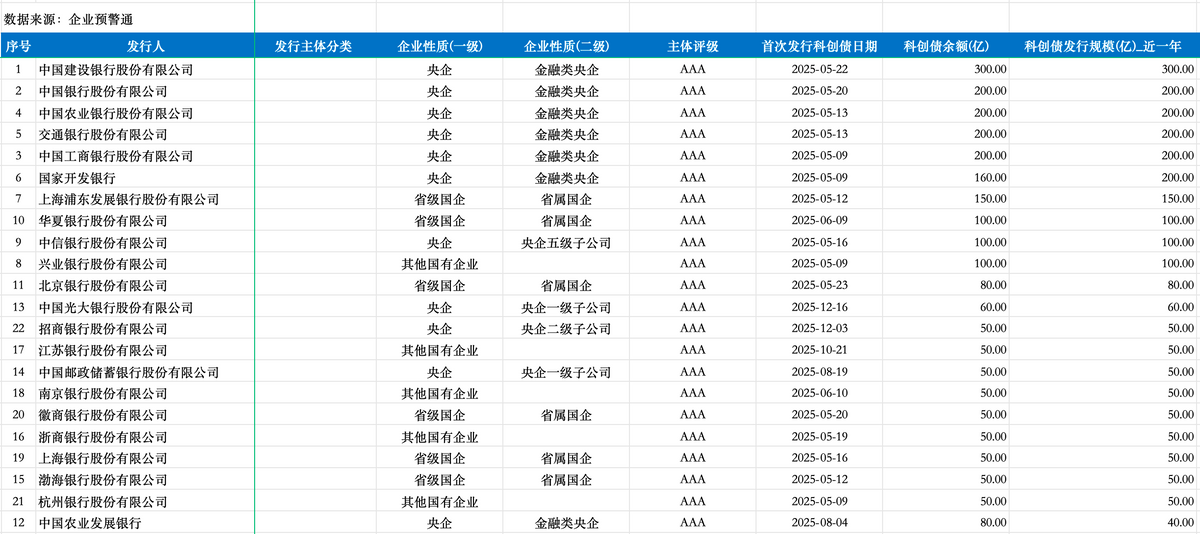
银行科创债破3000亿元,六大国有行占比超 38%,部分城农商行利率破2%
Tai Mei Ti A P P· 2025-12-19 01:13
Core Viewpoint - The issuance of technology innovation bonds by banks has significantly increased since the announcement by the central bank and the China Securities Regulatory Commission on May 7, with a total issuance scale reaching 301.4 billion yuan by December 18, 2023 [1][2]. Issuance Scale - A total of 67 banks have issued 75 technology innovation bonds, with state-owned banks being the primary issuers, accounting for 38.16% of the total issuance [1][3]. - The six major state-owned banks have collectively issued bonds worth 115 billion yuan, while city commercial banks and rural commercial banks have issued 74.9 billion yuan and 15 billion yuan, respectively [1][5]. - The issuance period is mainly concentrated in 5-year bonds, followed by 3-year bonds, with a small number of 6-month and 7-year bonds [1][9]. Interest Rates - The interest rates for the issued bonds range from 1.67% to 2.07%, with state-owned banks having slightly lower rates between 1.65% and 1.81% [1][7]. - City commercial banks and rural commercial banks have higher rates, with many exceeding 1.8% [1][9]. - The policy banks have rates of 1.4% for the National Development Bank and 1.65% for the Agricultural Development Bank [1][7]. Fund Allocation - The funds raised from technology innovation bonds are directed towards technology innovation sectors, including issuing loans for technology and investing in technology innovation enterprises [6].




六大行监事会全部撤销,谁来继续承担监督职能?
Xin Lang Cai Jing· 2025-12-19 00:20
今年以来,中国银行业掀起了一场深刻的公司治理架构调整浪潮。 12月16日,邮储银行发布公告,近日收到金监总局相关批复,该行自公司章程修订获核准生 效之日起,不再设立监事会,由董事会审计委员会依法行使监事会相关职权,监事会相关制 度同时废止。在此之前,工商银行、农业银行、中国银行、建设银行及交通银行五家国有大 行均已完成相关工作。除了国有大行,近期另有多家商业银行已完成或正在推进监事会撤销 工作,包括华夏银行、浙商银行、渝农商行、北京银行、宁波银行、南京银行等。 从国有大行到股份行,再到城、农商行,随着愈来愈多的商业银行加入,运行近30年的监事 会制度正逐步淡出银行业公司治理舞台。那么,当监事会正式退出后,谁来继续承担监督职 能?原监事会成员又将如何安置? 邮储银行不再设立监事会, 六大行监事会全部撤销 12月16日,邮储银行发布公告称,该行于今年10月9日召开的2025年第二次临时股东大会审 议批准了《关于修订<中国邮政储蓄银行股份有限公司章程>的议案》和《关于中国邮政储 蓄银行不再设立监事会的议案》。近日,该行收到《国家金融监督管理总局关于邮储银行修 改公司章程的批复》,自公司章程修订获核准生效之日起,不再 ...


京韵承初心 金融赴新途
Bei Jing Ri Bao Ke Hu Duan· 2025-12-18 22:48
Core Viewpoint - The Beijing Branch of Postal Savings Bank is actively integrating into the development of the Beijing Urban Sub-center, focusing on three main lines: regional construction, service for real economy development, and building a new ecosystem, thereby contributing to high-quality urban development [1][4]. Group 1: Strategic Positioning - The bank has completed its strategic relocation to the Beijing Urban Sub-center, becoming the first state-owned bank to establish a presence in the area, aligning with the national strategy of coordinated development in the Beijing-Tianjin-Hebei region [4]. - The bank benefits from the "one-stop service" provided by the management committee of the Canal Business District, which facilitates efficient business operations and resource connections [4]. Group 2: Financial Services and Innovations - The bank emphasizes "serving the sub-center and empowering new development," engaging in various practices in policy support, industrial collaboration, and green finance [5]. - It has established a financial ecosystem centered around the Beijing Postal Building, collaborating with organizations like the G20 Young Entrepreneurs Alliance and the Beijing Green Exchange [5]. - The bank has introduced innovative financial products, such as the "U Yi Calculation" platform, which uses computing power as collateral to support projects in the zero-carbon computing park [8]. Group 3: Green Finance Initiatives - The bank has developed a comprehensive green finance service system, with products like the "Carbon Reduction Loan," which links loan rates to carbon account ratings, incentivizing emissions reduction [9]. - It has allocated 1.01 billion yuan to support the renovation of green venues in the robotics industry park, achieving significant energy savings [9]. Group 4: Inclusive Finance - The bank has launched the "Xiao Wei Yi Loan" series, which streamlines the loan application process for small and micro enterprises, significantly reducing approval times [10]. - It has also implemented a "one town, one product" model to address funding issues for farmers, exemplified by the "Cherry Loan" [10]. Group 5: Digital Finance Development - The bank is leveraging digital finance to enhance service efficiency, having established the first Harmony ecosystem bank in the Beijing Urban Sub-center, which integrates smart devices for seamless operations [11][12]. - It has promoted cloud cabinet services, covering 99% of high-frequency transactions, facilitating convenient access for residents [12]. Group 6: Collaborative Ecosystem Building - The bank is focused on collaborative efforts to support major regional projects, such as the Beijing-Tianjin-Hebei Xinchuang Town project, which aims to enhance the functional capabilities of the urban sub-center [15][16]. - It has provided financing support for over 80 projects related to the coordinated development of Beijing-Tianjin-Hebei, with a loan balance exceeding 57 billion yuan [16]. Group 7: Future Outlook - The bank aims to deepen its integration into the Beijing Urban Sub-center, focusing on innovative sectors like hydrogen energy, biomedicine, and integrated circuits, to foster financial innovation and urban development [17].

潮起海之南 风好正扬帆|邮储银行书写海南自贸港开放新章
经济观察报· 2025-12-18 13:44
2025年12月18日,海南自由贸易港正式启动全岛封关。在这 片生机勃发的热土上,邮储银行以专业、创新、开放的金融服 务,深度融入区域发展进程,积极响应当地政策导向与市场需 求。从推动跨境贸易便利化到支持旅游消费升级,从助力科创 企业成长到促进产业开放融合,邮储银行以多元化的金融产品 与服务,全面展现国有大行在自贸港建设中的责任与作为,成 为助推海南高质量发展的金融中坚力量。 作者:柏炎 封图:邮储银行 南海潮涌,自贸扬帆! 2025年12月18日,海南自由贸易港正式启 动全岛封关。金融机构锚定国家战略,依托自贸 港政策优势,以全方位、多层次的金融服务体系 精准赋能,为海南自贸港高质量发展注入强劲动 能。 - 中国邮政储蓄银行始终与海南片热土共赴开 放新程,以金融之力支持自贸港提质焕新,在封 关保障、产业升级、服务民生中写下浓墨重彩的 篇章。 I I HTTHH 资质先行 拿下"双试点",铺平封美服务路 邮储银行率先拿下封关关键"双资 质",成为海南可提供全流程跨境金融服务 的国有大行,提前打通封关后企业"结算一 融资-避险"服务链路。 上十九州人川机二八三十九年加口十次 订 灯 小 欣 上 业 指 区 公 ...

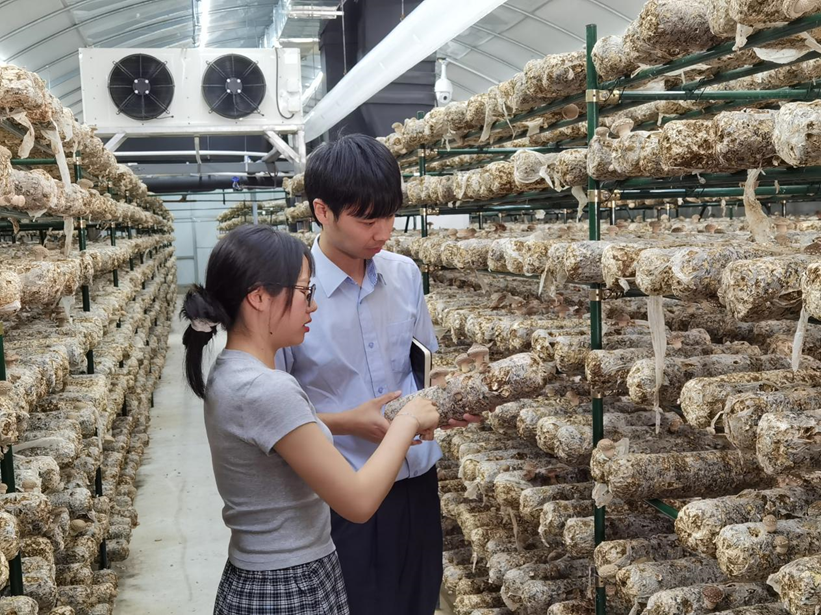
特色“产业链”变成“共富链” 浙江庆元食用菌产业实现跃迁
Zhong Guo Jin Rong Xin Xi Wang· 2025-12-18 12:23
Core Insights - The article highlights the efforts of Postal Savings Bank in supporting the edible mushroom industry in Qingyuan County, providing a total of 280 million yuan in credit support by the end of October 2025 [1] - Qingyuan County is recognized as the origin of artificial mushroom cultivation, with a robust industry chain that has significantly contributed to local farmers' income, achieving an industry chain output value of 5.8 billion yuan in 2024 [1] Group 1: Financial Support and Services - Postal Savings Bank has developed a comprehensive financial service system to address financing difficulties in the edible mushroom industry, transforming the "industrial chain" into a "common prosperity chain" [1] - The bank introduced the "Mushroom Loan" product, providing 3 million yuan in credit to Qingyuan County Jingchuang Edible Mushroom Technology Co., which has become a leading enterprise in the region [2] - The bank actively collaborates with the Qingyuan County Edible Mushroom Association to enhance financial service coverage, conducting targeted outreach to over 2,600 mushroom growers who cultivate more than 20,000 mushroom sticks [2] Group 2: Industry Development and Achievements - Qingyuan County's edible mushroom industry has developed a complete supply chain from spawn production to cultivation, processing, and sales, benefiting thousands of local farmers [1] - Zhejiang Baixing Food Co., a well-known deep processing and sales enterprise in the region, has been exporting products to countries like the USA, Australia, and Japan for 28 years [3] - The partnership between Postal Savings Bank and local enterprises has strengthened over time, with credit limits increasing from 5 million yuan during the pandemic to 30 million yuan by 2024 [4]
邮储力量 注入海南 南海潮涌 开放扬帆
Zhong Guo Xin Wen Wang· 2025-12-18 10:31
Core Viewpoint - Postal Savings Bank is actively integrating into the development of Hainan Free Trade Port by providing diverse financial services that support local policies and market demands, positioning itself as a key financial player in promoting high-quality development in Hainan [1] Group 1: Cross-Border Financial Services - Postal Savings Bank's Hainan branch leverages its parent bank's cross-border financial service platform and differentiated credit policies to offer tailored services for cross-border business clients [2] - The bank has accelerated the construction and acceptance of multi-functional free trade accounts, enhancing the level of cross-border financial services and has been approved as a pilot bank for high-level cross-border trade in Hainan [2] - These initiatives aim to improve capital efficiency and reduce transaction costs for enterprises, facilitating smoother cross-border trade operations [2] Group 2: Consumer Finance and Tourism - The bank has launched promotional activities such as offering 300 yuan duty-free shopping vouchers to attract tourists, enhancing the shopping experience in Hainan [3] - By collaborating with major duty-free brands and providing digital payment solutions, the bank aims to convert tourist traffic into repeat visitors, thereby boosting local consumption [3][4] - The bank's efforts in creating a "financial + consumption" ecosystem are designed to stimulate the tourism sector and enhance the overall visitor experience in Hainan [3] Group 3: Support for Technological Innovation - Postal Savings Bank is providing significant financial support to specialized and innovative enterprises, exemplified by a 45 million yuan funding to Hainan Zhongjian Cable, which has enabled the company to upgrade its technology and increase production capacity [5] - The bank's innovative financing models address the challenges faced by technology companies, such as lack of collateral and long R&D cycles, by offering personalized financing solutions [5] - The bank's commitment to building a technology finance service system aims to empower various innovative entities and drive industrial transformation in Hainan [5]
邮储银行天津曲江路支行焕新:打造社区“惠生活”金融新场景
Xin Lang Cai Jing· 2025-12-18 09:16
冬日的晨光穿透清冽的空气,静静铺洒在天津市河西区曲江路上。沿街商铺渐次开门,早点摊的热气袅 袅升起。在这片充满市井烟火的生活街区,一家陪伴街坊三十余年的银行网点——邮储银行天津河西区 曲江路支行,日前完成原址焕新,正式开门营业。 作为扎根陈塘庄街道超过三十年的金融机构,这家支行见证并参与了社区的发展变迁。从昔日简单的储 蓄汇兑,到如今多元的现代金融服务,它始终是街坊们生活中"离不开的金融邻居"。此次焕新,不仅是 对硬件环境的升级,更是服务理念与社区角色的再深化。 "我们不仅是一家银行,更希望成为社区的'合伙人'。"邮储银行天津河西曲江路支行行长毕淑英表示。 据介绍,支行将积极构建"15分钟社区生活服务圈",通过联动周边商户,打造惠民生活生态;同时计划 举办各类文化、联谊活动,搭建居民互动平台,让金融服务深度融入日常烟火之中。 走进厅堂,明亮温馨的气息扑面而来。重新规划的功能分区清晰有序,等候区舒适宽敞。银行工作人员 面带笑容,与进门张望的客户自然寒暄。"张阿姨,您来啦,孩子们见面感觉怎么样啊""小李,多亏了 你介绍,俩孩子计划明年订婚!"一声声熟稔的招呼,一句句暖心的家常,让这个金融空间瞬间褪去 了"银行"与 ...

邮储银行涨1.12%,成交额6.79亿元,今日主力净流入-2877.88万
Xin Lang Cai Jing· 2025-12-18 08:18
Core Viewpoint - Postal Savings Bank of China (PSBC) shows a stable performance with a recent stock price increase and consistent dividend payouts, indicating potential investment opportunities in the banking sector [1][2]. Financial Performance - PSBC's revenue for the period from January to September 2025 reached 265.08 billion yuan, reflecting a year-on-year growth of 1.82% [7]. - The net profit attributable to shareholders for the same period was 76.56 billion yuan, with a year-on-year increase of 0.98% [7]. - The bank has distributed a total of 137.80 billion yuan in dividends since its A-share listing, with 77.40 billion yuan paid out over the last three years [8]. Dividend and Shareholder Information - The bank's dividend yields over the past three years were 5.58%, 6.00%, and 4.61% respectively, showcasing its commitment to returning value to shareholders [2]. - As of September 30, 2025, the number of shareholders decreased by 13.09% to 142,600, while the average number of shares held per shareholder increased by 15.29% to 478,570 shares [7]. Market Activity - On December 18, PSBC's stock rose by 1.12%, with a trading volume of 679 million yuan and a turnover rate of 0.19%, leading to a total market capitalization of 653.32 billion yuan [1]. - The stock has experienced a net outflow of 28.78 million yuan from major investors today, ranking 6th in its industry, with a total net inflow of 5.09 billion yuan across the sector [3][4]. Technical Analysis - The average trading cost of PSBC shares is 5.19 yuan, with the current stock price fluctuating between resistance at 5.53 yuan and support at 5.31 yuan, suggesting potential for short-term trading strategies [5]. Company Overview - PSBC, established on March 6, 2007, and listed on December 10, 2019, primarily offers banking and financial services in China, with personal banking contributing 65.15% to its revenue, corporate banking 22.71%, and fund operations 12.10% [6]. - The bank is classified under the category of state-owned large banks and is ultimately controlled by China Post Group [2][6].
邮储力量,注入海南
Jin Rong Jie Zi Xun· 2025-12-18 06:46
Core Viewpoint - The Postal Savings Bank of China (PSBC) is actively integrating into the development of Hainan Free Trade Port by providing diverse financial services, supporting local policies, and responding to market demands, thereby becoming a key financial force in promoting high-quality development in Hainan [1]. Group 1: Cross-Border Financial Services - PSBC leverages its cross-border financial service platform and differentiated credit policies to offer tailored services for cross-border business clients, enhancing the level of cross-border financial services [1][3]. - The bank has been approved as a pilot bank for high-level open cross-border trade in Hainan, facilitating efficient global trade operations [1][3]. Group 2: Consumer Finance and Tourism - PSBC is enhancing consumer potential in Hainan's tourism sector by launching promotional activities, such as offering 300 yuan duty-free shopping vouchers, which significantly benefit tourists [3][5]. - The bank collaborates with major duty-free brands to create a "financial + consumption" ecosystem, providing 21,000 discount opportunities to stimulate consumer spending [6]. Group 3: Technology Finance - PSBC supports specialized and innovative enterprises, such as Hainan Zhongjian Cable, by providing 45 million yuan in funding, enabling them to upgrade equipment and increase production capacity [7][9]. - The bank's innovative financing models address the challenges faced by technology companies, such as lack of collateral and long R&D cycles, by offering personalized financing solutions [9]. Group 4: Future Commitment - PSBC aims to continue injecting financial momentum into the construction of Hainan Free Trade Port with greater efforts and practical measures, fulfilling its responsibilities as a state-owned bank [9].
