
WEIHAI BANK(09677)

Search documents
威海银行定增后资本充足率改善效果引关注
Xin Lang Cai Jing· 2026-02-20 07:51
业绩经营情况事件背景:2025年12月,威海银行完成向山东高速集团、津联集团及财鑫资产定向增发募 集30亿元,资金全部用于补充核心一级资本。增发价格为3.29元/股(约3.61港元/股),但截至2026年2 月10日港股股价报2.09港元,较定增价格倒挂超40%。关注点:定增前(2025年三季度末)公司核心一 级资本充足率已降至8.02%,接近7.5%的监管红线。需观察2025年年报及后续财报中资本充足率是否显 著提升,以及资金如何支持绿色贷款(2025年增幅50%)、科技贷款(增幅70%)等转型业务。 战略推进战略方向:在2026年度工作会议中,公司明确"市场化、专业化、数字化"转型路径,推进智慧 网点建设与垂直管理优化。合规压力:2026年1月7日,潍坊分行因"违规发放无实际用途贷款、虚增存 贷款规模"被罚款35万元。需关注后续是否加强信贷风控及业务合规性。 以上内容基于公开资料整理,不构成投资建议。 来源:经济观察网 经济观察网 威海银行(09677.HK)近期值得关注的事件:30亿元国资定增完成后的资本充足率改善效 果、股价异动与流动性风险的持续影响、业务转型与合规整改进展。 股票近期走势近期事件:2 ...
威海银行股价一度大跌创最低纪录 港股中小银行为何频现交易低迷?
Mei Ri Jing Ji Xin Wen· 2026-02-09 15:07
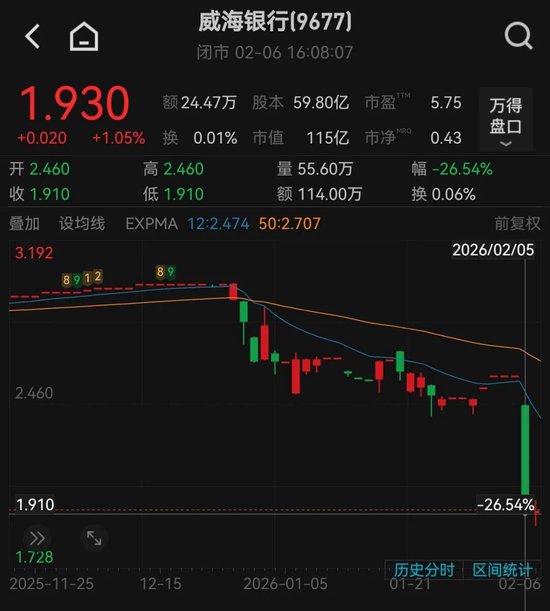
Core Viewpoint - Weihai Bank's stock price has significantly declined, with a drop of over 26% in a single day, reaching a record low since its listing in 2020, indicating severe market challenges for small banks in Hong Kong [1][2][4]. Group 1: Stock Performance - Weihai Bank's stock price fell to 1.910 HKD on February 5, 2025, marking a 26.54% decline, and further dropped to 1.850 HKD on February 6, 2025, the lowest since its IPO [2][4]. - The bank's market capitalization has evaporated by over 4 billion HKD, reducing to 115.420 billion HKD as of February 6, 2025 [4]. - The trading volume for Weihai Bank was only 68,400 shares over two days, with a total transaction value of merely 1.39 million HKD [1][4]. Group 2: Financial Performance - Since its listing, Weihai Bank has maintained revenue growth, achieving 5.06 billion RMB in revenue for the first half of 2025, a year-on-year increase of 11%, and a net profit of 1.13 billion RMB, up 5% [2]. - As of September 2025, the bank's total assets reached 502.8 billion RMB, but its capital adequacy ratios have declined, with the core Tier 1 capital ratio dropping to 8.02% by the end of Q3 2025, nearing the regulatory minimum of 7.5% [2][3]. Group 3: Capital Raising Efforts - In July 2025, Weihai Bank announced a plan to issue up to 758 million domestic shares and 154 million H-shares, aiming to raise up to 3 billion RMB to bolster its core Tier 1 capital [3]. - Major state-owned entities, including Shandong Hi-Speed Group, are set to subscribe to the capital increase at a price of 3.29 RMB per share, indicating strong institutional support [3]. Group 4: Market Dynamics - The trading environment for small banks in Hong Kong is characterized by low liquidity, with many banks experiencing similar trading challenges, as evidenced by other banks like Guangzhou Rural Commercial Bank and Tianjin Bank having transaction values below 50,000 HKD on February 6, 2025 [4][5]. - Experts suggest that the market is increasingly favoring larger institutions, leading to the marginalization of smaller banks, which face challenges such as narrowing net interest margins and asset quality pressures [5][6].
港股中小内银股流动性困局:100万港元撬动27%杀跌,一年内半数0成交
Di Yi Cai Jing· 2026-02-09 13:09
Core Viewpoint - The Hong Kong stock market is not suitable for small and medium-sized banks from mainland China, as evidenced by the liquidity challenges faced by these banks, particularly highlighted by the recent dramatic decline in the stock price of Weihai Bank [2][10]. Group 1: Market Performance - Weihai Bank experienced a significant drop of 26.54% on February 5, marking its largest single-day decline since its listing, with a closing price of 1.91 HKD per share and a market value loss exceeding 4.1 billion HKD [3][4]. - The trading volume for Weihai Bank was notably low, with only 55,600 shares traded on the day of the crash, indicating a severe liquidity issue [3][5]. - The bank's average turnover rate this year was only 0.0037%, with 8 out of 26 trading days showing zero transactions [5]. Group 2: Financial Performance - As of mid-2025, Weihai Bank reported total assets of 483.84 billion CNY, a 9.60% increase from the end of 2024, with total deposits and loans also showing growth of 12.73% and 9.01%, respectively [3][4]. - The bank achieved a net profit of 1.26 billion CNY for the first half of 2025, reflecting a year-on-year increase of 5.79% [3]. Group 3: Capital Adequacy - As of September 2025, Weihai Bank's capital adequacy ratio was 11.89%, with a tier 1 capital ratio of 10.04% and a core tier 1 capital ratio of 8.02%, meeting regulatory requirements but remaining close to the minimum thresholds [4]. Group 4: Liquidity Challenges - The liquidity issues faced by Weihai Bank are indicative of a broader trend among small and medium-sized banks listed in Hong Kong, with many experiencing prolonged periods of low trading activity [2][10]. - The market structure in Hong Kong, dominated by institutional investors, leads to a preference for larger, more liquid stocks, further marginalizing smaller banks [6][7]. Group 5: Market Dynamics - The lack of a robust market for small and medium-sized banks in Hong Kong results in a vicious cycle of low trading volume, reduced market attention, and valuation discounts [7][8]. - The absence of strict delisting criteria in the Hong Kong market allows underperforming stocks to persist without the pressure to improve liquidity or market performance [8][10]. Group 6: Investor Sentiment - Investors show limited interest in local small banks due to their regional focus and perceived opacity in business operations, which diminishes market engagement [7][10]. - The primary motivation for many small banks to list in Hong Kong is capital replenishment, rather than active market engagement, which exacerbates the issue of low trading activity [10][11].
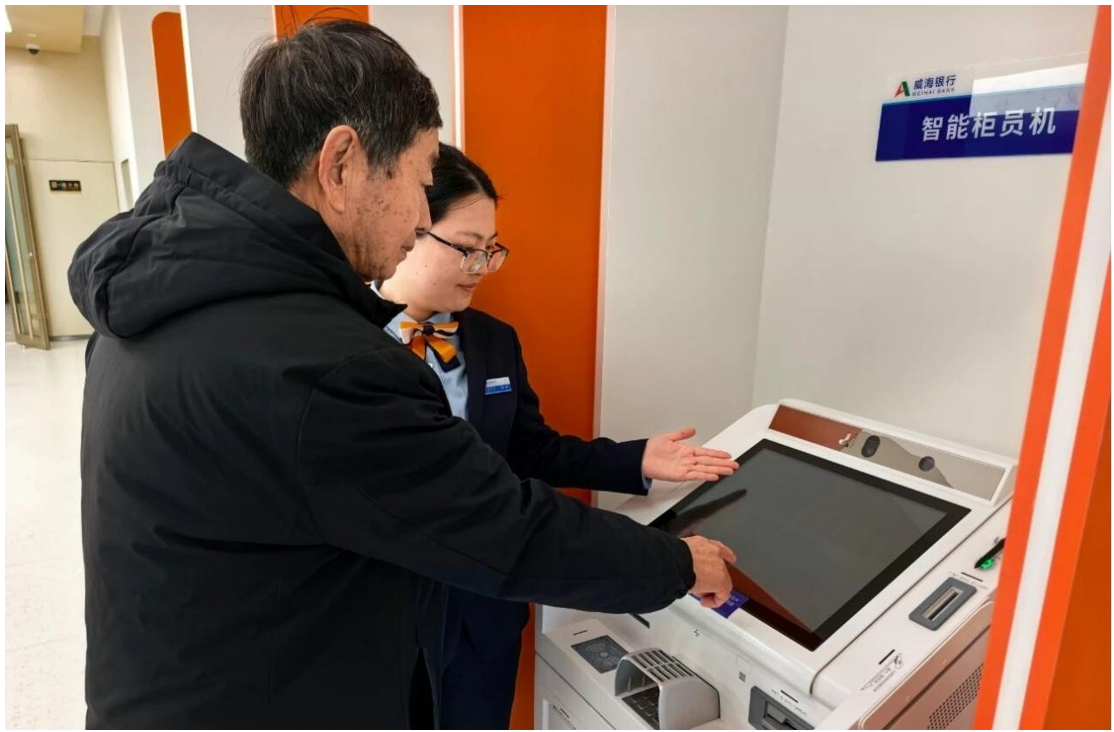
以“智”提效,向“新”而行|威海银行智慧服务迈上新台阶
Jin Rong Jie· 2026-02-09 08:16
Core Insights - Weihai Bank is actively advancing its digital transformation by constructing "smart branches" to enhance service efficiency and customer experience [1][7] - The bank has implemented a collaborative service mechanism that integrates physical branches, online services, and remote assistance [1][7] Group 1: Smart Branch Implementation - The Qingdao Road branch serves as a pilot for smart branch construction, equipped with various intelligent devices such as CRS deposit and withdrawal machines, enhancing service quality and efficiency [3] - These devices streamline high-frequency counter services, allowing for transactions like deposits, withdrawals, transfers, and account openings to be completed more quickly compared to traditional methods [3] Group 2: Remote Service Expansion - The bank's video banking service, launched in November 2025, includes features for credit card information maintenance and social security card services, integrating 21 high-frequency services to enhance remote service capabilities [4] - Over 260,000 customers have utilized the video banking service, which operates on weekends and holidays, thereby increasing service coverage and customer satisfaction [4] Group 3: Service Optimization - Weihai Bank focuses on optimizing service processes by improving the integration of smart devices and backend support, allowing for seamless cross-device service [5] - The bank aims to achieve a "one initiation, full completion" service model, significantly enhancing service fluidity [5] Group 4: Risk Management and Efficiency - The bank employs a centralized risk control system for high-risk transactions to ensure compliance and safety while optimizing staff allocation for personalized services [6] - This dual focus on risk management and operational efficiency aims to enhance overall service delivery [6] Group 5: Customer-Centric Approach - The ultimate goal of the smart branch initiative is to improve customer experience, with average processing times for personal account openings and investment purchases reduced by over 70% [7] - The bank provides specialized services for elderly customers to bridge the digital divide and offers customized service plans for clients with unique needs [7] - Weihai Bank plans to continue its digital transformation and smart branch development to better support regional economic growth and improve residents' quality of life [7]

威海银行暴跌26.5%
Xin Lang Cai Jing· 2026-02-06 12:18
Core Viewpoint - The article discusses the challenges faced by Weihai Bank, particularly its significant stock price drop and the implications of its listing on the Hong Kong Stock Exchange, suggesting that local banks may not need to pursue such listings for performance improvement [1][10]. Group 1: Stock Performance - Weihai Bank's stock price fell to 1.91 HKD on February 5, 2026, marking a 26.54% drop in a single day, the lowest since its listing in 2020 [2][12]. - The stock has consistently underperformed since its IPO, with a listing price of 3.35 HKD that quickly fell below this value [4][14]. - As of February 6, 2026, the bank's market capitalization had decreased to 11.542 billion HKD [4][14]. Group 2: Trading Volume and Liquidity Issues - The significant drop in stock price occurred with a low trading volume of only 556,000 shares, translating to a mere 1.14 million HKD in transaction value, highlighting the liquidity issues faced by small banks in the Hong Kong market [3][14]. - Weihai Bank experienced a period of 61 consecutive trading days with no transactions in 2022, and the total trading volume for early 2024 was less than 2 million HKD, ranking last among Hong Kong-listed banks [4][14]. Group 3: Capital Increase Challenges - In July 2025, Weihai Bank announced a 3 billion HKD capital increase plan, with domestic shares priced at 3.29 HKD each, nearly double the current market price, indicating a significant disconnect between market valuation and the capital raise price [5][15]. - Three state-owned institutions planned to subscribe for nearly 2.9865 billion HKD of the capital increase, reflecting a commitment to support the bank despite the risks associated with the price disparity [5][15]. Group 4: Financial Performance - Despite the stock market struggles, Weihai Bank reported a revenue of 5.07 billion HKD for the first half of 2025, a year-on-year increase of 11.0%, and a net profit of 1.13 billion HKD, up 5.0% [6][15]. - The bank's total assets grew from 267.6 billion HKD in 2020 to 441.5 billion HKD in 2024, a cumulative increase of 65% [8][17]. - The core tier one capital adequacy ratio fell to 8.02% by the end of Q3 2025, nearing the regulatory minimum of 7.50% [8][17]. Group 5: Broader Industry Context - The challenges faced by Weihai Bank are reflective of broader issues within the Hong Kong market, where small and medium-sized banks struggle with liquidity and investor interest [9][19]. - As of March 2023, among over 30 mainland bank stocks listed in Hong Kong, 10 had no trading activity, indicating a systemic issue with liquidity in this segment [9][19]. - Efforts by Weihai Bank to rebrand and amend its articles of association have had limited success in improving its market position [9][19].
智通港股52周新高、新低统计|2月5日
智通财经网· 2026-02-05 08:41
Key Points - As of February 5, 67 stocks reached their 52-week highs, with Rongda Technology (09881), Jiurong Holdings (02358), and Haojiang Electromechanical (01408) leading the increase rates at 162.10%, 91.30%, and 24.59% respectively [1] - The highest closing price for Rongda Technology was 20.620, with a peak of 65.000, indicating significant growth [1] - Jiurong Holdings closed at 0.016, reaching a high of 0.044, reflecting a strong performance [1] - Haojiang Electromechanical had a closing price of 0.330 and a peak of 0.380, showing a notable increase [1] 52-Week High Rankings - The top three stocks with the highest growth rates are: - Rongda Technology (162.10%) - Jiurong Holdings (91.30%) - Haojiang Electromechanical (24.59%) [1] - Other notable mentions include: - Honghai Holdings Group (08020) at 24.14% - Shangyu Group (01633) at 20.60% [1] 52-Week Low Rankings - The stocks that reached their 52-week lows include: - LeMo Technology (02539) with a decline of -42.01% - Weihai Bank (09677) at -20.42% - XL Ernan CO (07711) at -17.57% [2] - Additional stocks with significant declines are: - Songdu Service (09608) at -16.00% - XL Ernan Strategy (07799) at -13.86% [2]

泰山榜|山东银行版图透视:法人机构219家,一二级分行总数达420家
Xin Lang Cai Jing· 2026-02-03 23:55
Core Viewpoint - Shandong Province aims to reform and restructure rural commercial banks and village banks while deepening internal control and risk management actions in urban commercial banks, highlighting the importance of a well-distributed financial service network for regional economic vitality and development potential [2]. Financial Institutions Overview - As of now, Shandong Province has a total of 219 banking legal entities, including 170 first-level branches and 250 second-level branches, with a total of 639 headquarters and branches, supported by 14,700 other outlets [2]. - The core components of Shandong's banking industry include joint-stock banks, urban commercial banks, and rural commercial banks, which work collaboratively to outline a clear regional banking landscape [2]. Joint-Stock Banks - Joint-stock banks play a pivotal role in Shandong's banking sector, characterized by a "leading head, focused core, and precise efforts" strategy, connecting national financial markets with local economies [3][4]. - As of September 2025, Hengfeng Bank, the only national joint-stock commercial bank with independent legal status in Shandong, has total assets of 1.568726 trillion yuan, nearing the 1.6 trillion yuan mark [4]. - National joint-stock banks have established 25 first-level branches and 119 second-level branches in Shandong, with a notable presence in Jinan, Qingdao, and Yantai [4]. Urban Commercial Banks - Urban commercial banks are essential local financial institutions in Shandong, leveraging geographical and service advantages to empower local economies and improve livelihoods [5][6]. - Shandong has 14 local urban commercial banks, including Qilu Bank and Qingdao Bank, along with branches from three non-local urban commercial banks, forming a comprehensive service matrix across the province [5]. Rural Commercial Banks - Rural commercial banks are the most numerous banking entities in Shandong, with 110 institutions focused on serving rural areas and supporting agricultural development [7][8]. - These banks provide a full range of financial services, effectively addressing issues of financing difficulties in rural regions [7]. - Additionally, 91 village banks complement rural commercial banks by extending financial services to remote areas, creating a multi-layered and comprehensive rural financial service system [8]. Future Outlook - Despite facing challenges such as smaller scales and weaker risk resistance, rural commercial banks in Shandong are deepening reforms and enhancing service capabilities, with asset quality steadily improving [8]. - Experts suggest that the three banking groups—joint-stock banks, urban commercial banks, and rural commercial banks—should continue to leverage their strengths and address development challenges to support high-quality economic growth and rural revitalization in Shandong [8].




威海银行(09677) - 截至二零二六年一月三十一日止月份之股份发行人的证券变动月报表
2026-02-03 08:30
股份發行人及根據《上市規則》第十九B章上市的香港預託證券發行人的證券變動月報表 截至月份: 2026年1月31日 狀態: 新提交 致:香港交易及結算所有限公司 公司名稱: 威海銀行股份有限公司 呈交日期: 2026年2月3日 I. 法定/註冊股本變動 | 1. 股份分類 | 普通股 | 股份類別 | 其他類別 (請註明) | | 於香港聯交所上市 (註1) | | 否 | | | --- | --- | --- | --- | --- | --- | --- | --- | --- | | 證券代號 (如上市) | N/A | 說明 | 内資股 | | | | | | | | | 法定/註冊股份數目 | | 面值 | | | 法定/註冊股本 | | | 上月底結存 | | | 4,971,197,344 RMB | | | 1 RMB | | 4,971,197,344 | | 增加 / 減少 (-) | | | 0 | | | RMB | | 0 | | 本月底結存 | | | 4,971,197,344 RMB | | | 1 RMB | | 4,971,197,344 | | 2. 股份分類 | 普通股 ...
威海银行:金融赋能养老,绘就民生幸福画卷
Jin Rong Jie· 2026-01-16 07:04
Core Insights - Weihai Bank focuses on addressing the financing challenges in the elderly care industry by optimizing credit models and building a dedicated risk control system [1][2] - The bank aims to create a positive ecosystem where finance empowers industries and industries serve the public [1] Group 1: Financing Solutions - Weihai Bank has optimized its credit review logic to lower financing barriers and costs for elderly care institutions, which often face challenges such as light assets and long cycles [1] - A case study involves the Tai'an branch providing a loan of 10 million yuan to a private medical care enterprise, which lacked sufficient collateral but demonstrated strong operational capacity and growth potential [1] - The bank employs a multi-dimensional evaluation model that assesses operational capability, cash flow, and compliance to accurately profile enterprise credit [1] Group 2: Comprehensive Financial Services - In addition to credit support, Weihai Bank has developed comprehensive financial solutions tailored to the needs of elderly clients, including stable retirement financial products [1] - The bank is enhancing its physical branches to be more senior-friendly and has introduced online services such as a "large font" mobile banking app and priority customer service for elderly clients [1] - The bank's initiatives aim to bridge the digital divide and improve the overall service experience for older customers [1]
威海银行:践行“双碳”,绿色金融浇灌现代农业
Jin Rong Jie· 2026-01-16 07:04
Core Viewpoint - Weihai Bank is focusing on integrating "dual carbon" goals with rural revitalization, addressing challenges in ecological resource valuation and financing through innovative green financial products [1]. Group 1: Green Financial Products - Weihai Bank has developed a matrix of green financial products aimed at revitalizing ecological capital, including "carbon sink expected income right pledge loans" and "carbon emission right pledge loans" [1]. - The bank issued the first "marine shellfish carbon sink index insurance pledge loan" in the country, creating new pathways for realizing the value of blue ecological products [1]. - An innovative "biodiversity + sustainability-linked loan" has been introduced, linking interest rates to ecological targets, with a financing allocation of 10 million yuan for the Tianjin crab-rice symbiosis project [1]. Group 2: Inclusive Financial Services - Weihai Bank has promoted the "Green Agricultural Loan," providing 500 million yuan in support to nearly 1,000 farmers, with customized credit products for various agricultural products [1]. - Specific loans such as "garlic loan," "pepper loan," and "apple loan" have been tailored to cover a range of agricultural and marine products, supporting the development of marine specialty agriculture [1]. Group 3: Collaboration and Market Access - To lower financing barriers, Weihai Bank has deepened collaboration among "finance + banks + guarantees," promoting the "Huinong Loan" to convert policy benefits into rural development momentum [2]. - The bank has extended its service scenarios by creating platforms like "pension markets" to connect agricultural products directly with urban consumers, enhancing the financial service continuum from production to sales [2].