
TLC(09696)

Search documents
天齐锂业(002466) - 监事会决议公告
2025-03-26 13:30
股票代码:002466 股票简称:天齐锂业 公告编号:2025-017 天齐锂业股份有限公司 第六届监事会第十一次会议决议公告 本公司及监事会全体成员保证信息披露的内容真实、准确、完 整,没有虚假记载、误导性陈述或重大遗漏。 天齐锂业股份有限公司(以下简称"公司")第六届监事会第十一次会议(以下简称"会 议")于2025年3月26日在四川省成都市天府新区红梁西一街166号公司八楼会议室以现场结合 通讯的方式召开,会议由公司监事会主席王东杰女士召集并主持。召开本次会议的通知已于 2025年3月3日通过电子邮件方式送达各位监事,会议材料于2025年3月21日以电子邮件方式送 达各位监事。本次会议应到监事3人,实到监事3人。会议的召集、召开与表决程序符合《中华 人民共和国公司法》和《公司章程》及相关法律、法规的规定,合法有效。 本次会议审议通过了以下议案: 一、审议通过《2024 年度监事会工作报告》 表决结果:同意3票、反对0票、弃权0票、回避0票。 具体内容详见公司同日披露于巨潮资讯网(http://www.cninfo.com.cn)的《2024年度监事 会工作报告》。 此议案尚需提交公司2024年度股东大会 ...
天齐锂业(002466) - 董事会决议公告
2025-03-26 13:30
股票代码:002466 股票简称:天齐锂业 公告编号:2025-008 天齐锂业股份有限公司 第六届董事会第二十一次会议决议公告 本公司及董事会全体成员保证信息披露的内容真实、准确、完 整,没有虚假记载、误导性陈述或重大遗漏。 天齐锂业股份有限公司(以下简称"公司")第六届董事会第二十一次会议(以下简称"会 议")于2025年3月26日在四川省成都市天府新区红梁西一街166号公司八楼会议室以现场结合 通讯的方式召开。召开本次会议的通知已于2025年3月3日通过电子邮件方式送达各位董事,会 议材料于2025年3月21日以电子邮件方式送达各位董事。本次会议应参与表决董事8人(其中独 立董事4人),实际参与表决董事8人。本次会议由董事长蒋安琪女士召集并主持,会议的召集、 召开与表决程序符合《中华人民共和国公司法》和《公司章程》及相关法律、法规的规定,合 法有效。 本次会议审议通过了以下议案: 一、审议通过《2024 年度董事会工作报告》 表决结果:同意8票、反对0票、弃权0票、回避0票。 具体内容详见公司同日披露于巨潮资讯网(http://www.cninfo.com.cn)的《2024年度董事 会工作报告》。 公 ...
天齐锂业(002466) - 2024 Q4 - 年度财报
2025-03-26 13:30
Financial Performance - Tianqi Lithium reported a revenue increase of 25% year-on-year, reaching approximately CNY 10 billion in 2024[2]. - The company achieved total revenue of CNY 13.06 billion in 2024, a year-on-year decrease of 67.75%[171]. - The net profit attributable to shareholders was CNY -79.05 billion, representing a year-on-year decline of 208.32%[171]. - Revenue from the lithium mining sector was CNY 4.98 billion, down 81.70% year-on-year, while revenue from lithium compounds and derivatives was CNY 8.07 billion, down 39.24% year-on-year[175]. - The company's gross margin in the lithium mining sector was 63.71%, while the gross margin for chemical raw materials and products was 35.21%[177]. - The company reported a significant decline in quarterly net profit, with the fourth quarter showing a loss of -¥2,203,166,930.78[29]. - The net cash flow from operating activities decreased by 75.52% to ¥5,554,189,376.65 in 2024 from ¥22,688,073,725.98 in 2023[22]. - The company’s investment income recorded a loss of 839.70 million yuan, accounting for -65.00% of total profit, primarily due to losses from equity method investments[194]. Market Demand and Trends - User data indicates a 30% increase in demand for lithium products, driven by the electric vehicle market[2]. - The demand for lithium-ion batteries has surged, with their share of global lithium resource demand rising from 31% in 2015 to 87% in 2024[52]. - The global lithium market is undergoing significant changes, with new projects being launched and production steadily increasing despite some regions experiencing reductions due to price fluctuations[37]. - The global power battery shipments for electric vehicles are projected to be 1,051.2 GWh in 2024, growing by 21.5% year-on-year[54]. - The cumulative installed capacity of China's power batteries is expected to reach 548.4 GWh in 2024, with a year-on-year growth of 41.5%[55]. Strategic Initiatives - The company plans to invest CNY 1.5 billion in R&D for new lithium extraction technologies over the next three years[3]. - Tianqi Lithium is expanding its market presence in Europe, with plans to establish a new facility in Germany by 2025[2]. - The company is actively pursuing strategic partnerships and acquisitions to enhance its market position[21]. - The company aims to reduce production costs by 10% through operational efficiencies and technological advancements[3]. - The company has established long-term relationships with numerous global lithium end customers, including major battery manufacturers and electric vehicle companies[75]. Research and Development - The company has established a research and innovation center to focus on the development of new products and technologies, ensuring the effective utilization of lithium resources[124]. - The number of R&D personnel increased by 41.67% from 36 in 2023 to 51 in 2024, with a notable rise in the proportion of master's degree holders from 20 to 31[190]. - R&D investment amounted to ¥43,620,692.01 in 2024, representing a 43.61% increase compared to ¥30,374,934.57 in 2023, and the R&D investment as a percentage of operating revenue rose from 0.07% to 0.33%[190]. - The company is focusing on four major research directions: comprehensive utilization of mineral resources, new lithium extraction technologies, next-generation high-performance lithium materials, and battery recycling[190]. Production and Capacity - The company produced a total of 1.41 million tons of lithium concentrate during the reporting period, including 1.353 million tons of chemical-grade lithium concentrate and 57,000 tons of technical-grade lithium concentrate[80]. - The company’s lithium concentrate production capacity is currently 162,000 tons per year, with plans to increase to approximately 214,000 tons per year after the completion of the chemical-grade plant[129]. - The construction of the chemical-grade Phase III plant at the Greenbush site is underway, expected to add 52,000 tons/year to the total production capacity, bringing it to 214,000 tons/year by October 2025[81]. - The company has established lithium chemical product processing capacity of approximately 91,600 tons/year, with an additional planned capacity of 122,600 tons/year[89]. Risk Management - Tianqi Lithium has identified potential risks related to supply chain disruptions and is implementing measures to mitigate these risks[3]. - The company indicated uncertainty regarding its ability to continue as a going concern, as reflected in the negative net profit figures over the past three years[22]. - The company has identified potential risks from global geopolitical factors that may affect its overseas operations and sales of lithium chemical products due to trade protectionism trends[145]. - The company is facing intensified competition in the lithium chemical products industry, which may impact its market share and profitability[144]. Environmental, Social, and Governance (ESG) - The company's ESG rating improved from BB to BBB as of August 2023, and it was included in multiple S&P global ESG indices[163]. - The board of directors consists of 8 members, with 50% independent directors and 50% female members, ensuring diverse expertise in governance and risk management[164]. - The company has linked executive compensation to 22 ESG performance indicators, promoting sustainable practices within its operations[164]. - The company emphasizes environmental, health, and safety (EHS) management, with certifications such as ISO 14001 and ISO 45001 across its production facilities[117][116].
天齐锂业(002466) - 关于2024年度拟不进行利润分配的公告
2025-03-26 13:30
股票代码:002466 股票简称:天齐锂业 公告编号:2025-010 天齐锂业股份有限公司 关于 2024 年度拟不进行利润分配的公告 本公司及董事会全体成员保证信息披露的内容真实、准确、完 整,没有虚假记载、误导性陈述或重大遗漏。 | (元) | | | --- | --- | | 母公司报表本年度末累计未分配利 | 16,650,117,838.46 | | 润(元) | | | 上市是否满三个完整会计年度 | 是 | | 最近三个会计年度累计现金分红总 | 7,137,278,233.95 | | 额(元) | | | 最近三个会计年度累计回购注销总 | 0 | | 额(元) | | | 最近三个会计年度平均净利润 | 7,839,107,801.02 | | (元) | | | 最近三个会计年度累计现金分红及 | 7,137,278,233.95 | | 回购注销总额(元) | | | 是否触及《股票上市规则》第 | | | 9.8.1 条第(九)项规定的可能被 | 否 | | 实施其他风险警示情形 | | 三、公司 2024 年度拟不进行利润分配的说明 鉴于 2024 年度公司业绩出现亏损,为支持 ...
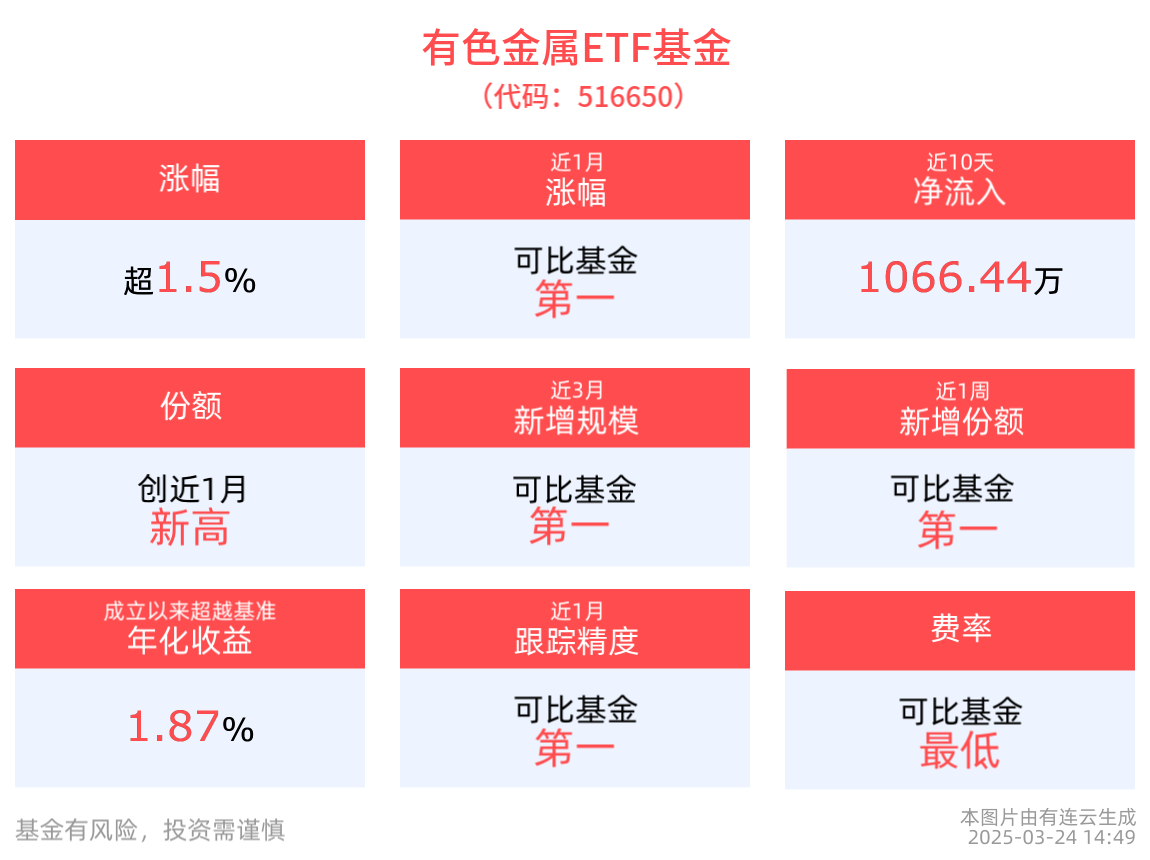
北方铜业涨停,有色金属ETF基金(516650)近10日流入超千万
Jie Mian Xin Wen· 2025-03-24 07:13
Core Viewpoint - Northern Copper Industry has seen a significant increase in stock price, with the non-ferrous metal ETF fund (516650) experiencing over 10 million inflows in the past 10 days [1][3]. Group 1: Market Performance - As of March 24, 2025, the CSI Non-ferrous Metal Industry Theme Index (000811) rose by 1.55%, with Northern Copper Industry hitting the daily limit, Jiangxi Copper up by 5.72%, and Baotai Co. up by 5.13% [3]. - The non-ferrous metal ETF fund (516650) increased by 1.50% [3]. - Over the past two weeks, the non-ferrous metal ETF fund has accumulated a rise of 1.53% and a net subscription of 10.6644 million yuan [3]. Group 2: Fund Characteristics - The management fee for the non-ferrous metal ETF fund is 0.50%, and the custody fee is 0.10%, which are the lowest among comparable funds [3]. - The tracking error for the non-ferrous metal ETF fund over the past month is 0.005%, indicating the highest tracking precision among comparable funds [3]. Group 3: Index Composition - As of February 28, 2025, the top ten weighted stocks in the CSI Non-ferrous Metal Industry Theme Index account for 49.57% of the index, including Zijin Mining, China Aluminum, Northern Rare Earth, and others [4].



天齐锂业(002466) - 关于举行2024年度业绩说明会的公告
2025-03-21 09:45
为充分尊重广大投资者,提升交流效率,现就公司 2024 年度网上业绩说明会提前 向投资者征集问题,广泛听取投资者的意见和建议。提问通道自发出公告之日起开放, 投资者可通过访问同顺路演问题征集页面(https://board.10jqka.com.cn/rs/pc/detail?roads howId=1010428)或"天齐锂业投资者关系"微信小程序问题征集页面(https://www.yu ediaoyan.com/research/index.php/Home/Live/roadshow_detail/id/8131),或扫描下方任一二 维码,进入本次年度业绩说明会的问题征集专题页面。公司将在 2024 年度业绩说明会 上,对投资者普遍关注的问题进行回答。 天齐锂业股份有限公司(以下简称"公司")将于 2025 年 3 月 27 日在巨潮资讯网 (http://www.cninfo.com.cn)和指定信息披露媒体披露公司《2024 年年度报告》及摘要。 为了让广大投资者进一步了解公司 2024 年度经营情况,公司将于 2025 年 3 月 27 日(星期四)下午 15:00-16:00 举办 2024 ...
天齐锂业(002466) - H股公告:董事会会议通告
2025-03-13 11:01
香港交易及結算所有限公司及香港聯合交易所有限公司對本通告之內容概不負責,對其準確性 或完整性亦不發表任何聲明,並明確表示,概不對因本通告全部或任何部分內容而產生或因倚 賴該等內容而引致之任何損失承擔任何責任。 Tianqi Lithium Corporation 天齊鋰業股份有限公司 (於中華人民共和國註冊成立的股份有限公司) (股份代號:9696) 蔣安琪 香港,2025年3月13日 於本通告日期,董事會由以下成員組成:執行董事蔣安琪女士、蔣衛平先生、夏 浚誠先生及鄒軍先生;及獨立非執行董事向川先生、唐國瓊女士、黃瑋女士及吳 昌華女士。 天齊鋰業股份有限公司(「本公司」)董事會(「董事會」)謹此宣佈,本公司將於 2025年3月26日(星期三)舉行董事會會議,藉以(其中包括)考慮及批准本公司及 其附屬公司截至2024年12月31日止年度之全年業績及其發佈,考慮派發末期股息 (如有),以及處理其他事項。 承董事會命 天齊鋰業股份有限公司 董事長兼執行董事 董事會會議通告 ...
【有色】从重置成本角度再看锂矿板块投资价值——碳酸锂产业链研究报告之八(王招华/马俊)
光大证券研究· 2025-03-13 09:05
Core Viewpoint - The lithium industry is entering a clearing phase, with potential for price increases due to production cuts and supply-demand improvements [2][3]. Group 1: Market Trends - Historical data shows that during the last lithium cycle, stock prices generally trended upward despite fluctuations, with Ganfeng Lithium's stock rising by 162.3% over a 15-month clearing period [2]. - As of January 2024, six Australian mines have announced production cuts or delays, indicating a potential for further reductions in 2025, which could enhance the supply-demand balance [2]. Group 2: Valuation Methods - The lithium sector lacks a clear valuation anchor, with companies experiencing extreme fluctuations in price-to-earnings (PE) ratios, sometimes exceeding hundreds of times during upswings and dropping below 10 times after peaks [3]. - Alternative valuation methods, such as the replacement cost method, may provide a more accurate reflection of asset values, especially given the volatility of lithium prices [3]. Group 3: Replacement Cost Calculation - The replacement cost method assesses the total cost required to acquire or construct a new asset under current conditions, including intangible assets like mining rights and fixed assets such as lithium refining and mining facilities [4]. - The calculation of replacement costs involves determining the value of lithium resources per ton and applying it to the resource quantities of various lithium mines, as well as estimating the investment costs for refining and mining operations [4]. Group 4: Current Valuation Status - Based on replacement cost calculations, companies like Ganfeng Lithium, Tianqi Lithium, Shengxin Lithium, and Yahua Group are already trading below their replacement costs, indicating potential undervaluation [5]. - Other companies, while having lower replacement costs than their current market values, may still be undervalued due to uncalculated non-lithium business assets [5].



天齐锂业(002466) - H股公告:证券变动月报表
2025-03-03 10:30
第 1 頁 共 11 頁 v 1.1.1 FF301 本月底法定/註冊股本總額: RMB 1,641,221,583 增加備註 備註: 1. 因本公司是於中華人民共和國註冊成立的股份有限公司,"法定股本"之概念不適用於本公司。在上述第 I 部顯示的資料是指本公司的"註冊股本"。 _ 股份發行人及根據《上市規則》第十九B章上市的香港預託證券發行人的證券變動月報表 | 截至月份: | 2025年2月28日 | | | | 狀態: | 新提交 | | | --- | --- | --- | --- | --- | --- | --- | --- | | 致:香港交易及結算所有限公司 | | | | | | | | | 公司名稱: | 天齊鋰業股份有限公司 | | | | | | | | 呈交日期: | 2025年3月3日 | | | | | | | | 法定/註冊股本變動 I. | 不適用 | | | | | | | | 1. 股份分類 | 普通股 | 股份類別 | H | | 於香港聯交所上市 (註1) | 是 | + | | 證券代號 (如上市) | 09696 | 說明 | | | | | | | 增加多櫃檯 ...
天齐锂业20250226
2025-02-26 16:22
Summary of Tianqi Lithium's Conference Call Company Overview - **Company**: Tianqi Lithium - **Date**: February 26, 2025 Key Points Industry Challenges and Financial Performance - Tianqi Lithium faces multiple challenges including pricing mismatches in aluminum products, tax litigation with SQM, suspension of the Kwinana Phase II project, and foreign exchange losses, leading to a decline in investment income [2][3] - The company anticipates a loss of 7.1 to 8.2 billion yuan for the year 2024, primarily due to significant declines in aluminum product prices and increased asset impairment losses [3] Production Capacity and Developments - The Greenbush lithium mine's capacity is steadily increasing, with the CDP3 plant expected to commence production in Q4 2025, raising capacity to 2.14 million tons per year [2][4] - Current lithium hydroxide production capacity stands at 188,600 tons per year, with a new 30,000-ton project in Zhangjiagang expected to be completed within 18 to 24 months, increasing total capacity to 218,600 tons per year [2][6] Kwinana Project Status - The Kwinana Phase II project has been terminated, while Phase I is still ramping up and is projected to produce approximately 5,000 to 6,000 tons in 2024 [2][10] - The total impairment for the Kwinana Phase II project is about 400 million yuan, with an additional inventory impairment of approximately 770 million yuan, impacting net profit by around 770 million yuan [2][14] Cost Structure - The cash mining cost at the Greenbush mine is approximately 300 AUD, with total costs around 500 AUD, translating to about 18,000 to 20,000 USD per ton [4][12] - The average cost of lithium carbonate from the Adaparama salt lake is between 5,000 to 7,000 USD, with costs rising due to electricity and environmental factors [4][13] SQM Resource Allocation Impact - Starting in 2025, SQM will receive 33,500 tons of lithium resource revenue, which will affect Tianqi Lithium's investment income. After 2030, resource allocation will be based on equity ratios [2][11] Future Plans and Innovations - Tianqi Lithium is expanding its metal lithium production capacity in Chongqing, targeting an additional 1,000 tons per year [2][17] - The company is focusing on the development of next-generation battery materials, particularly sulfide solid electrolytes, and has received positive feedback from downstream customers on high-purity lithium sulfide products [2][17] Impairment Provisions - The company plans to recognize an impairment of 2.2 billion yuan, reflecting current market conditions and asset value adjustments [2][14] Market Conditions - The procurement cost for refined materials has decreased from high levels at the end of 2023 to around 1,300 USD, with December prices for lithium around 705 USD [2][7] This summary encapsulates the critical insights from Tianqi Lithium's conference call, highlighting the company's operational challenges, production developments, financial outlook, and strategic initiatives in the lithium industry.