
CLOUDR(09955)

Search documents
港股异动 | 智云健康(09955)午前涨超4% 近日公司生成式医疗AI大模型研究项目入选杭州市重点科研计划
智通财经网· 2025-08-01 04:04
Core Viewpoint - Zhiyun Health (09955) has demonstrated its strong capabilities in the medical AI sector by successfully entering a key research project focused on generative medical AI models, which is expected to enhance remote decision-making support in healthcare [1] Group 1: Company Developments - Zhiyun Health's stock rose over 4%, reaching HKD 1.55 with a trading volume of HKD 3.1421 million [1] - The company’s project titled "Research on Key Technologies for Constructing Generative Medical AI Models and Their Application in Remote Decision Support" has been officially recognized by the Hangzhou Science and Technology Bureau as part of the 2025 key research plan [1] - The generative medical AI model developed by Zhiyun Health is already being demonstrated in multiple hospitals across the country, with plans for further expansion in coverage and application depth [1] Group 2: Technology and Innovation - The generative medical AI model utilizes IoT perception technology and precise data routing algorithms for medical information transmission [1] - It features a dynamic data collection system for chronic disease patients, establishing a secure transmission channel and data cleaning mechanism for remote healthcare [1] - The intelligent diagnostic assistance system developed by the company employs deep reinforcement learning to optimize decision model parameters in real-time, aiming to improve the accuracy and timeliness of remote diagnoses for conditions such as diabetes, cardiovascular diseases, and chronic obstructive pulmonary disease [1]
智云健康午前涨超4% 近日公司生成式医疗AI大模型研究项目入选杭州市重点科研计划
Zhi Tong Cai Jing· 2025-08-01 04:03
Core Viewpoint - Zhiyun Health (09955) has demonstrated its strong capabilities in the medical AI sector by successfully entering a key research project focused on generative medical AI models, as announced by the Hangzhou Science and Technology Bureau [1] Group 1: Company Developments - Zhiyun Health's stock rose over 4%, reaching 1.55 HKD with a trading volume of 3.1421 million HKD [1] - The company’s project titled "Research on Key Technologies for Constructing Generative Medical AI Models and Remote Decision Support" has been officially recognized, highlighting its expertise in the medical AI field [1] Group 2: Technology and Applications - The generative medical AI model developed by Zhiyun Health utilizes IoT perception technology and precise data routing algorithms for medical information transmission [1] - The model has been implemented in several hospitals across the country, with plans for further expansion in coverage and application depth to benefit more medical institutions and patients [1] - The system includes a smart diagnostic assistance feature that optimizes parameters in real-time through deep reinforcement learning, aiming to enhance the accuracy and timeliness of remote diagnoses for chronic diseases such as diabetes, cardiovascular diseases, and chronic obstructive pulmonary disease [1]
智云健康(09955.HK)7月7日收盘上涨8.26%,成交626.06万港元
Sou Hu Cai Jing· 2025-07-07 08:29
Company Overview - Zhiyun Health (09955.HK) is a leading provider of digital chronic disease management solutions in China, established in 2014 [3] - The company offers a comprehensive range of services including hospital SaaS systems, pharmacy SaaS systems, and advanced internet hospital platforms, covering the entire lifecycle of digital chronic disease management [3] - Zhiyun Health serves over 2,700 hospitals and more than 219,000 pharmacies nationwide, integrating upstream and downstream in the industry chain [3] Financial Performance - As of December 31, 2024, Zhiyun Health reported total revenue of 3.488 billion yuan, a year-on-year decrease of 5.49% [2] - The company experienced a net loss attributable to shareholders of 516 million yuan, a significant decline of 59.85% year-on-year [2] - The gross profit margin stood at 24.7%, with a debt-to-asset ratio of 49.63% [2] Market Performance - On July 7, the stock closed at 1.18 HKD per share, marking an increase of 8.26% with a trading volume of 5.484 million shares and a turnover of 6.2606 million HKD [1] - Over the past month, the stock has seen a cumulative increase of 3.81%, but it has declined by 9.17% year-to-date, underperforming the Hang Seng Index by 19.22% [2] Valuation Metrics - Currently, there are no institutional investment ratings for Zhiyun Health [2] - The company's price-to-earnings (P/E) ratio is -1.26, ranking 99th in the industry, while the average P/E ratio for the healthcare equipment and services sector is -2.82 [2] - Comparatively, other companies in the sector have P/E ratios ranging from 0.29 to 5.2 [2]
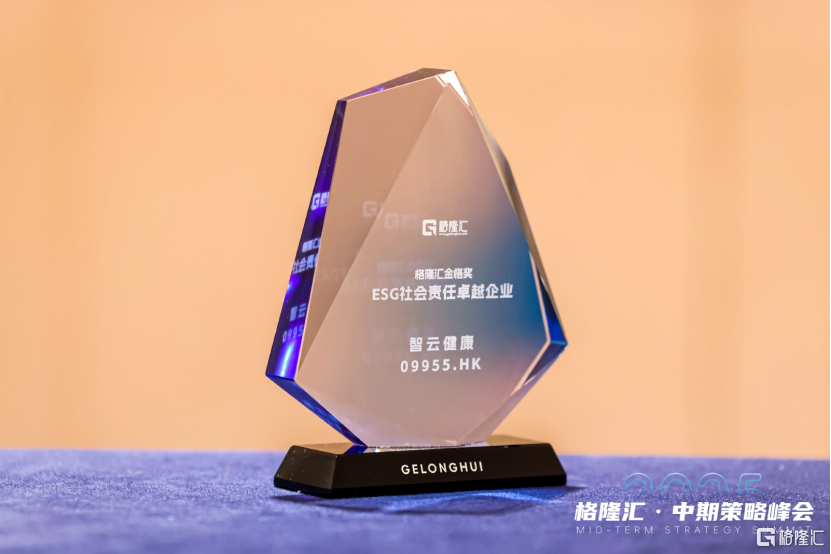
ESG“必选项”卓越典范:智云健康(09955.HK)获“ESG社会责任卓越企业”
Ge Long Hui· 2025-07-07 03:59
Core Insights - By 2025, global ESG asset management is expected to exceed $50 trillion, indicating that responsible investment has become mainstream and ESG standards are evolving into a core engine for corporate value reconstruction [1] - Zhiyun Health (09955.HK) was awarded the "Golden Award · ESG Social Responsibility Excellence Enterprise" at the "Gelonghui Mid-term Strategy Summit 2025," highlighting its integration of commercial and social value [1] Group 1: Strategic Upgrades and Innovations - Zhiyun Health's achievements in ESG stem from its deep insights into the healthcare industry and continuous business innovation, particularly in the chronic disease management market, which has significant growth potential [4] - The company has implemented a dual-driven strategy of "AI SaaS + P2M," enhancing overall efficiency in the healthcare ecosystem and establishing a vast network covering 2,738 hospitals and 242,700 pharmacies across China [4][6] - The P2M model has generated total revenue of 320 million yuan and achieved net profit, validating its commercial viability [4] Group 2: Product Development and Market Expansion - Zhiyun Health's self-developed product, Tangjing® Dapagliflozin Tablets, achieved over 10 million yuan in revenue within two months of its launch, indicating strong market penetration potential [5] - The company has entered into exclusive cooperation with Clinect Pty Ltd to introduce a new injectable drug for pulmonary arterial hypertension, expected to maintain rapid growth over the next five years [6] Group 3: Social Responsibility and Community Engagement - The company has implemented a SaaS system that has issued 264 million online prescriptions, benefiting over 38 million users while reducing paper usage and energy consumption [9] - Zhiyun Health actively participates in community activities, such as the "Rural Medical" charity initiative, donating digital health management software and medical equipment to improve healthcare services in underserved areas [10][12] Group 4: Future Outlook and ESG Integration - The integration of technology and a mission for inclusivity positions Zhiyun Health as a leader in sustainable growth, demonstrating that ESG is not merely a moral obligation but a compass for value creation [12] - The company's focus on personalized and precise health management solutions aims to enhance patient quality of life while fulfilling its social responsibilities [6][12]

智云健康(09955) - 2024 - 年度财报
2025-04-28 09:06
Financial Performance - Revenue for the year ended December 31, 2024, was RMB 3,488,094, a decrease of 5.5% compared to RMB 3,690,536 in 2023[7]. - Gross profit for 2024 was RMB 861,672, down 5.2% from RMB 909,382 in 2023[7]. - Operating loss increased by 19.7% to RMB 376,141 in 2024 from RMB 314,242 in 2023[7]. - Net loss for the year was RMB 491,390, representing a 50.1% increase from RMB 327,344 in 2023[7]. - The adjusted net loss (non-IFRS measure) for 2024 was RMB 116,093, an increase of 54.6% from RMB 75,100 in 2023[7]. - Total revenue for the year ended December 31, 2024, was RMB 3,488.1 million, a decrease of 5.5% year-on-year due to strategic transformation impacting value-added solutions in both inpatient and outpatient segments[22]. - Net loss for the reporting period was RMB 491.4 million, an increase of 50.1% year-on-year, primarily due to impairment losses related to assets of certain subsidiaries proposed for sale[22]. - Revenue for the fiscal year ending December 31, 2024, is projected to decrease by 5.5% to approximately RMB 3,488.1 million from RMB 3,690.5 million for the fiscal year ending December 31, 2023[50]. - Total loss for the fiscal year ending December 31, 2024, is projected to increase by 50.1% to approximately RMB 491.4 million, up from RMB 327.3 million for the fiscal year ending December 31, 2023[64]. Business Operations and Developments - The company has installed chronic disease management SaaS in over 2,700 hospitals, covering more than 40% of the top 100 hospitals in China[10]. - As of December 31, 2024, the company has installed pharmacy SaaS in over 242,650 pharmacies, achieving a penetration rate of over one-third of total pharmacies in China[11]. - The company issued over 1 billion online prescriptions through its internet hospitals, with a peak of over 1 million prescriptions per day in the last quarter of 2024[11]. - The company has developed two vertical models, ClouD GPT and ClouD DTx, enhancing accuracy and application capabilities in patient interaction and medical research[11]. - The company achieved an average of over 724,000 effective online prescriptions per day in 2024, continuing to serve more chronic disease patients[22]. - The company entered a licensing agreement to develop and market an injectable product for pulmonary arterial hypertension, expected to meet significant clinical demand in China[18][20]. - The company plans to focus on high-value AI-driven P2M solutions, optimizing resource allocation and improving cash flow in the short term[16]. - The strategic transformation aims to enhance the efficiency of the healthcare ecosystem and provide quality, affordable medical services and products[13]. - The company updated its revenue classification to better reflect business development, merging previous categories into inpatient and outpatient solutions[21]. Revenue Streams and Market Position - Subscription solution revenue, primarily from precision marketing services, decreased to RMB 281.9 million, a decline of 39.7% from RMB 467.2 million in the previous year[26][29]. - P2M solution revenue surged to RMB 286.0 million, marking a significant increase of 182.4% compared to RMB 101.2 million in the previous year[26][29]. - Revenue from the outpatient subscription solutions business line was RMB 57.3 million, a decrease of 3.0% from the previous year due to market competition[35]. - Revenue from the outpatient value-added solutions business line was RMB 591.7 million, down 1.3% year-over-year, as the strategic focus shifted to P2M solutions[35]. - The newly added P2M solutions business line generated revenue of RMB 34.4 million during the reporting period[35]. Employee and Compensation Information - The total number of employees as of December 31, 2024, was 1,218, with 408 in Hangzhou, 130 in Shanghai, and 680 in other offices in China[78]. - The total personnel-related costs for the year ended December 31, 2024, were approximately RMB 842.6 million, down from RMB 1,007.9 million for the year ended December 31, 2023[79]. - The cost for full-time employees for the year ended December 31, 2024, was approximately RMB 504.4 million, compared to RMB 629.4 million for the previous year[79]. - The company is committed to maintaining competitive and fair compensation, with total employee costs reflecting ongoing adjustments based on market research[79]. - The company has implemented various stock incentive plans to motivate employees and enhance performance[80]. Corporate Governance and Management - The company has a strong management team with diverse backgrounds in finance, technology, and healthcare, enhancing its strategic decision-making capabilities[160]. - The management team emphasizes the importance of independent judgment and oversight in corporate governance, as demonstrated by the roles of independent directors[155]. - The company is committed to maintaining high standards of corporate governance and compliance with listing rules[165]. - The independent auditor, KPMG, has audited the consolidated financial statements and is eligible for reappointment at the upcoming annual general meeting[144]. Shareholder Information and Equity - As of December 31, 2024, the total number of shares issued by the company is 587,038,219[167]. - Mr. Kuang holds 135,841,185 shares, representing 23.14% of the company's equity[167]. - Major shareholder Hang Tai Trust (Hong Kong) Limited holds 94,874,998 shares, representing 16.16%[171]. - The company has adopted three share plans, including pre-IPO equity incentive plans and post-IPO share reward plans[174]. - The total number of shares available for issuance under the pre-IPO equity incentive plan is capped at 25,440,160 shares, representing approximately 4.38% of the weighted average number of shares issued by the company from January 1, 2024, to December 31, 2024[175]. Risks and Regulatory Compliance - Risks associated with the contractual arrangements include potential penalties from the Chinese government if agreements are deemed non-compliant with laws[100]. - The company is closely monitoring regulatory developments in China to mitigate risks related to contractual arrangements[101]. - The company relies on its Chinese subsidiaries for dividend payments to meet cash and funding needs, which could impact business operations if restricted[100]. - Any failure by Hangzhou Kangming or registered shareholders to fulfill their contractual obligations could significantly adversely affect the company's business[100].
全力以赴拥抱AI新时代,智云健康(09955) 战略进阶2.0
智通财经网· 2025-03-31 01:01
Core Insights - The emergence of the domestic AI model DeepSeek has sparked significant interest in the AI+ healthcare sector in China, with predictions of substantial industry growth by 2030 [1] - The AI healthcare market is expected to grow at an annual rate of 43% from 2024 to 2032, potentially reaching a market size of $491 billion [1] - The company Zhiyun Health is positioned as a leading provider of chronic disease management and healthcare solutions in Hong Kong, focusing on strategic upgrades and business optimization [1][2] Company Performance - Zhiyun Health reported total revenue of approximately 3.49 billion RMB, with a slight increase in gross margin to 24.7%, despite an expanded net loss due to the disposal of non-core businesses [2][4] - The company's core business, the hospital solution segment, has shown robust growth through its unique "Touch, Deploy, Commercialize" (AIM) model, with over 2,700 hospitals adopting its SaaS products [3][4] Strategic Initiatives - The "P2M" strategy has been implemented to enhance operational efficiency and optimize business structure, resulting in a significant increase in revenue from P2M solutions, which reached 320 million RMB, nearly doubling year-on-year [4][5] - The company has signed contracts with 45 pharmaceutical companies, with a total of 55 SKUs, indicating strong collaboration in the pharmaceutical sector [4] Market Environment - The healthcare industry is undergoing significant changes due to centralized procurement reforms, with price reductions of 20% to 30% expected for many common drugs, which may pressure traditional business models [2] - The AI+ healthcare market is projected to exceed 100 billion RMB by 2026, with a compound annual growth rate of over 30%, presenting a substantial growth opportunity for companies like Zhiyun Health [7] Technological Advancements - Zhiyun Health has developed two vertical models, ClouD GPT and ClouD DTx, which excel in patient interaction and medical research, contributing to a comprehensive digital chronic disease management service [7][8] - The integration of the DeepSeek-R1 model into the company's AI system aims to enhance chronic disease management efficiency by leveraging over 1 billion electronic medical records [8] Future Outlook - With ongoing policy support and technological innovation, the AI+ healthcare market in China is expected to thrive, providing a favorable environment for Zhiyun Health's growth [6][7] - The company's strategic focus on optimizing its business structure and enhancing its AI capabilities positions it well for sustained growth and increased market share in the evolving healthcare landscape [9]
智云健康(09955)年度收入达34.88亿元,毛利8.62亿元 拟出售五间子公司股权
智通财经网· 2025-03-30 12:39
Core Viewpoint - Zhiyun Health (09955) reported a revenue of 3.488 billion RMB for the fiscal year ending December 31, 2024, with a gross profit of 862 million RMB and a stable gross margin of 24.7%, reflecting a year-on-year increase of 0.1 percentage points [1] Financial Performance - The increase in overall gross margin is attributed to the improvement in the gross margin of outpatient solutions, which rose from 14.2% for the year ending December 31, 2023, to 23.1% for the year ending December 31, 2024 [1] - The net profit of the five subsidiaries involved in the divestitures totaled 99.6 million RMB (pre-tax) for the fiscal year ending December 31, 2024 [6] Divestiture Details - On March 30, 2025, Zhiyun Health's subsidiary, Hangzhou Kangsheng Health Management Consulting Co., Ltd., agreed to sell 55% of Zhejiang Qilian Pharmaceutical Co., Ltd. for 33.5164 million RMB [1] - The company also agreed to sell 30% of Jiangsu Xinwange Medical Technology Co., Ltd. for 32 million RMB and 65% of Jiangsu Wandi Biotechnology Co., Ltd. for 3 million RMB [3] - Additionally, 75% of Lianyungang Zhenghe Scientific Instrument Co., Ltd. was sold for 8 million RMB, and 35% of Jiangsu Chengsheng Gene Precision Medical Technology Co., Ltd. was sold for 3 million RMB [4] Strategic Rationale - The divestitures align with the company's long-term strategy focusing on AI-driven SaaS technology advancements and monetizing the P2M (Patient to Manufacturer) pipeline [1] - The decision to divest is driven by strategic and operational considerations, particularly the need to optimize the P2M strategy and integrate AI as part of the company's transformation efforts [4] Market Impact - The five subsidiaries involved in the divestitures are significantly affected by the national medical insurance bureau's procurement policies, which have led to price reductions in their products [5] - The anticipated sixth batch of high-value medical consumables procurement and the eleventh batch of drug procurement by the national medical insurance bureau in 2025 is expected to adversely impact the future revenue, profit, and asset quality of these subsidiaries [5]
智云健康(09955) - 2024 - 年度业绩
2025-03-30 11:46
Financial Performance - For the fiscal year ending December 31, 2024, the company reported a revenue of RMB 3,488,094, a decrease of 5.5% compared to RMB 3,690,536 in 2023[3] - The gross profit for the same period was RMB 861,672, down 5.2% from RMB 909,382 in the previous year[3] - The company experienced an operating loss of RMB 376,141, which is a 19.7% increase from the operating loss of RMB 314,242 in 2023[3] - The net loss for the year was RMB 491,390, reflecting a 50.1% increase from RMB 327,344 in 2023[3] - The adjusted net loss (non-IFRS measure) was RMB 116,093, up 54.6% from RMB 75,100 in the previous year[3] - Total revenue for the year ended December 31, 2024, was RMB 3,488.1 million, a decrease of 5.5% year-on-year due to strategic transformation impacting value-added solutions[17] - The company's gross margin remained stable at 24.7%, an increase of 0.1 percentage points year-on-year[17] - The total comprehensive loss for the year was RMB 487,644 thousand, compared to RMB 321,464 thousand in 2023, highlighting increased financial challenges[79] - The company's total equity decreased to RMB 1,432,684 thousand in 2024 from RMB 1,765,306 thousand in 2023, reflecting a decline in shareholder value[81] - The group recorded a net operating cash outflow of RMB 148,391,000 and an operating loss of RMB 376,141,000 for the year ending December 31, 2024[84] Revenue Segmentation - The company has restructured its revenue classification into "in-hospital solutions" and "out-of-hospital solutions" to better reflect its business development and future direction[16] - Revenue from the "In-Hospital Solutions" segment decreased to RMB 2,115,411,000 in 2024 from RMB 2,304,597,000 in 2023, representing a decline of approximately 8.2%[89] - Revenue from the "Patient to Manufacturer (P2M) Solutions" increased significantly to RMB 285,968,000 in 2024 from RMB 101,249,000 in 2023, marking an increase of approximately 182.5%[89] - The P2M solutions achieved total revenue of RMB 320.4 million by December 31, 2024, driven by steady growth in the sales of proprietary products[12] - The revenue from outpatient solutions was RMB 804.8 million, a slight decrease of 1.5% from RMB 817.5 million in the previous year[29] - Inpatient solutions revenue decreased by 6.6% from approximately RMB 2,873.1 million to approximately RMB 2,683.3 million, primarily due to lower sales of medical devices and consumables[34] SaaS and Digital Solutions - The company has installed its hospital SaaS in over 2,700 hospitals, covering more than 40% of the top 100 hospitals in China[6] - The pharmacy SaaS has been installed in over 242,650 pharmacies, representing over one-third of the total pharmacies in China[7] - The company has issued over 1 billion online prescriptions through its internet hospital services, with a peak of over 1 million prescriptions per day in the last quarter of 2024[7] - The average daily effective prescriptions exceeded 724,000 in 2024, indicating continued service to a growing number of chronic disease patients[17] - The company aims to enhance its digital capabilities to connect industrial enterprises with end hospitals and pharmacies, improving product accessibility for chronic disease patients[12] - The company installed its Zhiyun Medical SaaS in 2,738 hospitals, including 822 tertiary public hospitals and 1,140 secondary public hospitals, enhancing its hospital network[19] Cost Management and Expenses - Administrative expenses decreased significantly by 31.8% from RMB 340.2 million to RMB 232.0 million, mainly due to reduced share-based payment expenses[39] - R&D expenses decreased from approximately RMB 88.0 million to approximately RMB 75.4 million, reflecting the maturity of SaaS products[40] - Employee costs decreased to RMB 504,409,000 in 2024 from RMB 629,381,000 in 2023, a reduction of approximately 19.8%[97] - The total personnel-related costs for the year ended December 31, 2024, were approximately RMB 842.6 million, a decrease from RMB 1,007.9 million for the year ended December 31, 2023[65] Strategic Partnerships and Future Plans - The strategic partnership with pharmaceutical companies is expected to drive profitability through exclusive rights to sell proprietary products[12] - The company plans to focus on high-value AI-driven P2M solutions, reducing reliance on low-margin medical supplies and consumables[11] - The company plans to focus on strengthening its hospital and pharmacy SaaS infrastructure and investing in product and technology innovation, particularly in medical AI[31] Divestments and Acquisitions - The company completed a share transfer agreement to sell 55% of its subsidiary Zhejiang Qilian Pharmaceutical Co., Ltd. for RMB 33,516,375, aligning with its long-term strategy focused on AI-driven SaaS technology advancements[113] - The company announced the strategic decision to divest five subsidiaries, including Zhenghe Scientific Instruments and Jiangsu Chengsheng, due to low value addition and minimal relevance to its core strategy[152] - The divestment is expected to improve the company's long-term cash flow by reducing the need for significant operational funding for the divested subsidiaries[153] - The total consideration for the sale of New Wange Medical is RMB 32,000,000, while the total consideration for the sale of Wandi Biotechnology is RMB 3,000,000[131] Financial Health and Liabilities - The company has no significant investments or capital asset future plans as of December 31, 2024[56] - The company did not have any significant contingent liabilities as of December 31, 2024, consistent with the previous year[59] - The debt-to-asset ratio increased to 42.1% from 33.2% as of December 31, 2023, primarily due to an increase in bank and other loans[57] - Financing costs rose by 44.8% from approximately RMB 11.5 million to approximately RMB 16.6 million, attributed to increased bank and other loans[42] Shareholder Returns - The company does not recommend the distribution of a final dividend for the fiscal year ending December 31, 2024[4] - The company did not recommend any dividends for the years ended December 31, 2024, and 2023[109]
智云健康携手浙江省图灵研究院,以AI共筑智慧医疗新生态
Sou Hu Cai Jing· 2025-03-26 04:37
Core Viewpoint - The strategic partnership between Zhiyun Health and Zhejiang Turing Research Institute aims to build a smart healthcare ecosystem through collaboration in digital technology and the health industry, enhancing healthcare services quality and efficiency [1][3]. Group 1: Strategic Cooperation - Zhiyun Health and Zhejiang Turing Research Institute signed a strategic cooperation agreement focused on building a smart healthcare ecosystem through resource sharing and collaborative development [1]. - The partnership will leverage both parties' strengths to create national standards and industry white papers for the smart healthcare sector, promoting standardized development [3][4]. Group 2: Technological Innovation - Zhiyun Health utilizes an "AI SaaS + P2M" model, employing advanced AI technologies like DeepSeek to establish a comprehensive service network in chronic disease management and internet hospitals [3]. - The Turing Research Institute, recognized for its expertise in AI and big data, aims to accelerate the transformation of cutting-edge research into practical applications in the healthcare sector [3][4]. Group 3: Innovation Ecosystem - The collaboration is expected to create a full-cycle innovation ecosystem centered around AI, enhancing the quality and efficiency of healthcare services [5]. - This ecosystem will facilitate the integration of technological research, practical validation, standardization, and project implementation, contributing to the "Healthy China 2030" strategic goals [5].

智云健康-AI-纪要
2025-02-21 02:39
Summary of Zhiyun Health Conference Call Company Overview - Zhiyun Health is the largest digital chronic disease management platform in China, utilizing standardized SaaS products and AI technology to connect over 2,700 hospitals and more than 220,000 pharmacies [3][4][15]. Core Business Model - The company focuses on chronic disease departments in hospitals, providing CRM systems and connecting medical IoT devices to assist doctors in the diagnosis process, accumulating structured case data for digital marketing and self-operated product sales [2][3]. - The introduction of the "AI + P2M" model aims to enhance medical efficiency and profitability by selecting quality self-operated products for sale [2][6]. AI and Technology Integration - Zhiyun Health has developed two major AI models: MediGPT for human-machine interaction and MediTXGPT for research, utilizing data from millions of literature guidelines and over 2,700 hospital HIS systems [2][5]. - The AI medical knowledge graph covers nearly 20,000 drug generic names and 200,000 entity relationships, achieving higher accuracy in chronic disease management than human doctors [2][9]. Financial Projections and Strategic Adjustments - The company is shifting its focus towards high-value businesses such as P2M and digital marketing, projecting overall revenue of 1.5 to 2 billion yuan by 2025, with a gross margin increase from 20% to 50% [4][21][24]. - Digital marketing services are expected to contribute significantly, with a gross margin of around 90% [22]. Data Management and Usage - Zhiyun Health has accumulated over 1 billion outpatient prescription data, with approximately 330 million generated in 2024 alone, making it the largest outpatient prescription system in China [2][8][15]. - Data acquisition is conducted with hospital consent, ensuring privacy through de-identification, and is primarily used for scientific research and academic purposes [8][40]. Product Portfolio and Market Performance - Key products include Dapagliflozin tablets, which is among the top 20 global sales drugs, with sales in China nearing 10 billion yuan [16][17]. - The company plans to expand its self-operated product offerings and digital marketing services to enhance engagement with doctors and hospitals [18][21]. Future Development Plans - Future strategies include deepening AI technology applications across all processes, expanding self-operated products, and optimizing the red-green light prescription review mechanism to improve overall medical quality [18][31]. - The company aims to achieve positive cash flow by 2025 and expects to turn a profit by 2026 [31]. Market Trends and Opportunities - The market for pulmonary arterial hypertension (PAH) drugs is expected to grow significantly, especially with the introduction of unique products like the Laisent injection [19][20]. - The company recognizes the importance of chronic disease management and aims to leverage AI to enhance diagnostic efficiency and patient care [41][44]. Conclusion - Zhiyun Health is positioned to capitalize on the growing demand for digital health solutions and chronic disease management, with a strong focus on AI integration, data utilization, and strategic partnerships to drive future growth and profitability [2][4][18][30].