
NTES(09999)

Search documents
藏不住!近5年最亮眼的半年报,游戏行业重回增长区间
Sou Hu Cai Jing· 2025-08-20 02:23
Core Viewpoint - The gaming industry has shown significant recovery in the first half of 2025, with many companies reporting improved financial performance, indicating a return to growth after a challenging period [3][6][26]. Group 1: Company Performance - Seven gaming companies turned losses into profits, while six companies reported profit increases, and one company saw a reduction in losses [3]. - Tencent's gaming revenue reached 1187 billion, growing by 23%, while NetEase's gaming revenue was 468 billion, up by 6.12% [6]. - Century Huatong's net profit is projected to be between 23.9 to 27 billion, marking a growth of 107.2% to 159% [4]. - Heartbeat Company reported a profit of 7.9 billion, an increase of 215% [4]. - Perfect World has turned a profit with a net profit of 4.8 to 5.2 billion, attributed to the success of its game "Zhu Xian World" [10]. Group 2: Industry Trends - The overall gaming market in China grew by 14.08% year-on-year, the highest growth rate in nearly five years [6][15]. - The number of approved game licenses has increased, with 946 licenses issued in the first seven months of the year, a 19.29% increase [15][19]. - The gaming sector is experiencing renewed investor interest, with gaming stocks outperforming other industries, and a gaming ETF rising over 38% this year [8][12]. Group 3: Government Support - Various local governments have introduced policies to support the gaming industry, including financial incentives for original games and technology innovation [19][23]. - The central government has recognized the cultural significance of games, leading to increased support for the industry [17][19]. Group 4: Future Outlook - The gaming industry is expected to continue its upward trajectory, with new high-quality projects being developed and a focus on diverse game types [20][25]. - The recovery of confidence in the industry is evident, with companies increasing R&D investments and launching promising new titles [20][25].




智通ADR统计 | 8月20日




智通财经网· 2025-08-19 22:42
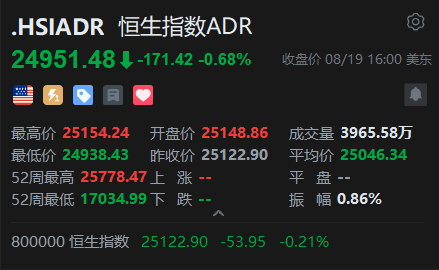
Market Overview - The Hang Seng Index (HSI) closed at 24,951.48, down by 171.42 points or 0.68% as of August 19, 16:00 Eastern Time [1] - The index reached a high of 25,154.24 and a low of 24,938.43 during the trading session, with a trading volume of 39.6558 million [1] - The 52-week high for the index is 25,778.47, while the 52-week low is 17,034.99 [1] Blue-Chip Stocks Performance - Major blue-chip stocks mostly declined, with HSBC Holdings closing at HKD 99.581, up 0.54% compared to the Hong Kong close [2] - Tencent Holdings closed at HKD 588.764, down 0.63% compared to the Hong Kong close [2] Individual Stock Movements - Tencent Holdings (00700) saw a price of HKD 592.500, an increase of HKD 5.500 or 0.94%, but its ADR price was HKD 588.764, down HKD 3.736 compared to the Hong Kong close [3] - Alibaba Group (09988) closed at HKD 118.300, down HKD 0.300 or 0.25%, with an ADR price of HKD 116.979, down HKD 1.321 [3] - HSBC Holdings (00005) had a closing price of HKD 99.050, up HKD 0.600 or 0.61%, with an ADR price of HKD 99.581, up HKD 0.531 [3] - Xiaomi Group (01810) closed at HKD 52.400, down HKD 0.650 or 1.23%, with an ADR price of HKD 52.255, down HKD 0.145 [3] - AIA Group (01299) closed at HKD 74.200, down HKD 0.400 or 0.54%, with an ADR price of HKD 73.722, down HKD 0.478 [3]
热门中概股周二涨跌不一 小鹏蔚来涨超4%


Xin Lang Cai Jing· 2025-08-19 20:32
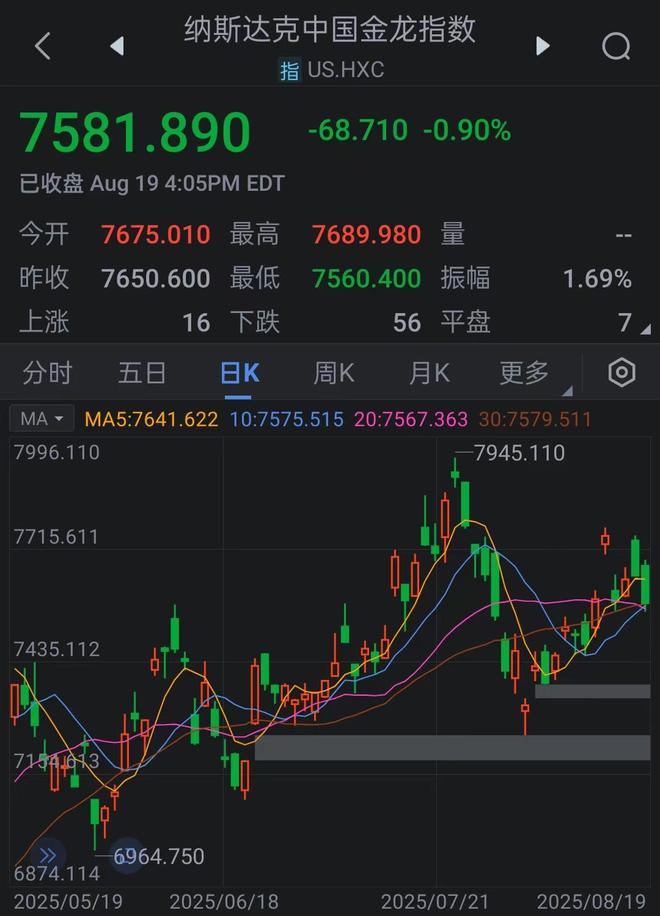
Group 1 - The Nasdaq Golden Dragon China Index declined by 0.9% on Tuesday [1] - TSMC fell over 3%, while Alibaba, NetEase, JD.com, Baidu, and Bilibili each dropped over 1% [1] - Futu Holdings decreased by more than 2%, and Li Auto fell nearly 1% [1] Group 2 - Xpeng and NIO saw gains of over 4% [1]
网易-S(09999.HK):销售费率环比回升 公司游戏持续布局全球化
Ge Long Hui· 2025-08-19 18:47
Group 1: Financial Performance - In Q2 2025, the company achieved revenue of 27.9 billion yuan, a year-on-year increase of 9% [1] - Non-GAAP net profit reached 9.5 billion yuan, up 22% year-on-year, with a Non-GAAP net profit margin of 34.2%, an increase of 3 percentage points [1] - The comprehensive gross profit margin was 64.7%, up 1.8 percentage points year-on-year, while the total operating expense ratio was 32%, down 3 percentage points year-on-year [1] Group 2: Gaming Business - Online gaming revenue for Q2 2025 was 22.1 billion yuan, a 15% year-on-year increase, with strong performance from titles like "Identity V" and "Marvel Duel" [2] - Deferred revenue reached 16.97 billion yuan, a 25% year-on-year increase, indicating healthy future revenue streams [2] - The company is focusing on global expansion with new game releases and updates, achieving significant rankings on various platforms [2] Group 3: Youdao and Cloud Music - Youdao's net revenue for Q2 2025 was 1.4 billion yuan, a 7% year-on-year increase, driven by a 24% growth in advertising services [2] - Net revenue for NetEase Cloud Music was 2 billion yuan, down 4% year-on-year, with a gross margin of 36.1%, up 4 percentage points year-on-year [3] - The company is expected to increase investment in copyright content in the second half of the year, which may lead to a decrease in gross margin [3] Group 4: Investment Outlook - The company is recognized for its strong game development capabilities and is expected to maintain profitability, with adjusted net profit forecasts of 39.3 billion, 42.5 billion, and 46.7 billion yuan for 2025-2027 [3] - Continued focus on high-quality and globalized game offerings is anticipated, with key titles to watch including "Destiny: Stars," "Forgotten Sea," and "Return to Tang" [3]
中华交易服务中国香港内地指数下跌0.14%,前十大权重包含网易-S等
Jin Rong Jie· 2025-08-19 14:25
Core Points - The China Hong Kong Mainland Index (CESHKM) experienced a slight decline of 0.14%, closing at 6792.28 points with a trading volume of 65.52 billion [1] - Over the past month, the CESHKM has decreased by 0.15%, while it has increased by 4.74% over the last three months and 21.51% year-to-date [1] Index Composition - The CESHKM is part of a series of indices that include the China 120 Index, China A80 Index, and China 280 Index, designed to reflect the overall performance of large and mid-cap securities listed in Shanghai, Shenzhen, and Hong Kong [1] - The index is based on a base date of December 31, 2004, with a base point of 2000.0 [1] Top Holdings - The top ten weighted stocks in the CESHKM are Tencent Holdings (11.22%), Alibaba-W (9.88%), Xiaomi Group-W (7.84%), China Construction Bank (7.63%), Meituan-W (6.08%), China Mobile (4.49%), Industrial and Commercial Bank of China (4.2%), Ping An Insurance (3.51%), BYD Company (3.46%), and NetEase-S (3.27%) [1] Sector Allocation - The index is fully composed of stocks listed on the Hong Kong Stock Exchange [2] - Sector allocations within the index include Consumer Discretionary (30.54%), Communication Services (23.36%), Financials (21.57%), Information Technology (10.58%), Energy (5.88%), Healthcare (3.31%), Real Estate (2.43%), Consumer Staples (1.16%), Industrials (0.62%), and Materials (0.54%) [2]
2025年Q2腾讯联想京东等实现两位数增长,释放了什么信号?
Sou Hu Cai Jing· 2025-08-19 10:03
Core Viewpoint - The major technology and internet companies in China, including Tencent, JD.com, Lenovo, and NetEase, reported second-quarter earnings that exceeded expectations, indicating a recovery in the industry after a challenging period [1][4]. Group 1: Financial Performance - Leading companies achieved nearly double-digit or higher-than-expected growth, with Tencent reporting revenue of 184.5 billion RMB, a 15% year-on-year increase; Lenovo's revenue reached 127.9 billion RMB, growing by 24%; JD.com reported 356.7 billion RMB, up 22.4%; and NetEase saw a growth of 9.4% [5]. - This growth suggests that the previously feared "winter" for the industry may have ended, marking a phase of sustained recovery and development with significant growth momentum [5]. Group 2: Macroeconomic Significance - The recovery of the technology and internet sector is particularly meaningful from a macroeconomic perspective, reflecting improvements in the domestic consumer market and accelerated digital transformation of industries [7]. - Companies like JD.com and Alibaba serve as barometers for the health of China's real economy, with JD.com exceeding expectations in its financial report [7]. Group 3: Role of Artificial Intelligence - All companies that reported growth identified AI as a strategic priority, elevating its role beyond just a tool to a core infrastructure [8]. - Tencent integrated AI into its gaming, advertising, and social ecosystems, driving significant growth in its core business areas [8]. - Lenovo's AI PC penetration reached over 30% of its total PC shipments, with AI infrastructure revenue surging by 155%, indicating a strong market position in AI solutions [8][9]. Group 4: Linkage to the Real Economy - Major tech companies are increasingly leveraging their technological capabilities and platform resources to support the real economy [10]. - JD.com is enhancing traditional retail through its supply chain services, while Lenovo is optimizing manufacturing processes with AI solutions, demonstrating the impact of technology on traditional industries [10]. - Tencent is providing comprehensive services to small and medium-sized enterprises, facilitating their digital transformation through various AI applications [10][11].


港股收评:恒指跌0.21%,芯片股下挫,东方甄选高台跳水近21%!
Ge Long Hui· 2025-08-19 08:47
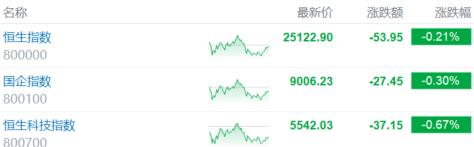
Market Overview - The Hong Kong stock market experienced a slight decline on August 19, with the Hang Seng Index falling by 0.21% to 25,122.90, the Hang Seng China Enterprises Index down by 0.30% to 9,006.23, and the Hang Seng Tech Index decreasing by 0.67% to 5,542.03, indicating a relatively stable overall sentiment [1][2]. Sector Performance - Major technology stocks mostly declined, with significant drops in the film and television sector, semiconductor stocks, Chinese brokerage firms, rare earth concept stocks, innovative pharmaceuticals, gold stocks, and brain-computer interface concept stocks. Notably, the live-streaming stock Dongfang Zhenxuan plummeted nearly 21% [2][3]. - The property management sector showed strength throughout the day, while consumer sectors such as restaurants and sports goods performed actively [2][3]. Individual Stock Movements - Major tech stocks like NetEase and Xiaomi fell by 1.2% and 1.23% respectively, while Meituan and JD.com also saw slight declines. Tencent and Kuaishou experienced minor increases [4][5]. - Semiconductor stocks faced significant declines, with SMIC and Hua Hong Semiconductor dropping over 3%. However, a report from Tianfeng Securities suggests a positive outlook for global semiconductor growth driven by AI by 2025 [5][6]. - The pharmaceutical outsourcing sector saw substantial losses, with Tigermed down over 8% and other companies like WuXi AppTec and Zai Lab also declining significantly [7][8]. - Chinese brokerage stocks fell, with Xingsheng International down over 6% and other major firms like China International Capital Corporation and Shenwan Hongyuan also experiencing declines. However, there are indications of improving liquidity in the securities market, which could benefit brokerage firms [8]. Gold and Precious Metals - Gold and precious metals stocks declined, with companies like Chifeng Jilong Gold and Lingbao Gold dropping over 3%. Market sentiment is influenced by expectations surrounding the Federal Reserve's policy direction and geopolitical developments [8][9]. Property Management and Consumer Sectors - The property management sector saw notable gains, with Wanwu Cloud rising over 7% and other firms like Zhengrong Service and Rongchuang Service also increasing by more than 5%. This is supported by government measures to stabilize the real estate market [9][10]. - The restaurant sector experienced significant gains, with Daoxiang Holdings up over 11% and other companies like Xiaocaiyuan and Haidilao also showing positive performance [11]. Capital Inflows - Southbound funds recorded a net inflow of 18.573 billion HKD, with the Shanghai-Hong Kong Stock Connect contributing 8.911 billion HKD and the Shenzhen-Hong Kong Stock Connect adding 9.662 billion HKD [14]. Market Sentiment - Huatai Securities noted that the Hong Kong stock index has been fluctuating but is on an upward trend, with increased volatility. The market is currently in a critical phase awaiting verification of significant domestic and international events, suggesting a window for position adjustments [16].


花旗给予中国生物制药买入评级
Xin Lang Cai Jing· 2025-08-19 07:50
Group 1 - Citigroup gives a "Buy" rating to China Biologic Products with a target price raised to HKD 10.5, expecting over 19 new products to be approved in the next three years, many with sales potential exceeding HKD 20 billion [1] - CMB International maintains a "Buy" rating for Sea Group, raising the target price to HKD 28, citing significant profit growth and improved profitability due to strong volume and price increases in the first half of the year [4] - CITIC Securities maintains a "Buy" rating for JD Health, highlighting strong sales growth in pharmaceuticals and health products, and the efficiency improvements from AI medical applications [2] Group 2 - CITIC Securities maintains a "Buy" rating for Netease-S, raising the target price to HKD 240, driven by steady growth in gaming revenue and expectations of new game launches boosting future income [3] - CITIC Securities maintains a "Buy" rating for Leap Motor, raising the target price to HKD 89.2, with expectations of accelerated new car cycles leading to sustained sales and profit growth [5] - CITIC Securities maintains a "Buy" rating for Xtep International, noting robust growth driven by e-commerce and double-digit growth in same-store sales for its subsidiary [6] Group 3 - CICC maintains an "Outperform" rating for Standard Chartered Group, with second-quarter results exceeding expectations, particularly in non-interest income and wealth management [7] - Huaxing Securities maintains a "Buy" rating for Tencent Holdings, raising the target price to HKD 685, citing strong performance across all business segments, particularly in AI-driven advertising revenue [8]



网易《率土之滨》与灵犀互娱《三国志·战略版》原创之争再起波澜:二审发回重审 玩法规则能否享有著作权?
Xin Lang Zheng Quan· 2025-08-19 06:09
Core Viewpoint - The Guangzhou Intellectual Property Court overturned the first-instance ruling that recognized copyright infringement by Lingxi Interactive Entertainment's "Three Kingdoms Strategy Edition" against NetEase's "Rate of the Land," emphasizing that game rules are considered "ideas" and not protected by copyright law [1][2]. Group 1: Legal Proceedings - The first-instance ruling in 2023 recognized 79 instances of structural plagiarism in "Three Kingdoms Strategy Edition," leading to a compensation order of 50 million yuan, marking a historic acknowledgment of gameplay mechanics under copyright [2]. - The second-instance ruling highlighted two critical issues: the use of a later version of "Rate of the Land" for comparison, which led to factual discrepancies, and the distinction between ideas and expressions, asserting that gameplay rules are operational methods that should not be monopolized [2]. Group 2: Market Dynamics - Following the second-instance ruling, NetEase signaled its intent to continue legal action, aiming to reinforce its brand image as a "true original" [3][5]. - "Rate of the Land" saw a 100% year-on-year increase in downloads in 2025, with a 28% rise in revenue, attributed to its youth-oriented gameplay model [5]. - Lingxi Interactive's "Three Kingdoms Strategy Edition" maintained a position in the top 20 bestsellers, with over 100 million global users in 2024, leveraging innovative designs and patented technologies [6]. Group 3: Industry Implications - The second-instance ruling clarified that copyright law protects only specific expressions, prompting companies to adjust their protection strategies by separating copyrightable elements and patenting technologies [7][8]. - The competitive landscape in the Three Kingdoms SLG sector has intensified, with both companies engaging in aggressive marketing strategies to attract younger users and deepen cultural connections [9]. Group 4: Future Outlook - The focus of the retrial will be on whether Lingxi's "Three Kingdoms Strategy Edition" intentionally mimicked the overall experience of "Rate of the Land," which could have broader implications for industry practices regarding gameplay innovation [10].
国信证券晨会纪要-20250819
Guoxin Securities· 2025-08-19 01:21
Key Insights - The report highlights the growth potential of the Chinese casual dining sector, with a market size projected to reach approximately 3.9 trillion yuan by 2025, growing at a CAGR of 8.9% from 2023 to 2028 [9] - The company "小菜园" (Little Garden) is identified as a leading player in the casual dining space, with a focus on cost-effectiveness and a successful expansion strategy across China [8][11] - In 2024, Little Garden achieved revenue of 5.21 billion yuan, representing a year-on-year increase of 14.5%, and a net profit of 580 million yuan, up 9.1% [8] - The company plans to continue its expansion, with projections to increase its store count significantly from 667 in 2024 to 1,809 by 2030 [10] Company Overview - Little Garden operates a direct sales model and emphasizes value for money, with an average dining price of 59.2 yuan in 2024 [8] - The company has a strong presence in the East China region, with over 80% of its stores located there, and aims to penetrate deeper into this market while exploring new regions [10] - The report anticipates that the company's net profit will grow to 770 million yuan, 940 million yuan, and 1.12 billion yuan in 2025, 2026, and 2027 respectively, reflecting growth rates of 32%, 22%, and 19% [11] Industry Analysis - The casual dining market is characterized by a fragmented landscape, with the top five companies holding less than 1% market share, indicating significant opportunities for brands that can capture the lower-tier markets and enhance online presence [9] - The report draws parallels with Japan's dining sector, noting that leading companies can thrive even during economic downturns, suggesting a resilient growth trajectory for Little Garden [9] - The report emphasizes the importance of supply chain efficiency and operational improvements as key drivers for profitability in the casual dining sector [10] Investment Recommendations - The report suggests a target stock price range for Little Garden of 13.4 to 14.3 HKD, indicating a potential upside of 32.3% from the current price [11] - The company is rated "outperform" based on its strong market position, effective expansion strategy, and improving operational efficiency [11]


