
NTES(09999)

Search documents
春节后第二个交易日,港股高开高走,科网股集体上涨,智谱盘中跌超20%、MINIMAX跌超10%|开盘播报
Mei Ri Jing Ji Xin Wen· 2026-02-23 01:58
Market Performance - The Hang Seng Index and the Hang Seng Tech Index opened high, with the Hang Seng Index rising by 1.46% and the Hang Seng Tech Index increasing by 1.77% [1] - As of the report, the Hang Seng Tech Index had risen over 3%, currently at 5368.750 points, while the Hang Seng Index was up by 2% [1] Stock Movements - Tech stocks collectively opened higher, with notable increases: NetEase up 3%, Meituan up 2%, Alibaba nearly 2%, Tencent up 1%, and Kuaishou over 3% [3] - Semiconductor stocks also showed strength, with Hua Hong Semiconductor rising by 4% and SMIC increasing by over 3% [3] - Gold stocks performed well, with China Gold International up nearly 7% and Shandong Gold up over 5% [3] Individual Stock Performance - Notable stock performances included: - NetEase-S at 186.000, up 3.74% [4] - JD Health at 58.750, up 3.34% [4] - Kuaishou-W at 68.500, up 3.01% [4] - Meituan-W at 87.750, up 7.180% [4] - Other stocks like Tencent Music-SW and Alibaba-W also saw increases of 2.05% and 1.90%, respectively [5] Declines in Specific Stocks - Zhipu experienced significant declines, with a drop of over 20% at one point, and MINIMAX also fell by over 10%, although the declines narrowed by the time of reporting [6] - Zhipu's apology letter addressed issues related to the GLM-5 release, citing problems with transparency and upgrade mechanisms, which contributed to the stock's volatility [6]



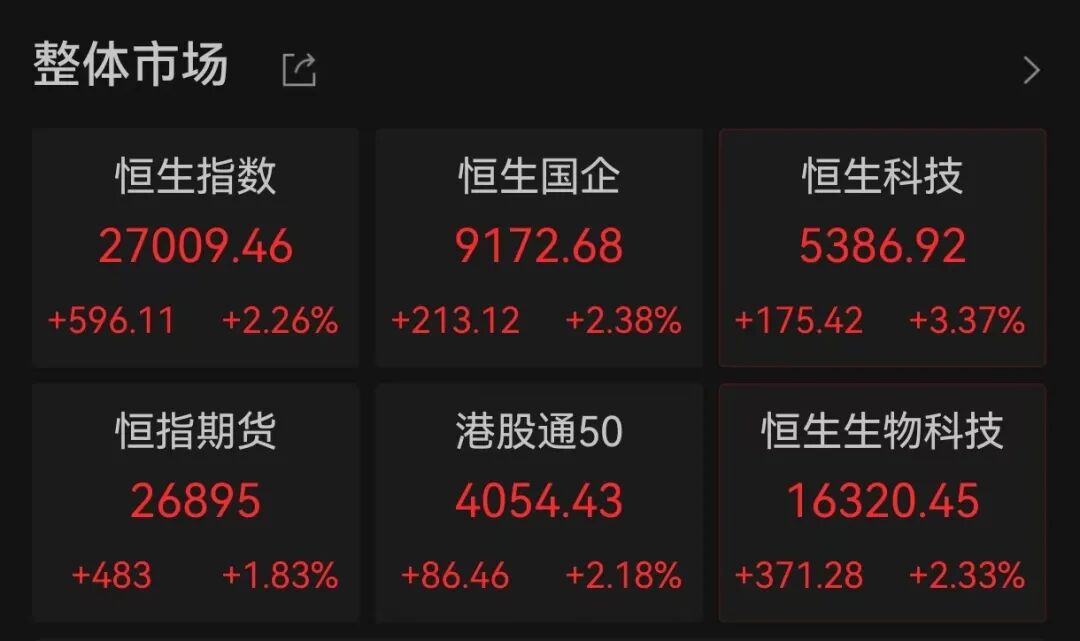
港股科网股盘初普涨,网易-S(09999.HK)涨4.18%、京东健康(06618.HK)涨3.2%、快手(01024.HK)涨3.01%、美团(036...
Jin Rong Jie· 2026-02-23 01:50
本文源自:金融界AI电报 港股科网股盘初普涨,网易-S(09999.HK)涨4.18%、京东健康(06618.HK)涨3.2%、快手(01024.HK)涨 3.01%、美团(03690.HK)涨3%。 ...


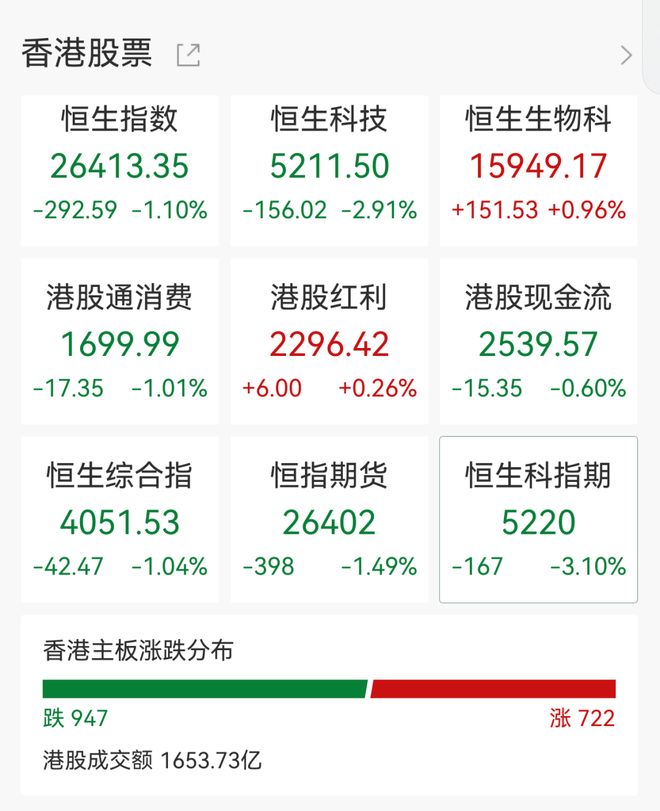
智通ADR统计 | 2月21日
智通财经网· 2026-02-20 23:59
Group 1 - Major blue-chip stocks mostly rose, with HSBC Holdings closing at HKD 137.775, up 2.59% from the previous close in Hong Kong [2] - Tencent Holdings closed at HKD 531.758, an increase of 1.87% from the previous close in Hong Kong [2] Group 2 - Tencent Holdings reported a latest price of HKD 522.000, down HKD 11.000 or 2.06%, with an ADR price of HKD 531.758, showing an increase of HKD 9.758 compared to the Hong Kong stock price [3] - Alibaba Group (W) had a latest price of HKD 147.100, down HKD 7.600 or 4.91%, with an ADR price of HKD 150.874, reflecting an increase of HKD 3.774 compared to the Hong Kong stock price [3] - HSBC Holdings had a latest price of HKD 134.300, up HKD 0.100 or 0.07%, with an ADR price of HKD 137.775, indicating an increase of HKD 3.475 compared to the Hong Kong stock price [3]




利弗莫尔中概股龙头指数收涨0.94%,网易有道涨近10%
Xin Lang Cai Jing· 2026-02-20 23:48
Core Viewpoint - The Lili Fomor Chinese concept stock index rose by 0.94%, indicating a positive market sentiment towards Chinese stocks listed in the U.S. [1] Group 1: Stock Performances - NetEase Youdao saw a significant increase of nearly 10% [1] - Hilltop Metal Mining rose over 5% [1] - Tuya Smart increased by more than 4% [1] - Daylight Technology and Zhiyuan Group both experienced gains of over 3% [1] Group 2: Declining Stocks - Century Internet fell by more than 4% [1] - AHG and NEGG both dropped over 3% [1] - Wenyan Zhixing and Bilibili declined by more than 2% [1]
网易有道股价单日涨超10%,AI开源产品与财报支撑市场信心
Xin Lang Cai Jing· 2026-02-20 22:46
Core Viewpoint - NetEase Youdao (DAO.N) stock experienced a significant increase on February 20, 2026, primarily due to the launch of its desktop-level Agent "LobsterAI," which is seen as a key move in deepening the company's "AI-native" strategy and expanding its technological applications [1] Group 1: Stock Price Movement Reasons - On February 19, NetEase Youdao officially open-sourced its desktop-level Agent "LobsterAI," positioning it as a "24/7 all-scenario personal assistant Agent," which resonated with the recent global AI trends and boosted investor confidence in AI applications [1] Group 2: Sector Performance - On February 20, the Hong Kong AI sector saw a significant surge, with companies like Zhiyuan AI and MiniMax experiencing stock price increases of over 14%, and some individual stocks rising by as much as 37%. Although NetEase Youdao trades on the US stock market, its business is closely related to AI applications, benefiting from the positive sentiment in the sector [2] Group 3: Performance and Operating Conditions - The company released its 2025 financial report on February 11, 2026, showing its first annual operating cash net inflow of 55.2 million yuan. The fourth quarter net revenue grew by 16.8% year-on-year, marking six consecutive quarters of profitability. Online marketing service revenue increased by 28.5%, and AI subscription service annual sales approached 400 million yuan, providing fundamental support for the stock price [3] Group 4: Financial and Technical Aspects - On February 20, NetEase Youdao's stock trading volume reached 239,254 shares, significantly higher than previous periods. The closing price was $10.18, with a single-day increase of 10.17% and a volatility of 12.55%. The active trading volume indicates concentrated market attention in the short term, potentially accelerating price fluctuations [4]
中概股龙头指数收涨0.94% 网易有道涨近10%




Mei Ri Jing Ji Xin Wen· 2026-02-20 22:10
Group 1 - The leading index of Chinese concept stocks rose by 0.94% on February 21 [1] - Among the constituent stocks, NetEase Youdao increased by nearly 10%, Hilltop Metal Mining rose over 5%, and Tuya Smart gained more than 4% [1] - Other notable gainers included Daylight Technology and Zhiyun Group, both rising over 3% [1] Group 2 - Century Internet and Lufax both fell by over 4%, while AHG and NEGG dropped more than 3% [1] - Other decliners included Wenyan Zhixing and Bilibili, which both decreased by over 2% [1]
两大交易所集中释放利好
2 1 Shi Ji Jing Ji Bao Dao· 2026-02-20 13:07
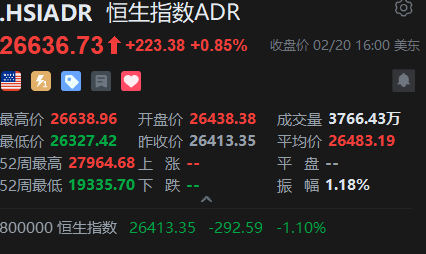
Market Overview - The Hong Kong stock market opened on February 20, 2023, with the Hang Seng Index closing down by 1.10% and the Hang Seng Tech Index down by 2.91% [1][8] - Despite the overall market decline, several robotics concept stocks rose significantly, indicating a "Spring Festival effect" [3][11] IPO and Market Activity - As of the new year, 24 new stocks have been listed on the Hong Kong Stock Exchange, raising over 87 billion HKD, with 488 companies currently waiting to go public [4][15] - The average daily trading volume in January exceeded 278 billion HKD, reflecting the effectiveness of liquidity enhancement measures [15] Sector Performance - The technology sector faced pressure, with major internet stocks like JD Health, Baidu, Alibaba, and Tencent experiencing declines ranging from 2.06% to 6.27% [9][10] - In contrast, the robotics sector saw notable gains, with stocks such as Yujian up by 21.4%, Sutech up by 9.24%, and Ubtech up by 4.71% [11][12] Gold Market - The Hong Kong gold market also performed well, with gold prices rising to 46,685 HKD per tael, an increase of over 200 HKD from the previous trading day [17][18] - The Hong Kong government aims to establish the city as an international gold trading center, targeting over 2,000 tons in gold storage within three years [16][17] Index Adjustments - The Hang Seng Index will increase its constituent stocks from 88 to 90, adding companies like CATL and Luoyang Molybdenum, effective March 9, 2023 [18][19] - The adjustments in the Hong Kong Stock Connect are expected to lead to significant trading activity, particularly for newly included stocks in the healthcare and technology sectors [19]


智通ADR统计 | 2月20日
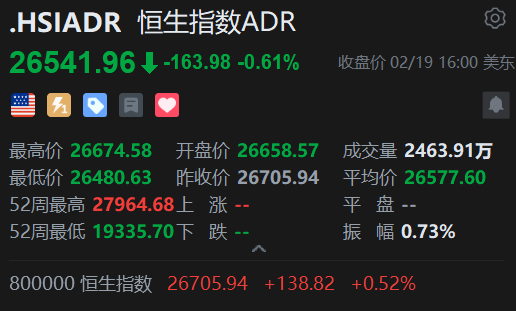
智通财经网· 2026-02-19 23:23
Market Overview - The Hang Seng Index (HSI) closed at 26,541.96, down by 163.98 points or 0.61% on February 19 [1] - The index opened at 26,658.57, reached a high of 26,674.58, and a low of 26,480.63, with a trading volume of 24.6391 million [1] Major Blue-Chip Stocks Performance - HSBC Holdings closed at HKD 135.722, up by 1.13% compared to the previous close [2] - Tencent Holdings closed at HKD 532.399, down by 0.11% compared to the previous close [2] Stock Price Movements - Tencent Holdings (00700) latest price is HKD 533.000, with a slight increase of 1.000 or 0.19% [3] - Alibaba Group (09988) latest price is HKD 154.700, down by 0.700 or 0.45% [3] - HSBC Holdings (00005) latest price is HKD 134.200, down by 1.500 or 1.11% [3] - AIA Group (01299) latest price is HKD 82.350, up by 2.050 or 2.55% [3] - Meituan (03690) latest price is HKD 82.050, down by 0.100 or 0.12% [3] - JD.com (09618) latest price is HKD 105.900, down by 0.500 or 0.47% [3]
网易有道2025年财报:全年净收入59.1亿元,AI战略聚焦学习与广告
Xin Lang Cai Jing· 2026-02-19 14:07
Core Insights - Net revenue for 2025 reached 5.91 billion yuan, representing a year-on-year growth of 5.0% [1][2] - Operating profit amounted to 220 million yuan, showing a significant increase of 48.7% year-on-year, with the company achieving its first annual operating cash inflow of 55.2 million yuan [1][2] - The fourth quarter revenue was 1.56 billion yuan, reflecting a year-on-year growth of 16.8%, marking the sixth consecutive quarter of profitability [1][2] Business Performance - Online marketing services generated net revenue growth of 28.5%, becoming the main driver of growth [2] - Learning services returned to a growth trajectory, driven by AI, with a year-on-year increase of 17.7% in the fourth quarter [2] - Revenue from smart devices declined by 18.2%, prompting the company to optimize this segment [2] Strategic Initiatives - The CEO emphasized the commitment to an "AI-native" strategy for 2026, focusing on learning services and advertising [3] - Plans to launch new AI applications and Agent products, including an English AI essay correction tool based on the "Ziyue" model, to enhance user engagement [3] - The learning services segment will leverage AI technology to improve customer acquisition efficiency and optimize personalized learning paths [3] Institutional Perspectives - CICC raised the target price to $13 but highlighted the need to monitor pressures on learning services and industry competition risks [4] - The market continues to track the commercialization progress of AI, with AI subscription services experiencing over 50% annual growth [4] - Future events may include new product launches, technology collaborations (such as the extension of the partnership with Turnitin in 2025), and quarterly earnings disclosures, which will reflect the effectiveness of strategic execution [4]
网易有道开源LobsterAI,携手社区打造“7×24小时全场景个人助理”
Xin Lang Cai Jing· 2026-02-19 04:31
Core Viewpoint - NetEase Youdao has officially announced the open-source release of its all-scenario personal assistant, LobsterAI, aiming to collaborate with the global developer community to create a more user-friendly, efficient, and engaging intelligent assistant [1] Group 1 - LobsterAI operates autonomously on computers 24/7, directly performing tasks for users [1] - The complete code for LobsterAI has been made publicly available on the software project hosting platform GitHub [1] - The initiative is intended to enhance the capabilities of intelligent assistants through community collaboration [1]