TONGWEI CO.,LTD(600438)

Search documents
光伏巨头大动作,600438,停牌
Zhong Guo Ji Jin Bao· 2026-02-24 22:57
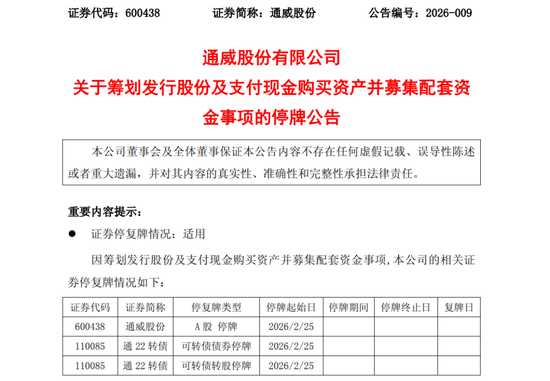
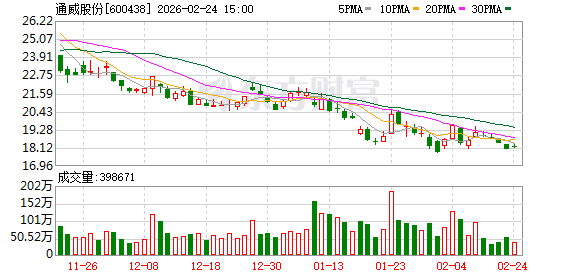
Core Viewpoint - Tongwei Co., Ltd. is planning to acquire 100% equity of Qinghai Lihua Qingneng Co., Ltd. through a combination of share issuance and cash payment, while also raising matching funds [1]. Group 1: Acquisition Details - The acquisition will not lead to a change in the controlling shareholder or actual controller of Tongwei, and it is not considered a related party transaction or a major asset restructuring [3]. - Trading of Tongwei's stock and convertible bonds will be suspended starting February 25, 2026, for a period not exceeding 10 trading days to ensure fair information disclosure [3]. Group 2: Company Profile - Lihua Qingneng, established in April 2021, focuses on the R&D, production, and sales of photovoltaic-grade high-purity silicon and electronic-grade polysilicon, and is a key investment project in Qinghai Province [4]. - The company is located in the Nanchuan Industrial Park of Xining Economic and Technological Development Zone, covering an area of 2,600 acres, with a planned total investment of 20 billion yuan, aiming for an annual production capacity of 200,000 tons of photovoltaic-grade high-purity silicon and 2,000 tons of electronic-grade high-purity silicon, expected to generate an annual output value of approximately 20 billion yuan and create over 3,000 jobs [4]. Group 3: Financial Performance - Tongwei expects a net loss attributable to shareholders of the parent company in the range of 9 billion to 10 billion yuan for the year 2025, indicating an increase in losses [5]. - The losses are attributed to a slowdown in the growth of new photovoltaic installations in the second half of the year, ongoing supply surplus issues, declining operating rates across the industry, rising prices of core raw materials, and a year-on-year drop in product prices [5]. Group 4: Stock Information - As of February 24, 2026, Tongwei's stock price closed at 18.16 yuan per share, with a total market capitalization of 81.756 billion yuan [6]. - The stock has experienced a 52-week high of 27.75 yuan and a low of 14.89 yuan, indicating significant volatility in its trading performance [7].


800亿光伏龙头,拟并购行业独角兽
Sou Hu Cai Jing· 2026-02-24 18:08
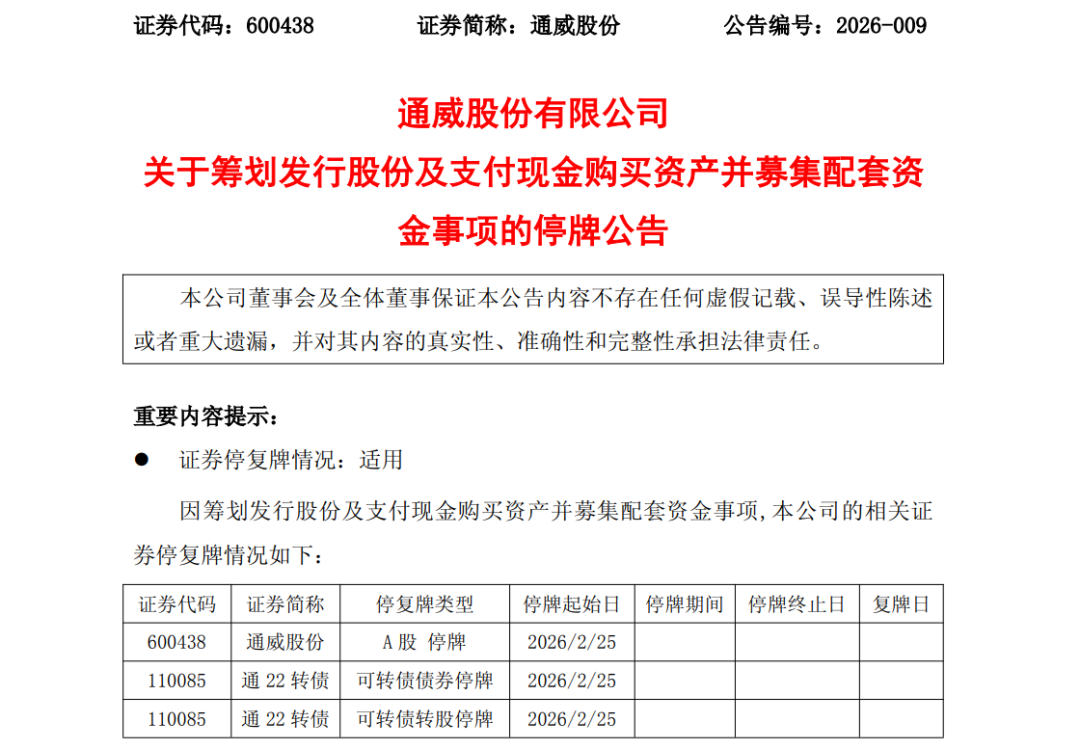
Core Viewpoint - Tongwei Co., Ltd. is planning to acquire 100% equity of Qinghai Lihua Qingneng Co., Ltd. through a combination of share issuance and cash payment, along with raising matching funds [1] Group 1: Transaction Details - The transaction will not lead to a change in the controlling shareholder or actual controller of the company and is not considered a related party transaction [3] - The company's stock and convertible bonds will be suspended from trading starting February 25, 2026, for a period not exceeding 10 trading days due to the ongoing planning stage of the transaction [3] Group 2: Target Company Overview - Lihua Qingneng, established in April 2021, focuses on the manufacturing, sales, and R&D of electronic materials and semiconductor devices, as well as photovoltaic equipment [5] - The company is a key investment project in Qinghai Province, with a planned total investment of 20 billion yuan and an expected annual output value of approximately 20 billion yuan [6] - Lihua Qingneng has been recognized as one of the "Top 50 Qinghai Enterprises" in the 2025 "China's Top 500 Enterprises" list, with a reported sales revenue of 3.954 billion yuan [6]
通威股份有限公司关于筹划发行股份及支付现金购买资产并募集配套资金事项的停牌公告
Shang Hai Zheng Quan Bao· 2026-02-24 17:05
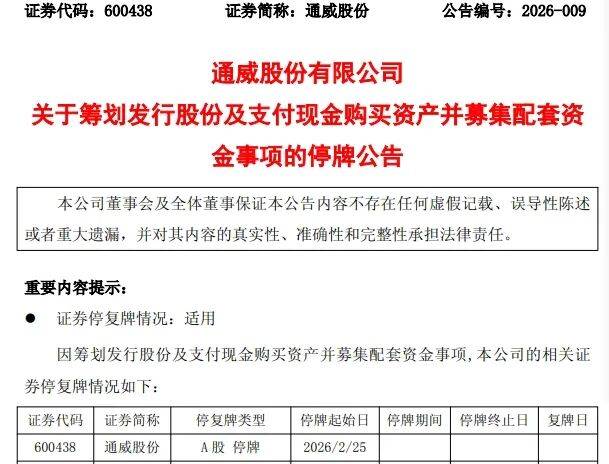
Core Viewpoint - Tongwei Co., Ltd. is planning to issue shares and pay cash to acquire 100% equity of Qinghai Lihua Qingneng Co., Ltd. and raise supporting funds, with the transaction not expected to change the controlling shareholder or actual controller of the company [2][5]. Group 1: Suspension of Trading - The company's stock, convertible bonds, and convertible bond conversion will be suspended from trading starting February 25, 2026, for a period not exceeding 10 trading days due to the ongoing planning of the transaction [2][8]. - The suspension is to ensure fair information disclosure and protect investor interests during the planning phase of the transaction [2][8]. Group 2: Transaction Details - The target company, Qinghai Lihua Qingneng Co., Ltd., was registered on April 29, 2021, with a registered capital of 1,006.913459 million yuan [3]. - The business scope of Qinghai Lihua Qingneng includes manufacturing and sales of electronic materials, semiconductor device manufacturing, and photovoltaic equipment [4]. - The transaction will be executed through a combination of share issuance and cash payment, with the specific transaction details to be disclosed in future announcements [6][7]. Group 3: Parties Involved - The transaction involves parties including Duan Yong, who is the chairman of Lihua Qingneng, and two limited partnership enterprises: Hainan Zhuoyue Enterprise Management and Hainan Haoyue Enterprise Management [5][6]. - The transaction price will be determined based on an assessment report from a qualified evaluation agency, with further negotiations among the parties involved [7].
硅料行业大事件!通威股份拟并购丽豪清能 业内人士:光伏产业“反内卷”的一个案例
Mei Ri Jing Ji Xin Wen· 2026-02-24 16:25
Core Viewpoint - The acquisition of Qinghai Lihua Qingneng Co., Ltd. by Tongwei Co., Ltd. is a significant move in the silicon material industry, aimed at optimizing the photovoltaic sector and addressing internal competition issues [2][6]. Group 1: Acquisition Details - Tongwei plans to acquire 100% of Lihua Qingneng through a combination of issuing shares and cash payments, with the stock expected to be suspended for up to 10 trading days starting February 25, 2026 [2]. - The acquisition will increase Tongwei's silicon material production capacity to over 1 million tons annually, combining its existing capacity of over 900,000 tons with Lihua Qingneng's planned capacity of 200,000 tons [3][6]. Group 2: Company Background - Lihua Qingneng specializes in the research, production, and sales of photovoltaic-grade high-purity crystalline silicon and electronic-grade polysilicon, with a total planned investment of 20 billion yuan for its production projects [3]. - The company is located in the Xining Economic and Technological Development Zone and has significant production projects planned, including a 200,000-ton photovoltaic-grade high-purity crystalline silicon project [3]. Group 3: Industry Implications - The merger is seen as a strategic move to combat the "involution" within the photovoltaic industry, enhancing Tongwei's leading position in the polysilicon sector during a current industry downturn [6]. - The integration is expected to facilitate management synergy and cultural alignment between the two companies, reducing acquisition risks and enhancing operational efficiency [5][6]. - The acquisition aligns with national policies encouraging industry consolidation, which is viewed positively by market participants [5].
公告精选 |《飞驰人生3》票房收入近30亿元 温氏股份归母净利同比减少44%
Sou Hu Cai Jing· 2026-02-24 16:12
Group 1: Control Acquisition - Dongyangguang is planning to acquire control of Yichang Dongshu No. 1 Investment Co., Ltd. through a share issuance and raise supporting funds, which is expected to constitute a major asset restructuring and related party transaction, but will not change the actual controller of the company [2] Group 2: Performance Reports - Wens Foodstuff Group reported a net profit attributable to shareholders of 5.235 billion yuan for 2025, a year-on-year decrease of 43.59%, with sales of 40.4769 million pigs and an average selling price of 13.71 yuan/kg, down 17.95% year-on-year [3] - Zhongke Shuguang achieved total operating revenue of 14.970 billion yuan in 2025, a year-on-year increase of 13.86%, with a net profit attributable to shareholders of 2.113 billion yuan, up 10.54% year-on-year, driven by product structure optimization and operational efficiency improvements [3] Group 3: Box Office Data - Light Media's subsidiary film "Fast Life 3" has accumulated box office revenue of approximately 2.926 billion yuan, exceeding 50% of the company's audited consolidated financial statement revenue for the most recent fiscal year, with revenue from this film estimated between 43 million and 53 million yuan [4] - The film "Silent Awakening" has accumulated box office revenue of approximately 867 million yuan, also exceeding 50% of the company's audited consolidated financial statement revenue for the most recent fiscal year, with revenue from this film estimated between 5.2 million and 6.6 million yuan [4] Group 4: Equity Acquisitions - Tongwei Co. is planning to acquire 100% equity of Qinghai Lihua Qingneng Co., Ltd. through a combination of share issuance and cash payment, which will not change the controlling shareholder or actual controller and is not expected to constitute a major asset restructuring [5] - Changxin Bochuang signed a letter of intent to acquire 93.8108% of Shanghai Honghui Guanglian Communication Technology Co., Ltd., with a tentative price of 375 million yuan, aiming to expand its product offerings in the upstream optical device sector [6] - Kaipu Cloud announced the termination of its major asset restructuring plan to acquire a stake in Nanning Taike Semiconductor Co., Ltd. due to failure to reach consensus on core transaction terms, committing not to plan any major asset restructuring for at least one month [6]






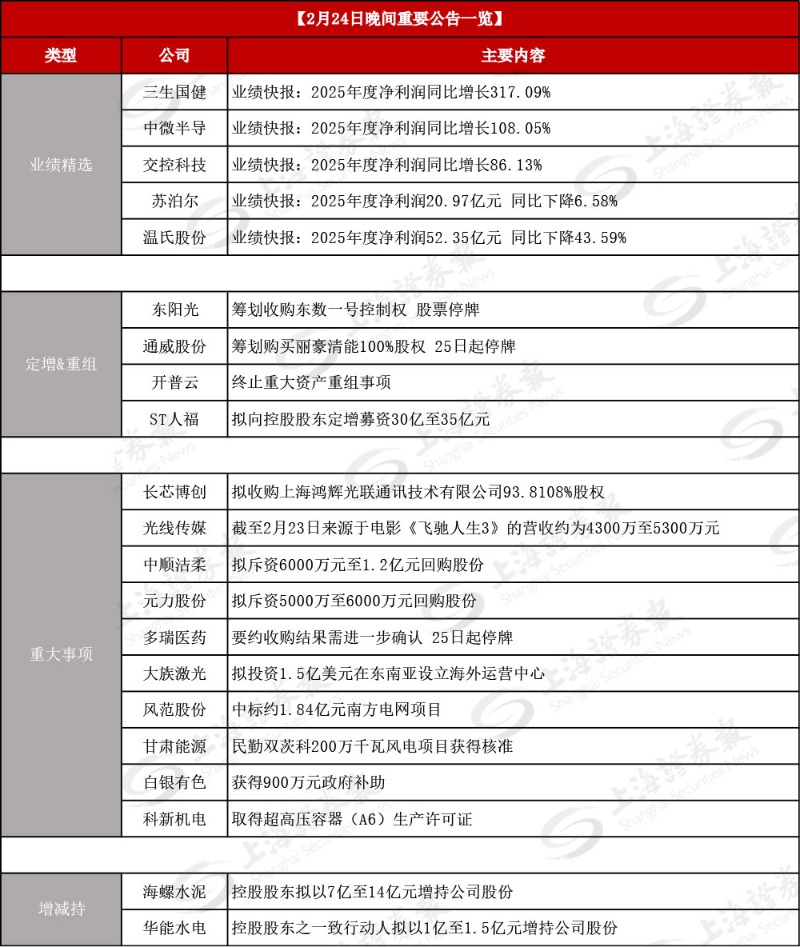
2月24日晚间重要公告一览 | 通威股份筹划购买丽豪清能100%股权 25日起停牌
Shang Hai Zheng Quan Bao· 2026-02-24 16:12
Performance Highlights - Sanofi's net profit for 2025 increased by 317.09% year-on-year, reaching 2.939 billion yuan, with total revenue of 4.199 billion yuan, a growth of 251.81% [5] - Zhongwei Semiconductor reported a net profit increase of 108.05% year-on-year for 2025, totaling 285 million yuan, with total revenue of 1.122 billion yuan, up 23.09% [5] - Jiaokong Technology's net profit rose by 86.13% year-on-year to 156 million yuan, with total revenue of 2.537 billion yuan, an increase of 16.08% [6] - Supor's net profit decreased by 6.58% year-on-year to 2.097 billion yuan, with total revenue of 22.772 billion yuan, a growth of 1.54% [6] - Wens Foodstuff Group's net profit fell by 43.59% year-on-year to 5.235 billion yuan, with total revenue of 103.884 billion yuan, down 1.67% [6][7] Mergers and Acquisitions - Tongwei Co., Ltd. is planning to acquire 100% equity of Qinghai Lihua Qingneng, with stock suspension starting from February 25, 2026, for up to 10 trading days [2] - Changxin Bochuang intends to acquire 93.8108% equity of Shanghai Honghui Optical Communication Technology Co., with a preliminary price of 375 million yuan [3] Major Events - Light Media reported revenue from the film "Fast and Furious 3" between 43 million to 53 million yuan as of February 23, 2026 [4] - Zhongshun Jierou plans to repurchase shares worth between 60 million to 120 million yuan [9] - Yuanli Co. plans to repurchase shares worth between 50 million to 60 million yuan [10] Capital Increase and Restructuring - Dongyangguang is planning to acquire control of Yichang Dongshu No. 1 Investment Co. through a share issuance, with stock suspension starting from February 24, 2026 [8] - ST Renfu plans to raise 3 billion to 3.5 billion yuan through a private placement to fund various projects [8] Shareholding Changes - Conch Cement's controlling shareholder plans to increase holdings between 700 million to 1.4 billion yuan [12] - Huaneng Hydropower's controlling shareholder plans to increase holdings between 100 million to 150 million yuan [12]
停牌!800亿市值光伏龙头 拟收购同行
Shang Hai Zheng Quan Bao· 2026-02-24 16:10
Core Viewpoint - Tongwei Co., Ltd. is planning to acquire 100% equity of Qinghai Lihua Qingneng Co., Ltd. through a combination of issuing shares and cash payment, amidst a backdrop of underutilized capacity in the polysilicon industry [2][4]. Group 1: Company Actions - The acquisition will not change the controlling shareholder or actual controller of Tongwei, and it is not classified as a related party transaction or a major asset restructuring [2][4]. - The company has signed a letter of intent for the equity acquisition with potential partners, indicating that the transaction is still in the planning stage [5]. Group 2: Industry Context - Both Tongwei and Lihua Qingneng are polysilicon manufacturers, and the industry is currently facing a significant supply-demand imbalance, with the market awaiting capacity clearance [6]. - Tongwei is projected to incur a loss of 9 to 10 billion yuan in 2025, highlighting the financial challenges within the polysilicon sector [6]. - The establishment of the "Polysilicon Capacity Integration Acquisition Platform" aims to address the industry's capacity issues through a dual-track model of "debt acquisition + flexible capacity utilization" [7]. Group 3: Market Response - As of February 24, Tongwei's stock closed at 18.16 yuan per share, with a market capitalization of 81.76 billion yuan [8].
通威股份,拟并购光伏独角兽!
DT新材料· 2026-02-24 16:05
【DT新材料】 获悉,2月24日, 通威股份 发布《关于筹划发行股份及支付现金购买资产并募集配套资金事项的停牌公告》,拟收购 青海丽豪清能股 份有限公司 。 根据公告,通威股份正在筹划通过发行股份及支付现金的方式,购买股权,并募集配套资金。已于近日与交易意向方段雍、海南卓悦企业管理合伙企业 (有限合伙)、海南豪悦企业管理合伙企业(有限合伙)签署了股权收购的《意向协议》。 根据青海丽豪官网显示, 青海丽豪清能股份有限公司 成立于2021年4月,主要从事光伏级高纯晶硅、电子级多晶硅等半导体材料的技术研发、生产和 销售,是青海省重点招商引资的项目。公司位于青海西宁经济技术开发区南川工业园区 ,占地面积2600亩,计划总投资200亿元,建设年产20万吨光 伏级高纯晶硅+2000吨电子级高纯晶硅生产项目。 丽豪清能旗下全资子公司 四川丽豪清能有限公司 成立于2023年1月,公司落户于"万里长江首城"宜宾,成渝发展经济带中心,其利用四川丰富的清 洁能源水电资源, 投资建设年产20万吨光伏级高纯晶硅+5000吨电子级高纯晶硅+25万吨工业硅生产项目。 今年2月,丽豪清能董事长段雍在新春致辞中提到,公司成功跻身" 2025全 ...
光伏巨头大动作!600438 停牌!
Zhong Guo Ji Jin Bao· 2026-02-24 15:54
Core Viewpoint - Tongwei Co., Ltd. is planning to acquire 100% equity of Qinghai Lihua Qingneng Co., Ltd. to enhance its semiconductor business, leading to a temporary suspension of its stock trading [2][4]. Group 1: Acquisition Details - The acquisition will be executed through a combination of issuing shares and cash payments, along with raising matching funds [2]. - The transaction is not expected to change the controlling shareholder or actual controller of the company and does not constitute a related party transaction or a major asset restructuring [4]. Group 2: Company Background - Lihua Qingneng, established in April 2021, focuses on the R&D, production, and sales of photovoltaic-grade high-purity silicon and electronic-grade polysilicon, with a planned total investment of 20 billion yuan [5]. - The company aims to achieve an annual production value of approximately 20 billion yuan and create over 3,000 jobs [5]. Group 3: Financial Performance - Tongwei Co., Ltd. is projected to report a net loss attributable to shareholders of approximately 9 billion to 10 billion yuan for the year 2025, indicating an increase in losses [5]. - The losses are attributed to a slowdown in the growth of new photovoltaic installations, industry supply surplus, rising core material prices, and declining product prices [6]. - As of February 24, the company's stock price was 18.16 yuan per share, with a total market capitalization of 81.756 billion yuan [7].
光伏巨头大动作!600438,停牌!
Xin Lang Cai Jing· 2026-02-24 15:46
Group 1 - Tongwei Co., Ltd. is planning to acquire 100% equity of Qinghai Lihua Qingneng Co., Ltd. through a combination of issuing shares and cash payment, while also raising matching funds [1][7] - The acquisition is not expected to change the controlling shareholder or actual controller of Tongwei, nor is it classified as a related party transaction or a major asset restructuring [3][8] - Trading of Tongwei's stock and convertible bonds will be suspended starting February 25, 2026, for a period not exceeding 10 trading days to ensure fair information disclosure [3][8] Group 2 - Lihua Qingneng, established in April 2021, focuses on the research, production, and sales of photovoltaic-grade high-purity silicon and electronic-grade polysilicon, with a planned total investment of 20 billion yuan and an expected annual output value of approximately 20 billion yuan [9] - Tongwei has developed a business model integrating agriculture (aquaculture) and photovoltaic resources, focusing on the development of "fishing and solar integration" bases to enhance industry synergy [4][9] - The company anticipates a net loss of approximately 9 to 10 billion yuan for the fiscal year 2025, attributed to a slowdown in the growth of new photovoltaic installations and ongoing industry pressures [4][10]