CSICPCL(600482)

Search documents
中船系概念下跌1.32%,主力资金净流出9股
Zheng Quan Shi Bao Wang· 2025-08-19 08:27
Core Viewpoint - The China Shipbuilding sector experienced a decline of 1.32% as of the market close on August 19, with several companies within the sector, including Jiuzhiyang, China Shipbuilding Defense, and China Marine Defense, showing significant losses [1] Market Performance - The top-performing concept sectors included Reducers (+2.62%), Animal Vaccines (+2.47%), and Avian Influenza (+2.45%), while the China Shipbuilding sector was among the worst performers [1] - The China Shipbuilding sector saw a net outflow of 1.635 billion yuan from main funds, with nine stocks experiencing net outflows, and nine stocks seeing outflows exceeding 10 million yuan [1] Fund Flow Analysis - The stock with the highest net outflow was China Shipbuilding, with a net outflow of 1.266 billion yuan, followed by China Shipbuilding Defense (122 million yuan), China Power (101 million yuan), and China Marine Defense (45.73 million yuan) [1] - The detailed fund flow for the China Shipbuilding sector shows that China Shipbuilding had a price change of -0.31% and a turnover rate of 5.53%, while China Shipbuilding Defense had a price change of -2.20% and a turnover rate of 3.25% [1]




中船系概念下跌4.10%,主力资金净流出9股
Zheng Quan Shi Bao Wang· 2025-08-14 09:00
Group 1 - The core viewpoint of the news highlights a significant decline in the China Shipbuilding System (中船系) concept stocks, which fell by 4.10%, ranking among the top decliners in the concept sector [1][2] - Within the China Shipbuilding System, stocks such as 中船特气, 昆船智能, and 中船汉光 experienced notable declines, contributing to the overall downturn of the sector [1][2] - The sector faced a net outflow of 393 million yuan in principal funds, with nine stocks experiencing net outflows, and five stocks seeing outflows exceeding 30 million yuan [2] Group 2 - The stock with the highest net outflow was ST应急, which saw a net outflow of 134.47 million yuan and a decline of 4.75% [2] - Other notable stocks with significant net outflows include 中船防务 (68.13 million yuan), 中船科技 (41.58 million yuan), and 昆船智能 (33.31 million yuan) [2] - 中船特气 had the largest percentage decline at 9.43%, with a turnover rate of 26.29% [2]


同类规模最大的自由现金流ETF(159201)冲击5连涨,在可比基金中跟踪精度最高
Sou Hu Cai Jing· 2025-08-14 02:26
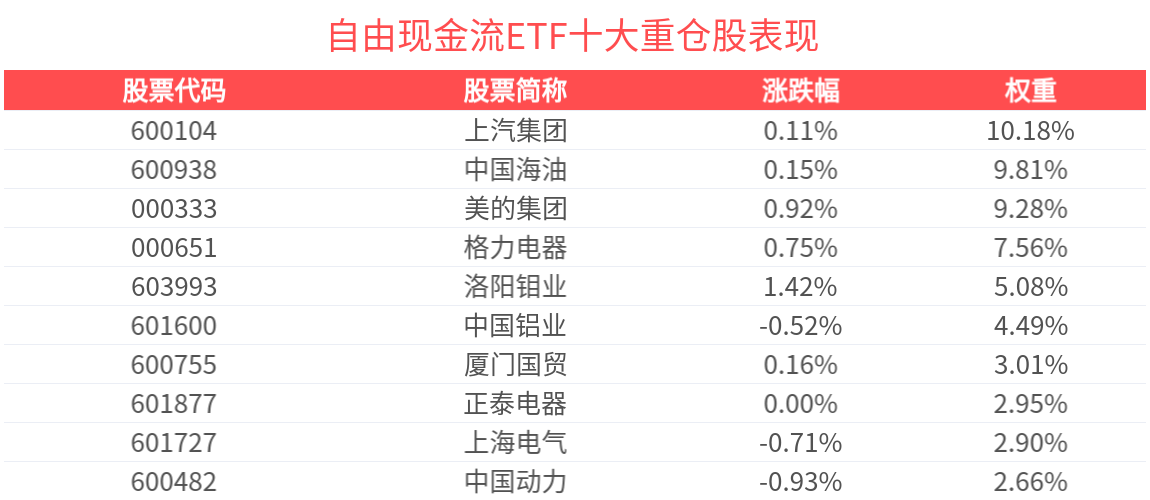
Core Viewpoint - The National Index of Free Cash Flow has shown a positive trend, with significant increases in component stocks, indicating a strong market performance driven by liquidity and supportive policies [1][2]. Group 1: Market Performance - As of August 14, 2025, the National Index of Free Cash Flow rose by 0.19%, with notable gains in stocks such as Mould Technology, which increased by over 8% [1]. - The Free Cash Flow ETF (159201) experienced a 0.09% increase, marking its fifth consecutive rise, with the latest price at 1.09 yuan [1]. - The average daily trading volume of the Free Cash Flow ETF over the past month was 318 million yuan, ranking it first among comparable funds [1]. Group 2: Tracking Accuracy - The Free Cash Flow ETF has demonstrated the highest tracking accuracy among comparable funds, with a tracking error of 0.071% over the past month [1]. Group 3: Top Holdings - As of July 31, 2025, the top ten weighted stocks in the National Index of Free Cash Flow accounted for 57.66% of the index, including SAIC Motor, China National Offshore Oil, Midea Group, and Gree Electric [1][3]. Group 4: Investment Characteristics - The Free Cash Flow ETF is designed to closely track the National Index of Free Cash Flow, selecting stocks with positive and high free cash flow, indicating high quality and strong risk resistance, suitable for long-term investment [4]. - The fund management fee is set at an annual rate of 0.15%, and the custody fee at 0.05%, both of which are among the lowest in the market [4]. Group 5: Market Dynamics - The current market rally is characterized by liquidity-driven dynamics, with active participation from ETFs, retail investors, and leveraged funds, supported by favorable policies aimed at enhancing the capital market [2].



中国动力上半年 净利预增最高141.9%
Zheng Quan Shi Bao· 2025-08-13 05:51
Group 1 - The shipbuilding industry continues to maintain growth momentum, with China Power (600482) forecasting a net profit of 800 million to 1.15 billion yuan for the first half of 2025, representing a year-on-year increase of 68.28% to 141.9% [1] - China Power is primarily involved in the research and production of ship power equipment, particularly in the diesel engine and marine machinery sectors, benefiting from the recovery of the global ship market, leading to significant growth in sales volume and delivery orders in the diesel engine segment [1] - The company reported a substantial increase in sales scale and contract settlements in its diesel engine segment for 2025, with rising prices for main products and improved gross margins, alongside efforts to enhance product profitability through cost control measures [1] Group 2 - On June 30, China Power announced that its application for issuing shares to purchase assets and raise supporting funds was accepted by the Shanghai Stock Exchange, intending to acquire a 16.51% stake in China Shipbuilding Industry Group's diesel engine division [2] - Following the equity change, China Shipbuilding Industry Group will hold 7.26% of China Power's shares, with the company being the only capital operation platform for the power business under the China Shipbuilding Group [2] - China Power has strong technological innovation capabilities and a comprehensive innovation system, leveraging military technology for civilian markets, achieving high market shares in various segments such as batteries and different types of diesel engines [2]
暴雨扰动供应+高温提振需求=中国动力煤价格触及五个月新高
Hua Er Jie Jian Wen· 2025-08-13 03:41
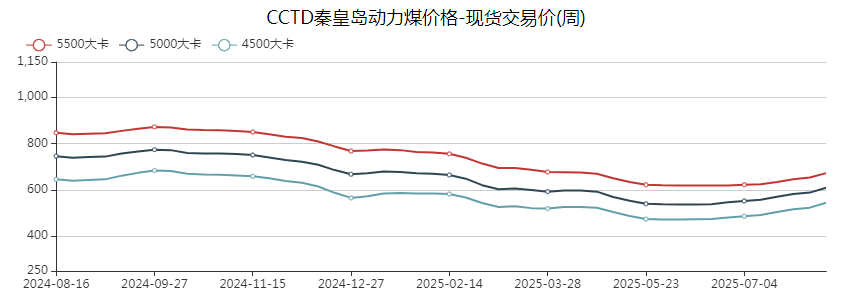
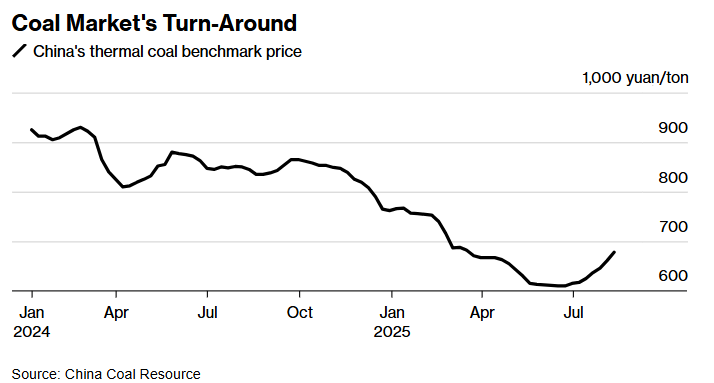
Core Insights - China's thermal coal prices have surged to a five-month high due to the dual impact of heavy rainfall on supply and increased demand from high temperatures [1][3] Supply and Demand Dynamics - The benchmark spot coal price in Qinhuangdao reached 678 yuan per ton, marking the highest level since March 17, and reflecting an 11% rebound from the four-year low seen in June [1][4] - Heavy rainfall in mining areas has disrupted normal coal mining operations, while inspections targeting excess capacity have further suppressed production [4] - Rising temperatures have led to a significant increase in air conditioning usage among residential and commercial users, driving up electricity consumption and consequently boosting demand for thermal coal [4] - Morgan Stanley analysts, including Hannah Yang, noted that coal consumption across 25 provinces reached its highest level in at least five years on August 6 [4] - Despite the current price surge, there is a cautious outlook for future trends, with expectations that coal prices may start to decline by late August [4]
高温提振需求+供应受阻 中国动力煤价格创五个月新高
Zhi Tong Cai Jing· 2025-08-13 02:00
Group 1 - The core point of the article is that China's coal prices have risen to their highest level since March due to heavy rainfall affecting production and increased cooling demand from hot weather [1][3] - The spot price of thermal coal at Qinhuangdao Port has reached 678 yuan (approximately 94 USD) per ton, marking an 11% increase from the four-year low seen in June [1] - Record production in the first half of the year had previously boosted inventory levels, while the widespread use of renewable energy led to a decrease in coal consumption by power plants, contributing to the price drop [1] Group 2 - The current rise in coal prices is attributed to strong rainfall and production inspections in mining areas, alongside soaring electricity demand due to high temperatures [3] - Analysts from Morgan Stanley, including Hannah Yang, reported that coal consumption across 25 provinces in China reached its highest level in at least five years on August 6 [3] - Despite the current upward trend in coal prices, it is expected to be short-lived, with a potential correction anticipated by the end of August as temperatures begin to drop and renewable energy capacity continues to rise [3]
中证智选船舶产业指数上涨0.47%,前十大权重包含中国动力等
Jin Rong Jie· 2025-08-12 14:26
Group 1 - The core viewpoint of the news is the performance of the China Securities Index for the shipbuilding industry, which has shown significant growth in recent months, indicating a positive trend in the sector [1] - The China Securities Index for the shipbuilding industry rose by 0.47% to 1490.83 points, with a trading volume of 24.76 billion yuan on August 12 [1] - Over the past month, the index has increased by 6.09%, by 15.64% over the past three months, and by 15.74% year-to-date [1] Group 2 - The index comprises 40 representative listed companies involved in ship materials, ship supporting, ship manufacturing, and shipping, reflecting the overall performance of the shipbuilding industry [1] - The top ten weighted companies in the index are China Shipbuilding (16.07%), China Heavy Industry (14.82%), China Power (13.99%), and others, indicating a concentration in a few key players [1] - The index's holdings are primarily listed on the Shanghai Stock Exchange (81.20%) and the Shenzhen Stock Exchange (18.80%) [1] Group 3 - The index is heavily weighted towards the industrial sector (93.82%), with minor contributions from materials (3.61%) and information technology (2.57%) [1] - The index samples are adjusted biannually, with changes implemented on the next trading day following the second Friday of June and December [2] - Adjustments to the sample size generally do not exceed 20%, and weight factors are fixed until the next scheduled adjustment [2]
上证军工指数上涨0.37%,前十大权重包含中航沈飞等
Jin Rong Jie· 2025-08-11 15:43
Core Points - The Shanghai Composite Index rose by 0.34%, while the Shanghai Military Industry Index increased by 0.37%, closing at 8877.18 points with a trading volume of 45.532 billion yuan [1] - The Shanghai Military Industry Index has seen a 10.23% increase over the past month, a 19.66% increase over the past three months, and a year-to-date increase of 22.58% [1] - The index includes listed companies primarily engaged in the military industry, selected from the ten major military groups and other related firms, reflecting the overall performance of military industry stocks in the Shanghai market [1] Index Composition - The top ten weighted companies in the Shanghai Military Industry Index are: China Shipbuilding (9.78%), AVIC Shenyang Aircraft (7.89%), China Heavy Industry (6.59%), Aero Engine Corporation (6.39%), Aerospace Electronics (3.56%), AVIC Avionics (3.52%), China Power (3.07%), Ruichuang Micro-Nano (2.9%), Western Superconducting (2.89%), and AVIC High-Tech (2.53%) [1] - The index is fully composed of companies listed on the Shanghai Stock Exchange, with an industry composition of 77.78% in industrials, 11.88% in information technology, 5.55% in materials, 3.34% in communication services, and 1.44% in consumer discretionary [1] Index Adjustment - The index samples are adjusted biannually, with adjustments occurring on the next trading day after the second Friday of June and December, with a sample adjustment ratio not exceeding 10% [2] - Weight factors are adjusted in accordance with the sample changes, remaining fixed until the next scheduled adjustment unless special circumstances arise [2]


中船系概念下跌1.24%,主力资金净流出8股
Zheng Quan Shi Bao Wang· 2025-08-11 09:17
Group 1 - The core viewpoint of the news is that the China Shipbuilding sector has experienced a decline, with a drop of 1.24% as of the market close on August 11, highlighting a negative trend in this concept sector [1][2] - Within the China Shipbuilding sector, notable declines were observed in stocks such as China Shipbuilding, China Heavy Industry, and Jiuzhiyang, while only two stocks, China Ship Defense and China Marine Technology, showed gains [1][2] - The sector faced a significant net outflow of capital amounting to 9.58 billion yuan, with major outflows from stocks like China Shipbuilding, which saw a net outflow of 7.54 billion yuan [2] Group 2 - The top decliners in the China Shipbuilding sector included China Shipbuilding (-2.85%), China Heavy Industry (-2.72%), and China Power (-2.52%), indicating a widespread downturn among key players [2] - Conversely, the stocks that attracted net inflows included China Ship Defense and China Marine Defense, with net inflows of 1.73 billion yuan and 1.48 billion yuan respectively, suggesting some investor interest in these companies despite the overall sector decline [2] - The trading activity showed that the turnover rates for the declining stocks were relatively low, with China Shipbuilding at 3.32% and China Heavy Industry at 2.46%, reflecting a cautious market sentiment [2]
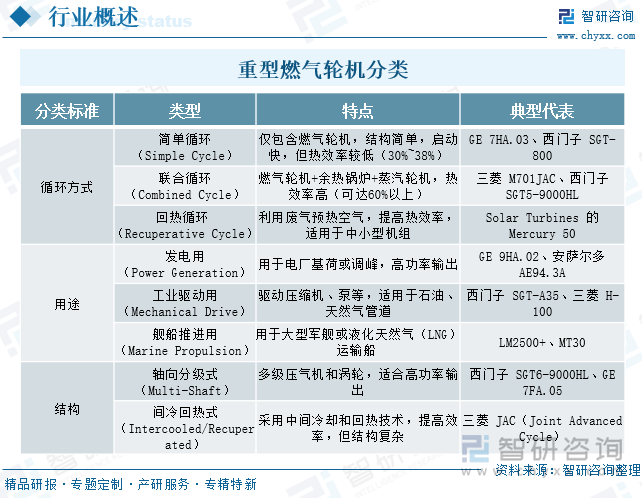
研判2025!中国重型燃气轮机行业发展历程、产业链全景、发展现状、竞争格局及发展趋势分析:自主创新加速突破,2025年百亿市场开启新纪元[图]
Chan Ye Xin Xi Wang· 2025-08-11 01:15
Core Insights - The heavy-duty gas turbine is a key power equipment in modern industry, converting thermal energy into mechanical energy, with a single unit power typically exceeding 50MW, and is widely used in power generation, industrial drives, and marine propulsion [1][4] - China has made significant breakthroughs in the heavy-duty gas turbine sector since launching the R0110 project in 2002, achieving complete self-research capabilities by 2024, with the market expected to reach 100 billion yuan by 2025 [1][16] - The industry is transitioning from being an "energy heart" to a "green engine," contributing to global energy transformation with advancements in hydrogen integration technology and digital twin management [1][22] Industry Overview - Heavy-duty gas turbines are classified based on cycle type (simple, combined, recuperative), application (power generation, mechanical drive, marine propulsion), and structure (multi-shaft, intercooled) [2][3] - The market for heavy-duty gas turbines in China reached 80 billion yuan in 2024, accounting for 10% of the overall market, with a projected growth to over 100 billion yuan in 2025 [16][18] Development History - The heavy-duty gas turbine sector in China has evolved from reliance on foreign technology to achieving significant self-sufficiency, with key milestones including the successful ignition of a 300MW F-class turbine in 2024 [4][16] - The establishment of the China Aviation Engine Group has accelerated technological advancements, enabling China to become one of the top five countries in heavy-duty gas turbine development [4][16] Industry Chain - The industry chain includes upstream material production (high-temperature alloys, titanium alloys), midstream turbine manufacturing led by state-owned enterprises, and downstream applications in power generation and industrial drives [6][8] - Domestic companies have achieved scale in mid-low end production, but high-end materials and precision processing still rely on imports, indicating a need for increased self-sufficiency [6][8] Current Market Status - The heavy-duty gas turbine market in China is characterized by a competitive landscape dominated by foreign giants (GE, Siemens, Mitsubishi) holding over 80% market share, while domestic companies are gradually increasing their market presence [18][19] - The F-class turbines have seen a domestic production rate exceeding 85%, while the H/J-class turbines still rely heavily on imports [18][19] Future Trends - The industry is moving towards low-carbon, intelligent, and diversified development paths, with hydrogen integration and digital twin technologies expected to enhance efficiency and reduce emissions [21][22] - The demand for gas turbines in new applications such as data centers and marine equipment is expected to grow significantly, driven by the need for high-efficiency, compact power solutions [22][24]