JLPC(600513)

Search documents
联环药业(600513) - 联环药业投资者关系活动记录表
2025-07-03 09:30
证券代码:600513 证券简称:联环药业 公告编号:2025-039 江苏联环药业股份有限公司 投资者关系活动记录表 | 的商业化前景充满信心。 | | --- | | 5、问:请介绍一下公司的财务状况,尤其是研发投入情 | | 况? | | 答:2024 年公司营收 21.60 亿,尽管受到一些政策 | | 影响利润有小幅下滑,但公司依然加大研发投入,2024 | | 年公司累计研发投入 2.77 亿,主要用于创新药研发,目 | | 前仿制药和创新药研发投入的约为 5/5。2025 年根据公 | | 司财务预算研发费用为 2.29 亿元。公司作为地方国企, 资金实力雄厚,能够持续投入研发,支撑企业长期发展。 | 合作开发背景、临床试验进展及数据预期? 答:LH-1801 项目是公司与中科院上海药物所合作 开发的治疗糖尿病的 SGLT2 抑制剂。该项目凭借创新的 分子结构、完善的临床前研究与充足的 I 期临床数据, 经与国家药监局药品审评中心(CDE)充分沟通,免除Ⅱ 期临床试验直接进入Ⅲ期临床试验。目前,两个试验组 分别于今年 1 月和 3 月按计划完成受试者入组工作,各 项试验正有序开展,目前处于临床数 ...

联环药业加速美阿沙坦钾片商业化 创新转型步入收获期
Zheng Quan Shi Bao Wang· 2025-07-03 00:31
Core Viewpoint - The ARB market is experiencing significant developments, particularly with the commercialization of the drug Benazepril by Lianhuan Pharmaceutical, which is expected to drive substantial revenue growth for the company [1][2]. Group 1: Market Position and Commercialization - Lianhuan Pharmaceutical has accelerated its market presence, with its Benazepril product already listed in 13 provinces as of June 30, indicating a rapid commercialization process [2]. - The drug is recognized as a first-line antihypertensive medication, with a strong clinical position and promising market prospects, potentially generating hundreds of millions in revenue for the company [2][3]. - The drug's core advantages include a breakthrough in receptor binding affinity, significant blood pressure reduction, and improved stability in blood pressure control, which enhance its market competitiveness [2]. Group 2: Research and Development Investments - Lianhuan Pharmaceutical has increased its R&D investment for three consecutive years, with a projected R&D expenditure of 277 million yuan in 2024, reflecting a year-on-year growth of 95.93% and surpassing 10% of its revenue for the first time [4]. - The company is advancing its core new drug LH-1801, which targets diabetes and hypertension, with clinical trials expected to conclude in early 2026, potentially opening a market worth 2 billion yuan [4]. Group 3: Product Portfolio and Strategic Positioning - Lianhuan Pharmaceutical has established a multi-layered product portfolio, including basic, combined, and innovative drugs, which strengthens its market position against competitors in the ARB market [6][7]. - The company is pursuing a "generic-innovative" strategy, which is crucial for its transformation into an innovative pharmaceutical enterprise, as it balances innovation with commercial viability [7].
联环药业(600513) - 联环药业投资者关系活动记录表
2025-07-01 09:30
在投资者关系管理上,公司始终秉持真诚沟通、开 放透明的原则,既把投资者请进上市公司,同时上市公 司也积极走出去。今年通过组织投资者调研活动,搭建 更直接的交流平台,增进投资者对公司的了解与信任; 同时持续创新沟通形式,如组织公司董监高、研发部负 责人、临床实验负责人等在北京、上海、广州、深圳等 一线城市,就公司创新药研发进展、管线布局及市场前 景等内容举办专题投资者现场沟通活动,加强与投资者 的互动交流。同时,公司重视回馈股东,已持续多年每 年分红比例达 30%,以实际行动回馈投资者,分享企业 发展成果。通过多维度协同推进,公司将不断提升企业 内在价值,实现市值与内在价值的良性互动与协同增长。 4、问:请问公司在提升研发人才稳定性、核心骨干 建设方面有哪些机制?是否设有研发激励制度,如项目 收益分享、股权激励等? 资领域持续发力。通过投资并购整合行业优质资源,完 善产业链布局,增强协同效应;积极探索多元化融资渠 道,合理规划融资方案,为企业发展提供充足资金支持。 答:公司高度重视研发人才的引进、培养和激励, 建立了较为完善的机制。在人才引进方面,公司积极从 国内外引进高端研发人才,充实研发团队力量。在人才 培 ...
联环药业创新药LH-1801片有望于2026年申报上市
Zheng Quan Ri Bao Wang· 2025-06-23 01:50
Core Viewpoint - Jiangsu Lianhuan Pharmaceutical Co., Ltd. is advancing its innovative drug LH-1801, which is expected to enter the market in 2026 if clinical trials proceed smoothly [1][2]. Company Summary - LH-1801 is a sodium-glucose co-transporter 2 (SGLT-2) inhibitor designed to lower blood sugar by preventing glucose reabsorption in the kidneys, thus reducing the risk of hypoglycemia [1]. - The drug has successfully completed Phase I clinical trials and has been granted exemption from Phase II trials, moving directly to Phase III due to its favorable pharmacokinetic properties and safety profile [2]. - The Phase III clinical study is being conducted across over 70 top hospitals in China, led by a prominent endocrinology expert, ensuring scientific rigor [2]. Industry Summary - Diabetes has become a significant health threat, with a large and growing patient base in China [3]. - The Chinese type 2 diabetes pharmaceutical market is projected to grow at a compound annual growth rate (CAGR) of 10.18% from 2025 to 2030, reaching a market size of 151.8 billion yuan by 2025 and potentially expanding to 259.2 billion yuan by 2030 [3]. - SGLT-2 inhibitors represent a shift in diabetes treatment from merely controlling blood sugar to providing comprehensive cardiovascular and renal protection, making them a core recommendation in global treatment guidelines [3].
联环药业: 联环药业2024年年度权益分派实施公告
Zheng Quan Zhi Xing· 2025-06-20 08:28
江苏联环药业股份有限公司 本公司董事会及全体董事保证本公告内容不存在任何虚假记载、误导性陈述或 者重大遗漏,并对其内容的真实性、准确性和完整性承担法律责任。 重要内容提示: ?每股分配比例 A 股每股现金红利0.089元 证券代码:600513 证券简称:联环药业 公告编号:2025-037 ?相关日期 股份类别 股权登记日 最后交易日 除权(息)日 现金红利发放日 A股 2025/6/20 - 2025/6/23 2025/6/23 ?差异化分红送转:否 一、通过分配方案的股东会届次和日期 本次利润分配方案经公司2025 年 5 月 9 日的2024年年度股东会审议通过。 二、分配方案 截至股权登记日下午上海证券交易所收市后,在中国证券登记结算有限责任 公司上海分公司(以下简称"中国结算上海分公司")登记在册的本公司全体股东。 三、相关日期 股份类别 股权登记日 最后交易日 除权(息)日 现金红利发放日 A股 2025/6/20 - 2025/6/23 2025/6/23 四、分配实施办法 (1)无限售条件流通股的红利委托中国结算上海分公司通过其资金清算系统 向股权登记日上海证券交易所收市后登记在册并在上海 ...
因垄断地塞米松原料价格 津药药业等四家药企被罚3.62亿元
Huan Qiu Wang· 2025-06-17 09:28
Core Viewpoint - Four pharmaceutical companies, including Tianjin Pharmaceutical Co., Ltd. (Tianjin Pharma), Zhejiang Xianju Pharmaceutical Co., Ltd. (Xianju Pharma), Jiangsu Lianhuan Pharmaceutical Co., Ltd. (Lianhuan Pharma), and Xi'an Guokang Ruijin Pharmaceutical Co., Ltd., were fined a total of 362 million yuan for price-fixing of dexamethasone raw materials, with Tianjin Pharma being penalized for the fourth time for similar monopolistic behavior [1][2][4]. Group 1: Companies Involved - Tianjin Pharma, Xianju Pharma, Lianhuan Pharma, and Xi'an Guokang Ruijin Pharma were involved in a price-fixing scheme for dexamethasone, leading to a significant increase in prices from 8,000 yuan/kg to 13,000 yuan/kg between February 2022 and March 2024 [2][4]. - Tianjin Pharma has a history of monopolistic practices, having been penalized multiple times since 2021 for various violations of antitrust laws [4][5]. - Lianhuan Pharma's fine represents 72.53% of its net profit, significantly impacting its financial performance [6][8]. Group 2: Regulatory Actions - The Tianjin Municipal Market Supervision Administration imposed fines based on the companies' previous year's sales, totaling 355 million yuan, along with confiscation of illegal gains [2][7]. - The regulatory body emphasized the importance of maintaining fair competition in the pharmaceutical sector and indicated a commitment to stricter enforcement of antitrust laws [2][4]. - Lianhuan Pharma has submitted a hearing request to reduce its penalties, but the regulatory authority rejected its arguments, affirming the validity of the evidence against the company [7]. Group 3: Financial Impact - Lianhuan Pharma reported revenues of 2.174 billion yuan and 2.160 billion yuan for 2023 and 2024, respectively, with net profits declining by 4.5% and 37.66% [6][8]. - The fine imposed on Lianhuan Pharma will reduce its net profit for 2025 by approximately 61.04 million yuan [8]. - Tianjin Pharma's market influence is significant, with a strong presence in the domestic market for steroid hormone raw materials [5].


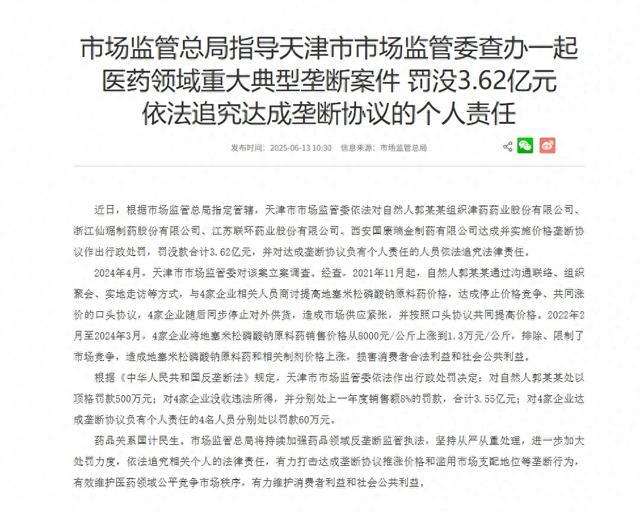
四药企串通抬价被罚3.55亿,个人顶格罚500万
Bei Jing Wan Bao· 2025-06-17 06:16
Core Viewpoint - The National Market Supervision Administration has imposed a total fine of 355 million yuan on four pharmaceutical companies for colluding to raise the price of dexamethasone phosphate raw materials, which saw a price increase of up to 282 times [1] Group 1: Companies Involved - Four companies involved in the price-fixing scheme include Tianjin Pharmaceutical Co., Jiangsu Lianhuan Pharmaceutical Co., Xi'an Guokang Ruijin Pharmaceutical Co., and Zhejiang Xianju Pharmaceutical Co. [1] - The organizer of the collusion, identified as Guo, was fined the maximum amount of 5 million yuan, while four responsible individuals from the companies were fined 600,000 yuan each [1] Group 2: Price Increases - Dexamethasone phosphate raw material prices were raised significantly, with Tianjin Pharmaceutical increasing prices from 9,000 yuan/kg to 13,800 yuan/kg, and Xi'an Guokang Ruijin raising prices from 7,900 yuan/kg to between 10,000 and 38,000 yuan/kg [1] - Zhejiang Xianju Pharmaceutical raised prices from 8,200 yuan/kg to 10,000 yuan/kg, while Jiangsu Lianhuan increased prices from 7,800 yuan/kg to 15,000 yuan/kg [1] Group 3: Market Impact - The collusion led to a severe market supply shortage, with the price of dexamethasone phosphate injection skyrocketing from 0.35 yuan per dose to 98.76 yuan per dose, marking a staggering increase of 282 times [1] - As of March 7, 2024, the monopolistic pricing of dexamethasone phosphate raw materials was still being enforced [1] Group 4: Legal Consequences - The total illegal gains from the price-fixing scheme were calculated as follows: Tianjin Pharmaceutical Co. 42,764,400 yuan, Zhejiang Xianju Pharmaceutical Co. 23,746,680 yuan, Xi'an Guokang Ruijin Pharmaceutical Co. 24,763,156 yuan, and Jiangsu Lianhuan Pharmaceutical Co. 17,899,200 yuan [1] - The fines imposed on the four companies amounted to 355 million yuan, which includes the confiscation of illegal gains and an additional penalty of 8% of the previous year's sales [1]
联环药业(600513) - 联环药业2024年年度权益分派实施公告
2025-06-16 10:15
证券代码:600513 证券简称:联环药业 公告编号:2025-037 江苏联环药业股份有限公司 | 股份类别 | 股权登记日 | 最后交易日 | 除权(息)日 | 现金红利发放日 | | --- | --- | --- | --- | --- | | A股 | 2025/6/20 | - | 2025/6/23 | 2025/6/23 | 差异化分红送转:否 2024年年度权益分派实施公告 本公司董事会及全体董事保证本公告内容不存在任何虚假记载、误导性陈述或 者重大遗漏,并对其内容的真实性、准确性和完整性承担法律责任。 重要内容提示: 每股分配比例 A 股每股现金红利0.089元 相关日期 一、通过分配方案的股东会届次和日期 本次利润分配方案经公司2025 年 5 月 9 日的2024年年度股东会审议通过。 二、分配方案 1.发放年度:2024年年度 2.分派对象: 截至股权登记日下午上海证券交易所收市后,在中国证券登记结算有限责任 公司上海分公司(以下简称"中国结算上海分公司")登记在册的本公司全体股东。 3.分配方案: 本次利润分配以方案实施前的公司总股本285,456,270股为基数,每股派发现 金红 ...
七成净利被罚没!联环药业遭上市以来最大罚单,操纵新冠救命药“地塞米松”价格暴涨282倍
Hua Xia Shi Bao· 2025-06-14 07:29
Core Viewpoint - The recent antitrust penalty imposed on Lianhuan Pharmaceutical for price-fixing of dexamethasone raw materials has significant financial implications, with the fine amounting to over 72% of the company's net profit from the previous year [2][5]. Antitrust Violation - Lianhuan Pharmaceutical, along with other companies, engaged in a price-fixing agreement to stop price competition and jointly raise prices for dexamethasone, violating the Anti-Monopoly Law of the People's Republic of China [3][4]. - The investigation revealed that the companies involved had a meeting in November 2021 to establish this agreement, which led to a dramatic price increase of dexamethasone injection from 0.35 yuan to 98.76 yuan, a rise of nearly 282 times [4][5]. Financial Impact - The total fines for the involved companies reached 326 million yuan, with Lianhuan Pharmaceutical specifically fined 61.04 million yuan, which is 72.53% of its net profit from the previous year [5][6]. - The penalty will reduce Lianhuan Pharmaceutical's net profit for 2025 by 61.04 million yuan, significantly impacting its financial performance [6]. Company Performance - Lianhuan Pharmaceutical has experienced a decline in net profit, with projections showing a drop from 135 million yuan in 2023 to 84 million yuan in 2024, a decrease of 37.66% [7][8]. - The company's revenue for 2023 and 2024 is projected at 2.174 billion yuan and 2.160 billion yuan, respectively, indicating a slight decline [8]. R&D Investment - The company has significantly increased its R&D expenditures, from 66 million yuan in 2021 to 155 million yuan in 2024, which has pressured profit margins [9]. - Lianhuan Pharmaceutical is shifting focus towards high-end formulations and innovative drugs, which has led to increased R&D costs but has not yet translated into higher profits [9][10]. Financing Challenges - Lianhuan Pharmaceutical has faced difficulties in securing external financing for its innovative drug projects, leading to a reliance on loans, which may increase its financial burden [9][10]. - The company attempted to raise funds through convertible bonds and private placements, but both plans were ultimately terminated due to market conditions and operational realities [10].

四家药企联合涨价被罚
券商中国· 2025-06-13 12:56
Core Viewpoint - The article discusses two significant antitrust enforcement cases in the pharmaceutical sector, highlighting the illegal price-fixing activities of four companies regarding the raw material dexamethasone phosphate, which led to substantial fines and penalties [1][2]. Group 1: Antitrust Cases - The first case involves the price-fixing of dexamethasone phosphate raw materials, where four companies collectively raised the price from 8,000 yuan per kilogram to 13,000 yuan, resulting in a total fine and confiscation of 362 million yuan [1]. - The companies involved in the price-fixing scheme include Tianjin Pharmaceutical Co., Zhejiang Xianju Pharmaceutical Co., Jiangsu Lianhuan Pharmaceutical Co., and Xi'an Guokang Ruijin Pharmaceutical Co. [1]. - The investigation revealed that starting from November 2021, an individual named Guo organized meetings and discussions among the companies to agree on price increases, leading to a significant reduction in market competition and increased healthcare costs for consumers [1]. Group 2: Penalties and Enforcement Actions - The Tianjin Market Supervision Administration imposed a maximum fine of 5 million yuan on the individual Guo, while the four companies were fined a total of 354 million yuan based on 8% of their previous year's sales [2]. - Additionally, four responsible individuals from the companies were fined 600,000 yuan each for their roles in the antitrust agreement [2]. - In a related case, a separate antitrust investigation into the injection of neostigmine methylsulfate resulted in fines totaling 223 million yuan, marking the first time personal responsibility for antitrust agreements was pursued against individuals [2].