
CHINA TELECOM(601728)

Search documents
中国电信(00728) - 海外监管公告 - 中国电信股份有限公司关於中国电信集团财务有限公司关联交...
2025-08-14 09:28
香港交易及結算所有限公司及香港聯合交易所有限公司對本公告的內容概不負責,對其準確性或完整性亦不發表任何聲 明,並明確表示概不對因本公告全部或任何部份內容而產生或因倚賴該等內容而引致的任何損失承擔任何責任。 China Telecom Corporation Limited 中国电信股份有限公司 本公告乃根據香港聯合交易所有限公司證券上市規則第 13.10B 條而作出。 兹載列中國電信股份有限公司(「本公司」)在上海證券交易所網站刊登的《中國電信股份有 限公司關於中國電信集團財務有限公司關聯交易 2025 年半年度風險持續評估報告》, 僅供參 考。 承董事會命 中國電信股份有限公司 董事長兼首席執行官 柯瑞文 中國北京,2025 年 8 月 14 日 於本公告刊發之日的本公司董事會包括柯瑞文(董事長兼首席執行官);劉桂清(總裁兼首席 運營官);唐珂、李英輝(財務總監)(皆為執行副總裁);呂永鐘(非執行董事);吳嘉寧、 楊志威、陳東琪、呂薇(皆為獨立非執行董事)。 中国电信股份有限公司 关于中国电信集团财务有限公司 关联交易 2025 年半年度风险持续评估报告 (於中華人民共和國註冊成立之股份有限公司) (股份編 ...
中国电信:2025年半年度净利润约230.17亿元,同比增加5.5%
Mei Ri Jing Ji Xin Wen· 2025-08-14 09:27
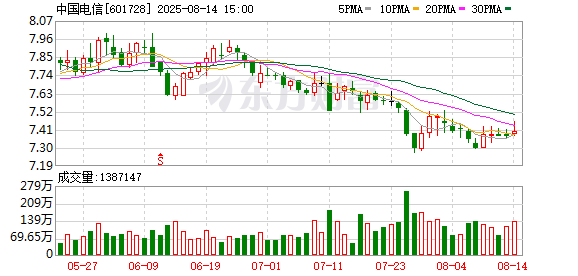
(文章来源:每日经济新闻) 中国电信(SH 601728,收盘价:7.4元)8月14日晚间发布半年度业绩报告称,2025年上半年营业收入 约2694.22亿元,同比增加1.3%;归属于上市公司股东的净利润约230.17亿元,同比增加5.5%;基本每 股收益0.25元,同比增加5.5%。 ...

中国电信(00728) - 海外监管公告 - 中国电信股份有限公司2025 年半年度报告摘要
2025-08-14 09:25
香港交易及結算所有限公司及香港聯合交易所有限公司對本公告的內容概不負責,對其準確性或完整性亦不發表任何聲 明,並明確表示概不對因本公告全部或任何部份內容而產生或因倚賴該等內容而引致的任何損失承擔任何責任。 China Telecom Corporation Limited 中国电信股份有限公司 (於中華人民共和國註冊成立之股份有限公司) (股份編號:728) 海外監管公告 中國電信股份有限公司 2025 年半年度報告摘要 本公告乃根據香港聯合交易所有限公司證券上市規則第 13.10B 條而作出。 兹載列中國電信股份有限公司(「本公司」)在上海證券交易所網站刊登的《中國電信股份有 限公司 2025 年半年度報告摘要》,僅供參考。 承董事會命 中國電信股份有限公司 董事長兼首席執行官 柯瑞文 中國北京,2025 年 8 月 14 日 於本公告刊發之日的本公司董事會包括柯瑞文(董事長兼首席執行官);劉桂清(總裁兼首席 運營官);唐珂、李英輝(財務總監)(皆為執行副總裁);呂永鐘(非執行董事);吳嘉寧、 楊志威、陳東琪、呂薇(皆為獨立非執行董事)。 公司代码:601728 公司简称:中国电信 中国电信股份有限公司 2 ...
中国电信:8月14日召开董事会会议
Mei Ri Jing Ji Xin Wen· 2025-08-14 09:24
Group 1 - China Telecom announced the convening of its 21st meeting of the 8th Board of Directors on August 14, 2025, in Hong Kong [2] - The meeting will review the proposal for the company's semi-annual report for 2025 [2] - For the year 2024, the company's revenue composition is 100.0% from the telecommunications industry [2]
中国电信(601728.SH)发布半年度业绩,归母净利润230.17亿元,同比增长5.5%
智通财经网· 2025-08-14 09:23
Core Insights - The company reported a revenue of RMB 2,694.22 billion for the first half of 2025, representing a year-on-year growth of 1.3% [1][2] - Net profit attributable to shareholders reached RMB 230.17 billion, up 5.5% year-on-year, with a basic earnings per share of RMB 0.25 [1] - The company plans to distribute a dividend of RMB 0.1812 per share (tax included) to all shareholders [1] Financial Performance - Service revenue amounted to RMB 2,491 billion, reflecting a 1.2% increase year-on-year [2] - Mobile communication service revenue grew to RMB 1,066 billion, marking a 1.3% increase, with an ARPU of RMB 46.0 [2] - Fixed-line and smart home service revenue reached RMB 641 billion, a slight increase of 0.2%, with a broadband ARPU of RMB 48.3 [2] Industry Trends - The telecommunications industry maintained stable operations, with total telecom business revenue reaching RMB 9,055 billion, a 1% year-on-year growth [1] - The number of 5G base stations reached 4.549 million, and the total length of optical cable lines was 73,770 kilometers [1] - The user base continued to expand, with mobile phone users totaling 1.81 billion and 5G users reaching 1.118 billion [1]
中国电信(00728) - 海外监管公告 - 中国电信股份有限公司2025年半年度报告
2025-08-14 09:22
香港交易及結算所有限公司及香港聯合交易所有限公司對本公告的內容概不負責,對其準確性或完整性亦不發表任何聲 明,並明確表示概不對因本公告全部或任何部份內容而產生或因倚賴該等內容而引致的任何損失承擔任何責任。 China Telecom Corporation Limited 中国电信股份有限公司 (於中華人民共和國註冊成立之股份有限公司) (股份編號:728) 海外監管公告 中國電信股份有限公司 2025 年半年度報告 本公告乃根據香港聯合交易所有限公司證券上市規則第 13.10B 條而作出。 兹載列中國電信股份有限公司(「本公司」)在上海證券交易所網站刊登的《中國電信股份有 限公司 2025 年半年度報告》,僅供參考。 承董事會命 中國電信股份有限公司 董事長兼首席執行官 柯瑞文 中國北京,2025 年 8 月 14 日 於本公告刊發之日的本公司董事會包括柯瑞文(董事長兼首席執行官);劉桂清(總裁兼首席 運營官);唐珂、李英輝(財務總監)(皆為執行副總裁);呂永鐘(非執行董事);吳嘉寧、 楊志威、陳東琪、呂薇(皆為獨立非執行董事)。 公司代码:601728 公司简称:中国电信 中国电信股份有限公司 2025 ...
中国电信(601728) - 2025 Q2 - 季度财报
2025-08-14 09:20
[Important Notice](index=2&type=section&id=Important%20Notice) This section provides essential declarations, audit status, profit distribution plans, and risk warnings for the interim report [Statement by the Board of Directors, Supervisory Board, and Senior Management](index=2&type=section&id=Statement%20by%20the%20Board%20of%20Directors%2C%20Supervisory%20Board%2C%20and%20Senior%20Management) The company's Board of Directors, Supervisory Board, and senior management guarantee the truthfulness, accuracy, and completeness of the interim report - The company's Board of Directors, Supervisory Board, and directors, supervisors, and senior management guarantee the truthfulness, accuracy, and completeness of the interim report, free from false statements, misleading representations, or major omissions, and assume individual and joint legal liabilities[3](index=3&type=chunk) [Information on Absent Directors](index=2&type=section&id=Information%20on%20Absent%20Directors) Director Lv Yongzhong was absent from a board meeting due to work reasons and entrusted Li Yinghui to attend on his behalf Absent Directors | Position of Absent Director | Name of Absent Director | Reason for Absence | Name of Proxy | | :--- | :--- | :--- | :--- | | Director | Lv Yongzhong | Work reasons | Li Yinghui | [Audit Status](index=2&type=section&id=Audit%20Status) This interim report has not been audited - This interim report has not been audited[4](index=4&type=chunk) [Statement by Company Head and Accounting Head](index=2&type=section&id=Statement%20by%20Company%20Head%20and%20Accounting%20Head) Ke Ruiwen, Li Yinghui, and He Jianquan declare the financial report's truthfulness, accuracy, and completeness - Company Head Ke Ruiwen, Head of Accounting Li Yinghui, and Head of Accounting Department He Jianquan declare that the financial report in the interim report is true, accurate, and complete[4](index=4&type=chunk) ["Quality Improvement, Efficiency Enhancement, and Return" Progress](index=2&type=section&id=%E2%80%9CQuality%20Improvement%2C%20Efficiency%20Enhancement%2C%20and%20Return%E2%80%9D%20Progress) The company continued to advance its "Quality Improvement, Efficiency Enhancement, and Return" initiative in H1 2025, embracing AI and upgrading its strategy to "Cloud-Digital Transformation and Intelligent Empowerment" for high-quality development - The company adhered to "Quality Improvement, Efficiency Enhancement, and Return" in H1 2025, fully implementing new development concepts, embracing AI, and upgrading its strategy from "Cloud-Digital Transformation" to "Cloud-Digital Transformation and Intelligent Empowerment" to continuously promote high-quality development[4](index=4&type=chunk) [Profit Distribution Plan](index=2&type=section&id=Profit%20Distribution%20Plan) The Board decided to distribute 72% of the H1 2025 net profit attributable to shareholders, totaling RMB 16.58 billion, or RMB 0.1812 per share (tax inclusive) H1 2025 Profit Distribution Plan | Metric | Amount (RMB) | | :--- | :--- | | Interim Net Profit Attributable to Shareholders | **23.02 billion** | | Dividend Distribution Ratio | **72%** | | Total Dividend Distributed | **16.58 billion** | | Dividend Per Share (Tax Inclusive) | **0.1812** | | Total Share Capital (as of June 30, 2025) | **91,507,138,699 shares** | [Forward-Looking Statement Risk Disclaimer](index=2&type=section&id=Forward-Looking%20Statement%20Risk%20Disclaimer) Forward-looking statements in the report do not constitute a commitment to investors, and actual performance may differ significantly, requiring investors to be aware of investment risks - Forward-looking statements in the company's H1 2025 interim report, such as development strategies, future operating plans, and outlooks, do not constitute a commitment to investors; these statements are subject to known and unknown risks, uncertainties, and other factors, which may cause the company's actual performance, financial condition, or operating results to differ materially from those implied by such forward-looking statements[6](index=6&type=chunk) [Fund Occupation and External Guarantees](index=2&type=section&id=Fund%20Occupation%20and%20External%20Guarantees) During the reporting period, the company had no non-operating fund occupation by controlling shareholders or related parties, nor any external guarantees in violation of decision-making procedures - No non-operating fund occupation by controlling shareholders or other related parties[7](index=7&type=chunk) - No external guarantees provided in violation of decision-making procedures[7](index=7&type=chunk) [Significant Risk Warnings](index=3&type=section&id=Significant%20Risk%20Warnings) The company detailed significant risks including economic and policy environment adaptation, technological innovation, network and data security, emerging businesses, and international operations - The company has detailed the existing risks in this report, including economic and policy environment adaptation, technological innovation, network and data security, emerging businesses in strategic and future industries, and international business operations[8](index=8&type=chunk) [Section I Definitions](index=5&type=section&id=Section%20I%20Definitions) This section defines common terms used in the report, covering company names, related parties, and various technical and financial terminologies [Definitions of Common Terms](index=5&type=section&id=Definitions%20of%20Common%20Terms) This chapter lists and defines common terms used in the report, including company names, related parties, and technical terms such as AI, AIDC, and QKD - **Artificial Intelligence (AI)** refers to a technical science that studies and develops theories, methods, technologies, and application systems for simulating, extending, and expanding human intelligence[13](index=13&type=chunk) - **AIDC** refers to Artificial Intelligence Data Center[13](index=13&type=chunk) - **QKD** refers to Quantum Key Distribution, which uses the indivisible, non-replicable, and uncertain physical properties of quantum mechanics to securely distribute keys remotely[13](index=13&type=chunk) [Section II Company Profile and Key Financial Indicators](index=6&type=section&id=Section%20II%20Company%20Profile%20and%20Key%20Financial%20Indicators) This section provides the company's basic information, contact details, stock overview, and key financial data and indicators for the reporting period [Company Information](index=6&type=section&id=Company%20Information) This chapter provides the company's official Chinese and English names, abbreviations, and legal representative Company Basic Information | Company's Chinese Name | China Telecom Corporation Limited | | :--- | :--- | | Company's Chinese Abbreviation | China Telecom | | Company's English Name | China Telecom Corporation Limited | | Company's English Abbreviation | CHINA TELECOM | | Legal Representative | Ke Ruiwen | [Contact Person and Contact Information](index=6&type=section&id=Contact%20Person%20and%20Contact%20Information) This chapter lists the names, addresses, phone numbers, faxes, and email addresses of the company's Board Secretary and Securities Affairs Representative Contact Person and Contact Information | | Board Secretary | Securities Affairs Representative | | :--- | :--- | :--- | | Name | Li Yinghui | Xu Fei | | Contact Address | 31 Jinrong Street, Xicheng District, Beijing | 31 Jinrong Street, Xicheng District, Beijing | | Phone | 010-58501508 | 010-58501508 | | Fax | 010-58501531 | 010-58501531 | | Email | ir@chinatelecom-h.com | ir@chinatelecom-h.com | [Brief Introduction to Changes in Basic Information](index=6&type=section&id=Brief%20Introduction%20to%20Changes%20in%20Basic%20Information) The company's registered and office addresses remain at 31 Jinrong Street, Xicheng District, Beijing, with no changes during the reporting period Company Registered and Office Address | Company Registered Address | 31 Jinrong Street, Xicheng District, Beijing | | :--- | :--- | | Historical Changes to Company Registered Address | Not applicable | | Company Office Address | 31 Jinrong Street, Xicheng District, Beijing | | Postal Code of Company Office Address | 100033 | | Company Website | www.chinatelecom-h.com | | Email | ir@chinatelecom-h.com | | Index for Changes During Reporting Period | Not applicable | [Brief Introduction to Changes in Information Disclosure and Document Storage Locations](index=6&type=section&id=Brief%20Introduction%20to%20Changes%20in%20Information%20Disclosure%20and%20Document%20Storage%20Locations) The company's designated information disclosure newspapers are four major securities newspapers, reports are published on SSE and HKEX websites, and documents are stored at the company's office address, with no changes during the reporting period Information Disclosure Channels | Designated Information Disclosure Newspapers | China Securities Journal, Shanghai Securities News, Securities Times, Securities Daily | | :--- | :--- | | Website Addresses for Interim Report Publication | Shanghai Stock Exchange website: www.sse.com.cn Hong Kong Stock Exchange website: www.hkexnews.hk | | Location for Company Interim Report Storage | 31 Jinrong Street, Xicheng District, Beijing | | Index for Changes During Reporting Period | Not applicable | [Brief Introduction to Company Shares](index=6&type=section&id=Brief%20Introduction%20to%20Company%20Shares) The company's shares include A-shares listed on the Shanghai Stock Exchange and H-shares listed on the Hong Kong Stock Exchange Company Share Information | Share Type | Listing Exchange | Stock Abbreviation | Stock Code | Previous Stock Abbreviation | | :--- | :--- | :--- | :--- | :--- | | A-share | Shanghai Stock Exchange | China Telecom | 601728 | Not applicable | | H-share | Hong Kong Stock Exchange | China Telecom | 00728 | Not applicable | [Company's Key Accounting Data and Financial Indicators](index=7&type=section&id=Company%27s%20Key%20Accounting%20Data%20and%20Financial%20Indicators) In H1 2025, the company's operating revenue grew by 1.3%, net profit attributable to shareholders increased by 5.5%, and basic EPS was RMB 0.25, while net cash flow from operating activities decreased by 19.4% Key Accounting Data (Jan-Jun 2025) | Key Accounting Data | Current Period (Jan-Jun) (RMB) | Prior Period (RMB) | YoY Change (%) | | :--- | :--- | :--- | :--- | | Operating Revenue | **269,421,736,705.26** | 265,973,118,881.02 | **1.3** | | Total Profit | 29,594,994,451.69 | 28,238,612,367.32 | 4.8 | | Net Profit Attributable to Listed Company Shareholders | **23,017,044,187.33** | 21,811,826,965.71 | **5.5** | | Net Cash Flow from Operating Activities | **47,034,217,345.82** | 58,340,550,541.53 | **(19.4)** | | Net Assets Attributable to Listed Company Shareholders (Period-end) | 466,871,350,365.87 | 452,389,720,102.38 | 3.2 | | Total Assets (Period-end) | 887,223,855,117.97 | 866,625,200,722.04 | 2.4 | Key Financial Indicators (Jan-Jun 2025) | Key Financial Indicators | Current Period (Jan-Jun) | Prior Period | YoY Change (%) | | :--- | :--- | :--- | :--- | | Basic Earnings Per Share (RMB/share) | **0.25** | 0.24 | **5.5** | | Diluted Earnings Per Share (RMB/share) | 0.25 | 0.24 | 5.5 | | Basic EPS After Deducting Non-Recurring Gains and Losses (RMB/share) | 0.24 | 0.24 | 0.2 | | Weighted Average Return on Net Assets (%) | **5.0** | 4.8 | **Increased by 0.2 percentage points** | | Weighted Average Return on Net Assets After Deducting Non-Recurring Gains and Losses (%) | 4.7 | 4.8 | Decreased by 0.1 percentage points | [Non-Recurring Gains and Losses and Amounts](index=7&type=section&id=Non-Recurring%20Gains%20and%20Losses%20and%20Amounts) This chapter lists the non-recurring gains and losses and their amounts for the reporting period, totaling RMB 1,296,324,708.25 Non-Recurring Gains and Losses and Amounts (Jan-Jun 2025) | Non-Recurring Gains and Losses Item | Amount (RMB) | | :--- | :--- | | Gains and Losses from Disposal of Non-Current Assets | (1,164,807,266.32) | | Government Subsidies Included in Current Profit and Loss | 633,280,162.97 | | Fair Value Changes and Disposal Gains/Losses from Financial Assets and Liabilities Held by Non-Financial Enterprises, Excluding Effective Hedge Accounting Related to Normal Business Operations | 78,009,846.38 | | Reversal of Impairment Provisions for Receivables Subject to Separate Impairment Testing | 3,894,681.03 | | Gains and Losses from Non-Monetary Asset Exchanges | 326,689,412.15 | | Gains and Losses from Fair Value Changes of Employee Remuneration Payable for Cash-Settled Share-Based Payments After Vesting Date | 474,708,095.28 | | Other Non-Operating Income and Expenses Apart from the Above | 1,359,063,411.22 | | Less: Income Tax Impact | (404,814,406.71) | | Minority Interest Impact (After Tax) | (9,699,227.75) | | Total | **1,296,324,708.25** | [Section III Management Discussion and Analysis](index=9&type=section&id=Section%20III%20Management%20Discussion%20and%20Analysis) This section provides an overview of the company's industry, business operations, financial performance, core competitiveness, and risk factors during the reporting period [Explanation of the Company's Industry and Main Business Operations During the Reporting Period](index=9&type=section&id=Explanation%20of%20the%20Company%27s%20Industry%20and%20Main%20Business%20Operations%20During%20the%20Reporting%20Period) In H1 2025, the telecom industry operated steadily with growing business volume and revenue, while the company embraced AI to drive strategic upgrades and integrated development of basic and industrial digital services - In H1 2025, the telecom industry operated generally stable, with telecom business volume and revenue maintaining growth, accumulating **RMB 905.5 billion** in revenue, a **1% YoY increase**[28](index=28&type=chunk) - The company adheres to a customer-centric approach, fully embracing AI, promoting its corporate strategy from "Cloud-Digital Transformation" to "Cloud-Digital Transformation and Intelligent Empowerment," and continuously advancing high-quality development[4](index=4&type=chunk)[30](index=30&type=chunk) - The company continuously promotes innovative development of basic services, accelerating connection upgrades, advancing mobile networks to 5G-A and home broadband to gigabit and FTTR, while expanding direct satellite services and quantum secure communication[29](index=29&type=chunk) - The company accelerates the creation of industry-leading large model applications, having launched over **80 industry large models** and **30 industry intelligent agents**, and deployed the Starry Sky MaaS platform and Starry Sky Industry Agent platform to provide integrated intelligent cloud services[29](index=29&type=chunk) [Discussion and Analysis of Operations](index=9&type=section&id=Discussion%20and%20Analysis%20of%20Operations) In H1 2025, the company achieved 1.3% YoY revenue growth and 5.5% net profit growth, driven by strategic upgrades, AI integration, technological innovation, and digital infrastructure enhancements, while actively fulfilling social responsibilities and gaining capital market recognition H1 2025 Overall Performance | Metric | Amount (RMB) | YoY Growth (%) | | :--- | :--- | :--- | | Operating Revenue | **269.4 billion** | **1.3** | | Service Revenue | **249.1 billion** | **1.2** | | Net Profit Attributable to Listed Company Shareholders | **23.0 billion** | **5.5** | | Basic Earnings Per Share | **0.25** | - | - The company continuously promotes innovation-driven integrated development of basic and industrial digital services, with steady growth in basic services and rapid development in strategic emerging businesses[33](index=33&type=chunk) - The Board decided to continue distributing an interim dividend for 2025, with a cash distribution ratio of **72%** of the net profit attributable to shareholders for the first half, amounting to **RMB 0.1812 per share (tax inclusive)**, a **YoY increase of 8.4%**[34](index=34&type=chunk) [Overall Performance](index=10&type=section&id=Overall%20Performance) In H1 2025, the company's operating revenue reached RMB 269.4 billion, up 1.3%, with net profit attributable to shareholders at RMB 23.0 billion, up 5.5%, driven by growth in mobile, fixed-line, and industrial digital services H1 2025 Revenue by Business Segment | Business Type | Revenue (RMB 100 million) | YoY Growth (%) | | :--- | :--- | :--- | | Mobile Communication Service Revenue | **1,066** | **1.3** | | Fixed-line and Smart Home Service Revenue | **641** | **0.2** | | Industrial Digitalization Revenue | **749** | - | | e-Surfing Cloud Revenue | **573** | - | | Intelligent Revenue | **63** | **89.4** | | Security Revenue | **91** | **18.2** | | Video Network Revenue | - | **46.2** | | Satellite Revenue | - | **20.5** | | Quantum Revenue | - | **171.1** | - Mobile users reached **433 million**, broadband users reached **199 million**, mobile user ARPU reached **RMB 46.0**, and broadband integrated ARPU reached **RMB 48.3**[33](index=33&type=chunk) [Seizing Opportunities for Strategic Initiative and Solid Steps Towards High-Quality Development](index=10&type=section&id=Seizing%20Opportunities%20for%20Strategic%20Initiative%20and%20Solid%20Steps%20Towards%20High-Quality%20Development) The company achieved high-quality development by building an intelligent cloud system, deepening "AI+" initiatives, accelerating technological innovation, upgrading digital infrastructure, and promoting green and secure development - The company, centered on its primary technology "Xirang," has completed the construction of an intelligent cloud system, providing integrated intelligent cloud services of "computing power + platform + data + model + application" based on cloud-network convergence[35](index=35&type=chunk) - The company accelerates the intelligent upgrade of its businesses, creating over **80 industry large models** and **30 intelligent agents**, serving over **20,000 enterprise customers**; it also released its self-developed Starry Sky Xiaochen intelligent agent, empowering the scaled development of AI anti-fraud phones and AI mid-screens[36](index=36&type=chunk) - The company deeply promotes AI technology empowerment, developing over **160 AI applications** across **21 key areas**, with intelligent customer service accounting for **87.5%** and fault work orders reduced by **9.8%**[37](index=37&type=chunk) - The company continuously optimizes its "Quantum+" product capabilities, with quantum communication user scale exceeding **6 million**, serving over **3,000 enterprise customers** in government, finance, and energy sectors[38](index=38&type=chunk) - The company continuously promotes high-level scientific and technological self-reliance, with its self-developed e-Surfing Cloud server operating system passing national security and reliability evaluations; it also retained its position as **number one in China's computing power interconnection and scheduling market**[39](index=39&type=chunk) - The company moderately advanced its computing infrastructure layout, with its own intelligent computing power reaching **43 EFLOPS**; data center racks exceeded **580,000**, with **85%** located in the eight major hub nodes[40](index=40&type=chunk) - The company actively practices green development, achieving a **double-digit decrease in carbon emissions per unit of telecom business volume**; AI energy saving covers over **5.96 million base station sectors** and **3,400 equipment rooms**, saving approximately **1.1 billion kWh of electricity annually**[41](index=41&type=chunk) - The company continuously explores the potential of security and AI integration and bidirectional empowerment, with its Cloud D-fence anti-DDoS scrubbing capability exceeding **18 Tbps**, maintaining leading protection capabilities and market share[43](index=43&type=chunk) [Further Deepening Reform and Opening Up, Improving Governance System and Capabilities](index=12&type=section&id=Further%20Deepening%20Reform%20and%20Opening%20Up%2C%20Improving%20Governance%20System%20and%20Capabilities) The company comprehensively advanced state-owned enterprise reform, strengthening talent development, optimizing R&D, and enhancing open cooperation in technology, digital infrastructure, capital, and international markets to drive high-quality development - The company comprehensively promotes the deepening and upgrading of state-owned enterprise reform, steadily advancing the "Mount Everest," "Kunlun," and "Five Sacred Mountains" plans, selecting **24 new chief experts**, and improving the echelon structure of scientific and technological talent[44](index=44&type=chunk) - The company continuously optimizes its RDO R&D organizational system, improves innovation evaluation and incentive mechanisms, and introduces a series of support policies for original and exploratory technological innovations to enhance the efficiency of scientific and technological achievement transformation[44](index=44&type=chunk) - The company comprehensively enhances its systemic open cooperation capabilities, strengthening technological open cooperation, collaborating with Shanghai AI Lab to build a **ten-thousand-card intelligent computing cluster**; it also achieved controlling interest in QuantumCTek, fully deploying in the three major areas of the quantum information industry[45](index=45&type=chunk) - Direct-to-satellite mobile service officially launched commercially in Laos, expanding services to Southeast Asian countries; the e-Surfing Video International Platform was officially released, collaborating with the industry ecosystem to provide open and co-created intelligent video services for the global market[45](index=45&type=chunk) [Actively Fulfilling Social Responsibilities and Gaining Widespread Capital Market Recognition](index=12&type=section&id=Actively%20Fulfilling%20Social%20Responsibilities%20and%20Gaining%20Widespread%20Capital%20Market%20Recognition) The company actively fulfilled social responsibilities, ensuring critical communications, supporting rural revitalization, providing inclusive services, and leveraging anti-fraud technology, earning widespread capital market recognition for its high-level governance and transparent information disclosure - The company successfully completed communication guarantees for major events such as the Harbin Asian Winter Games, Boao Forum for Asia, and Shenzhou-20 manned spacecraft launch, utilizing Tiantong satellites and drones in disaster relief to establish an unimpeded "communication lifeline"[47](index=47&type=chunk) - The company uses digital intelligence to promote rural revitalization, stimulating the vitality of the rural digital economy and continuously fulfilling universal service obligations; "Love Wing Stations" inclusive services are available in **80,000 urban and rural business halls**, organizing over **80,000 care activities**, benefiting over **8.6 million people**[47](index=47&type=chunk) - The company consistently adheres to high-level corporate governance, strictly complies with laws and regulations, continuously improves the quality and transparency of information disclosure, and constantly builds a scientific and comprehensive compliance management system[47](index=47&type=chunk) - The company's performance received high praise from domestic and international capital markets, winning the "Best Corporate Social Responsibility in Asia" award for the **sixth consecutive year** in Corporate Governance Asia's "Asian Excellence Awards 2025"[48](index=48&type=chunk) [Seizing Momentum, Guiding Direction, and Promoting Enterprise Strategic Upgrades](index=13&type=section&id=Seizing%20Momentum%2C%20Guiding%20Direction%2C%20and%20Promoting%20Enterprise%20Strategic%20Upgrades) The company upgraded its "Cloud-Digital Transformation" strategy to "Cloud-Digital Transformation and Intelligent Empowerment," focusing on customer-centricity, technological innovation, cloud-network convergence, green security, digital intelligence platforms, and talent development to become a world-class enterprise - The company seizes the momentum to upgrade its corporate strategy to Cloud-Digital Transformation and Intelligent Empowerment, adhering to a customer-centric approach, making the fulfillment of customers' aspirations for a better life its starting and ending point[50](index=50&type=chunk) - The company will continue to modernize its corporate governance system and capabilities, effectively promote strategic implementation, and accelerate high-quality development[50](index=50&type=chunk) - The company fully implements the Cloud-Digital Transformation and Intelligent Empowerment strategy, strengthening innovation-driven integrated development of basic and industrial digital services; it deeply promotes the "AI+" initiative, allowing intelligent dividends to better benefit all industries and households[51](index=51&type=chunk) [Analysis of Core Competitiveness During the Reporting Period](index=13&type=section&id=Analysis%20of%20Core%20Competitiveness%20During%20the%20Reporting%20Period) The company's core competitiveness stems from its "Cloud-Digital Transformation and Intelligent Empowerment" strategy, intelligent digital infrastructure, leadership in AI and quantum technology, application-driven product innovation, and strengthened security governance - The company firmly fulfills its responsibilities in building a strong cyber nation, a strong science and technology nation, a digital China, and maintaining cybersecurity, promoting its corporate strategy to "Cloud-Digital Transformation and Intelligent Empowerment," and striving to build a world-class service-oriented, technology-oriented, and security-oriented enterprise[51](index=51&type=chunk) - Digital information infrastructure construction accelerates, with continuous improvement in intelligence, security, and green levels; building intelligent computing capabilities that cover the nation, concentrate hot spots, lead in technology, and enable full-domain scheduling; constructing a cloud-edge-device integrated, intra-computing/inter-computing/in-computing collaborative intelligent computing network and a flexible, elastic, green new-generation AIDC[52](index=52&type=chunk) - The leading role of technological innovation is significantly enhanced; creating China Telecom's primary technology "Xirang," innovatively building the AI Flow technology system, continuously upgrading full-modal, full-size, and fully domestically produced Starry Sky foundational large models; releasing the world's first distributed cryptographic system integrating QKD and PQC[54](index=54&type=chunk) - Application orientation is more prominent, and product and service innovation continues to upgrade; centered on its primary technology "Xirang," the intelligent cloud system has been completed, with over **80 industry large models** built in industrial, emergency, transportation, and other fields, serving over **20,000 customers**; the Starry Sky large model is embedded in e-Surfing AI phones[55](index=55&type=chunk) - Security governance is continuously strengthened, ensuring high-quality development with high-level security; the company consistently strengthens AI security governance, building a large model protection system to achieve technical safety, reliability, and controllability; actively promoting the integration of quantum into cloud-network infrastructure, accelerating the construction of vertically and horizontally connected, cross-domain interoperable quantum security service capabilities[56](index=56&type=chunk) [Key Operating Performance During the Reporting Period](index=14&type=section&id=Key%20Operating%20Performance%20During%20the%20Reporting%20Period) This chapter analyzes the company's H1 2025 financial statement changes, asset-liability status, and investment activities, noting a 1.3% revenue increase, a 19.4% decrease in operating cash flow due to longer industrial digitalization payment cycles, and continued investment in 5G and industrial digitalization - In H1 2025, the company's operating revenue was **RMB 269.42 billion**, a **1.3% increase** YoY, primarily due to the company's customer-centric approach, focusing on new consumer demands, accelerating the deep integration of strategic emerging elements with products and services, and steady growth in basic and industrial digital services[58](index=58&type=chunk) - Net cash inflow from operating activities was **RMB 47.03 billion**, a **19.4% decrease** YoY, mainly because industrial digitalization businesses have longer payment cycles, leading to a higher increase in corresponding receivables[60](index=60&type=chunk) - As of June 30, 2025, the company's external investments primarily include equity in associates and joint ventures and equity instruments measured at fair value through other comprehensive income, with the book value of equity in associates and joint ventures being **RMB 44.389 billion**[68](index=68&type=chunk) - Total capital expenditure in the first half amounted to **RMB 34.2 billion**, with **RMB 12.1 billion** invested in mobile networks and **RMB 11.6 billion** in industrial digitalization[69](index=69&type=chunk) [Analysis of Main Business](index=14&type=section&id=Analysis%20of%20Main%20Business) Main business analysis shows a 1.3% increase in operating revenue, a 1.5% increase in operating costs, a 6.0% decrease in selling expenses, and increases in administrative and R&D expenses, while net cash flow from operating activities decreased by 19.4% and from investing activities increased by 23.2% Analysis of Changes in Financial Statement Items (Jan-Jun 2025) | Item | Current Period (RMB) | Prior Period (RMB) | Change (%) | | :--- | :--- | :--- | :--- | | Operating Revenue | **269,421,736,705.26** | 265,973,118,881.02 | **1.3** | | Operating Costs | 186,745,046,742.07 | 183,956,774,406.82 | 1.5 | | Selling Expenses | **25,917,063,047.53** | 27,568,338,730.65 | **(6.0)** | | Administrative Expenses | 18,451,402,311.24 | 17,843,542,563.52 | 3.4 | | Financial Expenses | 293,810,051.77 | 250,414,178.44 | 17.3 | | R&D Expenses | 4,782,250,996.98 | 4,658,846,538.04 | 2.6 | | Net Cash Flow from Operating Activities | **47,034,217,345.82** | 58,340,550,541.53 | **(19.4)** | | Net Cash Flow from Investing Activities | **(59,869,981,171.94)** | (48,581,641,678.51) | **23.2** | | Net Cash Flow from Financing Activities | (16,392,766,041.81) | (15,744,478,623.34) | 4.1 | - Selling expenses decreased by **6.0%**, primarily due to the company's continuous promotion of digital marketing service construction, accelerating AI intelligent marketing transformation, and improving the efficiency of selling expense utilization[59](index=59&type=chunk) - Net cash inflow from operating activities decreased by **19.4%** YoY, mainly because industrial digitalization businesses have longer payment cycles, leading to a higher increase in corresponding receivables[60](index=60&type=chunk) [Analysis of Assets and Liabilities](index=15&type=section&id=Analysis%20of%20Assets%20and%20Liabilities) As of the reporting period end, total assets increased by 2.4%, and net assets attributable to shareholders increased by 3.2%; accounts receivable surged by 74.00% due to longer industrial digitalization payment cycles, and employee compensation grew by 68.68% reflecting talent acquisition and incentives Changes in Assets and Liabilities (Period-end vs. Prior Year-end) | Item Name | Current Period-end (RMB) | Prior Year-end (RMB) | Change from Prior Year-end (%) | | :--- | :--- | :--- | :--- | | Financial Assets Held for Trading | **20,638,885,646.15** | - | - | | Notes Receivable | 1,147,683,432.32 | 3,218,754,580.38 | (64.34) | | Accounts Receivable | **68,987,550,475.78** | 39,648,270,450.34 | **74.00** | | Employee Compensation Payable | **30,549,255,449.12** | 18,110,862,306.16 | **68.68** | - Overseas assets amounted to **RMB 18.21 billion**, accounting for **2.05% of total assets**[64](index=64&type=chunk) - As of the end of the reporting period, the company's restricted monetary funds primarily consisted of statutory reserves deposited by its controlled subsidiary, China Telecom Group Finance Co., Ltd., with the central bank, totaling **RMB 3.50 billion**[66](index=66&type=chunk) [Analysis of Investment Status](index=17&type=section&id=Analysis%20of%20Investment%20Status) In H1 2025, the company's capital expenditure was RMB 34.2 billion, mainly for 5G and industrial digitalization; equity investments in associates and joint ventures totaled RMB 44.389 billion, with RMB 1.254 billion in investment income from China Tower, alongside strategic financial asset management - In H1 2025, the company adhered to a prudent and precise investment strategy, with total capital expenditure of **RMB 34.2 billion**, including **RMB 12.1 billion** in mobile network investment and **RMB 11.6 billion** in industrial digitalization investment[69](index=69&type=chunk) - As of June 30, 2025, the company's external investments primarily included equity in associates and joint ventures with a book value of **RMB 44.389 billion**, a **0.5% increase** from the beginning of the year[68](index=68&type=chunk) - During the reporting period, the company held approximately **3.60871 billion ordinary shares** of China Tower listed in Hong Kong, accounting for approximately **20.5%** of China Tower's total shares; in H1 2025, the company recognized **RMB 1.254 billion** in equity investment income from China Tower[68](index=68&type=chunk) Financial Assets Measured at Fair Value (June 30, 2025) | Asset Class | Period-end Amount (RMB) | Amount Purchased in Current Period (RMB) | Amount Sold/Redeemed in Current Period (RMB) | | :--- | :--- | :--- | :--- | | Stocks | 979,413,331.46 | - | - | | Private Equity Funds | 198,141,671.63 | - | 8,816,088.05 | | Others (Low-Risk Structured Deposits) | **20,889,446,328.03** | **55,505,000,000.00** | **35,135,633,966.02** | | Total | **22,067,001,331.12** | **55,505,000,000.00** | **35,144,450,054.07** | [Other Disclosure Matters](index=20&type=section&id=Other%20Disclosure%20Matters) The company faces risks related to economic and policy adaptation, technological innovation, network and data security, emerging business development, and international operations, with detailed mitigation strategies outlined - **Economic and Policy Environment Adaptation Risk**: Adverse impacts from external environment changes are deepening, and the company's internal cloud-digital transformation and structural adjustments need further deepening[77](index=77&type=chunk) - **Technological Innovation Risk**: AI, computing power services, and cloud businesses are becoming major development directions, and the company's technological innovation efforts and independent R&D and control capabilities for products need continuous improvement[78](index=78&type=chunk) - **Network and Data Security Risk**: Security risks brought by new technologies and scenarios are increasing, requiring further improvement of the company's network and data security system and continuous enhancement of its ability to maintain network and data security[79](index=79&type=chunk) - **Emerging Business Risk in Strategic and Future Industries**: Competition in the digital service market is becoming more diversified, with intense competition in large models, intelligent computing clouds, and other business areas, requiring further improvement of the company's emerging business R&D and application capabilities[80](index=80&type=chunk) - **International Business Operation Risk**: The intertwined global changes and policy environment shifts in business and investment host countries/regions increase uncertainties in international business expansion, and the company still has certain deficiencies in overseas product services, government and enterprise product development and operation capabilities, sales channel expansion[81](index=81&type=chunk) [Section IV Corporate Governance, Environment, and Society](index=21&type=section&id=Section%20IV%20Corporate%20Governance%2C%20Environment%20and%20Society) This section covers changes in the company's directors and senior management, profit distribution plans, employee incentive programs, and efforts in poverty alleviation and rural revitalization [Changes in Directors, Supervisors, and Senior Management](index=21&type=section&id=Changes%20in%20Directors%2C%20Supervisors%2C%20and%20Senior%20Management) During the reporting period, the company saw multiple changes in its senior management and board members, including new appointments for President and Executive Vice Presidents, election of a non-executive director, and resignations of several directors Changes in Directors, Supervisors, and Senior Management | Name | Position Held | Change Type | | :--- | :--- | :--- | | Liu Guiqing | President and Chief Operating Officer | Appointment | | Liu Ying | Executive Vice President | Appointment | | Huang Zhiyong | Executive Vice President | Appointment | | Lv Yongzhong | Non-Executive Director | Election | | Liang Baojun | Executive Director, President and Chief Operating Officer | Resignation | | Li Jun | Executive Director | Resignation | | Chen Shengguang | Non-Executive Director | Resignation | - Mr. Liu Guiqing was appointed as the company's President and Chief Operating Officer, no longer concurrently serving as Executive Vice President[84](index=84&type=chunk) - Mr. Liang Baojun resigned from his positions as Executive Director, President, and Chief Operating Officer due to work relocation; Mr. Li Jun resigned from his position as Executive Director due to work relocation; and Mr. Chen Shengguang resigned from his position as Non-Executive Director due to work adjustment[86](index=86&type=chunk) [Profit Distribution or Capital Reserve Conversion Plan](index=21&type=section&id=Profit%20Distribution%20or%20Capital%20Reserve%20Conversion%20Plan) The Board decided to distribute 72% of the H1 2025 net profit attributable to shareholders, totaling RMB 16.58 billion, or RMB 0.1812 per share (tax inclusive) Interim Profit Distribution Plan | Metric | Data | | :--- | :--- | | Whether to Distribute or Convert | Yes | | Dividend Per 10 Shares (RMB) (Tax Inclusive) | **1.812** | | Interim Net Profit Attributable to Shareholders | **23.02 billion** | | Dividend Distribution Ratio | **72%** | | Total Dividend Distributed | **16.58 billion** | | Dividend Per Share (Tax Inclusive) | **0.1812** | [Status and Impact of Company Equity Incentive Plans, Employee Stock Ownership Plans, or Other Employee Incentive Measures](index=22&type=section&id=Status%20and%20Impact%20of%20Company%20Equity%20Incentive%20Plans%2C%20Employee%20Stock%20Ownership%20Plans%2C%20or%20Other%20Employee%20Incentive%20Measures) The company implemented a second phase of stock appreciation rights incentive plan in 2021 for core employees, with the first and second vesting periods' exercise conditions met in October 2024, and benefits to be realized according to established rules - The company implemented a second phase of stock appreciation rights incentive plan in **2021** to provide long-term incentives for core employees (excluding the company's executive directors, non-executive directors, independent directors, supervisors, and senior management)[89](index=89&type=chunk) - The company's Board of Directors confirmed that the exercise conditions for the first and second vesting periods of the **2021 stock appreciation rights** have been met, and the company will uniformly handle the exercise of stock appreciation rights and realize benefits for incentive recipients according to established rules[89](index=89&type=chunk) - Stock appreciation rights are distributed based on contribution, adhering to a value-oriented approach; based on potential, adhering to a development-oriented approach; and based on performance, adhering to a performance-oriented approach, with the number of exercisable rights closely linked to company and individual employee performance[90](index=90&type=chunk) [Specific Progress in Consolidating Poverty Alleviation Achievements and Rural Revitalization](index=22&type=section&id=Specific%20Progress%20in%20Consolidating%20Poverty%20Alleviation%20Achievements%20and%20Rural%20Revitalization) In H1 2025, the company actively advanced targeted poverty alleviation and rural revitalization, purchasing RMB 442.77 million in agricultural products, training 61,081 individuals, serving over 100 million villagers through digital rural construction, and achieving the highest rating for central unit targeted assistance for seven consecutive years - In H1 2025, the company directly purchased and assisted in selling agricultural products worth **RMB 442.77 million**, and organized various talent training sessions for **61,081 participants**[91](index=91&type=chunk) - The company fully leverages its strengths to promote digital rural construction, empowering rural revitalization with digitalization, intelligence, and smart solutions, serving over **100 million villagers**[91](index=91&type=chunk) - The company successfully completed all targeted assistance tasks for **2024**, receiving the **highest rating** in the central unit targeted assistance performance evaluation for **seven consecutive years**, consistently ranking among the **top ten central enterprises**[91](index=91&type=chunk) [Section V Significant Matters](index=23&type=section&id=Section%20V%20Significant%20Matters) This section details the fulfillment of commitments, significant related party transactions, and the status of major contracts and external guarantees [Fulfillment of Commitments](index=23&type=section&id=Fulfillment%20of%20Commitments) The controlling shareholder's 57.377 billion restricted shares were released for trading on February 20, 2025, and other IPO-related commitments, such as avoiding horizontal competition and regulating related party transactions, were strictly fulfilled - The **57,377,053,317 initial public offering restricted shares** held by the company's controlling shareholder, China Telecom Group Co., Ltd., matured and were listed for trading on **February 20, 2025**, which is a commitment ongoing into the reporting period[94](index=94&type=chunk) Fulfillment of Commitments | Commitment Type | Promisor | Commitment Content | Commitment Date | Has Performance Deadline | Commitment Period | Timely and Strictly Fulfilled | | :--- | :--- | :--- | :--- | :--- | :--- | :--- | | Share Restriction | Controlling Shareholder | Share circulation restrictions and voluntary lock-up of shares held by shareholders | 2021-08-20 | Yes | 36 months from the date of the company's A-share listing | Yes | | Avoid Horizontal Competition | Controlling Shareholder | Commitment to avoid horizontal competition | 2021-08-20 | Yes | Long-term | Yes | | Regulate Related Party Transactions | Controlling Shareholder, Guangdong Guangcheng | Commitment to regulate and reduce related party transactions | 2021-08-20 | Yes | Long-term | Yes | [Significant Related Party Transactions](index=25&type=section&id=Significant%20Related%20Party%20Transactions) The company engages in extensive daily operational related party transactions with its controlling shareholder China Telecom Group and its subsidiaries, and China Tower, covering engineering, telecom services, IT services, procurement, financial services, and leasing, all conducted under relevant agreements and market terms - The company has extensive daily operational related party transactions with China Telecom Group and its subsidiaries, and China Tower[97](index=97&type=chunk)[98](index=98&type=chunk)[135](index=135&type=chunk)[137](index=137&type=chunk) [Related Party Transactions Related to Daily Operations](index=25&type=section&id=Related%20Party%20Transactions%20Related%20to%20Daily%20Operations) The company engaged in various daily operational related party transactions with its controlling shareholder China Telecom Group Co., Ltd. and its subsidiaries, including centralized services, inter-network settlement, property and land leasing, communication resource leasing, IT services, logistics, material procurement, and engineering design and construction services Daily Related Party Transactions with China Telecom Group Co., Ltd. (H1 2025) | Related Party Transaction Content | Related Party Transaction Amount (RMB) | | :--- | :--- | | Centralized Service Income | 2,028,726,645.89 | | Centralized Service Expenses | 33,584,389.20 | | Interconnection Settlement Expenses | 45,668,869.70 | | Property and Land Use Rights Lease Expenses | 531,801,620.41 | | IT Service Expenses | 2,963,360,814.59 | | Engineering Design and Construction Service Expenses | 8,068,893,662.86 | | Last-Mile Telecom Service Expenses | 10,727,131,705.23 | [Financial Business Between the Company and Related Finance Companies, and Between the Company's Controlled Finance Company and Related Parties](index=28&type=section&id=Financial%20Business%20Between%20the%20Company%20and%20Related%20Finance%20Companies%2C%20and%20Between%20the%20Company%27s%20Controlled%20Finance%20Company%20and%20Related%20Parties) The company engages in deposit, loan, and credit financial transactions with China Telecom Group Finance Co., Ltd. and other related parties, with interest rates adhering to regulations or market terms Related Party Deposit Business (June 30, 2025) | Related Party | Daily Maximum Deposit Limit (RMB) | Period-end Balance (RMB) | | :--- | :--- | :--- | | China Telecom Group Finance Co., Ltd. | **60,000,000,000.00** | **32,278,034,243.54 (Total amount withdrawn in current period)** | | China Telecom Group Co., Ltd. and its controlled non-listed subsidiaries | **22,000,000,000.00** | **14,643,693,552.87 (Total amount withdrawn in current period)** | | China Communications Services Corporation Limited | **12,500,000,000.00** | **7,719,197,883.42 (Total amount withdrawn in current period)** | Related Party Loan Business (June 30, 2025) | Related Party | Loan Limit (RMB) | Period-end Balance (RMB) | | :--- | :--- | :--- | | China Telecom Group Finance Co., Ltd. | / | **17,070,462,041.45** | | China Telecom Group Co., Ltd. and its controlled non-listed subsidiaries | **15,000,000,000.00** | **2,001,277,777.78** | | Beijing Chenan Technology Co., Ltd. | **800,000,000.00** | **68,625,047.22** | - The interest rates for deposits accepted by the finance company from China Telecom Group and its subsidiaries shall comply with relevant regulations of the People's Bank of China, and also refer to the benchmark deposit rates (if any) periodically announced by the People's Bank of China and the rates determined by major commercial banks cooperating with China Telecom Group and its subsidiaries for similar deposit services of the same term, and shall be conducted on general commercial terms or better terms[139](index=139&type=chunk) [Major Contracts and Their Fulfillment](index=29&type=section&id=Major%20Contracts%20and%20Their%20Fulfillment) The company's external guarantees are primarily non-financing guarantees provided by subsidiaries to other wholly-owned subsidiaries, with a total outstanding balance of RMB 71.7349 million at period-end, no overdue guarantees, and all within annual limits, with guaranteed parties having debt-to-asset ratios below 70% Company External Guarantees (June 30, 2025) | Item | Amount (RMB) | | :--- | :--- | | Total Guarantees Provided to Subsidiaries During Reporting Period | 13,960,779.20 | | Total Outstanding Guarantees to Subsidiaries at Period-end (B) | **71,734,868.09** | | Total Guarantees (A+B) | **71,734,868.09** | | Ratio of Total Guarantees to Company Net Assets (%) | **0.0151** | | Explanation of Potential Joint and Several Liability for Undue Guarantees | None | - The company's external guarantees are all non-financing guarantees provided by China Telecom Group Finance Co., Ltd. and China Telecom Global Limited, both subsidiaries of the company, to other wholly-owned subsidiaries of the company[110](index=110&type=chunk) - As of the end of the reporting period, the outstanding balance of external guarantees by the company and its subsidiaries was **RMB 71.7349 million**, all of which were guarantees provided by the company's subsidiaries to other wholly-owned subsidiaries of the company; the company did not provide guarantees to subsidiaries or third parties, and there were no overdue guarantees[114](index=114&type=chunk) [Section VI Share Changes and Shareholder Information](index=32&type=section&id=Section%20VI%20Share%20Changes%20and%20Shareholder%20Information) This section details changes in the company's share capital, including the release of restricted shares, and provides an overview of shareholder structure and top shareholders [Changes in Share Capital](index=32&type=section&id=Changes%20in%20Share%20Capital) The controlling shareholder's 57.377 billion initial public offering restricted shares were released for trading on February 20, 2025, resulting in zero restricted shares and a corresponding increase in unrestricted tradable shares, while the total share count remained unchanged Table of Share Changes (Unit: Shares) | | Number Before Change | Percentage Before Change (%) | Change (+, -) Subtotal | Number After Change | Percentage After Change (%) | | :--- | :--- | :--- | :--- | :--- | :--- | | I. Restricted Shares | **57,377,053,317** | **62.70** | **-57,377,053,317** | **0** | **0.00** | | 2. State-Owned Legal Person Shares | 57,377,053,317 | 62.70 | -57,377,053,317 | 0 | 0.00 | | II. Unrestricted Tradable Shares | **34,130,085,382** | **37.30** | **+57,377,053,317** | **91,507,138,699** | **100.00** | | 1. RMB Ordinary Shares | 20,252,675,382 | 22.13 | +57,377,053,317 | 77,629,728,699 | 84.83 | | 3. Foreign Shares Listed Overseas | 13,877,410,000 | 15.17 | 0 | 13,877,410,000 | 15.17 | | III. Total Shares | **91,507,138,699** | **100.00** | **0** | **91,507,138,699** | **100.00** | - The **57,377,053,317 initial public offering restricted shares** held by the company's controlling shareholder, China Telecom Group Co., Ltd., matured and were listed for trading on **February 20, 2025**[119](index=119&type=chunk) Changes in Restricted Shares (Unit: Shares) | Shareholder Name | Restricted Shares at Period Start | Restricted Shares Released During Reporting Period | Restricted Shares Increased During Reporting Period | Restricted Shares at Period End | Reason for Restriction | Release Date | | :--- | :--- | :--- | :--- | :--- | :--- | :--- | | China Telecom Group Co., Ltd. | 57,377,053,317 | 57,377,053,317 | - | - | Initial Public Offering | 2025-02-20 | | Total | 57,377,053,317 | 57,377,053,317 | - | - | / | / | [Shareholder Information](index=33&type=section&id=Shareholder%20Information) As of the end of the reporting period, the company had 222,841 ordinary shareholders, with China Telecom Group Co., Ltd. remaining the largest shareholder, holding 63.90% of the shares - Total number of ordinary shareholders at the end of the reporting period: **222,841**[120](index=120&type=chunk) Top Ten Shareholders' Holdings at Period-end (Excluding Shares Lent via Securities Relending) | Shareholder Name (Full Name) | Shares Held at Period-end | Percentage (%) | Shareholder Type | | :--- | :--- | :--- | :--- | | China Telecom Group Co., Ltd. | **58,476,519,174** | **63.90** | State-Owned Legal Person | | Hong Kong Securities Clearing Company Nominees Limited | 13,848,878,611 | 15.13 | Overseas Legal Person | | Guangdong Guangcheng Holdings Group Co., Ltd. | 4,794,082,653 | 5.24 | State-Owned Legal Person | | Zhejiang Provincial Financial Development Co., Ltd. | 2,137,473,626 | 2.34 | State-Owned Legal Person | | China Life Insurance Co., Ltd. - Traditional - Ordinary Insurance Product - 005L - CT001 Shanghai | 1,096,730,505 | 1.20 | Unknown | | Jiangsu Guoxin Group Co., Ltd. | 957,031,543 | 1.05 | State-Owned Legal Person | | Fujian Investment Development Group Co., Ltd. | 920,294,182 | 1.01 | State-Owned Legal Person | | Guofeng Xinghua (Beijing) Private Equity Fund Management Co., Ltd. - Honghu Zhiyuan (Shanghai) Private Equity Investment Fund Management Co., Ltd. | 761,742,240 | 0.83 | Other | | Hong Kong Securities Clearing Company Limited | 556,847,169 | 0.61 | Unknown | | State Grid Yingda International Holdings Group Co., Ltd. | 441,501,000 | 0.48 | State-Owned Legal Person | [Strategic Investors or General Legal Persons Becoming Top Ten Shareholders Due to New Share Placement](index=35&type=section&id=Strategic%20Investors%20or%20General%20Legal%20Persons%20Becoming%20Top%20Ten%20Shareholders%20Due%20to%20New%20Share%20Placement) State Grid Yingda International Holdings Group Co., Ltd. became a top ten shareholder due to new share placement, with its shares unlocked on August 22, 2022 Holdings of Strategic Investors or General Legal Persons | Name of Strategic Investor or General Legal Person | Agreed Shareholding Start Date | Agreed Shareholding End Date | | :--- | :--- | :--- | | State Grid Yingda International Holdings Group Co., Ltd. | Locked for 20 months from the listing date of August 20, 2021, unlocked on August 22, 2022 | - | [Section VII Bond-Related Information](index=36&type=section&id=Section%20VII%20Bond-Related%20Information) This section confirms that there are no company bonds, enterprise bonds, non-financial enterprise debt financing instruments, or convertible corporate bonds requiring disclosure during the reporting period [Corporate Bonds (Including Enterprise Bonds) and Non-Financial Enterprise Debt Financing Instruments](index=36&type=section&id=Corporate%20Bonds%20(Including%20Enterprise%20Bonds)%20and%20Non-Financial%20Enterprise%20Debt%20Financing%20Instruments) During the reporting period, the company had no corporate bonds or non-financial enterprise debt financing instruments requiring disclosure - Corporate Bonds (Including Enterprise Bonds) and Non-Financial Enterprise Debt Financing Instruments: □Applicable √Not Applicable[130](index=130&type=chunk) [Convertible Corporate Bonds](index=36&type=section&id=Convertible%20Corporate%20Bonds) During the reporting period, the company had no convertible corporate bonds requiring disclosure - Convertible Corporate Bonds: □Applicable √Not Applicable[130](index=130&type=chunk) [Section VIII Financial Report](index=37&type=section&id=Section%20VIII%20Financial%20Report) This section presents the company's unaudited financial statements, including balance sheets, income statements, cash flow statements, and statements of changes in equity, along with detailed notes on accounting policies, taxes, and financial risks [Audit Report](index=37&type=section&id=Audit%20Report) This interim financial report has not been audited - Audit Report: □Applicable √Not Applicable[132](index=132&type=chunk) [Consolidated and Company Balance Sheets](index=37&type=section&id=Consolidated%20and%20Company%20Balance%20Sheets) As of June 30, 2025, the company's consolidated total assets were RMB 887.24 billion, up 2.4% from 2024 year-end, with net assets attributable to parent company shareholders at RMB 466.87 billion, up 3.2%, and current liabilities exceeding current assets by approximately RMB 105.158 billion Key Consolidated Balance Sheet Data (June 30, 2025 vs. December 31, 2024) | Item | June 30, 2025 (RMB) | December 31, 2024 (RMB) | | :--- | :--- | :--- | | Total Assets | **887,223,855,117.97** | 866,625,200,722.04 | | Total Liabilities | 413,214,623,644.87 | 410,073,397,469.99 | | Total Equity Attributable to Parent Company Shareholders | **466,871,350,365.87** | 452,389,720,102.38 | | Cash and Cash Equivalents | 89,932,160,239.17 | 102,008,936,021.90 | | Accounts Receivable | 68,987,550,475.78 | 39,648,270,450.34 | | Employee Compensation Payable | 30,549,255,449.12 | 18,110,862,306.16 | - As of June 30, 2025, the Group's total current liabilities exceeded total current assets by approximately **RMB 105.158 billion** (December 31, 2024: RMB 137.252 billion)[152](index=152&type=chunk) [Consolidated and Company Income Statements](index=41&type=section&id=Consolidated%20and%20Company%20Income%20Statements) In H1 2025, the company's consolidated operating revenue was RMB 269.422 billion, up 1.3% YoY; net profit attributable to parent company shareholders was RMB 23.017 billion, up 5.5% YoY, with fair value change gains turning positive and credit impairment losses significantly increasing Key Consolidated Income Statement Data (Jan-Jun 2025 vs. Jan-Jun 2024) | Item | Six Months Ended June 30, 2025 (RMB) | Six Months Ended June 30, 2024 (RMB) | | :--- | :--- | :--- | | Operating Revenue | **269,421,736,705.26** | 265,973,118,881.02 | | Total Profit | 29,594,994,451.69 | 28,238,612,367.32 | | Net Profit Attributable to Parent Company Shareholders | **23,017,044,187.33** | 21,811,826,965.71 | | Investment Income | 1,336,811,616.39 | 1,236,915,745.75 | | Gains/(Losses) from Fair Value Changes | **477,545,829.52** | (1,064,182,922.65) | | Credit Impairment Losses | **(5,398,012,030.43)** | (3,762,414,499.55) | [Consolidated and Company Cash Flow Statements](index=42&type=section&id=Consolidated%20and%20Company%20Cash%20Flow%20Statements) In H1 2025, consolidated net cash flow from operating activities was RMB 47.034 billion, down 19.4% YoY; net cash flow from investing activities was -RMB 59.870 billion, an outflow increase of 23.2% due to low-risk structured deposits; and net decrease in cash and cash equivalents was RMB 29.248 billion Key Consolidated Cash Flow Statement Data (Jan-Jun 2025 vs. Jan-Jun 2024) | Item | Six Months Ended June 30, 2025 (RMB) | Six Months Ended June 30, 2024 (RMB) | | :--- | :--- | :--- | | Net Cash Flow from Operating Activities | **47,034,217,345.82** | 58,340,550,541.53 | | Net Cash Flow from Investing Activities | **(59,869,981,171.94)** | (48,581,641,678.51) | | Net Cash Flow from Financing Activities | (16,392,766,041.81) | (15,744,478,623.34) | | Net (Decrease)/Increase in Cash and Cash Equivalents | **(29,247,778,703.35)** | (5,973,475,477.22) | - Net cash flow from operating activities decreased by **19.4%** YoY, primarily due to longer payment cycles for industrial digitalization businesses, leading to a higher increase in corresponding receivables[60](index=60&type=chunk) - Net cash flow from investing activities increased by **23.2%** YoY, primarily because the company purchased short-term, low-risk structured deposits to enhance capital returns[60](index=60&type=chunk) [Consolidated Statement of Changes in Equity](index=43&type=section&id=Consolidated%20Statement%20of%20Changes%20in%20Equity) As of June 30, 2025, consolidated shareholders' equity totaled RMB 474.009 billion, an increase of RMB 17.457 billion from 2024 year-end, mainly due to a RMB 23.017 billion increase in net profit attributable to parent company shareholders and a RMB 8.483 billion decrease from profit distribution Key Consolidated Statement of Changes in Equity Data (June 30, 2025) | Item | December 31, 2024 (RMB) | Amount of Change in Current Period (RMB) | June 30, 2025 (RMB) | | :--- | :--- | :--- | :--- | | Share Capital | 91,507,138,699.00 | - | 91,507,138,699.00 | | Capital Reserve | 69,592,070,491.06 | (47,584,378.17) | 69,544,486,112.89 | | Other Comprehensive Income | (64,845,987.57) | (5,117,788.44) | (69,963,776.01) | | Retained Earnings | 199,769,549,660.51 | 14,534,332,430.10 | 214,303,882,090.61 | | Total Equity Attributable to Parent Company Shareholders | **452,389,720,102.38** | **14,481,630,263.49** | **466,871,350,365.87** | | Minority Interests | 4,162,083,149.67 | 2,975,797,957.56 | 7,137,881,107.23 | | Total Shareholders' Equity | **456,551,803,252.05** | **17,457,428,221.05** | **474,009,231,473.10** | - Net profit attributable to parent company shareholders increased by **RMB 23.017 billion** in the current period, while profit distribution decreased by **RMB 8.483 billion**[143](index=143&type=chunk)[114](index=114&type=chunk) [Company Statement of Changes in Equity](index=44&type=section&id=Company%20Statement%20of%20Changes%20in%20Equity) As of June 30, 2025, the company's shareholders' equity totaled RMB 439.735 billion, an increase of RMB 14.061 billion from 2024 year-end, primarily due to a RMB 22.485 billion increase in net profit attributable to parent company shareholders and a RMB 8.483 billion decrease from profit distribution - As of June 30, 2025, the company's total shareholders' equity was **RMB 439.735 billion**, an increase from **RMB 425.674 billion** as of December 31, 2024[145](index=145&type=chunk) [Notes to Financial Statements](index=45&type=section&id=Notes%20to%20Financial%20Statements) The notes detail the company's basic information, financial statement preparation basis, key accounting policies and estimates, taxes, consolidated financial statement items, changes in consolidation scope, interests in other entities, segment information, related party transactions, share-based payments, commitments, contingent liabilities, subsequent events, financial instruments and risks, fair value, capital management, and company financial statement items - These financial statements are prepared in accordance with the "Accounting Standards for Business Enterprises – Basic Standards" and specific accounting standards and related regulations issued by the Ministry of Finance on or after February 15, 2006, and the disclosure requirements of the China Securities Regulatory Commission's "Rules for the Preparation of Information Disclosure by Companies Issuing Securities to the Public No. 15 – General Provisions for Financial Reports"[151](index=151&type=chunk) - As of June 30, 2025, the Group's total current liabilities exceeded total current assets by approximately **RMB 105.158 billion**, but the Board believes the Group has sufficient funds to meet working capital commitments, anticipated capital expenditures, and debt repayments, thus preparing these interim financial statements on a going concern basis[152](index=152&type=chunk) - The Group completed the non-same-control business combination transaction with QuantumCTek Co., Ltd. in H1 2025, acquiring control and including it in the scope of consolidated financial statements[105](index=105&type=chunk)[106](index=106&type=chunk)[129](index=129&type=chunk) - The Group signed a framework cooperation agreement with China Unicom for co-building and co-sharing 5G access networks, where both parties' businesses and brands operate independently, users belong to their respective companies, revenues are recognized separately, and costs and expenses are borne separately[133](index=133&type=chunk) [General Information](index=45&type=section&id=General%20Information) China Telecom Corporation Limited, established in Beijing in 2002 by China Telecom Group Co., Ltd., is a leading large-scale full-service integrated intelligent information service operator for personal, family, and government/enterprise clients - China Telecom Corporation Limited was solely initiated by China Telecom Group Co., Ltd. and established in Beijing, People's Republic of China, in **2002**, with its headquarters located in Beijing, China[147](index=147&type=chunk) - The company and its subsidiaries (hereinafter referred to as "the Group") are a leading large-scale full-service integrated intelligent information service operator, providing comprehensive intelligent information services to personal (To C), family (To H), and government/enterprise (To B/G) customers[149](index=149&type=chunk) [Basis of Preparation of Financial Statements](index=45&type=section&id=Basis%20of%20Preparation%20of%20Financial%20Statements) These financial statements are prepared under "Enterprise Accounting Standards" and CSRC disclosure rules, on a going concern basis, using accrual accounting and historical cost, with some financial instruments measured at fair value - These financial statements are prepared in accordance with the "Accounting Standards for Business Enterprises – Basic Standards" and specific accounting standards and related regulations issued by the Ministry of Finance on or after February 15, 2006, and the disclosure requirements of the China Securities Regulatory Commission's "Rules for the Preparation of Information Disclosure by Companies Issuing Securities to the Public No. 15 – General Provisions for Financial Reports"[151](index=151&type=chunk) - As of June 30, 2025, the Group's total current liabilities exceeded total current assets by approximately **RMB 105.158 billion** (December 31, 2024: RMB 137.252 billion), but the Group has sufficient funds to meet working capital commitments, anticipated capital expenditures, and debt repayments; therefore, the Group and the company prepare these interim
中国电信(00728.HK):陈东琪获委任为薪酬委员会委员
Ge Long Hui· 2025-08-14 09:17
格隆汇8月14日丨中国电信(00728.HK)宣布,公司独立非执行董事陈东琪获委任为董事会薪酬委员会委 员,公司独立非执行董事吕薇获委任为董事会提名委员会委员,自2025年8月14日起生效。 ...
中国电信(601728) - 中国电信股份有限公司提名委员会议事规则
2025-08-14 09:16
中国电信股份有限公司 提名委员会议事规则 第一章 总 则 第一条 目的 委员会委员由董事会过半数董事表决通过后任命,对董事会负责并定期报告工作。 委员会的宗旨在于按照监管要求,恪尽职守,合理维护公司的最佳利益,公平维护股东的 整体利益,尤其是少数股东的利益。 第三条 委员会的构成及资格 委员会由三名以上的委员组成,公司董事会有权根据需要调整委员会的人数,但须符合监 管规定的最低要求。设主席(召集人)一名,由独立非执行董事担任。委员会应至少有一 名不同性别的董事。 除法律法规、监管要求另有规定外,委员会委员须为独立非执行董事,并且: 委员会任期与董事会一致,委员任期届满,可连选连任。 期间如有委员不再担任公司独立非执行董事职务,自动失去委员资格,并由董事会根据公 司有关规定补足委员人数。 为满足中国电信股份有限公司(以下简称"公司")上市地有关法律、法规、部门规章、规 范性文件(以下合称"法律法规")、公司股票上市地证券监督管理机构及证券交易所的有 关规定、《中国电信股份有限公司章程》(以下简称"《公司章程》")的规定,公司董事会下 设提名委员会(除特指外,以下简称"委员会"或"提名委员会")并制定本规则。 第 ...
中国电信(601728) - 中国电信股份有限公司薪酬委员会议事规则
2025-08-14 09:16
中国电信股份有限公司 薪酬委员会议事规则 第一章 总 则 第一条 目的 根据中国电信股份有限公司(以下简称"公司")上市地有关法律、法规、部门规章、规范 性文件(以下合称"法律法规")、公司股票上市地证券监督管理机构及证券交易所的有关 规定、《中国电信股份有限公司章程》(以下简称"《公司章程》")的规定,公司董事会下设 薪酬委员会(除特指外,以下简称"委员会"或"薪酬委员会")并制定本规则。 第二条 委员会的地位及宗旨 委员会委员由董事会过半数董事表决通过后任命,对董事会负责并定期报告工作。 委员会的宗旨在于按照监管要求,恪尽职守,合理维护公司的最佳利益,公平维护股东的 整体利益。 第三条 委员会的构成及资格 委员会由三名以上的委员组成,公司董事会有权根据需要调整委员会的人数,但须符合监 管规定的最低要求。设主席(召集人)一名,由独立非执行董事担任。 除法律法规、监管要求另有规定外,委员会的成员应全部为独立非执行董事,并且: (一) 与公司无重大关联关系; (二) 符合相关监管规定有关委员会委员"独立性"的要求。 对于公司外部独立审计师的前任合伙人,在以下日期(以日期较后者为准)起两年内,不 得聘用其为公司薪 ...