Bank Of Chongqing(601963)

Search documents
金融行业双周报:央行重启购债操作,有望缓解银行负债压力-20251107
Dongguan Securities· 2025-11-07 09:27
Investment Ratings - Banking: Overweight (Maintain) [1] - Securities: Market Weight (Maintain) [1] - Insurance: Overweight (Maintain) [1] Core Insights - The central bank's resumption of bond purchases aims to alleviate liquidity pressure on banks and enhance their lending capacity [1][4] - The securities industry has shown strong performance in the first three quarters of 2025, with a net profit of CNY 1,837.82 billion, a year-on-year increase of 61.25% [3][50] - The insurance sector is experiencing a strategic adjustment period due to changes in interest rates, with significant profit growth reported by major insurers [4] Summary by Sections Market Review - As of November 6, 2025, the banking, securities, and insurance indices have changed by +0.25%, +0.62%, and -0.67% respectively, while the CSI 300 index increased by +1.89% [12][19] - Among the sub-sectors, Chongqing Bank (+8.44%), Northeast Securities (+10.09%), and China Ping An (+1.90%) performed the best [12][19] Valuation Situation - As of November 6, 2025, the banking sector's price-to-book (PB) ratio is 0.78, with state-owned banks at 0.84 and joint-stock banks at 0.62 [21][22] - The securities sector's PB ratio is 1.54, indicating potential for valuation recovery [25] Recent Market Indicators - The one-year Medium-term Lending Facility (MLF) rate is 2.0%, with the one-year and five-year Loan Prime Rates (LPR) at 3.0% and 3.50% respectively [32][33] - The average daily trading volume of A-shares is CNY 19,673.61 billion, reflecting a decrease of 14.41% [38][40] Industry News - The insurance industry is adapting to new regulatory frameworks and interest rate changes, with a focus on optimizing product structures and enhancing profitability [43][44] - The central bank's actions are expected to provide a more stable liquidity environment for banks, especially as year-end liquidity fluctuations increase [48] Company Announcements - Major banks and insurers have reported varying earnings growth, with significant increases in net profits for companies like China Life and Xinhua Insurance [46][47]





重庆银行(601963) - 2025年第一次临时股东大会会议文件
2025-11-07 09:00
2025 年第一次临时股东大会 重庆银行股份有限公司 BANK OF CHONGQING CO.,LTD. 2025 年第一次临时股东大会 会议文件 (股票代码:A 股 601963 H 股 01963) 2025 年 11 月 28 日 2025 年第一次临时股东大会 大 会 议 程 现场会议时间:2025年11月28日(星期五)上午9:30开始 现场会议地点:重庆市江北区永平门街 6 号重庆银行总行大楼 3 楼多功能会议厅 会议议程: (一)宣布现场会议开始 (二)介绍现场参会来宾 (三)审议各项议案 (四)现场股东提问交流 (五)宣布出席会议股东人数、代表股份数 (六)投票表决 (七)统计并宣布现场会议表决结果 (八)律师宣读法律意见书 (九)宣布会议结束 2025 年第一次临时股东大会 会议文件目录 (一)普通决议案 1. 关于《2025 年三季度利润预分配方案》的议案...............1 (二)特别决议案 | 1.关于修订《重庆银行股份有限公司章程》的议案 3 | | --- | | 2.关于修订《重庆银行股份有限公司股东大会议事规则》的 | | 议案 91 | | 3.关于修订《重庆银 ...
重庆银行(601963) - 关于召开2025年第一次临时股东大会的通知
2025-11-07 09:00
证券代码:601963 证券简称:重庆银行 公告编号:2025-068 可转债代码:113056 可转债简称:重银转债 重庆银行股份有限公司 关于召开2025年第一次临时股东大会的通知 本行董事会及全体董事保证本公告内容不存在任何虚假记载、误导性陈述或 者重大遗漏,并对其内容的真实性、准确性和完整性承担法律责任。 重要内容提示: 一、召开会议的基本情况 (一)股东大会类型和届次 2025年第一次临时股东大会 (二)股东大会召集人:董事会 (三) 投票方式:本次股东大会所采用的表决方式是现场投票和网络投票相 结合的方式,其中网络投票仅适用于 A 股股东 时股东大会召开当日的交易时间段,即 9:15-9:25,9:30-11:30,13:00-15:00;通过 互联网投票平台的投票时间为临时股东大会召开当日的 9:15-15:00。 (四)现场会议召开的日期、时间和地点 召开的日期时间:2025 年 11 月 28 日 9 点 30 分 召开地点:重庆银行总行大楼 3 楼多功能会议厅 (五)网络投票的系统、起止日期和投票时间。 网络投票系统:上海证券交易所股东大会网络投票系统 网络投票起止时间:自2025 年 1 ...
城商行板块11月7日跌0.21%,齐鲁银行领跌,主力资金净流出1.48亿元
Zheng Xing Xing Ye Ri Bao· 2025-11-07 08:37
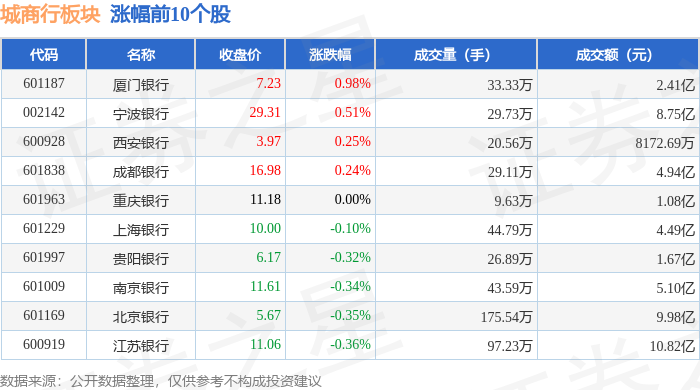
Market Overview - The city commercial bank sector experienced a decline of 0.21% on November 7, with Qilu Bank leading the drop [1] - The Shanghai Composite Index closed at 3997.56, down 0.25%, while the Shenzhen Component Index closed at 13404.06, down 0.36% [1] Individual Bank Performance - Xiamen Bank closed at 7.23, up 0.98% with a trading volume of 333,300 shares and a transaction value of 241 million [1] - Ningbo Bank closed at 29.31, up 0.51% with a trading volume of 297,300 shares and a transaction value of 875 million [1] - Qilu Bank closed at 6.08, down 1.46% with a trading volume of 648,100 shares and a transaction value of 39.86 million [2] - Suzhou Bank closed at 8.33, down 1.07% with a trading volume of 373,400 shares and a transaction value of 314 million [2] Capital Flow Analysis - The city commercial bank sector saw a net outflow of 148 million from institutional investors, while retail investors had a net inflow of 163 million [2] - Jiangsu Bank had a net inflow of 63.24 million from institutional investors, but a net outflow of 39.08 million from speculative funds [3] - Nanjing Bank experienced a net inflow of 24.45 million from institutional investors, with a net outflow of 30.58 million from speculative funds [3]



城商行板块11月6日跌0.11%,厦门银行领跌,主力资金净流出6.08亿元
Zheng Xing Xing Ye Ri Bao· 2025-11-06 08:51
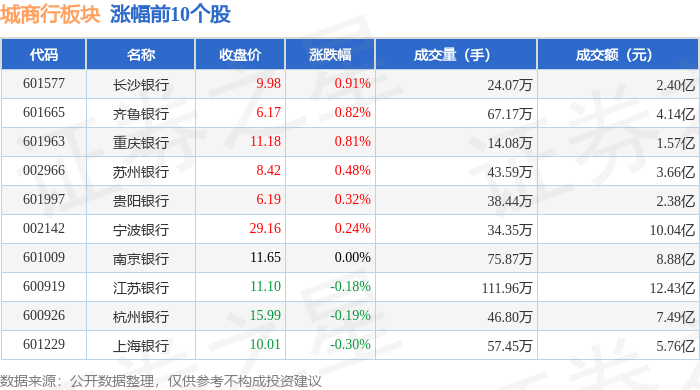
Core Viewpoint - The city commercial bank sector experienced a slight decline of 0.11% on November 6, with Xiamen Bank leading the drop, while the overall market indices showed positive movements with the Shanghai Composite Index up by 0.97% and the Shenzhen Component Index up by 1.73% [1][2]. Group 1: Market Performance - The closing price of Xiamen Bank was 7.16, reflecting a decrease of 2.59% with a trading volume of 539,700 shares and a transaction value of 387 million yuan [2]. - Other notable banks included Changsha Bank, which closed at 9.98 with a rise of 0.91%, and Qilu Bank, which closed at 6.17 with an increase of 0.82% [1]. - The city commercial bank sector saw a net outflow of 608 million yuan from major funds, while retail investors contributed a net inflow of 473 million yuan [2][3]. Group 2: Individual Bank Performance - Beijing Bank had a net inflow from major funds of 20.80 million yuan, while it experienced a net outflow from retail investors of 30.79 million yuan [3]. - Chongqing Bank recorded a net inflow of 11.91 million yuan from major funds but faced a net outflow of 12.20 million yuan from retail investors [3]. - Jiangsu Bank had a net inflow of 202.55 million yuan from major funds, while retail investors contributed a net inflow of 3.33 million yuan [3].

重庆银行长江·聚惠公募点金产品2025年第13期11月6日起发行,业绩比较基准2.5%-3.2%
Cai Jing Wang· 2025-11-06 05:57
注:业绩比较基准不是预期收益率,不代表产品的未来表现和实际收益,不构成对产品收益的承诺。 以上理财产品信息仅供参考,具体应以《产品说明书》等销售文件为准。本文不构成任何投资建议,投 资者据此操作,风险自担。 11月6日,据重庆银行(601963)披露,该行发行的长江·聚惠公募净值型封闭式点金产品2025年第13期 募集期为2025年11月6日到2025年11月13日。计划发行量5亿元,投资者认购起点金额为1万元。产品为 固定收益类,风险评级为中低风险,产品期限为1096天,业绩比较基准为2.50%~3.20%(年化)。 ...
债市成拖累?多家银行非息收入承压,央行重启国债买卖有何利好
Xin Lang Cai Jing· 2025-11-06 00:38
Core Viewpoint - The bond market's volatility has significantly impacted the non-interest income and overall revenue growth of listed banks in China during the first three quarters of the year [1][3][7]. Group 1: Non-Interest Income Decline - Among 42 A-share listed banks, 24 reported a year-on-year decline in non-interest income, with 8 banks experiencing a drop in net investment income [1][2]. - For instance, China Merchants Bank reported a 4.23% decrease in non-interest net income, primarily due to reduced bond and fund investment returns [3][4]. - Ping An Bank's revenue fell by 9.8%, influenced by declining loan rates and market volatility affecting non-interest income [3]. Group 2: Fair Value Changes - The significant drop in fair value changes has also been a major factor in revenue growth decline, with China Merchants Bank reporting a cumulative loss of 8.827 billion yuan in fair value changes for the first three quarters [4]. - Other banks like Everbright Bank and Huaxia Bank also reported losses in fair value changes, amounting to 4.982 billion yuan and 4.505 billion yuan, respectively [4]. - Analysts noted that fair value changes are highly influenced by bond market fluctuations, with smaller banks being more affected due to a higher proportion of FVTPL assets [4]. Group 3: Future Outlook and Central Bank Actions - The People's Bank of China announced the resumption of government bond trading operations, which is expected to help lower bond yields and benefit banks' non-interest income [11][12]. - Some bank executives expressed uncertainty about future non-interest income growth due to ongoing market volatility, suggesting that the bond market may remain in a fluctuating state [9][10]. - Analysts believe that the resumption of government bond trading will provide a safety net for the bond market, potentially stabilizing yields and supporting both bond and equity markets in the long term [12][13].




五家银行跻身绿色信贷“万亿俱乐部” 绿色债券存量规模近2万亿
2 1 Shi Ji Jing Ji Bao Dao· 2025-11-05 23:42
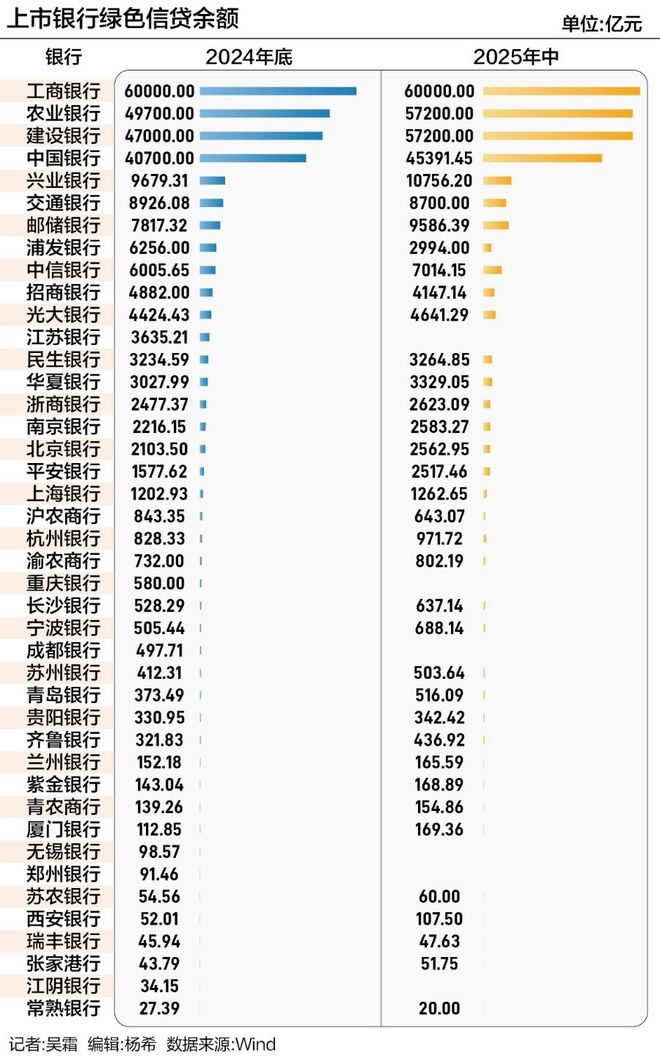
Core Insights - Green finance has transitioned from an optional choice to a mandatory requirement for the banking industry, serving as a new engine for strategic transformation and a blue ocean market for future growth [1] - The balance of green financing at Industrial Bank has reached nearly 2.5 trillion yuan, with green loans exceeding 1 trillion yuan and a non-performing loan rate of only 0.57% [1] - The People's Bank of China and other departments have issued a unified policy framework for green finance, effective from October 1, 2025, to standardize various financial products [2] Group 1: Green Credit Growth - As of the end of 2024, the total balance of green credit among 42 A-share listed banks exceeded 27 trillion yuan, reflecting a year-on-year growth of approximately 20% [3] - State-owned banks dominate the green credit market, with the six major state-owned banks accounting for over 21 trillion yuan, representing 77.6% of the total [3] - Industrial Bank's green loan balance has risen to 1.08 trillion yuan, joining the "trillion club" [3] Group 2: Performance and Sector Focus - The average growth rate of green credit for A-share listed banks in 2024 was 20.6%, a slowdown from approximately 28% in 2023, yet leading institutions maintained strong growth [4] - The focus of green credit issuance is concentrated in four key areas: clean energy, green transportation, energy conservation and environmental protection, and green buildings [4] - The Yangtze River Delta, Guangdong-Hong Kong-Macau Greater Bay Area, and Chengdu-Chongqing Economic Circle are identified as core regions for green credit [4] Group 3: Product Innovation - A-share listed banks are deepening innovation in green financial products, creating a multi-dimensional product system that includes loans, bonds, asset securitization, insurance, and carbon finance [5] - Sustainable Development Linked Loans (SLL), carbon emission rights pledge financing, and environmental rights collateral loans are gaining traction [5] - Industrial Bank has launched the first green loan with biodiversity protection insurance, while Bohai Bank introduced a green loan linked to data center energy efficiency [6] Group 4: Broader Financial Tools - The issuance of green bonds has expanded, with the cumulative issuance of labeled green bonds in 2024 surpassing 4 trillion yuan [6] - Banks are actively participating in green wealth management and fund products, enhancing investor engagement through innovative offerings [6] - Carbon finance tools are transitioning from pilot programs to broader applications, with various banks introducing carbon emission rights pledge financing products [6] Group 5: Future Directions - The banking industry is expected to continue innovating green financial products to support sustainable economic development, moving beyond traditional green credit [7] - The development of ESG-linked loans and financing models using carbon emission rights as collateral will be explored [7] - These innovations will not only assist in achieving national carbon reduction goals but also cultivate new growth momentum for banks [7]


银行行业2026年度投资策略:“稳健锚”与“增长帆”,从红利重估到能力定价
KAIYUAN SECURITIES· 2025-11-05 15:17
Core Views - The report emphasizes the importance of stable high-dividend assets in a low-interest-rate environment, highlighting the scarcity of such assets as a key investment opportunity [4][12] - It discusses the regulatory cycle and the reduction of potential credit risks through local debt resolution, reinforcing the concept of a "stable anchor" for banks [4][15] - The economic transformation from land credit to technology and consumption-driven growth is seen as providing a "growth sail" for banks, particularly in corporate deepening and wealth management [4][18] Policy Background and Investment Context - The low interest rate environment and asset scarcity highlight the attractiveness of stable high-dividend assets, with bank stocks favored for their strong performance stability and high dividend yields [4][12] - The ongoing resolution of local government debt is expected to reduce systemic credit risks, thereby solidifying banks' "stable anchor" [4][15] - The shift towards technology and consumption is anticipated to enhance banks' growth potential, particularly in wealth management and corporate services [4][18] Deep Revaluation of "Stable Anchor" - Bottom Line of Value - The report identifies the stability of earnings, attractiveness of dividends, and sustainability of payouts as key components of dividend value [5] - It notes that the expansion of bank balance sheets and the potential recovery of net interest margins are crucial for long-term value [5] - Enhanced investment capabilities in financial markets and asset circulation are highlighted as factors contributing to banks' stability [5] "Growth Sail" Capability Breakthrough - Elasticity of Value - The report emphasizes the importance of stable and high risk-adjusted return on capital (RAROC) for banks, which reflects their efficiency in capital usage [6] - It points out the advantages of wealth attributes and customer base, as well as strong non-performing asset management capabilities [6] - The ability to adjust and manage financial market investments effectively is seen as a significant strength for banks [6] Medium to Long-term Incremental Capital Drivers - Good Wind with Favorable Conditions - The report suggests a potential trend shift in insurance capital allocation towards bank equities, with a target dividend yield of 3.5%-4% seen as a reasonable baseline [7] - It notes that actively managed equity funds are currently underweight in bank stocks, while asset management companies (AMCs) are accelerating their investments in this sector [7] Investment Recommendations: Hold "Stable Anchor" and Raise "Growth Sail" - The report recommends a foundational allocation in large state-owned banks, with H-shares offering better value than A-shares, particularly for Agricultural Bank and Industrial and Commercial Bank [8] - Core allocations should focus on banks that combine stability with strong wealth management capabilities, such as China Merchants Bank and CITIC Bank [8] - For flexible allocations, it suggests high-quality regional banks with unique characteristics in specific areas or business lines, such as Jiangsu Bank and Chongqing Bank [8] Dividend Value Analysis - The report indicates that the operating income of listed banks grew by 0.91% year-on-year in the first three quarters of 2025, with net profit growth of 1.48% [28] - It highlights the significant performance differentiation among banks, with state-owned banks showing stable revenue growth while smaller banks face challenges [28][30] - The report notes that the dividend sustainability of banks is influenced by profitability, dividend policies, and capital considerations, with larger banks maintaining a more stable dividend distribution [41][43]


五家银行跻身绿色信贷“万亿俱乐部”,绿色债券存量规模近2万亿
2 1 Shi Ji Jing Ji Bao Dao· 2025-11-05 09:41
Core Insights - Green finance has transitioned from an optional strategy to a mandatory focus for banks, becoming a new engine for strategic transformation and a blue ocean market in the context of a shift towards a green low-carbon economy [1][2] - The balance of green financing at Industrial Bank has reached nearly 2.5 trillion yuan, with green loans exceeding 1 trillion yuan and a non-performing loan rate of only 0.57% [1] - The People's Bank of China and other departments have issued a unified policy framework for green finance, effective from October 1, 2025, to standardize the support scope for green loans and bonds [2] Green Credit Landscape - By the end of 2024, the total balance of green credit among 42 A-share listed banks exceeded 27 trillion yuan, with a year-on-year growth of approximately 20% [3] - State-owned banks are the main contributors to green credit, with the six major state-owned banks holding over 21 trillion yuan, accounting for 77.6% of the total [3] - The growth pattern shows large banks maintaining scale, joint-stock banks demonstrating strong vitality, and regional banks achieving rapid growth [3] Green Loan Balances - As of the end of 2024, only four listed banks had green loan balances exceeding 1 trillion yuan: Industrial Bank, Agricultural Bank, Construction Bank, and Bank of China [5] - Industrial Bank's green loan balance rose to 1.08 trillion yuan in the first half of the year, joining the "trillion club" [5] - Among joint-stock banks, Industrial Bank, CITIC Bank, and Pudong Development Bank lead in green credit scale, collectively accounting for nearly 40% of the total [5] Growth Rates and Sector Focus - The average growth rate of green credit for A-share listed banks in 2024 was 20.6%, a slowdown from approximately 28% in 2023, yet leading institutions maintained strong growth [5] - The focus of green credit is heavily concentrated in clean energy, green transportation, energy conservation, and green buildings, with key regions being the Yangtze River Delta, Guangdong-Hong Kong-Macau Greater Bay Area, and Chengdu-Chongqing economic circle [6] Financial Product Innovation - A-share listed banks are deepening innovation in green financial products, creating a multi-dimensional product system that includes loans, bonds, asset securitization, insurance, and carbon finance [7] - Green loans remain the core vehicle for green finance, with a total balance exceeding 27 trillion yuan by the end of 2024, reflecting a year-on-year growth of about 20% [7] - Innovative tools such as sustainability-linked loans and carbon emission rights pledge financing are gaining traction [7] Bond and Investment Developments - The issuance of green bonds has expanded, with the cumulative issuance of labeled green bonds in 2024 surpassing 4 trillion yuan [8] - Banks are actively participating in green wealth management and fund products, enhancing investor engagement through innovative offerings [8] - Carbon finance tools are transitioning from pilot programs to broader applications, with banks launching carbon emission rights pledge financing products [8] Future Directions - The banking sector is expected to continue innovating green financial products to support sustainable economic development more effectively [9] - This evolution will extend beyond traditional green loans to include financing models linked to carbon emissions and environmental rights [10]