
Bank Of Chongqing(601963)

Search documents
城商行板块1月21日跌0.55%,重庆银行领跌,主力资金净流入5.08亿元
Zheng Xing Xing Ye Ri Bao· 2026-01-21 08:54
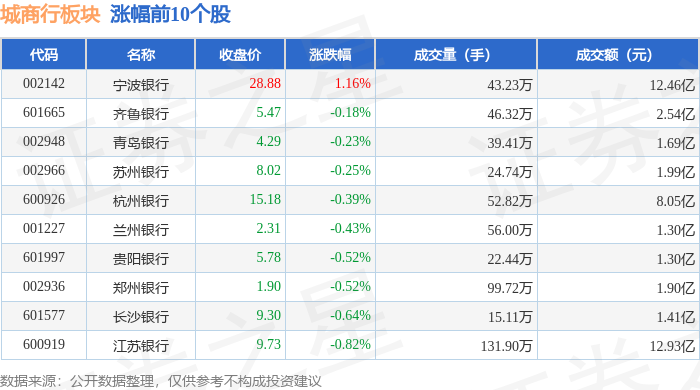
Market Overview - The city commercial bank sector experienced a decline of 0.55% on January 21, with Chongqing Bank leading the drop [1] - The Shanghai Composite Index closed at 4116.94, up 0.08%, while the Shenzhen Component Index closed at 14255.12, up 0.7% [1] Individual Stock Performance - Ningbo Bank closed at 28.88, with an increase of 1.16% and a trading volume of 432,300 shares, amounting to a transaction value of 1.246 billion [1] - Chongqing Bank closed at 10.25, down 1.82%, with a trading volume of 106,800 shares and a transaction value of 110 million [2] - Other notable performers include Xiamen Bank, which closed at 7.13, down 1.66%, and Chengdu Bank, which closed at 15.72, down 1.38% [2] Capital Flow Analysis - The city commercial bank sector saw a net inflow of 508 million from institutional investors, while retail investors experienced a net outflow of 566 million [2] - The capital flow for individual stocks indicates that Hangzhou Bank had a net inflow of 158 million from institutional investors, while it faced a net outflow of 86.5 million from retail investors [3] - Shanghai Bank also saw a net inflow of 107 million from institutional investors, with a net outflow of 121 million from retail investors [3]





银行板块持续调整 农业银行跌近3%
Mei Ri Jing Ji Xin Wen· 2026-01-21 06:40
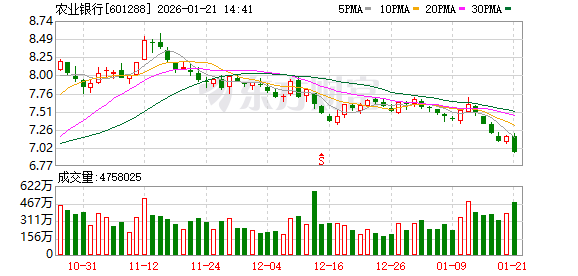
每经AI快讯,1月21日午后,银行板块持续调整,农业银行跌近3%,工商银行、中信银行、浦发银行、 重庆银行、邮储银行等跌幅靠前。 (文章来源:每日经济新闻) ...




ETF复盘资讯|化工、贵金属逆市爆发!化工ETF(516020)劲涨1.27%续创阶段新高!电力ETF(159146)上市首日开门红!
Sou Hu Cai Jing· 2026-01-20 13:47
Market Overview - Major Asia-Pacific indices showed a collective decline, with the A-share market also experiencing consolidation, as the Shanghai Composite Index fluctuated while the Shenzhen Component and ChiNext indices performed weakly. The total trading volume in Shanghai, Shenzhen, and Beijing reached 2.8 trillion yuan, an increase of 72 billion yuan compared to the previous day [1] Real Estate Sector - The real estate sector rebounded strongly, with a notable increase in the price of a real estate ETF (159707) by 3.22%, marking multiple consecutive gains. According to the National Bureau of Statistics, the sales price of newly built commercial residential properties in first-tier cities decreased by 0.3% month-on-month in December 2025, with Shanghai seeing a slight increase of 0.2% [1] Chemical Sector - The chemical sector experienced a significant rally, with the chemical ETF (516020) reaching a new high since August 2022, closing up 1.27%. Major companies in the sector, such as BASF and Dow, have been raising prices across Europe, Asia, and the Middle East. The ETF attracted 1.148 billion yuan in the last ten days [1][4] - The chemical ETF has seen substantial net inflows, with over 5.8 billion yuan in net subscriptions in the last five trading days and 11 billion yuan in the last ten days. The Ministry of Industry and Information Technology has set guidelines for zero-carbon factory construction, which may limit new capacity in the chemical sector [6][7] Banking Sector - The banking sector showed resilience amid market volatility, with a significant number of bank stocks rising. The top bank ETF (512800) closed up 0.77%, ending a four-day losing streak. Historical data indicates that the banking sector has a high probability of generating absolute and excess returns before the Spring Festival, with an average return of 4.4% from 2017 to 2025 [8][11][14] - The banking sector is expected to benefit from continued growth in credit, supported by stable growth policies and a favorable low-interest-rate environment. The latest dividend yield for the banking index stands at 4.78%, significantly higher than the 10-year government bond yield of 1.84% [14][15] AI and Technology Sector - The AI and technology sectors faced a downturn, with the entrepreneurial AI ETF (159363) experiencing a four-day decline. Despite this, the sector remains attractive for future investments, particularly in light of ongoing developments in AI applications and infrastructure [16][18] - The communication and semiconductor industries are expected to see increased attention due to their potential for earnings upgrades, with significant growth anticipated in the coming years [18][20]

城商行板块1月20日涨1.35%,成都银行领涨,主力资金净流入2.66亿元
Zheng Xing Xing Ye Ri Bao· 2026-01-20 08:56
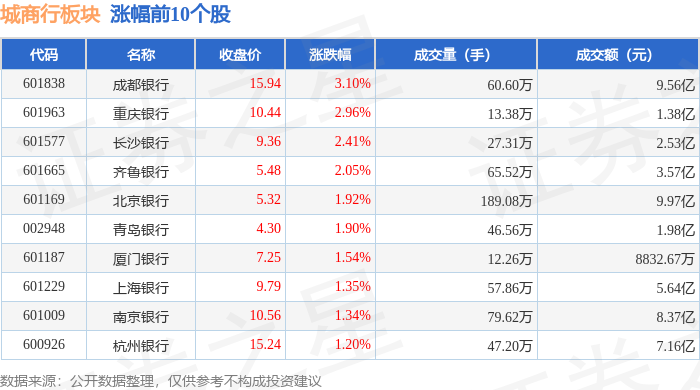
Core Insights - The city commercial bank sector experienced a rise of 1.35% on January 20, with Chengdu Bank leading the gains [1] - The Shanghai Composite Index closed at 4113.65, down 0.01%, while the Shenzhen Component Index closed at 14155.63, down 0.97% [1] Stock Performance - Chengdu Bank (601838) closed at 15.94, up 3.10% with a trading volume of 606,000 shares and a transaction value of 9.56 billion [1] - Chongqing Bank (601963) closed at 10.44, up 2.96% with a trading volume of 133,800 shares and a transaction value of 138 million [1] - Other notable performers include: - Changsha Bank (601577): closed at 9.36, up 2.41% [1] - Qilu Bank (601665): closed at 5.48, up 2.05% [1] - Beijing Bank (601169): closed at 5.32, up 1.92% [1] - Qingdao Bank (002948): closed at 4.30, up 1.90% [1] - Xiamen Bank (601187): closed at 7.25, up 1.54% [1] - Shanghai Bank (601229): closed at 9.79, up 1.35% [1] - Nanjing Bank (601009): closed at 10.56, up 1.34% [1] - Hangzhou Bank (600926): closed at 15.24, up 1.20% [1] Capital Flow - The city commercial bank sector saw a net inflow of 266 million from institutional investors, while retail investors experienced a net outflow of 42.84 million [1] - Detailed capital flow for selected banks includes: - Shanghai Bank (601229): net inflow of 1.051 billion from institutional investors, with net outflows from retail and speculative investors [2] - Hangzhou Bank (600926): net inflow of 90.48 million from institutional investors, with significant outflows from retail and speculative investors [2] - Nanjing Bank (601009): net inflow of 26.57 million from institutional investors, with outflows from retail investors [2] - Other banks also showed varying levels of net inflows and outflows [2]


国泰海通:预计2025年银行利息净收入增速转正 息差阶段性企稳
Zhi Tong Cai Jing· 2026-01-20 06:20
Core Viewpoint - The report from Guotai Junan predicts that the revenue and net profit growth rate for listed banks in 2025 will be 1.5% and 2.2% respectively, benefiting from stable interest margins and declining credit costs [1][2] Revenue and Profit Forecast - The expected revenue and net profit growth rates for the sample banks (26 listed banks) in 2025 are 1.5% and 2.2%, which represent an increase of 0.3 percentage points compared to the first three quarters of 2025 [2] - The net interest income growth is projected to turn positive, with an expected annual growth rate of 0.3%, improving from a negative growth of -0.6% in the first three quarters of 2025 [1][2] Asset Growth - For Q4 2025, the growth rates of interest-earning assets and loans are expected to be 9.04% and 8.07% respectively, showing a slight decline from Q3 2025 [2] - By the end of December 2025, the growth rates for loans and bond investments are projected to be 6.9% and 16.4%, respectively, both lower than the end of September 2025 [2] Interest Margin - The interest margin for 2025 is expected to stabilize at 1.40%, with the net interest income growth projected to improve to 0.3% for the year [2] - The stability in interest margin is attributed to the repricing of high-cost long-term deposits and a stable Loan Prime Rate (LPR) [2] Non-Interest Income - The growth rate for non-interest income is expected to be 4.8% in 2025, a decrease of 2.8 percentage points compared to the first three quarters of 2025 [3] - The attractiveness of dividend insurance products is expected to drive growth in fee income through the bancassurance channel [3] Asset Quality - The credit cost for 2025 is projected to be 0.58%, a decrease of 8 basis points compared to the first three quarters of 2025 [4] - The non-performing loan (NPL) ratio is expected to remain stable at 1.21%, with a slight decrease in the provision coverage ratio to 239.1% [4] Investment Recommendations - For 2026, the investment focus in the banking sector includes identifying banks with potential for growth, recommending Ningbo Bank, China Merchants Bank, and Nanjing Bank [4] - Emphasis on banks with convertible bond expectations, recommending Chongqing Bank and Changshu Bank [4] - Continuation of dividend strategies is anticipated, recommending Bank of Communications, Jiangsu Bank, and others [4]



银行板块震荡走高,成都银行涨超3%
Xin Lang Cai Jing· 2026-01-20 05:44
Group 1 - The banking sector experienced a significant upward movement, with Chengdu Bank rising over 3% [1] - Other banks such as Chongqing Rural Commercial Bank, CITIC Bank, and Changshu Bank saw increases of over 2% [1] - Additionally, Chongqing Bank and Qilu Bank also followed the upward trend [1]

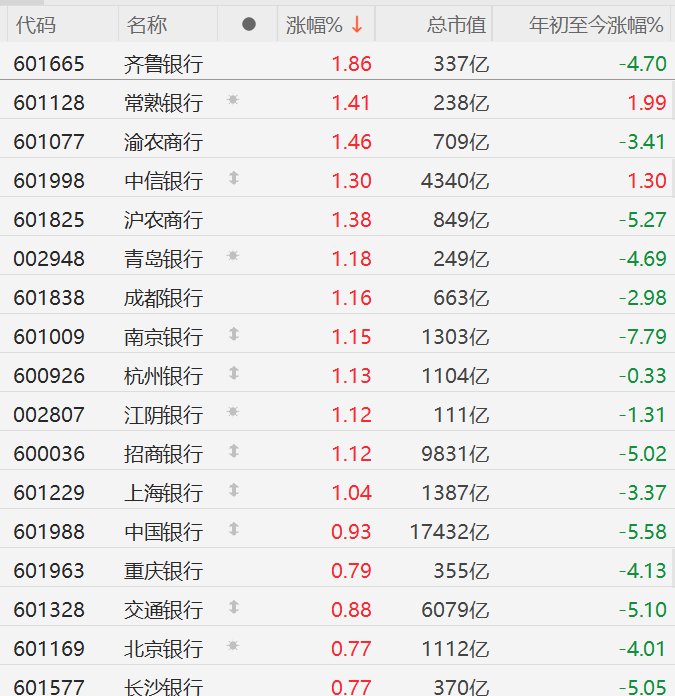
银行股逆势普涨,齐鲁银行涨近2%
Ge Long Hui· 2026-01-20 03:06
Group 1 - The A-share market saw a significant increase in bank stocks, with Qilu Bank rising nearly 2% and several other banks, including Changshu Bank and Chongqing Rural Commercial Bank, increasing by over 1% [1] - The total market capitalization of Qilu Bank is 33.7 billion, while Changshu Bank has a market cap of 23.8 billion [2] - Year-to-date performance shows that Qilu Bank has decreased by 4.70%, while Changshu Bank has increased by 1.99% [2] Group 2 - Other banks that experienced gains include Yunnan Rural Commercial Bank (1.46%), CITIC Bank (1.30%), and Shanghai Bank (1.04%) [2] - The total market capitalization of CITIC Bank is 434 billion, and it has a year-to-date performance of 1.30% [2] - Despite the gains, many banks still show negative year-to-date performance, such as Shanghai Bank (-3.37%) and China Bank (-5.58%) [2]

金融行业周报(2026、01、18):央行宣布结构性降息,衍生品交易监管更规范-20260118
Western Securities· 2026-01-18 11:43
Investment Rating - The report does not explicitly state an overall investment rating for the financial industry, but it provides specific recommendations for various sectors and companies within the industry [3][21]. Core Insights - The financial industry experienced a decline this week, with the non-bank financial index down by 2.63%, underperforming the CSI 300 index by 2.06 percentage points. The banking sector saw a decline of 3.03%, also underperforming the CSI 300 index by 2.46 percentage points [1][9]. - The report highlights a structural interest rate cut by the central bank, which is expected to impact various financial sectors, particularly banks and insurance companies. The insurance sector is viewed as being in a critical window for performance and valuation recovery [3][21]. - Regulatory measures have been introduced to stabilize the derivatives market, which is expected to benefit well-capitalized and compliant brokerage firms [2][17]. Summary by Sections 1. Weekly Performance and Sector Insights - The non-bank financial index decreased by 2.63%, with the securities, insurance, and diversified financial indices down by 2.21%, 3.59%, and 1.83% respectively [1][9]. - The banking sector's performance was notably poor, with state-owned banks, joint-stock banks, city commercial banks, and rural commercial banks experiencing declines of 2.20%, 4.08%, 2.40%, and 2.20% respectively [1][9]. 2. Insurance Sector Insights - The insurance sector's index fell by 3.59%, underperforming the CSI 300 index by 3.02 percentage points. The report indicates that regulatory cooling measures have created short-term pressure on the insurance sector, but the long-term outlook remains positive due to asset growth and interest margin recovery [1][13][15]. - Key companies such as China Pacific Insurance, China Life, and New China Life are recommended for investment due to their strong fundamentals and recovery potential [3][16]. 3. Brokerage Sector Insights - The brokerage sector saw a decline of 2.21%, with the report emphasizing the potential benefits of new regulatory measures aimed at enhancing the derivatives market. The focus is on larger, well-capitalized firms that can navigate the evolving regulatory landscape [2][17]. - Recommendations include major brokerages like Guotai Junan and Huatai Securities, which are expected to benefit from the anticipated recovery in profitability and valuation [2][18]. 4. Banking Sector Insights - The banking sector's index fell by 3.03%, with the central bank's recent interest rate cut expected to support the sector's performance in the long run. The report suggests that banks may see a gradual recovery in net interest income and profitability [3][21][22]. - Specific banks such as Hangzhou Bank and Ningbo Bank are highlighted as potential investment opportunities, particularly those with previously undervalued positions [3][22].




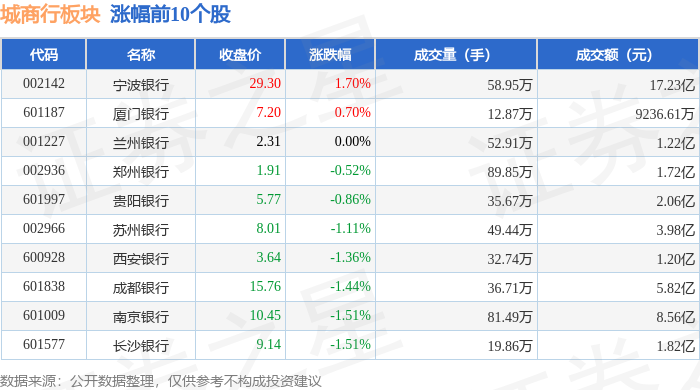
城商行板块1月16日跌1.27%,江苏银行领跌,主力资金净流出2.29亿元
Zheng Xing Xing Ye Ri Bao· 2026-01-16 08:56
Core Viewpoint - The city commercial bank sector experienced a decline of 1.27% on January 16, with Jiangsu Bank leading the drop. The Shanghai Composite Index closed at 4101.91, down 0.26%, while the Shenzhen Component Index closed at 14281.08, down 0.18% [1]. Group 1: Stock Performance - Ningbo Bank closed at 29.30, up 1.70% with a trading volume of 589,500 shares and a transaction value of 1.723 billion [1]. - Xiamen Bank closed at 7.20, up 0.70% with a trading volume of 128,700 shares and a transaction value of 92.3661 million [1]. - Jiangsu Bank closed at 9.76, down 2.69% with a trading volume of 2,061,300 shares and a transaction value of 2.033 billion [2]. - Shanghai Bank closed at 9.64, down 2.43% with a trading volume of 961,200 shares and a transaction value of 933.3 million [2]. Group 2: Capital Flow - The city commercial bank sector saw a net outflow of 229 million from main funds, while speculative funds had a net inflow of 716 million, and retail investors experienced a net outflow of 487 million [2]. - Hangzhou Bank had a main fund net inflow of 153 million, while retail investors saw a net outflow of 113 million [3]. - Nanjing Bank recorded a main fund net inflow of 70.5 million and a retail net outflow of 131 million [3].

银行行业点评报告:企业信贷超季节性增长,信贷投放前置趋势或延续
KAIYUAN SECURITIES· 2026-01-16 05:44
Investment Rating - Investment rating: Positive (maintained) [2] Core Viewpoints - In December, corporate credit experienced a seasonal growth, with expectations that the credit issuance in Q1 2026 may reach the highest level in history [4] - The report highlights that while the year-end credit issuance slowed down, the impact of debt reduction policies has weakened, allowing for stable credit growth [4] - The report indicates that the demand for corporate loans has shown signs of recovery, with a year-on-year increase of 5.8 trillion yuan in December, although the overall demand still requires further observation [4] - The report notes that the new issuance rates for corporate and personal housing loans have stabilized at 3.10%, reflecting a shift in bank lending strategies [5][6] Summary by Sections Credit Market Analysis - December saw a new issuance of 910 billion yuan in RMB loans, a year-on-year decrease of 80 billion yuan, with a balance growth rate of 6.4% [4] - The corporate loan structure improved, with short-term and medium-to-long-term loans increasing by 3.9 trillion yuan and 2.9 trillion yuan respectively [4] - The report emphasizes that the overall credit demand from residents remains weak, with a year-on-year decrease of 441.6 billion yuan in December [4] Social Financing and Government Bonds - In December, social financing increased by 2.2 trillion yuan, a year-on-year decrease of 646.2 billion yuan, with a stock growth rate of 8.3% [5] - The slowdown in government bond issuance has been identified as a drag on social financing, with new government bonds issued at 683.3 billion yuan, one of the lowest levels of the year [5] Monetary Supply and Deposits - M2 growth in December was 8.5%, while M1 growth fell to 3.8% [6] - The report notes that the increase in fiscal deposits may indicate a weaker year-end fiscal spending compared to the previous year [6] Investment Recommendations - The report suggests that banks with strong wealth management businesses and active financial environments in key regions will benefit from the stable growth policies [7] - Recommended banks include CITIC Bank, with beneficiaries including Agricultural Bank of China, China Merchants Bank, and others [7]