
Bank Of Chongqing(601963)

Search documents
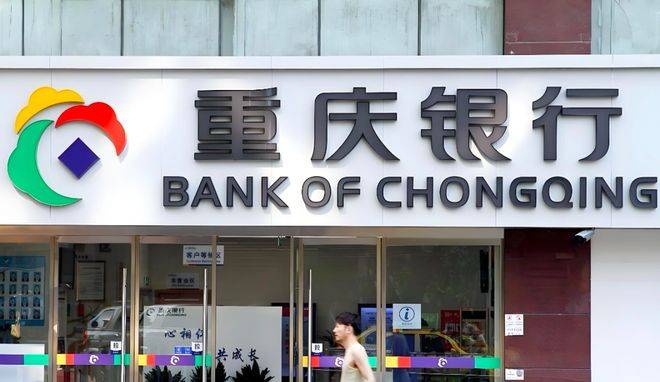
重庆银行跌2.7% 领跌银行板块
Zhong Guo Jing Ji Wang· 2026-01-08 09:32
(责任编辑:徐自立) 中国经济网北京1月8日讯 重庆银行(601963.SH)今日股价收报10.45元,跌幅2.70%。今日,银行 板块跌0.70%,重庆银行为该板块跌幅最大的上市公司。 ...

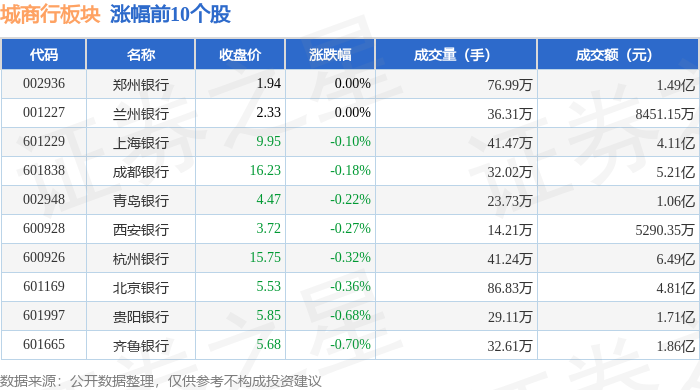
城商行板块1月8日跌0.89%,重庆银行领跌,主力资金净流入673.97万元
Zheng Xing Xing Ye Ri Bao· 2026-01-08 08:56
Market Overview - The city commercial bank sector experienced a decline of 0.89% on January 8, with Chongqing Bank leading the drop [1] - The Shanghai Composite Index closed at 4082.98, down 0.07%, while the Shenzhen Component Index closed at 13959.48, down 0.51% [1] Individual Stock Performance - Zhengzhou Bank closed at 1.94 with no change, while Lanzhou Bank also remained unchanged at 2.33 [1] - Shanghai Bank closed at 9.95, down 0.10%, and Chengdu Bank closed at 16.23, down 0.18% [1] - Chongqing Bank saw a significant decline of 2.70%, closing at 10.45, with a trading volume of 99,000 shares [2] Trading Volume and Turnover - The trading volume for Zhengzhou Bank was 769,900 shares with a turnover of 149 million yuan, while Lanzhou Bank had a trading volume of 363,100 shares and a turnover of 84.51 million yuan [1] - The highest turnover was recorded for Nanjing Bank at 1.342 billion yuan with a trading volume of 1,217,000 shares [2] Capital Flow Analysis - The city commercial bank sector saw a net inflow of 6.7397 million yuan from institutional investors, while retail investors experienced a net outflow of 70.5351 million yuan [2] - Chengdu Bank had a net inflow of 87.0825 million yuan from institutional investors, but a net outflow of 46.0321 million yuan from retail investors [3] Summary of Capital Flows - Institutional investors showed a positive net flow for several banks, including Hangzhou Bank with 77.8301 million yuan and Qingdao Bank with 8.4480 million yuan [3] - Conversely, Chongqing Bank had a negative net flow of 535,600 yuan from institutional investors, indicating a lack of confidence [3]

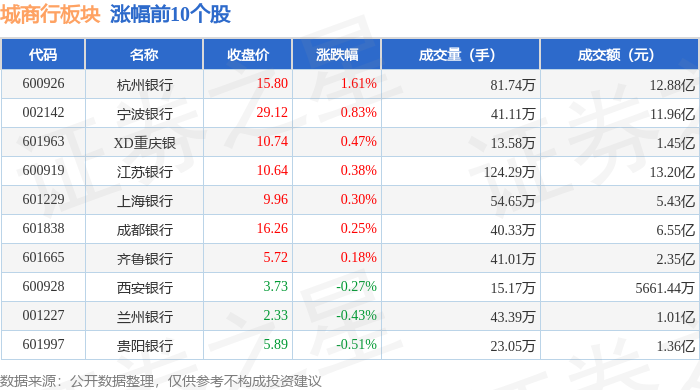
城商行板块1月7日涨0%,杭州银行领涨,主力资金净流出1.7亿元
Zheng Xing Xing Ye Ri Bao· 2026-01-07 08:58
Market Performance - The city commercial bank sector experienced a slight increase of 0.0% on January 7, with Hangzhou Bank leading the gains [1] - The Shanghai Composite Index closed at 4085.77, up 0.05%, while the Shenzhen Component Index closed at 14030.56, up 0.06% [1] Individual Stock Performance - Hangzhou Bank (600926) closed at 15.80, with a rise of 1.61% and a trading volume of 817,400 shares [1] - Ningbo Bank (002142) closed at 29.12, up 0.83%, with a trading volume of 411,100 shares [1] - Other notable performances include Jiangsu Bank (601963) at 10.64 (+0.38%) and Shanghai Bank (601229) at 9.96 (+0.30%) [1] Capital Flow Analysis - The city commercial bank sector saw a net outflow of 170 million yuan from institutional investors, while retail investors contributed a net inflow of 188 million yuan [2] - The overall capital flow indicates a mixed sentiment, with institutional investors withdrawing funds while retail investors increased their positions [2] Detailed Capital Flow by Bank - Jiangsu Bank had a net inflow of 123 million yuan from institutional investors, while retail investors saw a net outflow of 27 million yuan [3] - Hangzhou Bank experienced a net inflow of 84 million yuan from institutional investors, but retail investors had a significant outflow of 132 million yuan [3] - Chengdu Bank recorded a net inflow of 55 million yuan from institutional investors, with retail investors also experiencing a net outflow [3]




A股飙涨21% H股劲升37%!重庆银行凭什么领跑上市城商行?
Sou Hu Cai Jing· 2026-01-07 06:46
规模跃升的同时,盈利能力同步提质。2024年营收、净利润分别同比增长3.54%、5.59%,2025年上半 年增速加速至7%和5.73%,其中营业收入创下13个季度新高;三季度更是实现营收、净利双双超10%的 高增长,创下近9年最佳业绩。资产质量持续优化成为坚实后盾,不良贷款率降至1.14%,拨备覆盖率 提升至248.11%,风险抵御能力稳居行业前列,实现"量质齐升"的良性发展。 立足区域、深耕实体,是重庆银行穿越周期的核心密码。依托成渝地区双城经济圈、西部陆海新通道等 国家战略叠加优势,该行精准布局重点领域,2025年前三季度投向成渝经济圈的融资余额超3000亿元, 增幅达20%,通过贷款、债券等多种方式,支持重庆轨道交通7号线、仙桃数字经济孵化基地、渝顺高 铁南川北站等超120个区域重大项目建设,成为区域经济发展的金融引擎。在西部陆海新通道建设中, 融资余额高达533亿元,同比大增79%,"惠畅陆海"贸易金融品牌入选重庆市国资委通道建设标志性成 果,成为贸易金融领域的特色标杆。 战略引领与团队赋能,为发展注入持久动力。2024年领导班子换届后,"70后"年轻化管理团队凭借专业 优势,确立"高目标引领、高站 ...
重庆正川医药包装材料股份有限公司 关于使用闲置自有资金进行现金管理的进展公告
Zhong Guo Zheng Quan Bao - Zhong Zheng Wang· 2026-01-06 23:49
Overview - The company has approved the use of idle self-owned funds for cash management to enhance fund utilization efficiency and increase returns for the company and its shareholders [2][3]. Cash Management Details - The total investment amount for this cash management initiative is 150 million RMB [4]. - The funds used for this cash management are entirely sourced from idle self-owned funds [5]. - The cash management product is a structured deposit from Chongqing Bank, with a term of 365 days [7]. Product Specifications - The structured deposit has a guaranteed minimum return of 1.50% and a floating return of either 0.55% or 0.75% [8]. - The product's start date is January 7, 2026, and it will mature on January 7, 2027 [8]. - The product is linked to the EUR/USD exchange rate, with specific conditions determining the actual annualized return [8]. Risk Control Measures - The company will select investment products that are high in safety, good in liquidity, and of medium to low risk [6][9]. - Independent directors have the authority to supervise and audit the use of funds, ensuring compliance with regulations [10]. - The company will monitor the progress of cash management closely and take necessary actions to ensure fund safety [10]. Impact on the Company - The cash management initiative will not affect the company's normal operational cash flow or its main business development [13]. - Utilizing idle self-owned funds for cash management is expected to improve fund efficiency and create better returns for the company and its shareholders [13]. Decision-Making Process - The board of directors and the supervisory board approved the cash management proposal on June 4, 2025, allowing for a maximum daily balance of 300 million RMB to be used for cash management within a 12-month rolling period [15].

2025年A股银行板块涨幅放缓 个股分化显著 机构看好2026年上市银行营收利润增速改善
Xin Lang Cai Jing· 2026-01-06 23:23
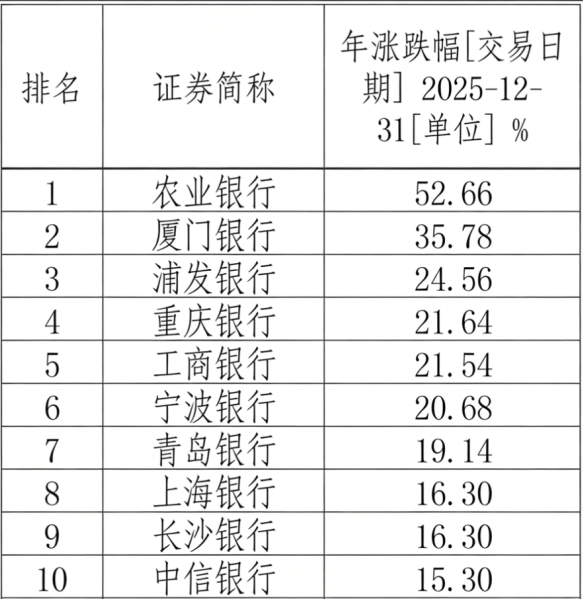
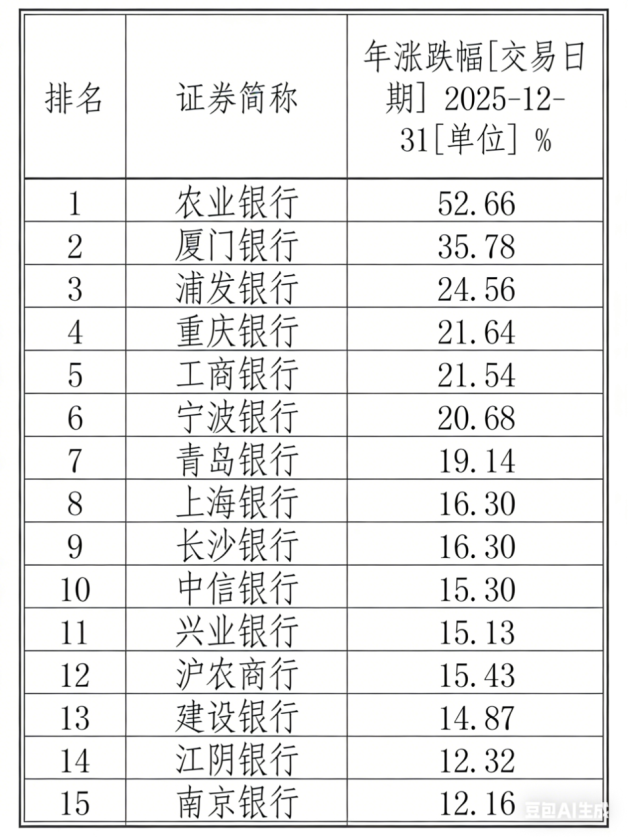
Core Viewpoint - The A-share banking sector is expected to achieve a market value breakthrough in 2025, but the overall growth rate is slowing and underperforming compared to the broader market, with significant individual stock differentiation [1][7]. Market Performance - As of December 31, 2025, the Wind Banking Index reached 7180.68 points, with an annual growth of 12.04%, lower than the previous year's 43.56%. The total market value of the sector at year-end was 15.71 trillion yuan, an increase of over 15% from the beginning of the year, having briefly surpassed 16 trillion yuan [1][7]. - The banking sector exhibited a clear phase differentiation throughout the year, with a mild increase in Q1, a significant rise in Q2, a deep correction in Q3, and a recovery in Q4 [2][8]. Individual Stock Performance - In 2025, 35 out of 42 A-share listed banks saw their stock prices rise, accounting for over 83%. Among the six banks with over 20% growth, Agricultural Bank led with a 52.66% increase, followed by Xiamen Bank, Shanghai Pudong Development Bank, Chongqing Bank, Industrial and Commercial Bank, and Ningbo Bank with growth rates ranging from 20.68% to 35.78% [3][9]. - Conversely, seven banks experienced declines, with Huaxia Bank at the bottom with a 9.82% drop, and Zhengzhou Bank, Beijing Bank, and China Everbright Bank all declining by over 5% [3][9]. Future Outlook - Multiple brokerage firms predict an improvement in revenue and profit growth for listed banks in 2026, with expected revenue growth rates of +2.5% and +3.6% for 2026 and 2027, respectively, and net profit growth rates of +1.9% and +2.6% [4][10]. - The improvement in revenue and profit growth is attributed to several factors, including a reduction in net interest margin pressure, a shift towards quality in credit issuance, and a stabilization in fee income growth [4][10]. Investment Strategy - In light of the different characteristics of new inflows, the equity market in 2025 is characterized by increased stable return strategy products, enhanced structural trends, and greater individual stock volatility. For 2026, it is recommended to prioritize stable stocks and adopt a bottom-fishing strategy, while also considering elastic stocks for rotation trading [6][12].




重庆银行:2025年二级市场成绩单亮眼
Sou Hu Cai Jing· 2026-01-06 17:44
Core Viewpoint - Chongqing Bank stands out in the A-share banking sector with impressive performance in both capital markets and operational results, achieving a stock price increase of 21.64% in 2025, ranking fourth among 42 listed banks nationwide and second among 17 listed city commercial banks [1][2]. Market Performance - As of December 31, 2025, Chongqing Bank's total market capitalization for its A+H shares reached 31.7 billion yuan, a 19.6% increase from the beginning of the year, making it the top financial institution listed in Chongqing [2]. - The A-share closing price was 10.83 yuan per share (adjusted price 13.60 yuan), with a 21.64% increase, outperforming the industry average by 9.6 percentage points [2]. - The H-share closing price was 7.85 HKD per share (adjusted price 17.71 HKD), with a 37.26% increase, ranking sixth among 30 mainland banks listed in Hong Kong [5]. Operational Performance - Chongqing Bank's asset scale surpassed 1 trillion yuan in the second half of 2025, achieving its "14th Five-Year" strategic goal ahead of schedule, and setting a new benchmark for the development of the western banking industry [1][10]. - The bank's revenue for 2024 grew by 3.54% year-on-year, while net profit increased by 5.59%. In the first half of 2025, revenue reached 7.659 billion yuan, a 7% year-on-year increase, marking a new high in 13 quarters [7][8]. - By the third quarter of 2025, both revenue and net profit achieved over 10% growth, marking the best performance in nearly nine years [7]. Asset Quality - The bank's non-performing loan ratio decreased to 1.14%, and the provision coverage ratio increased to 248.11%, indicating improved asset quality and risk resilience [8]. Strategic Focus - Chongqing Bank has focused on the Chengdu-Chongqing economic circle, with financing in this area exceeding 300 billion yuan, a 20% increase, supporting over 120 major regional projects [7]. - The bank's leadership has implemented a "Five High" strategic positioning to drive high-quality development, emphasizing efficiency and service quality [10][12].
重庆银行:A股涨21.64%,H股涨37.26%,2025年二级市场成绩单亮眼
Tai Mei Ti A P P· 2026-01-06 10:45
Core Viewpoint - Chongqing Bank has emerged as a standout performer in the A-share banking sector, achieving significant stock price growth and operational performance, marking it as a new benchmark in the western banking industry [1][2]. Stock Performance - As of December 31, 2025, Chongqing Bank's A+H total market capitalization reached 31.7 billion yuan, a 19.6% increase from the beginning of the year, ranking first among local financial institutions in Chongqing [2]. - The A-share closing price was 10.83 yuan per share (post-adjusted price 13.60 yuan), with a 21.64% increase, outperforming the industry average by 9.6 percentage points, ranking 4th among 42 listed banks and 2nd among 17 city commercial banks [2][4]. - The H-share closing price was 7.85 HKD per share (post-adjusted price 17.71 HKD), with a 37.26% increase, ranking 6th among 30 listed mainland banks in Hong Kong and 4th among 15 city commercial banks [4]. Operational Performance - Chongqing Bank's asset scale surpassed 1 trillion yuan in the second half of 2025, achieving its "14th Five-Year" strategic goal ahead of schedule, with multiple business indicators breaking historical records [1][10]. - By the end of the third quarter of 2025, the bank's total assets reached 1,022.75 billion yuan, a 19.39% increase from the end of 2024, ranking second in growth among over a hundred banks nationwide [10][11]. - The bank's revenue and net profit both achieved over 10% growth in the third quarter of 2025, marking the best performance in nearly nine years [8]. Strategic Focus - Chongqing Bank has leveraged its regional advantages, focusing on the Chengdu-Chongqing economic circle and other major strategies, which has driven differentiated development and continuous operational breakthroughs [6][10]. - The bank has supported over 120 major regional projects, with financing in the Chengdu-Chongqing economic circle exceeding 300 billion yuan, reflecting a 20% increase [6]. - In the construction of the Western Land-Sea New Corridor, the bank's financing balance reached 53.3 billion yuan, a 79% year-on-year increase [7]. Asset Quality - The bank's asset quality has improved, with the non-performing loan ratio decreasing to 1.14% and the provision coverage ratio increasing to 248.11%, indicating enhanced risk resilience [9].
银行业2026年度策略:新起点下的结构性机遇
China Post Securities· 2026-01-06 08:23
Core Insights - The report maintains a strong market rating for the banking sector, highlighting structural opportunities amid a new economic starting point in 2026 [3][5] - The macroeconomic environment is expected to support credit growth, with fiscal policies becoming more proactive and monetary policies remaining moderately accommodative [3][4] - The banking sector is anticipated to experience a stabilization in net interest margins, with a narrowing space of less than 5 basis points expected in 2026 [4][40] Macroeconomic Fundamentals - The GDP growth target for 2026 is projected to remain stable at around 5%, supported by structural improvements in financing demand from enterprises and households [12][14] - The fiscal deficit rate is expected to increase from 4% in 2025, with proactive fiscal policies aimed at stabilizing growth and expectations [14][16] - Monetary policy will continue to be moderately accommodative, with social financing growth expected to maintain above 8% [16][17] Industry Core Policy Guidance - Regulatory bodies are focusing on protecting net interest margins, with measures in place to guide banks in pricing management and alleviate margin pressures [25][26] - New supportive policies, including interest subsidies for personal consumption loans, are expected to create favorable asset deployment scenarios for banks [27][28] - Capital supplementation policies are being optimized to enhance banks' credit expansion capabilities and risk resilience [28][29] 2026 Profitability Outlook - Corporate loan growth is expected to be a key driver of credit expansion, while retail credit improvements will depend on policy support for income and consumption [4][34] - The net interest margin is projected to stabilize, with a potential bottoming out in 2026, supported by regulatory measures and market conditions [40][41] - Fee income is anticipated to recover, particularly for city commercial banks, as market sentiment improves [42][43] 2026 Asset Quality Outlook - The overall asset quality of the banking sector is expected to stabilize, with non-performing loan ratios remaining low for corporate lines, while retail lines may still face risks [4][20] - The trend of provisioning coverage is expected to improve, providing banks with more flexibility in managing their asset quality [20][21] 2026 Industry Landscape Outlook - Differentiation among banks is likely to become a dominant theme, with larger banks expected to see more stable revenue growth compared to smaller banks facing complex operating environments [4][5] - Regional economic vitality will significantly influence the performance of local banks, with areas of strong economic growth presenting better investment opportunities [5][6] Investment Recommendations - The insurance sector is projected to see over 2 trillion yuan in new market funds in 2026, increasing demand for high-dividend assets [5] - Focus on state-owned banks with stable operations, such as Industrial and Commercial Bank of China and China Construction Bank, as attractive investment targets [5] - Attention should be given to regional banks in economically vibrant areas, such as Jiangsu Bank and Chongqing Bank, which are expected to perform well [5][6]


重庆银行(01963) - 海外监管公告 - 关於股东权益变动的提示性公告
2026-01-05 12:04
香港交易及結算所有限公司及香港聯合交易所有限公司對本公告的內容概不負責,對其 準確性或完整性亦不發表任何聲明,並明確表示,概不就因本公告全部或任何部分內容 而產生或因倚賴該等內容而引致的任何損失承擔任何責任。 BANK OF CHONGQING CO., LTD.* 重慶銀行股份有限公司* ( 於 中 華 人 民 共 和 國 註 冊 成 立 的 股 份 有 限 公 司 ) (股份代號:1963) 海外監管公告 本公告乃重慶銀行股份有限公司*(「本行」)根據香港聯合交易所有限公司證券上市規則第 13.10B條而作出。 茲載列本行在上海證券交易所網站刊發之《關於股東權益變動的提示性公告》,僅供參閱。 代表董事會 重慶銀行股份有限公司* 董事長 楊秀明 中國重慶,2026年1月5日 於本公告刊發日期,本行的執行董事為楊秀明先生、高嵩先生及侯曦蒙女士;本行的非 執行董事為黃漢興先生、郭喜樂先生、吳珩先生、付巍先生、周宗成先生及余華先生; 本行的獨立非執行董事為朱燕建先生、劉瑞晗女士、汪欽琳女士、曾宏先生及陳鳳翔先 生。 * 本行經中國銀行業監督管理機構批准持有B0206H250000001號金融許可證,並經重慶市市 ...