
Jinko Solar(688223)

Search documents
晶科能源上周获融资净买入1996.75万元,居两市第337位
Jin Rong Jie· 2025-12-29 01:00
Core Viewpoint - JinkoSolar has seen a net financing inflow of 19.97 million yuan last week, ranking 337th in the market, with a total financing purchase of 266 million yuan and repayment of 246 million yuan [1] Group 1: Financing and Market Performance - JinkoSolar's main financing inflow last week was 266 million yuan, while the repayment amount was 246 million yuan [1] - Over the past 5 days, the main capital outflow from JinkoSolar was 80.5 million yuan, with a price drop of 4.09% [1] - In the last 10 days, the main capital outflow reached 123 million yuan, with a price decline of 3.98% [1] Group 2: Company Overview - JinkoSolar was established in 2006 and is located in Shangrao City, primarily engaged in the manufacturing of electrical machinery and equipment [1] - The company has a registered capital of 1,000,520,267.8 yuan and a paid-in capital of 800 million yuan [1] - The legal representative of JinkoSolar is Li Xiande [1] Group 3: Investment and Intellectual Property - JinkoSolar has invested in 53 companies and participated in 1,644 bidding projects [1] - The company holds 748 trademark registrations and 2,887 patents, along with 70 administrative licenses [1]

晶科能源涨1.78%,成交额6.56亿元,后市是否有机会?
Xin Lang Cai Jing· 2025-12-26 07:40
Core Viewpoint - JinkoSolar is focusing on advancing its N-type TOPCon technology and aims to maintain its leadership position in the solar energy sector, with significant investments planned for future growth [2]. Group 1: Company Performance - JinkoSolar's stock rose by 1.78% on December 26, with a trading volume of 656 million yuan and a market capitalization of 57.23 billion yuan [1]. - The company reported a revenue of 47.99 billion yuan for the period from January to September 2025, a year-on-year decrease of 33.14% [7]. - The net profit attributable to shareholders for the same period was -3.92 billion yuan, representing a year-on-year decrease of 422.67% [8]. Group 2: Technology and Production - JinkoSolar has a strong technological reserve in the N-type TOPCon field, with clear pathways for efficiency improvement and cost reduction [2]. - The company has successfully ramped up production at its 16GW N-type TOPCon battery facilities in Hefei and Haining, achieving a mass production efficiency of 24.7% at the Hefei plant [2]. - JinkoSolar is also actively developing new technologies, including IBC and perovskite batteries, and has achieved a world record in conversion efficiency for its perovskite/TOPCon tandem cells [2]. Group 3: Market Position and Shareholder Information - JinkoSolar's main business includes the research, production, and sales of solar photovoltaic modules, battery cells, and silicon wafers, providing high-quality solar products globally [3]. - As of September 30, 2025, the number of shareholders increased to 77,300, with an average of 129,456 shares held per shareholder, a decrease of 3.97% from the previous period [7]. - The company has distributed a total of 3.355 billion yuan in dividends since its A-share listing, with 3.125 billion yuan distributed over the past three years [9].
A股光伏巨头晶科能源,获马斯克"点赞"!公司回应
Shang Hai Zheng Quan Bao· 2025-12-26 07:30
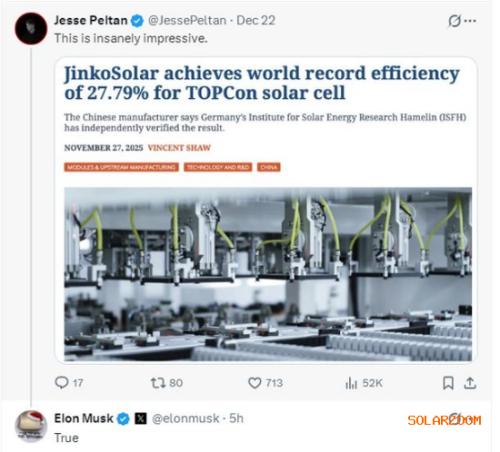
Core Insights - JinkoSolar has achieved a new world record for solar cell efficiency, reaching 27.79% based on its TOPCon technology platform, certified by the German Institute for Solar Energy Research (ISFH) [1][3][6] - Elon Musk acknowledged this achievement on social media, highlighting the significance of energy technology advancements in the context of increasing energy demands in the U.S. [1][3][8] Technology and Innovation - The record-breaking efficiency is attributed to a series of innovative advancements in the TOPCon technology, including new passivation contact techniques, ultra-low optical parasitic absorption, and novel metallization methods [6][7] - The integration of these technological breakthroughs has significantly enhanced the solar cell's performance, demonstrating the ongoing potential of the TOPCon platform to lower the levelized cost of electricity (LCOE) and support global energy transition efforts [6][7] Future Developments - JinkoSolar is also developing perovskite-TOPCon tandem solar cells, which have achieved a conversion efficiency of 34.76%, further solidifying the company's leadership in next-generation solar technology [7] - The company plans to scale up production of these advanced technologies, aiming to provide more efficient and reliable solar products to global customers [7]

新能源发电行业2026年投资策略:反内卷大势不改,新技术推动升级
Bank of China Securities· 2025-12-26 06:19
Overview - The report maintains a "stronger than market" rating for the renewable energy sector, highlighting that the demand for offshore wind power in China and Europe is increasing, leading to a rise in foundation demand and profit recovery for wind turbines. The "anti-involution" policy is expected to continue driving the photovoltaic sector, particularly with the expansion of perovskite technology. Overall, while short-term installation demand for renewable energy globally may be weak, there are structural opportunities in the market [1]. Key Points Supporting the Rating - The "anti-involution" trend is stabilizing wind turbine prices, enhancing profitability for manufacturers. China's offshore wind projects are becoming economically viable, contributing significantly to installed capacity. The demand for offshore wind in Europe and emerging markets is also on the rise [3]. - In the photovoltaic sector, the "anti-involution" policy remains the main theme, with a focus on the potential for capacity exits in battery and module production, as well as the industrialization potential of perovskite technology. Investment should prioritize growth-oriented new technology directions and the main industry chain benefiting from the "anti-involution" trend [3]. Investment Recommendations - For wind power, the report suggests prioritizing investments in the turbine segment, which is expected to recover profitability, and in the foundation segment that is progressing quickly in Europe. The offshore wind market is projected to grow significantly, with a focus on deep-sea projects [3]. - In the photovoltaic sector, the report emphasizes the importance of monitoring the "anti-involution" policy's impact on the industry, particularly regarding the exit of inefficient capacity and the enhancement of efficiency in battery and module production [3]. Long-term Outlook for Renewable Energy Demand - The report indicates that China's renewable energy demand is expected to remain robust in the long term, with an average annual installation capacity of over 400GW projected from 2025 to 2035. This is driven by the country's energy security needs and the ongoing transition to a low-carbon economy [13][16]. - The "136 Document" is noted for guiding the development of renewable energy projects towards market-oriented pricing, which is expected to stabilize project returns and promote high-quality development in the sector [31]. Photovoltaic Sector Insights - The report anticipates a moderate decline in photovoltaic installations in 2026 due to a phase of pre-installation in 2025, with projected installations of 290GW in 2025 and 180GW in 2026, reflecting a year-on-year decrease of 38% [33]. - The report highlights that the European photovoltaic market is facing growth challenges, with a forecasted installation of 64.2GW in 2025, indicating a slight decline. The U.S. market is also expected to experience pressure on growth due to policy adjustments [34][37]. Perovskite Technology Potential - Perovskite technology is identified as a key area for enhancing competitiveness in the photovoltaic manufacturing sector, with expectations for significant breakthroughs in industrialization by leading manufacturers in 2026 [33][44].





晶科能源取得光伏组件缓冲层专利
Jin Rong Jie· 2025-12-26 06:16
Group 1 - JinkoSolar has obtained a patent for "photovoltaic modules," with the authorization announcement number CN117637886B, applied on November 2023 [1] - JinkoSolar Co., Ltd., established in 2006 and located in Shangrao, primarily engages in the manufacturing of electrical machinery and equipment, with a registered capital of 1,000,520,267.8 RMB [1] - The company has invested in 53 enterprises, participated in 1,644 bidding projects, and holds 748 trademark records and 2,884 patent records, along with 70 administrative licenses [1] Group 2 - JinkoSolar (Shangrao) Co., Ltd., founded in 2020 and also based in Shangrao, focuses on electricity and heat production and supply, with a registered capital of 397,250,000 RMB [1] - This subsidiary has invested in 1 enterprise, participated in 32 bidding projects, and holds 258 patent records, along with 12 administrative licenses [1]
研判2025!中国光伏检测设备行业相关政策、发展现状、企业分析及未来前景展望:光伏产业供过于求,导致行业内企业业绩短期承压[图]
Chan Ye Xin Xi Wang· 2025-12-26 01:17
Core Viewpoint - The photovoltaic testing equipment industry is experiencing rapid growth driven by the expansion of photovoltaic cell and module production capacity, leading to increased demand for testing equipment and higher quality standards in production processes [1][3][6]. Industry Overview - Photovoltaic testing equipment is essential for assessing the performance, quality, safety, and reliability of photovoltaic components and systems, playing a crucial role in the development of the photovoltaic industry [3][4]. - The market size of China's photovoltaic testing equipment industry is projected to reach 2.101 billion yuan in 2024, representing a year-on-year increase of 4.9% [1][7]. Industry Policies - Recent government policies have been implemented to promote the development of the photovoltaic industry, including guidelines for updating and replacing equipment to improve efficiency standards [4][6]. - The 2024-2025 energy conservation and carbon reduction action plan emphasizes the construction of large-scale photovoltaic bases in desert areas, which will further drive the demand for testing equipment [4][6]. Market Dynamics - The cumulative installed capacity of photovoltaic systems in China increased from 204.2 GW in 2019 to 886.66 GW in 2024, with new installations rising from 30.1 GW to 277.17 GW during the same period [6]. - The rapid growth in installed capacity is expected to lead to increased demand for testing equipment to ensure quality control and operational efficiency [6][10]. Competitive Landscape - The photovoltaic testing equipment market is dominated by a few large manufacturers from Europe, the United States, and Japan, while domestic companies in China are rapidly improving their technology and quality [8][9]. - Key players in the Chinese market include Shanghai Optoelectronics Technology Co., Ltd., Shenzhen Huashengchang Technology Co., Ltd., and others, with varying performance and revenue trends [8][9]. Development Trends - The industry is moving towards greater automation and intelligence in testing processes, integrating visual defect detection systems to enhance production efficiency and reduce labor costs [10][11]. - As the focus shifts from quantity to quality, there is an increasing demand for high-performance testing equipment, prompting continuous technological innovation within the industry [11]. - Global expansion is accelerating, with Chinese companies establishing production bases in Southeast Asia and the Middle East to meet international market demands and comply with global testing standards [12].

上游材料价格上升 光伏组件厂商相继上调组件报价
2 1 Shi Ji Jing Ji Bao Dao· 2025-12-26 00:06
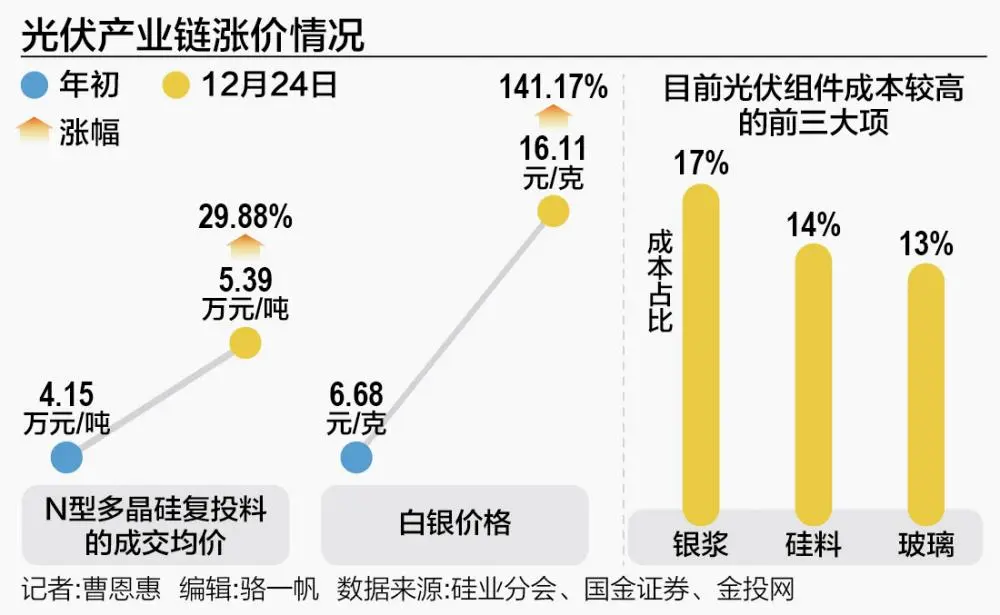
Core Viewpoint - The recent price increase of photovoltaic (PV) modules is primarily driven by rising upstream material costs, particularly silver paste, which has seen significant price hikes due to surging silver prices [1][4]. Group 1: Price Increases and Market Dynamics - Major PV manufacturers like Longi Green Energy and JinkoSolar have raised module prices by 0.02 to 0.05 yuan per watt, citing increased costs of upstream materials [1]. - Silver futures and spot prices have reached historical highs, with increases of over 130% and 150% respectively this year [1]. - Despite the price increases in upstream materials, the price of PV modules has only risen by less than 2% this year, lagging behind other components like silicon wafers and battery cells, which have seen increases of over 19% and 15% respectively [4][6]. Group 2: Cost Structure Changes - The cost structure of PV modules has shifted, with silver paste now accounting for 17% of the total cost, surpassing silicon materials, which have decreased in cost share due to falling prices [3]. - The average transaction price of N-type multi-crystalline silicon has risen from 41,500 yuan/ton at the beginning of the year to 53,900 yuan/ton by December 24, marking a 29.88% increase [4]. Group 3: Investment Returns and Market Sentiment - The internal rate of return (IRR) for PV projects has been negatively impacted by declining feed-in tariffs, with current IRR expectations for domestic projects ranging from 6% to 7%, down from previous standards of 7% to 7.5% [5][6]. - There is a strong correlation between module prices and IRR, suggesting that rising module prices could deter investment in new installations [6]. Group 4: Future Outlook and Demand - The demand for PV modules is currently limited, and expectations for rapid market growth are diminishing, with the industry facing a potential inflection point in demand growth [8]. - The National Energy Administration reported that from January to October, China added 252.87 GW of new PV capacity, but the market is expected to stabilize rather than experience rapid growth in the future [8].
白银狂飙141%,硅料大涨,光伏组件想涨价却涨不动
21世纪经济报道· 2025-12-25 23:34
Core Viewpoint - The recent price increase of photovoltaic (PV) modules is primarily driven by rising upstream material costs, particularly silver paste, which has seen significant price hikes due to the surge in silver prices [1][5][6]. Group 1: Price Increases and Cost Structure - Major PV module manufacturers, including Longi Green Energy and JinkoSolar, have raised their module prices by 0.02 to 0.05 yuan per watt due to increased costs of upstream materials [1]. - Silver paste has become the largest cost component in PV modules, accounting for 17% of the total cost, followed by silicon materials at 14% and glass at 13% [5]. - The average price of N-type multicrystalline silicon has risen from 41,500 yuan/ton at the beginning of the year to 53,900 yuan/ton by December 24, marking a 29.88% increase [6]. - The spot price of silver has increased from 6.68 yuan/gram to 16.11 yuan/gram, reflecting a 141.17% rise [6]. Group 2: Market Dynamics and Investment Returns - The price increase of upstream materials has not effectively translated to module prices due to concerns over the internal rate of return (IRR) for downstream solar power plant operators, which has been negatively impacted by recent policy changes [6][7]. - The IRR for domestic PV projects has decreased to a range of 6% to 7%, down from previous standards of 7% to 7.5% [6][7]. - There is a strong correlation between module prices and the IRR for solar power plants, indicating that any price increase in modules could dampen installation demand [7]. Group 3: Future Price Expectations and Market Demand - Industry experts suggest that module prices need to reach at least 0.8 yuan/W to ensure profitability for integrated module companies, with some estimates suggesting a target range of 0.88 to 0.99 yuan/W [9]. - The current average price for N-type TOPCon modules is 0.698 yuan/W, with a slight increase of 0.7% noted recently [9]. - Despite the desire for price increases, the limited market demand poses challenges for driving module prices higher in the short term [10]. - The newly released data indicates that China's newly installed PV capacity reached 252.87 GW from January to October, but the growth rate is expected to slow down, leading to uncertainty in future demand [10].

白银狂飙141%,硅料大涨,光伏组件想涨价却涨不动
Xin Lang Cai Jing· 2025-12-25 23:31
Core Viewpoint - The recent price increase of photovoltaic (PV) modules is primarily driven by rising upstream material costs, particularly silver paste, which has seen significant price hikes due to soaring silver prices [1][3][4]. Group 1: Price Increases and Market Dynamics - Major PV manufacturers like Longi Green Energy and JinkoSolar have raised module prices by 0.02 to 0.05 yuan per watt due to increased costs of raw materials [1][3]. - Silver futures and spot prices have surged, with increases exceeding 130% and 150% respectively this year [1][3]. - The price increase of PV modules has lagged behind other components in the supply chain, with module prices rising less than 2% compared to significant increases in silicon wafers and battery cells [4][12]. Group 2: Cost Structure Changes - The cost structure of PV modules has shifted, with silver paste now accounting for 17% of the total cost, surpassing silicon materials which have decreased in cost share [11][12]. - The average transaction price of N-type multi-crystalline silicon has risen from 41,500 yuan per ton at the beginning of the year to 53,900 yuan per ton by December 24, marking a 29.88% increase [12]. - The price of silver has increased from 6.68 yuan per gram to 16.11 yuan per gram, reflecting a 141.17% rise [12]. Group 3: Investment Returns and Market Sentiment - The internal rate of return (IRR) for PV projects has been negatively impacted by declining electricity prices, with current IRR estimates for domestic projects ranging from 6% to 7% [4][13]. - There is a strong correlation between module prices and the IRR for solar power plants, suggesting that rising module prices could deter investment due to lower expected returns [5][13]. - Industry experts express skepticism about the sustainability of the recent price increases, questioning whether they can be maintained in the face of limited market demand [6][14]. Group 4: Future Market Outlook - The China Photovoltaic Industry Association has not provided forecasts for new installed capacity for 2026, indicating increased uncertainty regarding future demand [8][16]. - From January to October, China's newly installed PV capacity reached 252.87 GW, attributed to a surge in installations earlier in the year [8][16]. - The global PV market is expected to experience a slowdown in growth, with future demand projected to stabilize rather than increase rapidly [9][16].
晶科能源:TOPCon技术持续深耕,N型TOPCon/钙钛矿叠层电池转化效率突破34.76%
Jin Rong Jie· 2025-12-25 09:40
有投资者在互动平台向晶科能源提问:"近日世界首富马斯克点赞贵公司光电转换效率新纪录:'令人印 象深刻'。考虑到马斯克旗下有特斯拉、The Boring Company、SpaceX等都有可能用上贵公司的产品, 贵公司应积极主动联系这些公司推广贵公司产品。名人效应的正面影响是很大的,比如某新能源轿车巨 头在推出轿车初期就总是宣传巴菲特投资该公司。贵公司也应利用好本次马斯克点赞的名人效应,甚至 可考虑联系马斯克投资贵公司。供参考。" 本文源自:市场资讯 针对上述提问,晶科能源回应称:"尊敬的投资者您好,感谢您的诚挚建议,公司将认真考虑。公司本 次基于TOPCon技术平台高效电池效率纪录的取得,源于在TOPCon技术上的持续深耕,且TOPCon技术 能够与下一代钙钛矿叠层技术无缝衔接,公司N型TOPCon/钙钛矿叠层电池的转化效率经认证已突破 34.76%。公司在光伏技术上的连续突破,为未来在题述更多场景的应用奠定了坚实的技术基础。感谢 您的关注!" 作者:公告君 声明:市场有风险,投资需谨慎。本文为AI基于第三方数据生成,仅供参考,不构成个人投资建议。 ...