Keqian Biology(688526)

Search documents
春节宠物消费增长快,关注宠物经济蓬勃之势
GUOTAI HAITONG SECURITIES· 2026-02-24 00:45
Investment Rating - The report maintains an "Overweight" rating for the pet economy sector, highlighting its rapid growth during the Spring Festival [4][7]. Core Insights - The pet consumption during the Spring Festival has seen significant growth, with a 20%+ year-on-year increase in searches for "New Year pet gift boxes" on Tmall. The sales of pet clothing surged by 330%, and pet New Year's dinners increased by 290% [7]. - The report emphasizes the comprehensive nature of pet services, with a 46% month-on-month increase in pet boarding demand. The expansion of pet transport services on high-speed trains and airlines is also noted [7]. - Upcoming pet exhibitions in March are expected to further stimulate market interest, with major brands likely to launch new products [7]. Summary by Sections Important Industry Data Overview - The agricultural sector index stands at 2,858.1, with a year-on-year increase of 14.28%. The wholesale price index for agricultural products is at 129.6, reflecting a 4.95% year-on-year increase [10]. - The average price of live pigs is 12.3 yuan/kg, down 15.81% year-on-year, while the average price of piglets is 471.0 yuan/head, down 25.24% year-on-year [10]. Pig Farming Sector - The report anticipates a seasonal decline in pig prices post-Spring Festival, with expectations of low prices leading to potential losses in farming [5][12]. - Recommended stocks in the pig farming sector include Muyuan Foods and Wens Foodstuffs, with additional recommendations in the agricultural product supply chain [5]. Poultry Sector - The report discusses the white feather broiler market, noting a decrease in chick prices and stable prices for broiler meat [19][20]. - The average price of broiler chicks is reported at 2.4 yuan/chick, with a 4.35% increase month-on-month [10]. Feed Sector - The report indicates stable feed prices, with corn prices at 2,372.2 yuan/ton and soybean meal prices at 3,167.7 yuan/ton [10][30]. - The analysis highlights the fluctuations in import prices for soybeans and corn, impacting the feed sector [32]. Key Company Profit Forecasts and Valuations - The report provides earnings per share (EPS) forecasts for key companies, with Muyuan Foods projected at 2.54 yuan for 2025 and 4.81 yuan for 2026, maintaining an "Overweight" rating [36]. - Other companies such as Wens Foodstuffs and Petty Holdings also receive "Overweight" ratings, indicating strong growth potential [36].





科前生物:公司是一家专注于兽用生物制品研发、生产、销售及动物防疫技术服务的生物医药企业
Zheng Quan Ri Bao· 2026-02-11 11:41
Group 1 - The company, KQ Bio, focuses on the research, development, production, sales, and animal epidemic prevention technology services of veterinary biological products [2] - The main products of the company include non-mandatory immunization vaccines for pigs and poultry vaccines [2]


科前生物:初步形成了一套黑水虻规模化转化农业有机废弃物的系统解决方案
Zheng Quan Ri Bao· 2026-02-11 11:41
Core Viewpoint - The company is focusing on the national strategy of reducing the use of feed protein and is collaborating with a key laboratory to develop solutions for converting agricultural organic waste into insect protein [2] Group 1: Company Initiatives - The company is working closely with the National Key Laboratory for the Exploration and Utilization of Agricultural Microbial Resources [2] - It is exploring large-scale breeding processes and automated breeding equipment for the production of insect protein from black soldier flies and microbial conversion of livestock manure and food waste [2] - A systematic solution for the large-scale conversion of agricultural organic waste using black soldier flies has been initially formed, laying the foundation for future improvement and application [2]
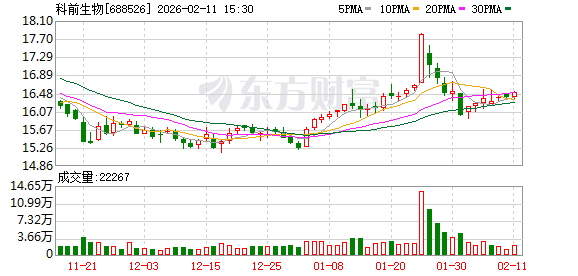
科前生物:上市公司股价受宏观经济形势、政策变化、市场情绪等多重因素综合影响
Zheng Quan Ri Bao· 2026-02-11 11:11
Core Viewpoint - The company acknowledges that its stock price is influenced by multiple factors including macroeconomic conditions, policy changes, and market sentiment [2] Group 1 - The company is committed to high-quality development and will continue to increase its investment in research and development [2] - The company aims to enhance its operational capabilities and provide returns to investors [2]
科前生物新兽药获批 丰富产品线
Jing Ji Guan Cha Wang· 2026-02-11 09:19
Group 1 - The core viewpoint of the article is that the company, Keqian Biotechnology, has received approval from the Ministry of Agriculture and Rural Affairs for a new veterinary drug registration certificate for a vaccine aimed at preventing diseases caused by Porcine Circovirus Type 2 [1][2] - The approved product is a recombinant virus-inactivated vaccine (CH17 strain, suspension culture) specifically designed for the prevention of Porcine Circovirus Type 2 infections [1][2] - The approval will enrich the company's product line, but the market promotion and sales situation remain uncertain until the product obtains the necessary approval number for market sales [1]
2月9日晚间重要公告一览
Xi Niu Cai Jing· 2026-02-09 10:13
Group 1 - XianDao Intelligent has set the final price for its H-share public offering at HKD 45.8 per share, with expected listing on February 11, 2026 [1] - Jida Communication is a candidate for a project with China Mobile, with an estimated service fee of approximately CNY 51.04 million [2] - Bowei Alloy's controlling shareholder plans to increase holdings by CNY 100 million to 150 million from February 10 to August 9, 2026 [3] Group 2 - Xiamen Airport reported 16,368 aircraft takeoffs and landings in January 2026, a year-on-year decrease of 4.82%, with passenger throughput of 2.38 million, down 3.84% [4] - Yitong Century has won a bid for a project worth CNY 107 million, providing comprehensive maintenance services for China Tower [5] - Huayi Brothers' controlling shareholder's 70 million shares are subject to judicial auction, representing 42.89% of his holdings and 2.52% of the company's total shares [6] Group 3 - Lianhuan Pharmaceutical received approval for the sale of Tadalafil tablets (20mg) in Ghana [7] - Aonong Biological reported a pig sales volume of 166,600 in January 2026, a year-on-year increase of 35.36% [8] - Xiantan Co. achieved chicken product sales revenue of CNY 546 million in January 2026, a year-on-year increase of 54.9% [9] Group 4 - Zhengbang Technology reported a January sales revenue of CNY 816 million from pig sales, a year-on-year increase of 19.69% [10] - Qianjin Pharmaceutical's net profit for 2025 grew by 24.74% to CNY 288 million [11] - Xinhua Pharmaceutical received a drug registration certificate for glucosamine sulfate capsules [12] Group 5 - Yuandong Bio completed the first dosing of its EP-0210 monoclonal antibody in a Phase I clinical trial for inflammatory bowel disease [13] - Jiaokong Technology signed a contract for the Sydney Metro West Line signal system subcontracting project worth AUD 93.53 million [14] - Dangsheng Technology signed a strategic cooperation framework agreement with Huineng Technology in solid-state batteries and the new energy industry [15] Group 6 - Jinhui Co. plans to acquire 100% of Fusheng Mining for CNY 210 million [16] - Cangzhou Mingzhu announced Guangzhou Light Industry as its new controlling shareholder after a share transfer [17] - Dingxin Technology's vice president was fined CNY 120,000 for short-term trading [18][19] Group 7 - China Modern Pharmaceutical's subsidiary passed a GMP compliance inspection for its production line [20] - Chaosheng Electronics plans to increase capital by CNY 400 million in its subsidiary to enhance competitiveness [21] - Lonyu Mountain reported a 25.03% year-on-year increase in pig sales revenue in January 2026 [22] Group 8 - Sanbo Brain Science's chairman has been released from investigation, and the company is operating normally [23] - Hainan Mining is planning to acquire control of Luoyang Fengrui Fluorine Industry and will resume trading on February 10, 2026 [24] - Dongwei Technology's net profit for 2025 increased by 86.81% [25] Group 9 - Yuanjie Technology plans to invest CNY 1.251 billion in a semiconductor chip and device R&D production base [26] - Metro Design signed a contract for an energy management project with Guangzhou Metro Group worth CNY 924 million [27] - Zhongmin Energy intends to acquire 51% of Fujian Yongtai Mintou Pumped Storage Co. for CNY 864 million [28] Group 10 - Dianzhi Technology plans to repurchase shares worth CNY 100 million to 200 million [29] - China Baoan was not selected as a restructuring investor for the Singshan Group [30] - Zhiguang Electric's subsidiary signed a CNY 1.004 billion contract for energy storage systems [31] Group 11 - Zhifei Biological received approval for a clinical trial of its herpes zoster vaccine [32] - KQ Bio received a new veterinary drug registration certificate for a vaccine against porcine circovirus type 2 [33] - Huanxu Electronics reported a 4% year-on-year increase in consolidated revenue for January 2026 [34] Group 12 - Xiangjia Co. reported a 10.42% year-on-year increase in live poultry sales revenue in January 2026 [35] - Kemin Foods' subsidiary reported a 68.29% year-on-year increase in pig sales revenue in January 2026 [36] - Liyuan Technology signed a procurement contract worth CNY 54.98 million [37] Group 13 - Jiuqiang Bio received a medical device registration certificate for a fibrin degradation product detection kit [38] - Zhongguancun's subsidiary passed the consistency evaluation for Tramadol Hydrochloride tablets [39] - Rundou Co. received a drug registration certificate for Candesartan Etil [40]


科前生物(688526) - 武汉科前生物股份有限公司关于获批新兽药注册证书的自愿性信息披露公告
2026-02-09 08:00
证券代码:688526 证券简称:科前生物 公告编号:2026-001 武汉科前生物股份有限公司 关于获批新兽药注册证书的自愿性信息披露公告 本公司董事会及全体董事保证本公告内容不存在任何虚假记载、 误导性陈述或者重大遗漏,并对其内容的真实性、准确性和完整性依 法承担法律责任。 根据《兽药管理条例》和《兽药注册办法》规定,经中华人民共 和国农业农村部审查,批准公司申报的猪圆环病毒 2 型重组杆状病毒 灭活疫苗(CH17 株,悬浮培养)为新兽药,并核发《新兽药注册证 书》,具体详情如下: 一、新兽药的基本信息 新兽药名称:猪圆环病毒 2 型重组杆状病毒灭活疫苗(CH17 株, 悬浮培养) 英文名:Porcine Circovirus Type 2 Recombinant Baculovirus Vaccine,Inactivated (Strain CH17, Suspension Culture) 新兽药注册证书号:(2026)新兽药证字 31 号 注册分类:三类 研制单位:武汉科前生物股份有限公司 监测期:3 年 主要成分与含量:每头份疫苗中含有表达的猪圆环病毒 2d 型 Cap 武汉科前生物股份有限公司以 ...
科前生物:获批猪圆环病毒2型重组杆状病毒灭活疫苗新兽药证书
Jin Rong Jie· 2026-02-09 07:55
Core Viewpoint - The company has received approval for its recombinant inactivated vaccine for Porcine Circovirus Type 2, which will enhance its product offerings and competitiveness in the market [1] Group 1: Product Approval - The vaccine has been approved by the Ministry of Agriculture and Rural Affairs and has received the New Veterinary Drug Registration Certificate [1] - The registration classification of the vaccine is categorized as Class III, with a monitoring period of three years [1] Group 2: Vaccine Efficacy - The vaccine is intended to prevent infections caused by Porcine Circovirus Type 2, providing active immunity that lasts for four months after 28 days of administration [1] - Passive immunity for piglets lasts until 21 days of age [1] Group 3: Market Impact - The approval of the product will diversify the company's product range and enhance its competitive position in the industry [1] - However, the timeline for production and sales remains uncertain pending the acquisition of the necessary approval number [1]
科前生物获批一款新兽药注册证书
Zhi Tong Cai Jing· 2026-02-09 07:50
Core Viewpoint - The approval of the new vaccine by the Ministry of Agriculture and Rural Affairs of the People's Republic of China represents a significant milestone for the company, enhancing its product portfolio and market competitiveness [1] Group 1: Product Development - The company has received approval for its recombinant inactivated vaccine for Porcine Circovirus Type 2 (CH17 strain, suspension culture) as a new veterinary drug [1] - This approval is in accordance with the Veterinary Drug Management Regulations and the Veterinary Drug Registration Measures [1] Group 2: Business Impact - The successful approval of the vaccine will diversify the company's product offerings, promoting a multi-faceted business development strategy [1] - The new product is expected to positively influence the company's operational growth and market competitiveness [1]
2026年中央一号文件点评:聚焦粮食稳产提质,重视农业科技
Shenwan Hongyuan Securities· 2026-02-06 13:59
Investment Rating - The report gives an "Overweight" rating for the agricultural industry, indicating that it is expected to outperform the overall market [3][10]. Core Insights - The 2026 Central Document emphasizes food security and agricultural modernization, reiterating the importance of "new agricultural productivity" and the continuous focus on seed industry revitalization, particularly in biological breeding [4]. - In livestock, there is a shift towards "strengthening" comprehensive regulation of pig production capacity, with a focus on stabilizing the beef and dairy industries, and promoting dairy product consumption [4]. - The document highlights the importance of grain security, aiming to stabilize grain production at around 14 trillion jin, and introduces measures to enhance grain circulation efficiency [4]. - The report outlines the implementation of agricultural technology, including the integration of artificial intelligence with agriculture, and identifies key application scenarios such as drones, IoT, and robotics [4]. - The report suggests three main investment focuses: the recovery of the beef and dairy industries, the expected rebound in the pig cycle, and the continued advancement of the seed industry and biological breeding [4]. Summary by Sections Livestock Industry - The report indicates a comprehensive approach to regulating pig production capacity and acknowledges the success of measures taken to support the beef and dairy industries [4]. - It also mentions the introduction of multiple measures to promote dairy product consumption for the first time [4]. Crop Production - The focus remains on food security, with a commitment to stabilize grain production and enhance the efficiency of grain circulation [4]. - The report introduces a new round of initiatives aimed at increasing grain production capacity, particularly for oilseed crops like soybeans [4]. Seed Industry - The report emphasizes the ongoing implementation of seed industry revitalization actions and the acceleration of biological breeding industrialization [4]. - It notes the continuous mention of biological breeding in the Central Document over the past six years, highlighting its growing importance [4]. Agricultural Technology - The report outlines the path for implementing new agricultural productivity, emphasizing the need for technology integration, particularly in AI applications [4]. Agricultural Trade - The report advocates for the coordination of agricultural trade and production, promoting diversification of agricultural imports and supporting the export of competitive agricultural products [4].