JXPCB(688655)

Search documents
迅捷兴(688655) - 股东减持股份结果公告
2025-09-23 10:02
股东持有的基本情况 本次减持计划实施前,深圳市迅捷兴科技股份有限公司(以下简称"公司") 股东泰安市捷兴投资合伙企业(有限合伙)(原"淮安市捷兴投资合伙企业(有 限合伙)",以下简称"捷兴投资")持有公司股份 2,808,400 股,占公司总股本 2.11%;股东泰安市迅兴投资合伙企业(有限合伙)(原"淮安市迅兴投资合伙企 业(有限合伙)",以下简称"迅兴投资")持有公司股份 841,100 股,占公司总 股本 0.63%;上述股份为公司首次公开发行前取得的股份,并于 2024 年 5 月 13 日起上市流通。捷兴投资与迅兴投资为公司员工持股平台,合计持有公司股份 3,649,500,占公司总股本 2.74%,为实际控制人马卓先生一致行动人。 减持计划的实施结果情况 证券代码:688655 证券简称:迅捷兴 公告编号:2025-063 深圳市迅捷兴科技股份有限公司 股东减持股份结果公告 本公司董事会、全体董事及相关股东保证本公告内容不存在任何虚假记载、 误导性陈述或者重大遗漏,并对其内容的真实性、准确性和完整性依法承担法律 责任。 重要内容提示: 公司于 2025 年 6 月 4 日在上海证券交易所网站(ww ...

迅捷兴9月17日获融资买入683.65万元,融资余额1.30亿元
Xin Lang Zheng Quan· 2025-09-18 01:27
Group 1 - The core viewpoint of the news highlights the recent performance of Xunji Technology, including a decline in stock price and significant changes in financing activities [1] - On September 17, Xunji Technology's stock fell by 3.70%, with a trading volume of 87.1464 million yuan [1] - The financing data indicates that on the same day, the company had a financing buy-in amount of 6.8365 million yuan and a financing repayment of 11.1736 million yuan, resulting in a net financing buy of -4.3371 million yuan [1] Group 2 - As of September 17, the total balance of margin trading for Xunji Technology was 130 million yuan, accounting for 4.33% of its market capitalization [1] - The financing balance is above the 70th percentile level over the past year, indicating a relatively high level [1] - In terms of securities lending, there were no shares repaid or sold on September 17, with a lending balance of 0.00 shares, which is at the 90th percentile level over the past year [1] Group 3 - As of June 30, the number of shareholders for Xunji Technology was 5,406, a decrease of 16.34% from the previous period [2] - The average circulating shares per person increased by 19.53% to 24,674 shares [2] - For the first half of 2025, Xunji Technology achieved an operating income of 292 million yuan, a year-on-year increase of 27.66%, while the net profit attributable to the parent company was -2.7661 million yuan, a decrease of 169.48% year-on-year [2] Group 4 - Since its A-share listing, Xunji Technology has distributed a total of 30.0128 million yuan in dividends, with 20.0085 million yuan distributed over the past three years [2] - As of June 30, 2025, Xunji Technology's top ten circulating shareholders saw the exit of Xin'ao New Energy Industry Stock A from the list [2]
迅捷兴:珠海智慧样板厂已投产,珠海基地正处产能磨合期
Ju Chao Zi Xun· 2025-09-10 08:38
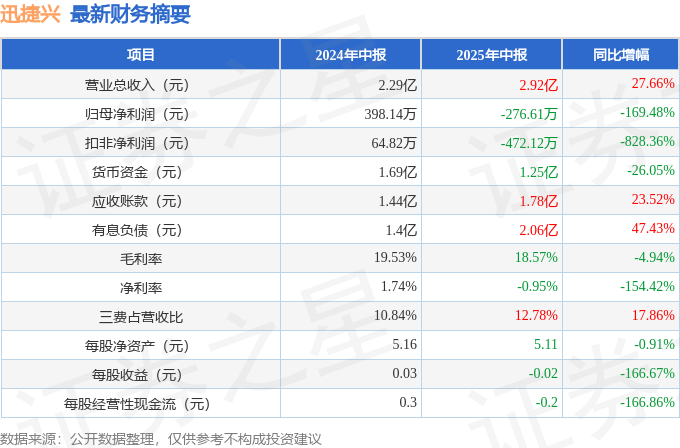
Core Viewpoint - The company has commenced production at its Zhuhai Smart Model Factory, which is currently in the capacity adjustment phase, and aims to expedite the integration of sample and batch orders while enhancing collaboration with major clients [2] Financial Performance - In the first half of the year, the company achieved total operating revenue of 292 million yuan, representing a year-on-year increase of 27.66% [2] - The company reported a net loss attributable to shareholders of 2.77 million yuan, compared to a profit of 3.98 million yuan in the same period last year [2] - The non-recurring net profit also showed a loss of 4.72 million yuan, down from a profit of 648,200 yuan in the previous year [2] Production and Development - The company is actively developing various products for AI servers, including motherboards, GPU accelerator cards, and GPU module boards, as well as secondary power supply boards for servers and high-speed communication applications [2] - Some orders have already been delivered in bulk, indicating progress in production capabilities [2] Strategic Initiatives - To overcome the initial production challenges at the Zhuhai factory, the company plans to accelerate the introduction of sample and batch orders and establish strategic partnerships for research and development of sample orders [2]


迅捷兴(688655):捷兴(688655):Q2业绩实现扭亏,布局高成长赛道成效显著
Xinda Securities· 2025-09-09 13:32
Investment Rating - The report assigns a "Buy" rating for Xunjiexing (688655) based on its strong growth potential in high-growth sectors such as humanoid robots and AI infrastructure [1]. Core Views - Xunjiexing achieved a significant revenue increase of 27.66% year-on-year in H1 2025, with total revenue reaching 292 million yuan. The company reported a net profit of -2.77 million yuan, primarily due to initial losses from new capacity at its Zhuhai factory [1]. - The company's early-stage layout in humanoid robotics aligns well with the current development phase of the industry, providing a one-stop PCB service that supports early-stage smart robotics companies in scaling their operations [1]. - Orders for optical modules are expected to increase, driven by high growth in AI-related sectors. The company has successfully supplied 400G optical modules and power supply equipment for computing servers, with significant capacity expansion planned [1]. - Profit forecasts indicate that the company's net profit is expected to grow significantly from 32 million yuan in 2025 to 334 million yuan by 2027, reflecting a strong growth trajectory [1]. Financial Summary - In H1 2025, the company reported a revenue of 292 million yuan, with a year-on-year growth of 27.66%. The gross margin was 18.57%, a slight decrease of 0.96 percentage points compared to the previous year [1]. - The projected total revenue for 2025 is 794 million yuan, with a year-on-year growth rate of 67.3%. By 2027, the revenue is expected to reach 2.83 billion yuan, reflecting a growth rate of 48.8% [2]. - The net profit for 2025 is estimated at 32 million yuan, with a remarkable growth rate of 1723.3% compared to 2024. By 2027, the net profit is projected to reach 334 million yuan [2]. - The company's gross margin is expected to improve from 19.5% in 2025 to 25.6% in 2027, indicating enhanced operational efficiency [2].
股市必读:迅捷兴(688655)9月5日主力资金净流出545.57万元
Sou Hu Cai Jing· 2025-09-07 20:15
Group 1 - The core point of the article is that Shenzhen Xunjiexing Technology Co., Ltd. is in the process of acquiring 100% equity of Shenzhen Jiazhi Hong Electronics Co., Ltd. through a combination of issuing shares and cash payment, which is expected to constitute a major asset restructuring [1][3] - As of September 5, 2025, Xunjiexing's stock closed at 22.58 yuan, with an increase of 1.67%, a turnover rate of 2.61%, a trading volume of 34,800 hands, and a transaction amount of 77.5587 million yuan [1] - On September 5, 2025, the net outflow of main funds was 5.4557 million yuan, while the net inflow of speculative funds was 5.5594 million yuan, and the net outflow of retail funds was 103,700 yuan [1][3] Group 2 - The company announced that the stock has been suspended since March 27, 2025, and is expected to remain suspended for no more than 10 trading days [1] - The board of directors and the supervisory board approved the relevant proposals for the transaction on April 9, 2025, and the stock resumed trading on April 10, 2025 [1] - Currently, intermediary institutions have begun due diligence, and auditing and evaluation work is ongoing, but the transaction still requires further approval from the board of directors, shareholders' meeting, Shanghai Stock Exchange review, and China Securities Regulatory Commission registration, indicating uncertainty [1]
每周股票复盘:迅捷兴(688655)拟购嘉之宏电子100%股权
Sou Hu Cai Jing· 2025-09-06 21:20
Group 1 - The stock price of Xunjiexing (688655) closed at 22.58 yuan on September 5, 2025, down 4.93% from the previous week's closing price of 23.75 yuan [1] - The highest intraday price for Xunjiexing this week was 24.76 yuan on September 2, 2025, while the lowest was 21.83 yuan on September 5, 2025 [1] - The current total market capitalization of Xunjiexing is 3.012 billion yuan, ranking 52nd out of 56 in the component sector and 4469th out of 5152 in the A-share market [1] Group 2 - Xunjiexing plans to acquire 100% equity of Shenzhen Jiahong Electronics Co., Ltd. through a combination of issuing shares and cash payment, along with raising supporting funds [2][3] - This transaction is expected to constitute a major asset restructuring but will not qualify as a restructuring listing [2][3] - The company's stock was suspended from trading since March 27, 2025, and is expected to remain suspended for no more than 10 trading days [2] - The board of directors and supervisory board approved the transaction on April 9, 2025, and the stock resumed trading on April 10, 2025 [2] - The transaction is still subject to further board and shareholder approvals, as well as reviews by the Shanghai Stock Exchange and registration with the China Securities Regulatory Commission, indicating some uncertainty [2][3]
迅捷兴(688655.SH):积极开发应用于高速通信领域和智能硬件方面的任意阶HDI板、800G光模块等
Ge Long Hui· 2025-09-05 09:30
Group 1 - The company has achieved mass supply of 400G optical modules [1] - The company is actively developing arbitrary-layer HDI boards and 800G optical modules for high-speed communication and smart hardware applications [1] - The company aims to accelerate the import of bulk orders in high value-added areas [1]
迅捷兴(688655) - 关于发行股份及支付现金购买资产并募集配套资金事项的进展公告
2025-09-05 09:15
证券代码:688655 证券简称:迅捷兴 公告编号:2025-062 深圳市迅捷兴科技股份有限公司 深圳市迅捷兴科技股份有限公司(以下简称"公司")拟通过发行股份及支 付现金的方式购买深圳市嘉之宏电子有限公司(下称"嘉之宏")的 100%股权并 募集配套资金(下称"本次交易")。本次交易预计构成《上市公司重大资产重组 管理办法》《上海证券交易所科创板股票上市规则》规定的重大资产重组。本次 交易不会导致公司实际控制人发生变更,不构成重组上市。 二、本次交易的进展情况 根据上海证券交易所相关规定,经向上海证券交易所申请,公司股票(证券 简称:迅捷兴,证券代码:688655)自 2025 年 3 月 27 日(星期四)开市起停牌。 预计停牌时间不超过 10 个交易日。具体内容详见公司于 2025 年 3 月 27 日在上 海证券交易所网站(www.sse.com.cn)披露的《关于筹划发行股份及支付现金购 买资产并募集配套资金事项的停牌公告》(公告编号:2025-029)。 停牌期间,公司积极组织相关各方推进本次交易的相关工作,并定期发布停 牌进展公告。2025 年 4 月 3 日公司在上海证券交易所网站披露了《关 ...
PCB行业盛宴红利旁落,迅捷兴扩产反陷增收不增利困境 | 看财报
Tai Mei Ti A P P· 2025-08-29 03:07
Core Viewpoint - The company XunJieXing (688655.SH) reported a revenue of 292 million yuan for the first half of the year, a year-on-year increase of 27.66%, but faced a net loss of 2.76 million yuan, contrasting sharply with a profit of 3.98 million yuan in the same period last year, marking it as a notable "laggard" in the booming PCB industry [2][3]. Group 1: Company Performance - XunJieXing's main business is the research, production, and sales of printed circuit boards (PCBs), focusing on small-batch, customized demands rather than large-volume orders [3][4]. - Despite the overall PCB market experiencing significant growth, XunJieXing's unique business model has limited its ability to capture market share, as small-batch and sample boards account for only 15%-20% of the industry [4][5]. - The company’s net loss was primarily attributed to the initial phase of new capacity release from its subsidiary, resulting in a loss of 11.54 million yuan [4]. Group 2: Industry Context - The PCB industry is projected to grow by 6.8% year-on-year in 2023, with the AI/HPC server PCB segment expected to see a compound annual growth rate (CAGR) of 32.5% from 2023 to 2028 [3]. - Competitors such as Shenghong Technology and Pengding Holdings reported significant revenue and profit increases, highlighting XunJieXing's underperformance in comparison [3]. Group 3: Strategic Initiatives - XunJieXing has initiated a three-pronged strategy of expansion, acquisition, and incentive programs to address its challenges [6][8]. - The company is expanding its production capacity with a new smart factory project set to produce 600,000 square meters of PCBs, which is expected to be operational by the end of 2023 [6][7]. - An acquisition of Shenzhen Jiazhihong Electronics Co., which specializes in flexible circuit boards, is planned, potentially doubling XunJieXing's revenue if successful [7][8]. - A stock incentive plan has been introduced to bind the core team to revenue and profit growth targets, aiming for a revenue increase of at least 30% by 2025 [8].

迅捷兴2025年中报简析:增收不增利
Zheng Quan Zhi Xing· 2025-08-28 22:59
Financial Performance - Company reported a total revenue of 292 million yuan for the first half of 2025, an increase of 27.66% year-on-year, but a net profit loss of 2.77 million yuan, a decline of 169.48% year-on-year [1] - In Q2 2025, revenue was 169 million yuan, up 32.66% year-on-year, while net profit was 2.09 million yuan, down 60.15% year-on-year [1] - Gross margin decreased to 18.57%, down 4.94% year-on-year, and net margin was -0.95%, a drop of 154.42% year-on-year [1] - Total expenses (selling, administrative, and financial) amounted to 37.35 million yuan, representing 12.78% of revenue, an increase of 17.86% year-on-year [1] Business Model and Strategy - Company relies heavily on capital expenditure for performance, necessitating careful evaluation of capital projects and their financial viability [3] - The company has three production bases, with the Zhuhai base focusing on smart projects and expected to enhance sample production capacity significantly [4][7] - The company aims to provide high-quality, cost-effective PCB services to clients in the robotics sector, leveraging its experience in rapid response and diverse production capabilities [5][6] Market and Growth Potential - The company is positioned to benefit from the growing demand in various sectors, including smart security, automotive electronics, and industrial control [4] - Expected growth drivers include increased capacity from the Xinfeng plant and the launch of the Zhuhai smart sample factory, which is currently in the capacity ramp-up phase [6] - The company is also focusing on high-value products like servers and optical modules, with a strong demand in the industry [9]