
VR/AR

Search documents
Meta Platform (META) Signs Multibillion-Dollar AI Chip Agreement With Google
Yahoo Finance· 2026-03-05 07:28
Group 1 - Meta Platforms Inc. is recognized as one of the 15 best stocks to invest in according to billionaires [1] - On February 27, Meta signed a multiyear agreement to lease Google's AI chips, valued at billions of dollars, for developing new AI models [1] - Citizens analyst Andrew Boone maintained a Market Outperform rating for Meta with a price target of $900, driven by significant engagement on Instagram [2][4] Group 2 - Instagram's global time spent increased by 19.2% year-over-year in January, outpacing user growth, which was only 6% [4] - In the U.S., Instagram engagement rose by 16.5% while monthly active users grew by just 2%, indicating effective user engagement strategies [4] - Meta operates through two segments: Family of Apps, which includes Facebook, WhatsApp, Threads, Instagram, and Messenger, and Reality Labs, focusing on the metaverse and VR/AR hardware [5]


老街新春更有戏
Huan Qiu Wang· 2026-02-27 02:19
Core Viewpoint - The "Cross-Strait Digital Intangible Cultural Heritage Year" series of activities in Xiamen has successfully attracted tourists and revitalized the historical Zhongshan Road through a blend of technology and traditional culture [5][6][9] Group 1: Event Overview - The series features over 100 activities across 10 themes, including a cross-strait intangible cultural heritage market showcasing local cuisine, folk performances, and technology product displays [6][9] - The event aims to create an immersive experience of the Spring Festival and historical culture, utilizing advanced technologies such as VR/AR and robotics [7][9] Group 2: Technological Integration - The event incorporates cutting-edge technologies like 3D modeling, digital scanning, and humanoid robots to rejuvenate traditional culture in the digital age [7][8] - A notable performance titled "Tech Art Array" featured 16 humanoid robots collaborating with traditional performers, highlighting the innovative fusion of robotics and cultural expression [7][9] Group 3: Cultural Exchange - The activities emphasize cultural connections between the two sides of the Taiwan Strait, showcasing performances that blend traditional arts with modern technology [9] - The event fosters emotional resonance and cultural identity among participants, reinforcing the shared heritage of both regions [9]


(新春走基层)“00后”赋能丝路潮玩 青年学子投身机器人文旅新场景
Zhong Guo Xin Wen Wang· 2026-02-26 04:08
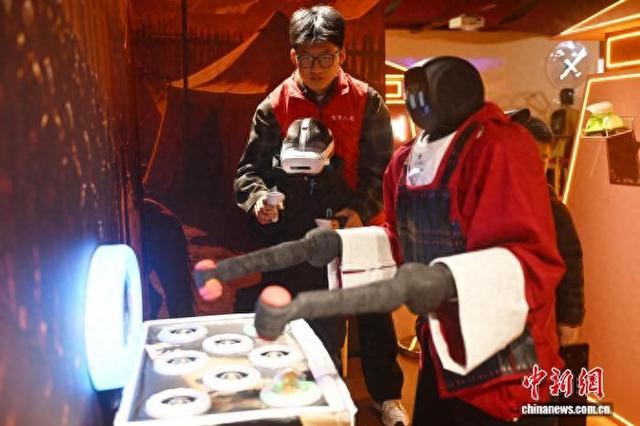
Core Insights - The article highlights the integration of advanced robotics technology with cultural heritage in Lanzhou, Gansu, during the Spring Festival, attracting a significant number of young visitors [1][3]. Group 1: Project Overview - The mobile robot-themed amusement park, created by the Gansu Humanoid Robot Innovation Center in collaboration with local universities and institutions, opened on February 13 and will remain operational until April 30 [1][9]. - The project features a 400-square-meter modular experience space that connects historical landmarks along the Hexi Corridor with modern technology through immersive experiences [3][9]. Group 2: Immersive Experience Zones - The park includes five immersive experience zones, allowing visitors to engage in interactive tasks that blend historical scenarios with robotics, such as controlling robots to simulate ancient transportation and military battles [3][5]. - Specific activities include operating humanoid robots to transport goods at the Yellow River ancient ferry, simulating battles with VR technology, and using robotic arms for wall painting restoration [3][4][7]. Group 3: Educational Impact - The initiative aims to transform theoretical knowledge into practical applications, providing local students with exposure to cutting-edge technology and fostering a deeper understanding of the integration of advanced technology and rich cultural heritage [4][9]. - Feedback from families indicates that the hands-on experiences are more effective for learning than traditional textbook methods, enhancing children's interest in science and culture [7][8]. Group 4: Future Developments - The project is the first of ten planned application scenarios by the center, with future plans to establish a comprehensive facility for science education, technology research, and data collection in the region [9].

上市十年首亏!青岛城市传媒发布2025年业绩预告由盈转亏
Sou Hu Cai Jing· 2026-02-25 05:52
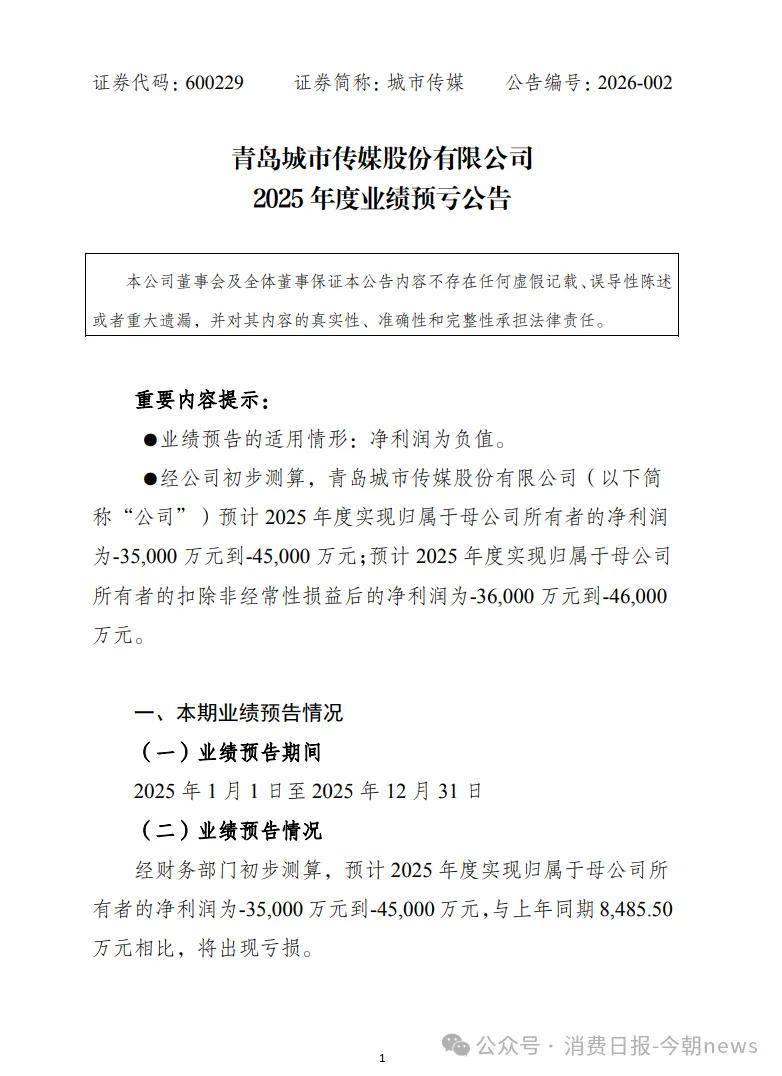
Core Viewpoint - Qingdao Urban Media Co., Ltd. is expected to report a significant loss for the year 2025, marking the first loss since its listing, with projected net profit attributable to shareholders ranging from -350 million to -450 million yuan, compared to a profit of 84.855 million yuan in 2024, indicating a decline of over 430 million yuan [2][5][4]. Group 1: Performance Forecast - The performance forecast period is from January 1, 2025, to December 31, 2025 [3]. - The company anticipates a net profit attributable to shareholders of -350 million to -450 million yuan for 2025, indicating a shift from profit to loss compared to the previous year [3][5]. - The forecasted net profit after deducting non-recurring gains and losses is expected to be -360 million to -460 million yuan [2][5]. Group 2: Financial Performance Analysis - The company reported a revenue of 1.622 billion yuan in the first three quarters of 2025, ranking 8th among 19 companies in the industry, but with a net profit of only 30.635 million yuan, placing it 13th in the industry [6]. - The company experienced a significant decline in profitability, with losses expanding in the fourth quarter, leading to an overall loss for the year [6]. - Despite the anticipated losses, the company's financial structure remains stable, with total assets of 4.216 billion yuan and a debt of 1.04 billion yuan, resulting in a debt-to-asset ratio of 24.68%, which is lower than the industry average of 32.11% [6]. Group 3: Reasons for Loss - The primary reason for the anticipated loss is the pressure on commercial real estate operations, leading to substantial asset impairments, particularly in key properties like Qingdao Urban Media Plaza and Jiaonan Cultural Building [6][7]. - The core educational book business has been severely impacted by the "double reduction" policy, changes in the ordering model, and a decrease in school-age population, resulting in a significant drop in sales [7]. - New business investments and non-operating factors have further exacerbated losses, with ongoing projects in VR/AR and IP development not yet generating stable profits, alongside non-recurring losses from investments in platforms like Himalaya [7].

新春消费新体验!厦门通过AI赋能打造新业态新场景
Sou Hu Cai Jing· 2026-02-18 10:59
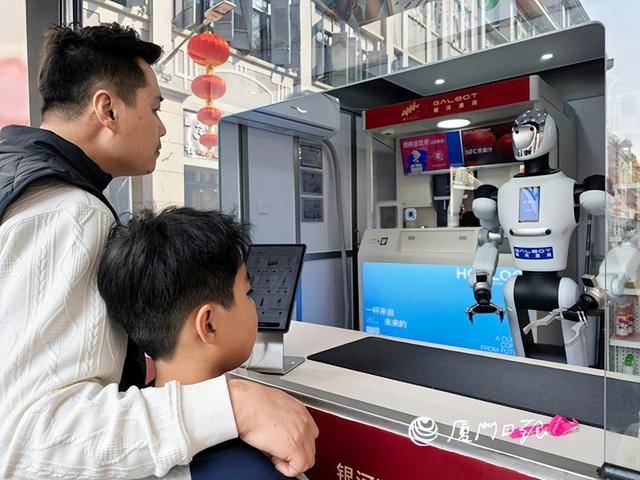
Core Viewpoint - Xiamen is integrating AI technology into daily life, enhancing the traditional experience of the Spring Festival with innovative digital interactions and smart services [1][11]. Group 1: New Business Models - AI robots are being deployed in various sectors, including tourism, retail, and service industries, creating new business models that enhance consumer experiences during the Spring Festival [2][4]. - The introduction of AI-powered guides and service robots in locations like Gulangyu Island provides personalized experiences, from storytelling to food recommendations, ensuring seamless digital tourism [2][4]. - Retail environments are evolving with the presence of robots that handle tasks such as order taking, payment processing, and product delivery, showcasing a new era of automated retail [4][6]. Group 2: New Experiences - The integration of traditional cultural performances with advanced technology, such as AI and robotics, creates immersive experiences that attract visitors and enhance cultural appreciation [7][9]. - Interactive digital experiences, including VR and AR, allow visitors to engage with historical narratives and cultural heritage in innovative ways, transforming traditional tourism into a tech-savvy adventure [9][10]. - Smart shopping experiences are being developed, where AI systems assist customers in navigating malls, recommending stores, and providing real-time support, making shopping more efficient and enjoyable [10]. Group 3: Enhanced Consumer Engagement - The use of AI technology in public spaces, such as smart shopping malls and waterfront attractions, offers consumers a blend of convenience and entertainment, enriching their overall experience [10][11]. - AI-driven services, such as intelligent coffee-making robots and automated customer service, are streamlining operations and enhancing customer satisfaction in retail environments [6][11]. - The combination of cultural events and technological innovations is redefining consumer engagement, making traditional festivities more vibrant and appealing to a tech-savvy audience [7][9].
这个春节,AI很忙
Xin Lang Cai Jing· 2026-02-11 18:46
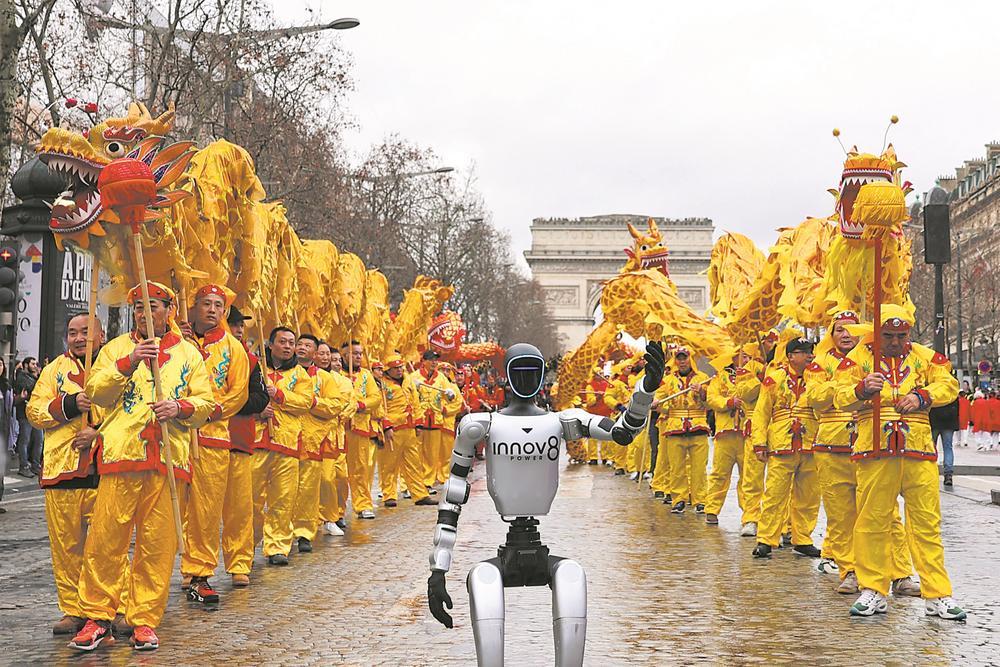
Group 1 - The integration of traditional customs with cutting-edge technology is creating new experiences for the upcoming Year of the Horse Spring Festival, showcasing AI, VR/AR, and big data in cultural activities [2] - Xi'an is leveraging digital technology to enhance historical experiences, with projects like "The Empire Code - Qin Shi Huang's Tomb" using XR technology to allow visitors to interact with virtual historical scenes [2] - The Beijing Technology Temple Fair is upgraded to attract public participation, featuring a "robot party" with over ten leading intelligent companies showcasing various robots performing traditional arts [3] Group 2 - The use of AI and robotics is enhancing travel experiences during the Spring Festival, with innovations like AI digital tour guides and climbing assistance robots in scenic areas [3] - The integration of technology in cultural presentations is accelerating the development of related technologies, preventing cultural dilution and enriching the "cyber Spring Festival" experience [4] - Robots are expected to play a significant role in performances during the Spring Festival Gala, indicating advancements in technology beyond mere entertainment [3][4]
华珠成立微短剧产业学院
Xin Lang Cai Jing· 2026-02-02 00:29
Core Insights - The establishment of the Micro-Short Drama Industry College at South China Agricultural University, Zhujiang College, marks a significant milestone in the integration of education and industry in the Greater Bay Area [1][2] - The college aims to create a complete ecological chain for the micro-short drama industry by leveraging various platforms and resources [1] - The college will focus on innovative talent cultivation, technology empowerment, and building an open ecosystem to support the regional micro-short drama industry [2] Group 1 - The Micro-Short Drama Industry College is the first of its kind in the Greater Bay Area, emphasizing the integration of education and local industry [1] - The college will utilize resources from the "Bay Area International Creator Ecological Valley" and other platforms to enhance cultural industry development in the region [1] - The establishment is seen as a collaboration milestone between the university and local government, highlighting the unique cultural and natural resources of Zhaoqing [1] Group 2 - The college will innovate talent training models by collaborating with leading industry enterprises to create shared internship and training bases [2] - It aims to enhance the application of new technologies such as VR/AR and artificial intelligence in micro-short drama creation [2] - The college plans to host industry forums, professional competitions, and vocational training to contribute to the development of the regional micro-short drama industry [2]
创新怀旧经济,激活体验消费潜力
Xin Lang Cai Jing· 2026-01-21 13:24
Core Insights - The nostalgic economy in China is projected to reach a market size of 355.25 billion yuan in 2025, with a year-on-year growth of 11.7%, and is expected to reach 587.85 billion yuan by 2030 [1] - Nostalgic economy, driven by consumer sentiment, utilizes old items, traditional crafts, and classic IPs to evoke emotional resonance and meet consumers' spiritual needs while also providing practical value and social attributes [1][2] Group 1: Market Trends - The trend of nostalgia has transformed from mere emotional resonance into a significant business opportunity, with young consumers driving this change [2] - Sales of nostalgic products such as retro cameras, old gaming consoles, and nostalgic snacks have seen a 120% year-on-year increase, with 65% of orders coming from the 18 to 35 age group [1] Group 2: Consumer Behavior - In a fast-paced, uncertain world, nostalgia serves as a "psychological anchor," providing a sense of security, continuity, and identity, while experiential consumption translates this abstract comfort into tangible social moments [3] - Nostalgic experiences cater to emotional healing, allowing consumers to reconnect with childhood memories and cultural heritage, thus fulfilling deeper psychological needs [3] Group 3: Challenges and Innovations - The nostalgic economy faces challenges such as inflated prices, severe homogenization, counterfeit goods, and a lack of innovation [4] - To enhance the nostalgic experience, companies should leverage technologies like VR/AR to recreate classic scenes, explore local unique memories, and integrate contemporary aesthetics with retro elements [4]
十年前邮件分歧看Meta元宇宙困局:卡马克 vs 扎克伯格
Sou Hu Cai Jing· 2026-01-20 00:43
Core Insights - Meta's ten-year journey into the metaverse has faced significant challenges, resulting in over $70 billion in losses, layoffs, studio closures, and a strategic pivot towards AI and practical technology initiatives like smart glasses [1][9] - Despite setbacks, the existence of successful VR applications like "Gorilla Tag" and VRChat indicates that real social experiences in virtual reality are achievable, diverging from Meta's grand vision [1][9] Strategic Vision: Divergence Between Leaders - Mark Zuckerberg views VR/AR as the next major computing platform, aiming to reduce Meta's reliance on Apple and Google, while John Carmack emphasizes starting small with high-quality VR applications rather than building a vast ecosystem [2][4] - Zuckerberg's strategic goals include establishing a strong position in the next computing wave, while Carmack warns against the pitfalls of overambitious plans that may not yield immediate user benefits [2][4] Ecosystem Development: Acquisition vs. Collaboration - Zuckerberg argues for acquiring Unity to enhance Meta's VR strategy, believing it crucial for increasing platform service adoption and mitigating risks of being outpaced by competitors [5][6] - In contrast, Carmack advocates for leveraging existing successful companies' work rather than attempting to control all aspects of the ecosystem, suggesting collaboration with established services like Netflix [6][10] Technical Approach: Operating System and Practicality - Zuckerberg acknowledges the need for significant investment in hardware and systems to accelerate VR/AR development, while Carmack opposes the necessity of a proprietary operating system, arguing it could become a burden [7][12] - Carmack emphasizes the importance of focusing on user experience and practical applications rather than abstract technological frameworks [7][12] Cultural Perspective: Innovation vs. User-Centricity - Zuckerberg highlights the importance of innovation for Meta's brand, asserting that success in VR/AR will enhance the company's reputation and attract talent [8][30] - Carmack critiques the company's culture, noting a disconnect between product development and user needs, suggesting that Meta's focus on media over user experience has hindered its progress [8][10] Retrospective Analysis: Lessons from Past Communications - The emails from 2015 foreshadowed Meta's challenges in the metaverse, with Zuckerberg's vision of VR/AR as a dominant platform facing underestimation of technical challenges and timelines [9][10] - Carmack's warnings about the risks of ambitious projects and the need for a user-focused approach have proven prescient, highlighting the importance of practical solutions over grand narratives [9][10]

鲁酒文化大模型建设正式启动
Qi Lu Wan Bao· 2026-01-16 13:24
Group 1 - The "2025 Lu Liquor High-Quality Development Forum and Lu Liquor Classic Inheritance Brand Release" was held on January 15, 2026, in Jinan, marking the official launch of the Lu Liquor Cultural Model, which aims to be the first digital and intelligent cultural model in the liquor industry [1] - The Lu Liquor Cultural Model will systematically promote the protection, excavation, dissemination, and innovative transformation of Lu liquor culture through digital and intelligent means, injecting new momentum into the high-quality development of the core industry [1][2] - The construction of the Lu Liquor Cultural Model includes the establishment of a cultural gene bank, which will consist of five core databases: historical literature, brewing techniques, brand assets, production area ecology, and consumption scenarios, forming a complete "Lu Liquor Cultural Knowledge Brain" [1][2] Group 2 - The model will enable the transformation of static cultural information into a dynamic knowledge system through deep processing and knowledge extraction of vast cultural data, creating a Lu Liquor cultural knowledge graph [2] - The model will enhance cultural content creation by utilizing AIGC capabilities to automatically generate diverse cultural dissemination materials, significantly improving content creation efficiency and richness [2] - The construction of immersive cultural experience scenarios using digital twin and VR/AR technologies will allow users to remotely experience the brewing environment and interactively learn about brand history, greatly expanding the perception and dissemination of Lu liquor culture [2] Group 3 - The model aims to drive value creation and transformation upgrades in the industry by digitizing and modeling core cultural elements such as brewing techniques and flavor systems, providing data-driven decision support for process optimization and new product development [2] - The use of digital humans and intelligent marketing tools will deepen emotional connections with consumers, particularly younger demographics, enhancing brand loyalty and market competitiveness [3] - The establishment of digital archives for non-heritage brewing techniques and VR training systems will ensure the sustainable transmission of traditional skills, while a knowledge-sharing platform will promote collaboration among enterprises, enhancing the overall competitiveness of the Lu liquor industry [3]