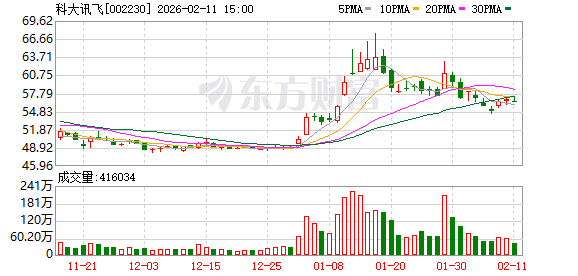
IFLYTEK(002230)

Search documents
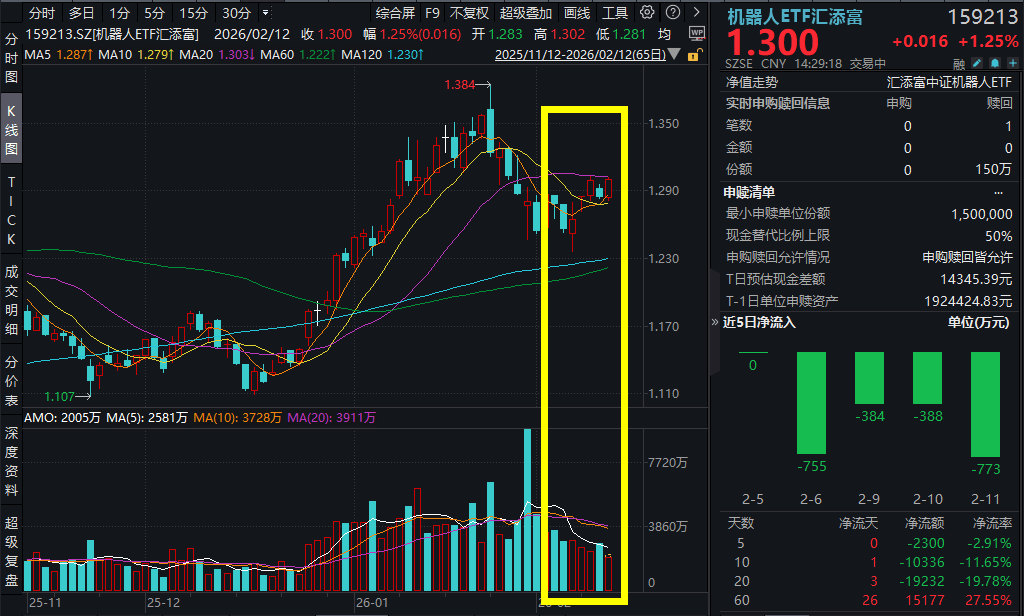
具身智能企业扎堆启动上市,机器人板块走强,大族激光涨超7%,机器人ETF汇添富(159213)反包涨超1%,对比新能源汽车,机器人走到哪了?
Sou Hu Cai Jing· 2026-02-12 06:52
Core Viewpoint - The A-share market is experiencing an upward trend, particularly in the technology sector, with a notable rise in the robotics sector, as evidenced by the performance of the Robotics ETF Huatai-PineBridge (159213) which increased by 1.25% [1] Group 1: Robotics ETF Performance - The Robotics ETF Huatai-PineBridge (159213) has shown a mixed performance among its constituent stocks, with major gains from companies like Dazhu Laser, which rose over 7%, and others like Greentech Harmony and iFlytek, which increased by over 2% [2][3] - The top ten constituent stocks of the Robotics ETF include iFlytek with a 2.21% increase and Dazhu Laser with a 7.33% increase, indicating strong performance in the sector [4] Group 2: Technological Developments - Xiaomi has officially launched and open-sourced its first-generation robotics VLA model, Xiaomi-Robotics-0, which features 4.7 billion parameters and excels in visual language understanding and real-time execution capabilities [5] - Alibaba's DAMO Academy has released the RynnBrain model, which significantly enhances robotic intelligence by introducing spatial reasoning and memory capabilities, outperforming leading models like Google's Gemini Robotics ER 1.5 [5] Group 3: Market Trends and IPO Activity - There is a surge in companies focused on embodied intelligence initiating IPO processes, with three companies already advancing their A-share listings as of February 10 [6] - The robotics industry is compared to the electric vehicle sector, with both undergoing a phase of technological validation and expected to benefit from policy support and market demand [7][8] Group 4: Investment Insights - The investment focus in the humanoid robotics sector is shifting from thematic investments to expectations of mass production, with key milestones anticipated from Tesla's developments in humanoid robots [8] - The industry is expected to see a reduction in the timeline from technology validation to commercial rollout compared to the electric vehicle sector, due to the accumulated resources and capital in the robotics field [8]


AI应用概念股震荡狂飙,涨停龙头领衔,多股跟涨,资金扎堆涌入掀上涨热潮
Jin Rong Jie· 2026-02-12 06:28
Group 1 - The A-share AI application concept stocks are experiencing a strong upward trend, with sectors like AI office, AI healthcare, and industrial AI showing synchronized growth, leading to a positive market sentiment [1] - Key stocks such as Liou Co., Wanxing Technology, Koyuan Wisdom, and Guangyun Technology are performing well, indicating a leading and coordinated market structure [1] - Increased capital allocation towards AI applications is driven by accelerated commercialization, expanding application scenarios, and favorable policies, resulting in a healthy price-volume relationship in the sector [1] Group 2 - Recent government policies are promoting the large-scale implementation of AI applications, elevating the AI industry to a core strategic level for fostering new productive forces [2] - The commercialization of AI applications is accelerating, with market demand on the rise, as evidenced by significant price adjustments in AI products, reflecting an increase in commercial value [2] - The AI application industry is seeing a broad expansion across various sectors, with major companies like Kingsoft Office and iFLYTEK reaching market capitalizations exceeding 100 billion [2] Group 3 - The AI office software sector is experiencing growth, with a reported 28% year-on-year increase in AI office software usage since early 2026, driving demand in the industry [3] - The AI healthcare market is projected to reach 38.5 billion yuan by 2025, with the proliferation of AI applications enhancing the development of medical information technology [3] - The industrial automation sector is benefiting from the integration of AI, with a 19% year-on-year increase in sales of AI inspection equipment since early 2026, indicating a positive trend in demand [3]

全国产算力 科大讯飞发布星火X2大模型
Xin Jing Bao· 2026-02-12 05:00
Group 1 - The core viewpoint of the article highlights the recent launch of the Starfire X2 model by iFLYTEK, marking a significant advancement in domestic AI models in China [2] - The Starfire X2 model represents a comprehensive upgrade in general capabilities compared to its predecessor, the Starfire 1.5 version [2] - Two main highlights of the Starfire X2 include a complete upgrade in general capabilities and significant improvements in product application solutions [2] Group 2 - The Starfire X2 model can operate on a single Ascend server, showcasing its efficiency and accessibility [2]
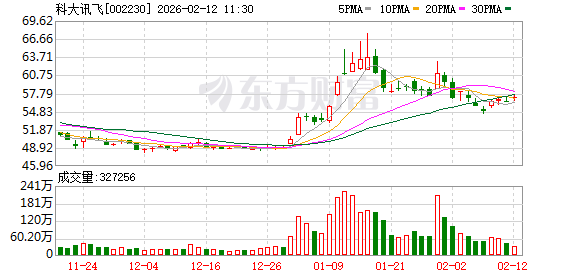
全国产算力,科大讯飞发布星火X2大模型
Xin Jing Bao· 2026-02-12 04:57
Core Viewpoint - The domestic large model market is experiencing a surge in new releases, with iFLYTEK officially launching the Xinghuo X2 model, which is based on fully domestic computing power training [1] Group 1: Company Developments - iFLYTEK has announced the official release of the Xinghuo X2 model on February 11, following the previous version 1.5 of the Xinghuo model [1] - The Xinghuo X2 model features a comprehensive upgrade in general capabilities and significant improvements in product application solutions [1] - The Xinghuo X2 can operate on a single Ascend server through quantization, indicating advancements in efficiency and accessibility [1]
星火X2大模型发布 讯飞医疗(02506)实现硬核升级
Zhi Tong Cai Jing· 2026-02-12 03:40
Core Insights - The launch of the Spark X2 model by iFlytek marks a significant advancement in domestic computing power and capabilities, particularly in AI health services [1] - The Spark X2 model achieves international standards in core competencies such as mathematics, reasoning, and language understanding, with a 50% improvement in inference performance compared to its predecessor [1] - The iFlytek Xiaoyi AI health assistant has accumulated over 180 million AI health consultations, achieving a user satisfaction rate of 98% [2] Group 1: Technological Advancements - The Spark X2 model utilizes a 293B MoE sparse architecture, enabling efficient deployment on domestic platforms and enhancing overall performance [1] - The model's capabilities in multiple languages have improved, maintaining industry leadership in key languages for regions like Latin America and ASEAN [1] - The Spark Medical Model X2 has surpassed competitors like DeepSeek V3.2 in key tasks such as health analysis and report interpretation [1] Group 2: Product Upgrades - The iFlytek Xiaoyi has transitioned from an "AI consultation tool" to an "AI health steward," offering a comprehensive digital health space for users [2] - The upgraded app includes features for multi-round consultations, report interpretation, and chronic disease management, while ensuring user privacy [2] - The "Smart Family Doctor" model enhances the efficiency of grassroots family doctors through intelligent task arrangement and health profiling [2] Group 3: Industry Impact - The upgrade signifies a deeper integration of AI in healthcare, contributing to the construction of a healthier China by improving access to quality medical resources [2]
星火X2大模型发布 讯飞医疗实现硬核升级
Zhi Tong Cai Jing· 2026-02-12 03:34
Core Insights - The launch of the Spark X2 model by iFlytek represents a significant advancement in domestic computing power and capabilities, particularly in the healthcare sector [1][2] - The Spark X2 model achieves international-level performance in core competencies such as mathematics, reasoning, and language understanding, with a 50% improvement in inference performance compared to its predecessor [1] - iFlytek's AI health assistant, iFlytek Xiaoyi, has accumulated over 180 million AI health consultations with a user satisfaction rate of 98%, showcasing its effectiveness and user acceptance [2] Group 1: Spark X2 Model - The Spark X2 model is based on fully domestic computing power training, marking a dual breakthrough in both domestic capabilities and core competencies [1] - The model employs a 293B MoE sparse architecture, enabling efficient deployment on domestic platforms and enhancing overall performance [1] - It has been evaluated by the Shanghai Medical Model Application Testing and Verification Center, receiving an "A" rating in multiple health service tasks, indicating its professional advantages and compliance [1] Group 2: iFlytek Xiaoyi Upgrade - The upgrade of iFlytek Xiaoyi transforms it from an "AI consultation tool" to an "AI health steward," enhancing its service capabilities significantly [2] - The app now supports comprehensive health management for family members, including features like voice interaction, detailed report interpretation, and chronic disease management [2] - The innovative "Smart Family Doctor" model empowers grassroots family doctors, improving service efficiency and enhancing residents' sense of well-being [2]
星火医疗大模型X2正式发布,智能报告解读等关键能力显著超越DeepSeek V3.2、GPT-5.2和Qwen3-Max
Ge Long Hui· 2026-02-12 03:32
Core Viewpoint - The release of the Spark X2 model by iFlytek marks a significant advancement in AI healthcare solutions, showcasing superior performance compared to leading models in the industry [1] Group 1: Model Performance - The Spark X2 model demonstrates significant improvements in key tasks such as intelligent health analysis, report interpretation, dietary and exercise recommendations, diagnostic assistance, and medication review, outperforming DeepSeek V3.2, GPT-5.2, and Qwen3-Max [1] - The model has successfully passed authoritative evaluations from the Shanghai Medical Model Application Testing and Verification Center, establishing its credibility in the healthcare sector [1] Group 2: Service Capabilities - iFlytek's Xiaoyi has undergone a comprehensive upgrade, enhancing its capabilities in multi-turn consultations, medication inquiries, and interpretation of medical reports, maintaining a significant competitive edge in the industry [1] - The transition from "AI consultation tool" to "AI health steward" for end-users signifies a shift towards providing comprehensive health services throughout the care cycle [1] Group 3: Market Impact - The Spark X2 model empowers family doctors in the B-end market, improving the quality and efficiency of grassroots medical services, thereby unlocking practical value for medical AI [1]

OpenAI奥特曼:在ChatGPT中更新了GPT-5.2;全球首款仓储通用人形机器人发布丨AIGC日报
创业邦· 2026-02-12 00:28
Group 1 - OpenAI has updated ChatGPT with the release of GPT-5.2, aiming for slight improvements in user experience [2] - NetEase Youdao has launched a desktop-level personal assistant called "LobsterAI," designed to operate 24/7 and support both mobile and PC interactions [2] - iFlytek has officially released the Xinghuo X2 model, which boasts significant upgrades in general capabilities, matching international top models in areas like mathematics and language understanding [2] Group 2 - The world's first general-purpose humanoid robot for warehousing, Gino 1, has been launched by Geekplus, designed to handle various tasks in warehouse operations [2]


胖东来创始人于东来年后退休;雷军:初代SU7正式停产;拓竹科技年终奖总额增超50%,最高奖金超200万;xAI两位联合创始人离职 丨邦早报
创业邦· 2026-02-12 00:28
Core Insights - The article discusses various significant corporate announcements and developments, including leadership changes, financial results, and strategic initiatives across multiple industries. Group 1: Leadership Changes - The founder of Pang Donglai, Yu Donglai, announced his retirement effective after the Lunar New Year, transitioning to an advisory role with decision-making now handled by a committee [2] - Two co-founders of xAI, Jimmy Ba and Wu Yuhua, have left the company, marking a significant talent drain as six out of twelve co-founders have departed since its inception [6][6] Group 2: Financial Performance - NetEase reported a total revenue of 112.6 billion yuan for 2025, with R&D investment reaching 17.7 billion yuan, marking six consecutive years of over 10 billion yuan in R&D [11] - Heineken announced a global workforce reduction of 5,000 to 6,000 employees and lowered its 2026 operating profit growth forecast to 2% to 6%, down from a previous estimate of 4% to 8% [13] - Yonghui Supermarket's CEO reflected on past mistakes in prioritizing scale over quality, announcing plans to close nearly 400 low-quality stores and distribute nearly 50 million yuan in profit sharing to employees in 2025 [10] Group 3: Strategic Initiatives and Investments - Meta plans to invest over $10 billion in a new data center in Indiana, which will create approximately 4,000 construction jobs and over 300 operational positions [10] - Zhiran Medical completed a 300 million yuan A+ round of financing to advance large-scale clinical trials and product iterations in brain-machine interface technology [14] - Runway, an AI video generation startup, raised $315 million in E round financing, bringing its valuation to approximately $5.3 billion, with plans to accelerate the development of next-generation models [15] Group 4: Market Developments - The global gaming market saw player spending reach $7.1 billion in January, with "Honor of Kings" topping the revenue charts [20] - In January, China's power battery installation volume was 42.0 GWh, showing a year-on-year increase of 8.4% despite a month-on-month decline [20]



科大讯飞发布星火X2大模型
Zheng Quan Ri Bao· 2026-02-11 16:35
Core Viewpoint - The launch of the Xinghuo X2 model by iFlytek represents a significant advancement in the domestic large model industry, transitioning from "independent research and development" to "practical application" [2][3] Group 1: Product Development - The Xinghuo X2 model has achieved a comprehensive upgrade in general capabilities and will focus on high-specialty and high-experience scenarios such as education, healthcare, automotive, and intelligent agents [2] - Since the debut of the Xinghuo cognitive model V1.0 in 2023, iFlytek has maintained a rapid iteration pace, with each upgrade focusing on technological breakthroughs and scene adaptation [2] Group 2: Industry Impact - The continuous iteration and implementation of the Xinghuo X2 model are expected to not only upgrade iFlytek's own business but also lead the domestic large model industry towards "independence, practicality, and scalability" [3] - According to the "China Large Model Bidding Project Monitoring and Insight Report (2025)," iFlytek is projected to achieve the highest number and amount of bids in the industry for large model-related projects, with a bid amount reaching 2.316 billion yuan [3]