
Lepu Medical(300003)

Search documents
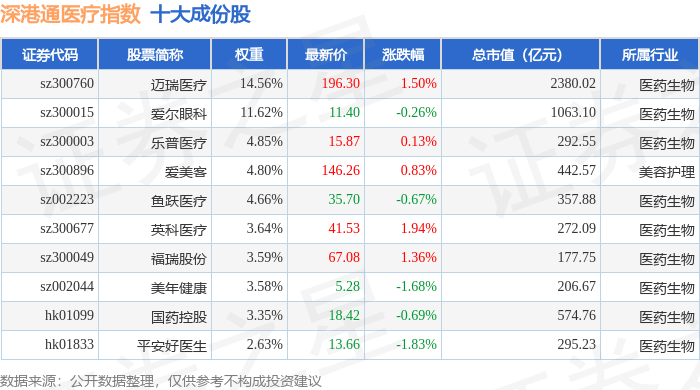
11月27日深港通医疗(983035)指数涨0.15%,成份股医脉通(02192)领涨
Sou Hu Cai Jing· 2025-11-27 11:10
Core Points - The Shenzhen-Hong Kong Medical Index (983035) closed at 4494.42 points, up 0.15%, with a trading volume of 7.52 billion yuan and a turnover rate of 0.75% [1] - Among the index constituents, 32 stocks rose while 24 fell, with Medical Pulse leading the gainers at 3.65% and Health Road leading the decliners at 3.41% [1] Index Constituents Summary - The top ten constituents of the Shenzhen-Hong Kong Medical Index include: - Mindray Medical (14.56% weight, latest price 196.30 yuan, market cap 238 billion yuan, up 1.50%) [1] - Yier Eye Hospital (11.62% weight, latest price 11.40 yuan, market cap 106.31 billion yuan, down 0.26%) [1] - Lejin Medical (4.85% weight, latest price 15.87 yuan, market cap 29.26 billion yuan, up 0.13%) [1] - Aimeike (4.80% weight, latest price 146.26 yuan, market cap 44.26 billion yuan, up 0.83%) [1] - Yuyue Medical (4.66% weight, latest price 35.70 yuan, market cap 35.79 billion yuan, down 0.67%) [1] - Yingke Medical (3.64% weight, latest price 41.53 yuan, market cap 27.21 billion yuan, up 1.94%) [1] - Furuide (3.59% weight, latest price 67.08 yuan, market cap 17.78 billion yuan, up 1.36%) [1] - Meinian Health (3.58% weight, latest price 5.28 yuan, market cap 20.67 billion yuan, down 1.68%) [1] - Sinopharm (3.35% weight, latest price 18.42 yuan, market cap 57.48 billion yuan, down 0.69%) [1] - Ping An Good Doctor (2.63% weight, latest price 13.66 yuan, market cap 29.52 billion yuan, down 1.83%) [1] Capital Flow Analysis - The net outflow of main funds from the index constituents totaled 58.83 million yuan, while retail investors saw a net inflow of 78.07 million yuan [1] - Specific stock capital flows include: - Aimeike: Main fund net inflow of 46.99 million yuan, retail net outflow of 30.07 million yuan [2] - Mindray Medical: Main fund net inflow of 33.08 million yuan, retail net outflow of 17.11 million yuan [2] - Furuide: Main fund net inflow of 13.68 million yuan, retail net outflow of 19.08 million yuan [2] Recent Adjustments - The Shenzhen-Hong Kong Medical Index has undergone adjustments in the last 10 days, with one new stock added [2]




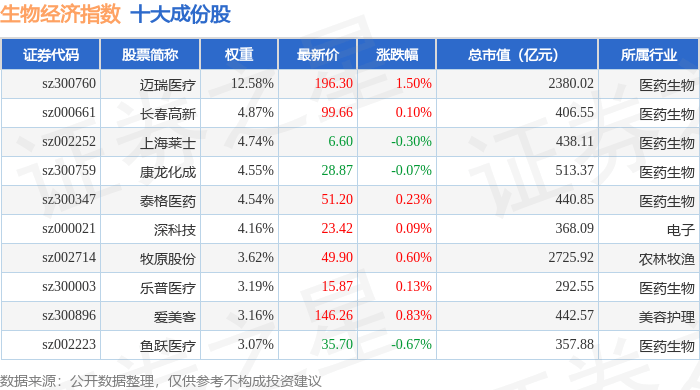
11月27日生物经济(970038)指数跌0.06%,成份股京新药业(002020)领跌
Sou Hu Cai Jing· 2025-11-27 10:52
Core Points - The Biotech Index (970038) closed at 2134.66 points, down 0.06%, with a trading volume of 13.045 billion yuan and a turnover rate of 0.95% [1] - Among the index constituents, 22 stocks rose while 27 fell, with Hualan Vaccine leading the gainers at 2.57% and Jingxin Pharmaceutical leading the decliners at 5.97% [1] Index Constituents Summary - The top ten constituents of the Biotech Index include: - Mindray Medical (12.58% weight, latest price 196.30 yuan, market cap 238 billion yuan) [1] - Changchun High-tech (4.87% weight, latest price 99.66 yuan, market cap 40.655 billion yuan) [1] - Shimi Aoshi (4.74% weight, latest price 6.60 yuan, market cap 4.3811 billion yuan) [1] - Kanglong Chemical (4.55% weight, latest price 28.87 yuan, market cap 51.337 billion yuan) [1] - Tigermed (4.54% weight, latest price 51.20 yuan, market cap 44.085 billion yuan) [1] - Deep Technology (4.16% weight, latest price 23.42 yuan, market cap 36.809 billion yuan) [1] - Muyuan Food (3.62% weight, latest price 49.90 yuan, market cap 272.592 billion yuan) [1] - Lepu Medical (3.19% weight, latest price 15.87 yuan, market cap 29.255 billion yuan) [1] - Aimeike (3.16% weight, latest price 146.26 yuan, market cap 44.257 billion yuan) [1] - Seeyou Medical (3.07% weight, latest price 35.70 yuan, market cap 35.788 billion yuan) [1] Capital Flow Analysis - The Biotech Index constituents experienced a net outflow of 84.2481 million yuan from institutional investors, while retail investors saw a net inflow of 67.1618 million yuan [1] - Notable capital flows include: - Muyuan Food: 104 million yuan net inflow from institutional investors, but net outflows from retail and speculative investors [2] - Aimeike: 46.9918 million yuan net inflow from institutional investors, with outflows from retail and speculative investors [2] - Mindray Medical: 33.0761 million yuan net inflow from institutional investors, with outflows from retail and speculative investors [2]



研报掘金丨国盛证券:维持乐普医疗“买入”评级,创新业务是公司未来增长极
Ge Long Hui A P P· 2025-11-27 05:48
Core Insights - The report from Guosheng Securities highlights that Lepu Medical's innovative business segment is making significant progress with product approvals and external collaborations, focusing on neuromodulation, innovative drugs, and medical aesthetics as new growth drivers [1] Neuromodulation - The rechargeable implantable deep brain stimulation system has received NMPA approval, marking a key advancement in the neuromodulation sector [1] Innovative Drugs - Lepu Medical has licensed the MWN105 injection to Danish company Sidera for a fee, receiving an initial investment and milestone payments totaling $35 million. Future milestone payments could reach up to $1.01 billion based on clinical development and commercialization sales [1] Medical Aesthetics - The company has received approvals for its Tongyan injection and sodium hyaluronate solution, and has established a strategic partnership with Meituan to enhance product distribution [1] Future Growth Potential - The report suggests that the impact of policies is gradually diminishing, and new businesses like medical aesthetics are in a rapid growth phase, positioning the innovative segment as a key driver for the company's future growth [1]

朝闻国盛:全球AIPCB龙头厂商,深度拥抱GPU+ASIC头部客户
GOLDEN SUN SECURITIES· 2025-11-27 00:49
Group 1: Core Insights - The report highlights Shenghong Technology (300476.SZ) as a leading global AI PCB manufacturer, emphasizing its deep engagement with top GPU and ASIC clients [15][16][18] - The company has achieved significant advancements in HDI technology, being one of the first to mass-produce 6-layer 24-layer HDI products and is actively developing next-generation 10-layer 30-layer HDI technology [16] - Shenghong Technology is expanding its production capacity both domestically and internationally, with ongoing projects in Thailand and Vietnam, and is enhancing its collaboration with major clients to align with their R&D and production schedules [17] Group 2: Financial Projections - The revenue forecast for Shenghong Technology is projected to reach 370 billion and 599 billion yuan in 2026 and 2027, respectively, with expected net profits of 120 billion and 197 billion yuan [18] - The company is expected to benefit from the increasing value of PCBs in AI servers, which will further strengthen its competitive position in the market [16][18] Group 3: Industry Context - The report notes that the AI sector is experiencing rapid growth, with significant investments from major players like Google, which has increased its capital expenditure guidance for the year [15] - The demand for advanced PCB technology is rising in line with the growth of AI applications, positioning Shenghong Technology favorably within this expanding market [15][16]



乐普医疗涨2.09%,成交额8673.95万元,主力资金净流入376.47万元
Xin Lang Cai Jing· 2025-11-26 02:28
Core Viewpoint - Lepu Medical has shown a significant increase in stock price and revenue growth, indicating a positive market sentiment and operational performance in the medical device sector [1][2]. Group 1: Stock Performance - On November 26, Lepu Medical's stock rose by 2.09%, reaching 16.13 CNY per share, with a trading volume of 86.74 million CNY and a turnover rate of 0.34%, resulting in a total market capitalization of 29.73 billion CNY [1]. - Year-to-date, Lepu Medical's stock price has increased by 46.00%, with a slight increase of 0.12% over the last five trading days, but a decline of 8.61% over the last 20 days and 18.90% over the last 60 days [1]. - The company has appeared on the "Dragon and Tiger List" once this year, with a net buy of 29.56 million CNY on June 4, accounting for 9.42% of total trading volume [1]. Group 2: Business Overview - Lepu Medical, established on June 11, 1999, and listed on October 30, 2009, is based in Changping District, Beijing, and operates in the medical device sector, including cardiac treatment products, new interventional therapies, in vitro diagnostic reagents, and medical product distribution [2]. - The company's revenue composition includes 52.72% from medical devices, 33.16% from pharmaceuticals, and 14.11% from medical services and health management [2]. - Lepu Medical is categorized under the pharmaceutical and biological industry, specifically in medical devices and consumables, with involvement in concepts such as brain engineering, blood oxygen monitors, artificial intelligence, smart healthcare, and innovative drugs [2]. Group 3: Financial Performance - For the period from January to September 2025, Lepu Medical reported a revenue of 4.939 billion CNY, reflecting a year-on-year growth of 3.20%, while the net profit attributable to shareholders was 982 million CNY, representing a year-on-year increase of 22.35% [2]. - Since its A-share listing, Lepu Medical has distributed a total of 4.957 billion CNY in dividends, with 2.058 billion CNY distributed over the past three years [3]. Group 4: Shareholder Information - As of September 30, 2025, Lepu Medical had 82,900 shareholders, a decrease of 17.13% from the previous period, with an average of 19,490 circulating shares per shareholder, an increase of 20.67% [2]. - The top ten circulating shareholders include notable entities such as Huabao Zhongzheng Medical ETF and Hong Kong Central Clearing Limited, with varying changes in their holdings compared to the previous period [3].
乐普医疗涨2.06%,成交额1.53亿元,主力资金净流出1117.39万元
Xin Lang Cai Jing· 2025-11-24 05:51
Core Viewpoint - Lepu Medical's stock price has shown a year-to-date increase of 43.28%, but has recently experienced declines over various trading periods, indicating potential volatility in the market [1][2]. Group 1: Stock Performance - On November 24, Lepu Medical's stock rose by 2.06%, reaching a price of 15.83 CNY per share, with a trading volume of 1.53 billion CNY and a turnover rate of 0.62%, resulting in a total market capitalization of 29.181 billion CNY [1]. - The stock has seen a net outflow of 11.1739 million CNY from major funds, with significant selling pressure observed [1]. - Year-to-date, the stock has increased by 43.28%, but has declined by 3.00% over the last five trading days, 11.02% over the last 20 days, and 12.06% over the last 60 days [1]. Group 2: Company Overview - Lepu Medical, established on June 11, 1999, and listed on October 30, 2009, is based in Changping District, Beijing, and operates in the medical device sector, including cardiac treatment products, in vitro diagnostic reagents, and medical services [2]. - The company's revenue composition includes 52.72% from medical devices, 33.16% from pharmaceuticals, and 14.11% from medical services and health management [2]. - Lepu Medical is categorized under the pharmaceutical and biological industry, specifically in medical devices and consumables, and is involved in various innovative sectors such as brain-machine interfaces and smart healthcare [2]. Group 3: Financial Performance - For the period from January to September 2025, Lepu Medical reported a revenue of 4.939 billion CNY, reflecting a year-on-year growth of 3.20%, while the net profit attributable to shareholders was 982 million CNY, marking a 22.35% increase [2]. - The company has distributed a total of 4.957 billion CNY in dividends since its A-share listing, with 2.058 billion CNY distributed over the past three years [3]. - As of September 30, 2025, Lepu Medical had 82,900 shareholders, a decrease of 17.13% from the previous period, with an average of 19,490 circulating shares per shareholder, an increase of 20.67% [2].
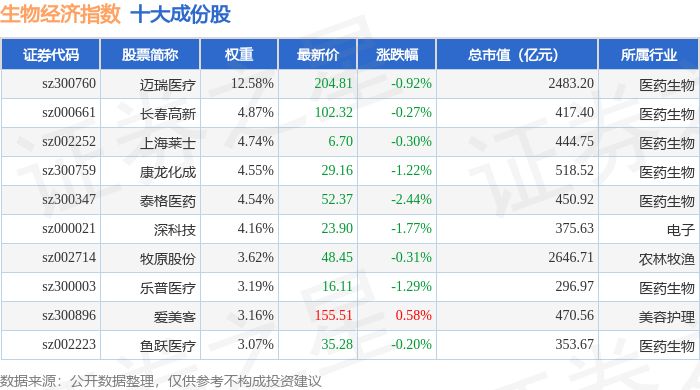
11月19日生物经济(970038)指数跌0.94%,成份股华兰疫苗(301207)领跌
Sou Hu Cai Jing· 2025-11-19 10:23
Core Insights - The Biotech Index (970038) closed at 2182.31 points, down 0.94%, with a trading volume of 13.462 billion yuan and a turnover rate of 1.08% [1] - Among the index constituents, 7 stocks rose while 42 stocks fell, with Xinlitai leading the gainers at 0.83% and Hualan Biological leading the decliners at 5.98% [1] Index Constituents Summary - The top ten constituents of the Biotech Index include: - Mindray Medical (sz300760) with a weight of 12.58%, latest price at 204.81, and a decline of 0.92% [1] - Changchun High-tech (sz000661) with a weight of 4.87%, latest price at 102.32, and a decline of 0.27% [1] - Shimeiao (sz002252) with a weight of 4.74%, latest price at 6.70, and a decline of 0.30% [1] - Kanglong Chemical (sz300759) with a weight of 4.55%, latest price at 29.16, and a decline of 1.22% [1] - Tigermed (sz300347) with a weight of 4.54%, latest price at 52.37, and a decline of 2.44% [1] - Shenzhen Technology (sz000021) with a weight of 4.16%, latest price at 23.90, and a decline of 1.77% [1] - Muyuan Foods (sz002714) with a weight of 3.62%, latest price at 48.45, and a decline of 0.31% [1] - Lepu Medical (sz300003) with a weight of 3.19%, latest price at 16.11, and a decline of 1.29% [1] - Aimeike (sz300896) with a weight of 3.16%, latest price at 155.51, and an increase of 0.58% [1] - Yuyue Medical (sz002223) with a weight of 3.07%, latest price at 35.28, and a decline of 0.20% [1] Capital Flow Analysis - The Biotech Index constituents experienced a net outflow of 1.382 billion yuan from major funds, while retail investors saw a net inflow of 1.358 billion yuan [1] - Notable capital flows include: - Aimeike (sz300896) had a net inflow of 26.5772 million yuan from major funds, but a net outflow from retail investors of 20.4422 million yuan [2] - Changchun High-tech (sz000661) saw a net inflow of 8.8418 million yuan from major funds, with a slight net inflow from retail investors of 186.25 thousand yuan [2] - Other stocks like Furuisi (sz300049) and Yuyue Medical (sz002223) also showed mixed capital flows with significant net outflows from retail investors [2]



HTI医药 2025年11月第二周周报:行业高景气,持续推荐创新药械产业链-20251117
Haitong Securities International· 2025-11-17 09:40
Investment Rating - The report continues to recommend the innovative drug and medical device industry chain, indicating a high level of investment interest in this sector [1][5]. Core Views - The report highlights the high prosperity in innovative drugs, suggesting potential value revaluation for companies such as Jiangsu Heng Rui Medicine, Hansoh Pharmaceutical Group, 3SBio, Sichuan Kelun Pharmaceutical, and Jiangsu Nhwa Pharmaceutical [2][5]. - It emphasizes the importance of Biopharma/Biotech companies with innovative pipelines and performance entering a volume increase phase, including Innovent Biologics, BeiGene, and others [2][5]. - The report also points out the recovery potential for leading medical equipment companies like United Imaging Healthcare, Lepu Medical, and others [2][5]. Summary by Sections A-Shares Performance - In the second week of November 2025, the A-Shares pharmaceutical sector outperformed, with the SW Pharmaceutical and Biological index rising by 3.3% while the SHCOMP fell by 0.2% [2][30]. - The pharmaceutical commerce, chemical raw materials, and chemical preparations sub-sectors showed strong performance, with increases of 5.7%, 5.1%, and 4.4% respectively [2][30]. - Notable stock gains included GDK (+61.6%), HPGC Renmintongtai Pharmaceutical Corporation (+61.1%), and Chengda Pharmaceuticals Co., Ltd. (+58.3%) [2][30]. Hong Kong and U.S. Market Performance - The Hong Kong pharmaceutical sector also outperformed, with the Hang Seng Healthcare index increasing by 6.8% and the Hong Kong Biotechnology index by 7.1% [2][31]. - In the U.S., the S&P Healthcare Select Sector rose by 3.9%, significantly outperforming the S&P 500, which only increased by 0.1% [2][32]. Valuation Metrics - As of November 14, 2025, the premium level of the pharmaceutical sector relative to all A-Shares is at a normal level, with a current relative premium rate of 77.0% [2][15]. - The report provides earnings forecasts and valuation metrics for various companies, indicating expected growth rates and price-to-earnings ratios for the coming years [6][7].



乐普医疗:选举产生第六届董事会职工代表董事
Zheng Quan Ri Bao Wang· 2025-11-10 14:11
Core Viewpoint - Lepu Medical announced the election of Ms. Pu Fei as the employee representative director of the sixth board of directors during the employee representative conference held on November 10, 2025 [1] Group 1 - The employee representative conference was held on November 10, 2025 [1] - The election of Ms. Pu Fei was unanimously approved by the attending employee representatives [1]
乐普医疗(300003) - 北京市中伦律师事务所关于公司2025年第二次临时股东大会的法律意见书
2025-11-10 10:22
法律意见书 北京市中伦律师事务所 关于乐普(北京)医疗器械股份有限公司 2025 年第二次临时股东大会的 法律意见书 致:乐普(北京)医疗器械股份有限公司 北京市中伦律师事务所(以下简称"本所")作为乐普(北京)医疗器械股 份有限公司(以下简称"公司")的常年法律顾问,受公司委托,指派律师出席 公司2025年第二次临时股东大会(以下简称"本次股东大会")。本所律师根据 《中华人民共和国公司法》(以下简称"《公司法》")、《中华人民共和国证 券法》(以下简称"《证券法》")》《上市公司股东会规则》等相关法律、法 规、规范性文件及《乐普(北京)医疗器械股份有限公司章程》(以下简称"《公 司章程》")的规定,对本次股东大会进行见证并出具法律意见。 1 法律意见书 即其已提供了本所律师认为作为出具本法律意见书所必需的材料,所提供的原始 材料、副本、复印件等材料、口头证言均符合真实、准确、完整的要求,有关副 本、复印件等材料与原始材料一致。 在本法律意见书中,本所律师仅对本次股东大会的召集、召开程序、出席本 次股东大会人员和召集人的资格、会议表决程序及表决结果是否符合《公司法》 等法律、法规、规范性文件及《公司章程》的 ...