Adobe(ADBE)

Search documents
Evaluating Adobe Against Peers In Software Industry - Adobe (NASDAQ:ADBE)
Benzinga· 2025-12-09 15:01
Core Insights - The article provides a comprehensive analysis of Adobe's performance in the Software industry, comparing it with major competitors to identify potential investment opportunities and risks [1] Company Overview - Adobe specializes in content creation, document management, and digital marketing software and services, operating through three segments: digital media content creation, digital experience for marketing solutions, and publishing for legacy products [2] Financial Metrics Comparison - Adobe's Price to Earnings (P/E) ratio is 21.14, which is lower than the industry average by 0.2x, indicating potential value [3] - The Price to Book (P/B) ratio of 12.06 is 0.6x the industry average, suggesting potential undervaluation [3] - Adobe's Price to Sales (P/S) ratio is 6.34, which is 0.27x the industry average, indicating possible undervaluation based on sales performance [3] - The Return on Equity (ROE) of 15.26% is 7.36% above the industry average, highlighting efficient use of equity to generate profits [3] Profitability and Growth - Adobe's EBITDA stands at $2.46 billion, which is 2.48x above the industry average, demonstrating stronger profitability and robust cash flow generation [7] - The gross profit of $5.35 billion is 2.96x above the industry average, indicating stronger profitability from core operations [7] - Revenue growth of 10.72% is significantly below the industry average of 22.05%, suggesting challenges in increasing sales volume [7] Debt-to-Equity Ratio - Adobe's debt-to-equity (D/E) ratio is 0.56, placing it in a middle position among its top 4 peers, indicating a relatively balanced financial structure [10] - The D/E ratio allows for a concise evaluation of Adobe's financial health and risk profile compared to its peers [8]



Adobe Q4 2025 Earnings Preview: Rising forecasts amid strong AI momentum (NASDAQ:ADBE)
Seeking Alpha· 2025-12-09 15:00
To ensure this doesn’t happen in the future, please enable Javascript and cookies in your browser.If you have an ad-blocker enabled you may be blocked from proceeding. Please disable your ad-blocker and refresh. ...

Buy 5 AI Laggards of 2025 to Tap Their Growth Potential in 2026
ZACKS· 2025-12-09 14:26
Core Insights - The AI-driven bull run of 2023 and 2024 continues into 2025, with AI-centric stocks poised for significant growth [1] Group 1: AI Stocks with Growth Potential - Several AI stocks have experienced double-digit negative returns in 2025, but five stocks with favorable Zacks Ranks show potential for growth [2] - The identified stocks are Marvell Technology Inc. (MRVL), Atlassian Corp. (TEAM), Adobe Inc. (ADBE), Workday Inc. (WDAY), and Snap Inc. (SNAP), all carrying Zacks Rank 1 (Strong Buy) or 2 (Buy) [3] Group 2: Marvell Technology Inc. (MRVL) - MRVL is a key player in the solid-state drive controllers market, benefiting from increasing demand due to growing data volumes [6] - In Q3 fiscal 2026, MRVL's revenues grew 36.8% year-over-year, driven by data center growth and recovery in enterprise networking [7] - MRVL's acquisition of Celestial AI, expected to close in Q1 fiscal 2027, will enhance its capabilities in optical interconnect technology [8] - The expected revenue and earnings growth rates for MRVL are 21.7% and 25.7%, respectively, for the next year [8] Group 3: Atlassian Corp. (TEAM) - TEAM is benefiting from the demand for remote working tools, with over 1 million monthly active users engaging with its AI features, a 25X year-over-year increase [11] - The company's focus on generative AI features is expected to drive long-term revenue growth [13] - Atlassian has an expected revenue and earnings growth rate of 20.8% and 29.4%, respectively, for the current year [14] Group 4: Adobe Inc. (ADBE) - ADBE has integrated AI applications across its products, including the introduction of generative AI-driven Adobe Firefly [15] - The company is diversifying into digital marketing services using its AI-driven cloud platform [16] - ADBE's expected revenue and earnings growth rates are 9.2% and 13.3%, respectively, for the current year [18] Group 5: Workday Inc. (WDAY) - WDAY's diversified product portfolio and cloud-based business model are key growth drivers, with strong customer wins across various sectors [19] - Significant investment from Elliott Investment Management is expected to drive innovation and AI integration [20] - WDAY has an expected revenue and earnings growth rate of 12.1% and 17.4%, respectively, for next year [21] Group 6: Snap Inc. (SNAP) - SNAP's integration of AI is transforming user interaction and creating monetization opportunities beyond traditional advertising [22] - The partnership with Perplexity will generate $400 million over one year, enhancing SNAP's AI capabilities [23] - SNAP has an expected revenue and earnings growth rate of 13.4% and 52.3%, respectively, for next year [25]



Options Corner: ADBE "Vast Underperformer" Into Earnings
Youtube· 2025-12-09 14:15
Time now for Options Corner. Joining us to take a deeper look at this chart is Rick Dukat, lead market technician here on Schwab Network. Rick, this has been an underperformer this year.So, it's disappointing for investors. What trends are you paying attention to. >> An underperformer to say the least.You know, Adobe down 38% on the year versus XLK, the tech sector ETF up 23%. So, uh a vast underperformer and really this whole software sector is is quite troubled here. This is the uh index for the S&P softw ...

Is Adobe Stock A Better Pick Over Salesforce Stock?
Forbes· 2025-12-09 12:10
Core Insights - Salesforce's shares increased by approximately 13% following a strong Q3 fiscal 2026 earnings report, which included an earnings surprise and an updated revenue forecast [2] - Adobe's stock rose by 10% ahead of its Q4 fiscal 2025 earnings report, driven by optimistic analyst projections for revenue and earnings [2] - Both companies are experiencing positive sentiment from institutional investors, anticipating potential earnings surprises [2] Financial Comparison - Adobe's quarterly revenue growth was reported at 10.7%, compared to Salesforce's 8.6% [9] - Over the last 12 months, Adobe's revenue growth also stood at 10.7%, surpassing Salesforce's 8.4% [9] - Adobe demonstrated superior profitability with a margin of 36.2% for the last twelve months and a three-year average margin of 35.4% [9] Investment Considerations - There is a debate regarding which stock presents a better value, with some analysts suggesting that Adobe may offer a more attractive investment opportunity compared to Salesforce [3][4] - A side-by-side comparison of critical fundamental metrics indicates that Adobe is more favorably positioned relative to Salesforce [4]


Adobe财报前瞻:目前“最佳”的机会
Xin Lang Cai Jing· 2025-12-09 11:22
Core Viewpoint - Both Adobe and Salesforce have lost favor on Wall Street, yet their fundamentals continue to strengthen, presenting a potential investment opportunity or indicating a decline not yet reflected in financial data [1] Company Overview - Adobe is set to release its Q4 FY2025 earnings report on December 10, which will provide insights into its performance and future expectations [1] - The company has transitioned to a subscription-based model, with nearly 97% of its revenue coming from subscriptions [1] - Adobe's operations are divided into three main segments: Digital Media (approximately 74% of total revenue), Digital Experience (25%), and Publishing & Advertising (1%) [1] Financial Performance - For FY2024, Adobe reported a revenue of $21.5 billion and aims for a target of at least $23.65 billion for FY2025 [2] - The company anticipates its first quarter revenue to exceed $6 billion, with a projected net profit margin over 30% and an EPS range of $16.53 to $16.58 [2] - Adobe's revenue guidance has been consistently raised throughout the year, indicating strong growth prospects [5] Growth Metrics - Adobe's core financial indicators have shown steady improvement over the past decade, with no signs of adverse impacts from AI on its business [6] - From FY2021 to FY2024, Adobe's product revenue has grown at an average annual rate of at least 12%, with Document Cloud experiencing a compound annual growth rate of 23% [6] Market Perception and AI Integration - Concerns about AI negatively impacting Adobe's business appear exaggerated, as the management emphasizes that AI presents significant growth opportunities [9][10] - Adobe is integrating AI deeply into its core products, enhancing user experience and maintaining high-quality tools for professional users [10] - The company has reported that over $5 billion of its annual revenue is driven by AI technology, up from an estimated $3.5 billion a year ago [12] Customer Retention and Ecosystem - Adobe has not experienced user attrition; instead, customer retention rates are improving, driven by the integration of AI into its products [12] - The introduction of intelligent workflows has increased user engagement within Adobe's ecosystem, with 70% of eligible customers utilizing the AI assistant feature [11] Valuation and Stock Buyback - Adobe's current P/E ratio stands at 20, with a forward PEG ratio of 1.16, indicating a potentially undervalued position in the tech sector [12] - The company has been actively repurchasing shares, with a total buyback of nearly $12 billion over the past four quarters, reflecting confidence in its valuation [14] Future Outlook - If Adobe maintains a 12% net profit growth rate, its forward P/E could decrease to 14.9 by 2026, suggesting a valuation more typical of industrial firms despite its tech giant profitability [13] - Analysts believe that Adobe's narrative may shift positively, similar to Google's recent market performance, potentially leading to significant returns for investors [16][17]
Adobe Inc. (NASDAQ: ADBE) Quarterly Earnings Forecast and Strategic Moves
Financial Modeling Prep· 2025-12-09 11:00
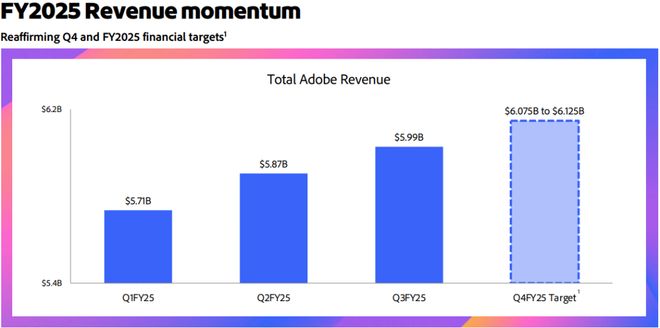
Core Insights - Adobe Inc. is set to report its quarterly earnings on December 10, 2025, with analysts predicting an EPS of $5.39 and revenue of approximately $6.11 billion, marking its first $6 billion quarter [1][6] - The company is experiencing improved retention and accelerated enterprise adoption, indicating strengthening fundamentals despite a 27% drop in stock year-to-date [2] - Adobe's acquisition of Semrush for $1.9 billion aims to enhance its marketing tools and competitive position in the Creative Cloud market [3][6] Financial Metrics - Adobe's financial metrics show a P/E ratio of approximately 20.91, a price-to-sales ratio of about 6.12, and an enterprise value to sales ratio of roughly 6.20 [5][6] - The company's earnings yield is approximately 4.78%, and its debt-to-equity ratio stands at about 0.56, indicating a moderate level of debt [5] - Adobe has a current ratio of approximately 1.02, suggesting a slightly higher level of current assets compared to current liabilities [5] Market Position and Analyst Sentiment - Analysts have noted that Adobe's valuation multiples have decreased to levels typical of industrial sectors, making it potentially the most undervalued opportunity in the big tech sector [2] - Some analysts remain optimistic, labeling Adobe a "Strong Buy" due to resilient revenue and low valuation multiples for a SaaS leader, with potential for growth driven by generative AI and Firefly [4] - Citi has adjusted its price target for Adobe to $366, citing potential margin pressure from costs associated with AI and third-party large language models [3]
Adobe财报前瞻:目前“最佳”的机会
美股研究社· 2025-12-09 10:53
Core Viewpoint - Both Adobe and Salesforce have lost favor on Wall Street, yet their fundamentals continue to strengthen, presenting a dilemma: they could either be the most attractive stocks in the software sector or companies in decline whose downturn has not yet reflected in financial data [1]. Adobe Financial Performance - Adobe is set to release its Q4 FY2025 earnings report on December 10, which will provide insights into its performance for the fiscal year and expectations for the next fiscal year [3]. - The company's success over the past decade is attributed to its transition to a subscription-based business model, with nearly 97% of revenue coming from subscriptions. The revenue breakdown includes approximately 74% from digital media, 25% from digital experience, and 1% from publishing and advertising [4]. - For FY2024, Adobe's revenue target is set at no less than $23.65 billion, with expectations of quarterly revenue surpassing $6 billion for the first time [4][7]. - The projected net profit margin for the current fiscal year is expected to exceed 30%, with earnings per share (EPS) estimated between $16.53 and $16.58, leading to a trailing P/E ratio of approximately 20.5 [4][7]. Revenue Guidance and Growth - Adobe's revenue guidance has been consistently raised throughout the year, with the latest targets exceeding earlier projections made in March [8]. - Over the past decade, Adobe's core financial metrics have shown steady improvement, with no signs of adverse impacts from AI on its business. The average annual revenue growth rate for its products from 2021 to 2024 is projected to be no less than 12%, with Document Cloud experiencing a compound annual growth rate of 23% [8]. AI Integration and Market Perception - Concerns about AI disrupting Adobe's business model may be overstated, as the management has emphasized that AI presents significant growth opportunities [10]. - Adobe's professional user base requires high-quality tools, and while AI can enhance content production efficiency, it also increases the demand for post-processing, which could drive growth for Adobe [10][11]. - The integration of AI into Adobe's core products, such as Photoshop and Illustrator, is being executed through Adobe Firefly, which uses authorized datasets to mitigate legal risks [11]. - The adoption of AI features has led to a 70% penetration rate among eligible customers using Adobe Experience Platform's AI assistant, indicating that AI is becoming a growth driver rather than a threat [13][14]. Valuation and Stock Buyback - Adobe's current P/E ratio stands at 20, with a forward PEG ratio of 1.16, suggesting it is undervalued compared to typical tech valuations. The forward EV/EBITDA ratio is 12.4, and the forward P/FCF ratio is 15.34 [14]. - If Adobe maintains a 12% net profit growth rate, its forward P/E could drop to 14.9 by 2026, indicating a valuation more typical of industrial companies despite its tech-level profitability [15]. - The company has been actively repurchasing shares, with a total buyback of nearly $12 billion over the past four quarters, reflecting confidence in its undervalued stock [15][16]. Investment Outlook - Analysts view Adobe as an attractive investment opportunity, likely to yield substantial returns in the coming years, as the divergence between market narratives and the company's fundamentals becomes more pronounced [18]. - A comparison is drawn to Google's previous undervaluation, suggesting a similar turnaround could occur for Adobe by 2026 [19].

Fed Showdown Looms With Stocks Near Records: Key Risks to Watch This Week
Investing· 2025-12-09 09:43
Corporate Earnings - Oracle (ORCL) is set to report its fiscal second-quarter results, with shares down nearly 30% from their September record, raising investor concerns regarding its aggressive AI strategy and a $300 billion deal with OpenAI [5] - Broadcom is expected to deliver year-over-year earnings growth on higher revenue for the quarter ended October 2025, with actual results being a key driver for the stock [6] - Costco is anticipated to post year-over-year earnings growth on higher revenue for the quarter ended November 2025, with consensus expecting earnings to rise 9.2% next year from $18.03 to $19.69 per share, alongside reported quarterly revenue growth of 8.1% to $86.16 billion and net income climbing over 11% to $2.61 billion [7] Economic Indicators - The Federal Reserve's upcoming meeting on December 10 is crucial, with a split among FOMC voters regarding an interest-rate cut, marking a level of division not seen since 2019 [8] - The Personal Consumption Expenditures (PCE) report showing cooling inflation has reinforced expectations for a rate cut, while U.S. consumer sentiment has improved in December [8] Earnings Outlook - S&P Capital forecasts a 6.7% year-over-year growth in S&P 500 earnings for the fourth quarter, a slowdown from the 15% gain in Q3, with the information-technology sector expected to lead with a 22.5% increase [11] - For the full year, S&P Global projects an 11% earnings growth for S&P 500, followed by gains of 13.4% in 2026 and 14.6% in 2027 [12]


正值12月财报季!期权可以怎么操作放大你的收益?看这篇就够了!
贝塔投资智库· 2025-12-09 08:45
Core Viewpoint - The article emphasizes the significance of the upcoming earnings season in December for U.S. stocks, highlighting the potential for significant stock price volatility and the effectiveness of options as a tool for investors to amplify returns during this period [1][2]. Earnings Calendar - A detailed schedule of key U.S. companies' earnings releases for December 2025 is provided, including companies like AutoZone, GameStop, Adobe, and Nike, with specific dates and times for earnings announcements [1][2]. Options Strategies - The article outlines five classic options strategies that can be employed during earnings season: - **Buy Call**: A strategy for bullish investors expecting significant price increases [4][6]. - **Bull Call Spread**: A moderate bullish strategy with limited upside potential [7]. - **Buy Put**: A strategy for bearish investors anticipating significant price declines [9]. - **Bear Put Spread**: A moderate bearish strategy with limited downside potential [11]. - **Long Straddle**: A strategy for investors expecting high volatility in either direction [13]. Strategy Details - Each strategy includes specific scenarios for application, initial costs, potential returns, and risk profiles: - **Buy Call**: High potential returns with unlimited upside and maximum loss equal to the premium paid [6]. - **Bull Call Spread**: Limited risk and reward, with a defined maximum profit and loss [7]. - **Buy Put**: Limited maximum profit with a defined risk equal to the premium paid [9]. - **Bear Put Spread**: Similar to the Buy Put but with reduced risk and capped profit [11]. - **Long Straddle**: Captures significant price movements in either direction, with defined risk limited to the total premium paid [13]. Trading Considerations - The article advises investors to focus on the breakeven points of their strategies and to select options with sufficient time until expiration to avoid liquidity issues and time decay [4][6].