Applied Materials(AMAT)

Search documents
应用材料:美国政府支持芯片制造商的举措不会改变公司的需求预测
Ge Long Hui A P P· 2025-08-29 02:16
Group 1 - The CFO of Applied Materials, Brice Hill, stated that U.S. government incentives for chip manufacturers will not alter the demand forecast for high-end chip manufacturing tools [1] - The U.S. government announced the acquisition of approximately 10% stake in Intel, which is a customer of Applied Materials [1] - Hill mentioned that while this support may change the location of factory construction, it will not increase overall demand [1] Group 2 - Increased competition may slightly reduce the average utilization rate of factories, but it is not expected to change Applied Materials' five-year forecast [1]


Applied Materials (AMAT) 2025 Conference Transcript
2025-08-28 19:02
Summary of the Conference Call Company and Industry Overview - The conference featured Bryce Hill, CFO of Applied Materials, discussing the semiconductor equipment industry, particularly focusing on DRAM and leading logic markets [1][2]. Key Points and Arguments Earnings and Market Outlook - Applied Materials reported record revenues and earnings per share in Q3, driven by strong demand in DRAM and leading logic, despite facing headwinds in the ICAPs segment, particularly in China [4][5]. - The company expected DRAM and leading logic to be the fastest-growing equipment markets over the next five years, with a projected growth rate of 26% [10][18]. - The leading edge market showed unexpected non-linear demand, primarily influenced by a significant customer and their factory timing [6][8]. China Market Dynamics - China’s market is experiencing slower growth, with a decrease of over 24% expected in the ICAP space, which is attributed to previous over-investments in 2023 and 2024 [5][18]. - The company has lost approximately $400 million in business due to restrictions on serving entity-listed customers in China, but anticipates potential recovery depending on future regulatory changes [25][28]. Technology and Innovation - The transition to advanced nodes, such as gate-all-around transistors, is expected to enhance power efficiency by 20% to 30%, making it a favorable choice for AI applications [6][14]. - Applied Materials is focusing on new applications and architectures as customers reevaluate their equipment needs during technology transitions [11][12]. DRAM and HBM Market Trends - High Bandwidth Memory (HBM) is projected to grow at a CAGR of 30% to 40%, with 15% of DRAM capacity currently allocated for HBM production [55]. - The overall DRAM market is expected to be one of the fastest-growing equipment markets, driven by multinationals compensating for lost business in China [56]. Services and Gross Margins - The services segment, particularly subscription-based revenues, is expected to grow at low double digits, supported by an increasing installed base and demand for expert technicians [61][64]. - Gross margins are projected at 48.1%, with improvements attributed to a better product mix and pricing strategies, despite challenges from tariffs [66][68]. Other Important Insights - The semiconductor industry is experiencing a shift in customer order patterns, with increased volatility and late commitments due to uncertainties in the market [22][23]. - The competitive landscape is evolving, with potential impacts from government incentives for foundries, but Applied Materials does not foresee significant changes in overall demand forecasts [30][35]. - The company is optimistic about the long-term growth potential in both DRAM and leading logic, despite short-term challenges in the China market and ICAPs segment [19][20].
全球半导体:《芯片法案 3》,中国资本支出持续增长,尽管面临挑战,迁移仍在推进Global Semis_ CHIPS Act 3_ China capex continues to grow; migration ongoing despite challenges
2025-08-28 02:12
Summary of Semiconductor Industry Conference Call Industry Overview - The conference call focuses on the **semiconductor industry in China**, particularly in the context of the **CHIPS Act** and its implications for capital expenditures (capex) and technology development [1][4][5]. Key Points Capital Expenditures (Capex) - China's semiconductor capex is projected to increase to **US$43 billion to US$46 billion** for the period **2025-2030**, up from previous estimates of **US$40 billion to US$44 billion** [4][16]. - A strong investment of **US$41 billion** was recorded in **2024**, representing a **19% year-over-year increase** [4][16]. - The investment focus is expected to shift towards **memory** and **advanced node technologies**, with local suppliers anticipated to contribute **26%** of wafer fabrication equipment procurement in **2025**, increasing to **36%** by **2030** [4][16]. Demand and Supply Chain Migration - The semiconductor supply chain in China is undergoing significant migration, with expansions in **CIS**, **automotive chips**, and **AI chips** [5]. - Local foundries and OSATs are enhancing their manufacturing technologies, driven by structural technology innovations and better services [5]. Lithography Demand - An estimated **2,261 additional lithography systems** will be required by **2035** to meet the projected chip demand in China, necessitating an investment of approximately **US$110 billion** [6][39]. - The breakdown of required lithography systems includes **212 EUVs**, **843 immersion DUVs**, and **2,564 dry DUV/UV systems** [39]. Market Dynamics - The semiconductor market in China is expected to see a **5% to 1%** growth in capex from **2025 to 2030**, driven primarily by foundries and memory players, which will account for about **80%** of the capex [16][22]. - Chinese semiconductor manufacturers are projected to capture **17%** of the semiconductor demand value in **2024**, increasing to **37%** by **2030** [33]. Equipment Market - The Wafer Fabrication Equipment (WFE) market in China is expected to reach **US$41 billion** by **2026**, with local suppliers increasing their market share from **17%** in **2024** to **36%** by **2027** [28][32]. - The growth in WFE revenues is attributed to the increasing semiconductor spending, with China expected to account for **37% to 38%** of global WFE spending in **2025-2027** [28]. Implications for Global Suppliers - US suppliers are expected to maintain a strong market share in China's WFE spending, despite facing challenges from local manufacturers and export controls [45]. - Japanese SPE manufacturers may see a gradual decline in their market share in China, although they will still benefit from the high capex environment [49]. Additional Insights - The semiconductor industry in China is characterized by a robust local ecosystem supported by ongoing technology development and a large home market [1][4]. - The demand for lithography systems is critical for meeting future chip production needs, highlighting the importance of investment in R&D and local manufacturing capabilities [6][39]. This summary encapsulates the key insights and projections regarding the semiconductor industry in China, emphasizing the growth in capital expenditures, the demand for advanced technologies, and the evolving dynamics of the supply chain.




先进封装设备厂商如何应对全球化市场挑战-How Do Advanced Packaging Equipment Vendors Tackle Challenges in a Globalized Market_
2025-08-27 15:20
Summary of Key Points from the Semiconductor Industry Research Industry Overview - The research focuses on the global semiconductor industry, particularly the front-end Wafer Fab Equipment (WFE) and back-end advanced packaging supply chains, highlighting the challenges posed by globalization and geopolitics [2][6][32]. Core Companies Involved - Major players in the semiconductor industry include TSMC, UMC, Samsung Electronics, Intel, ASML, Applied Materials (AMAT), Lam Research, Tokyo Electron (TEL), KLA, ASE, Amkor, JCET, Disco, Besi, ASMPT, K&S, Semes, Hanmi, Hanwha, EVG, SUSS, Teradyne, SCREEN, Canon, Nikon, and Lasertec [19][49]. Key Trends and Insights 1. **Advanced Packaging Demand**: The demand for advanced packaging technologies such as 2.5D/3D packaging, Hybrid Bonding, and CoWoS is surging due to the rise of AI and high-performance computing (HPC) applications [2][8][10]. 2. **Moore's Law and Packaging**: As Moore's Law slows, advanced packaging has become the primary pathway for sustaining semiconductor performance gains, with technologies like CoWoS and SoIC leading the way [3][38][49]. 3. **Geopolitical Challenges**: Geopolitical pressures and government policies, such as the CHIPS Act, are reshaping the supply chain dynamics, pushing companies to diversify their manufacturing and service locations [7][44][60]. 4. **Localization Trends**: There is a significant trend towards localization in the semiconductor supply chain, with companies establishing production bases in North America, Europe, Japan, and Southeast Asia to mitigate risks [7][32][60]. 5. **Material Innovation**: The shift from equipment-centric to materials-centric innovation is becoming critical, with new materials like UV resins, advanced thermal interface materials, and low-Dk dielectrics emerging as strategic differentiators [15][47][49]. Market Dynamics - The WFE market is projected to grow from approximately USD 13.3 billion in 2024 to USD 16.5 billion by 2029, with a significant portion of revenue coming from equipment shipments [49][72]. - The back-end packaging market is also expanding, with the TCB equipment market estimated at around USD 936 million and HB equipment projected at USD 397 million by 2030 [53]. Challenges and Opportunities 1. **Cost and Pricing Pressures**: Equipment suppliers face challenges related to cost, pricing, and sustainability, which are becoming critical factors in maintaining competitiveness [8][29][49]. 2. **Technological Integration**: The ability to integrate differentiated materials and technologies will increasingly define competitiveness in the semiconductor industry [39][49]. 3. **Sustainability Goals**: Companies are embedding sustainability into their operational metrics, with ESG (Environmental, Social, and Governance) goals becoming essential for process efficiency and cost competitiveness [45][49][69]. Conclusion - The semiconductor industry is undergoing significant transformations driven by technological advancements, geopolitical factors, and evolving market demands. Companies that can effectively navigate these challenges while innovating in materials and processes are likely to secure a competitive edge in the future [49][72].


AMAT's Etch Business Crosses $1B: Can DRAM Momentum Continue?
ZACKS· 2025-08-27 14:36
Core Insights - Applied Materials (AMAT) is experiencing significant growth in its memory business, particularly driven by strong demand for advanced Dynamic Random Access Memory (DRAM) [1][10] - The etch business of Applied Materials achieved over $1 billion in quarterly revenues for the first time, attributed to increased customer investments in high-performance DRAM for AI workloads [1][10] - The company secured new production positions at major DRAM manufacturers for its advanced chemical vapor deposition system and Pioneer dielectric patterning system, aimed at next-generation memory requirements [2] Future Outlook - Customers are preparing to transition to vertical transistor or 4F2 architectures, expected to begin in 2027-2028, with Applied Materials anticipating an opportunity to gain over five points of incremental market share [3] - For fiscal 2025, Applied Materials expects revenues from leading-edge DRAM customers to increase by approximately 50% [3][4] - The company's DRAM portfolio is currently delivering record results, with AI-driven workloads increasing the demand for high-bandwidth, high-performance memory [4] Competitive Landscape - Competitors like Lam Research and ASML Holding are also experiencing strong momentum as memory makers invest in next-generation technologies [5] - Lam Research secured new application wins at a major DRAM manufacturer and recorded its highest DRAM revenues in fiscal 2025, driven by node upgrades and higher demand for High Bandwidth Memory (HBM) [6] - ASML Holding reported strong customer demand for its products, particularly from DRAM and logic customers ramping leading-edge nodes using its EUV systems [7] Valuation and Performance - Applied Materials shares have gained 1.2% year to date, compared to the Electronics - Semiconductors industry's growth of 16.4% [8] - The company trades at a forward price-to-sales ratio of 4.47X, which is lower than the industry average of 8.65X [12] - The Zacks Consensus Estimate for Applied Materials' fiscal 2025 and 2026 earnings implies year-over-year growth of 8.3% and 1.5%, respectively, with recent downward revisions in estimates [15][16]

全球与中国Review SEM设备市场现状及未来发展趋势
QYResearch· 2025-08-27 08:59
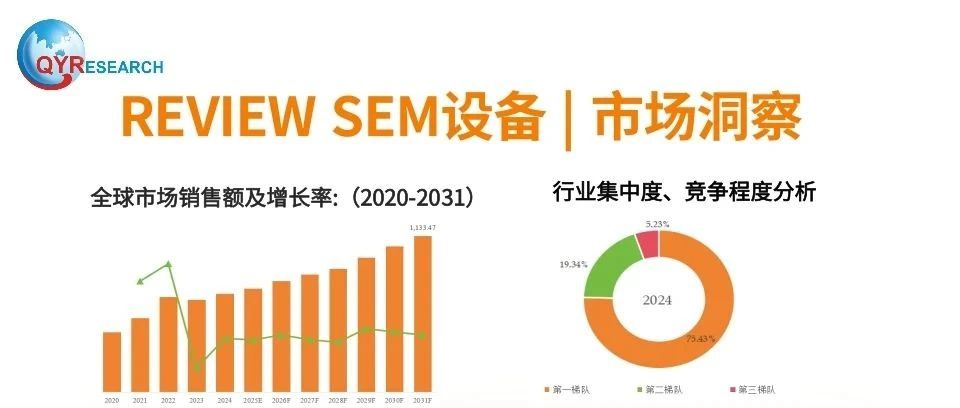
Core Viewpoint - Review SEM devices are essential for defect analysis and process monitoring in semiconductor manufacturing, particularly as technology nodes shrink below 10nm, necessitating high-resolution imaging for accurate defect classification and analysis [2][5][19]. Industry Background and Development History - Review SEM is a critical tool in semiconductor manufacturing for defect analysis and process optimization, especially as optical defect detection devices face limitations in resolution [2]. - The evolution of Review SEM began in the early 1990s, transitioning from CD-SEM platforms to more automated systems capable of handling complex defect types as technology advanced [3][4]. - The demand for Review SEM surged with the introduction of more intricate multi-patterning structures in nodes below 90nm, leading to a systematic approach to defect analysis [3][5]. Technological Advancements - Key technological developments include low-voltage imaging to minimize sample damage, high-speed automated alignment, and AI-driven defect classification algorithms [6][7][9]. - Current mainstream devices achieve resolutions below 1nm and support low acceleration voltages (0.5–1.5kV), crucial for sensitive materials [7][20]. - Integration with inline process control systems is becoming a trend, allowing Review SEM to work in conjunction with other defect detection equipment [11][12]. Market Structure and Leading Manufacturers - The Review SEM market is highly concentrated, dominated by major players such as Applied Materials, Hitachi High-Technologies, and KLA, with Chinese manufacturers still in the early stages of development [13][28]. - The global market for Review SEM devices is projected to grow from $712 million in 2024 to $1.13 billion by 2031, with a CAGR of 7.06% from 2025 to 2031 [26]. Application Demand Trends - The expansion of wafer fabrication capacity, particularly in 12-inch logic factories and advanced packaging lines, is driving a rigid demand for Review SEM [14][15]. - The transition to EUV masks, which have low defect tolerance, is increasing the need for Review SEM as a standard detection tool [16][17]. - There is a rising demand for Review SEM in advanced packaging processes, indicating a new market expansion direction [18]. Future Development Trends - Review SEM is evolving from a passive inspection tool to an integrated, intelligent defect analysis platform, driven by the need for high precision in defect detection as technology nodes approach physical limits [19]. - The integration of AI for defect classification and image recognition is a key focus, with future developments expected to include unsupervised learning for unknown defect identification [21]. - Enhanced automation for defect positioning and real-time feedback mechanisms are essential for maintaining precision in defect analysis [22][23].

全球TOP30半导体巨头集体亮相,湾芯展2025成产业合作新纽带
半导体芯闻· 2025-08-26 10:09
Core Viewpoint - The Bay Area Semiconductor Industry Ecological Expo (Bay Chip Expo 2025) aims to enhance international collaboration and resource integration in the semiconductor industry, showcasing cutting-edge technologies and fostering global partnerships [3][17]. Group 1: Event Overview - The second Bay Chip Expo will be held from October 15 to 17, 2025, at the Shenzhen Convention Center, focusing on semiconductor wafer manufacturing equipment, components, materials, advanced packaging, IC design, and third-generation semiconductors [3][18]. - The expo will serve as a platform for communication, trade, and international cooperation, expanding its reach beyond regional boundaries [3][17]. Group 2: International Participation - The expo will feature a significant increase in international exhibitors, with leading semiconductor companies from over 20 countries, including ASML, Applied Materials, Tokyo Electron, and others, showcasing innovations across the entire semiconductor value chain [4][6]. - Domestic leaders such as North Huachuang and Shanghai Microelectronics will also participate, highlighting the complementary nature of the global supply chain [6][11]. Group 3: High-Level Dialogues and Forums - The event will host high-level dialogues, including the 9th International Advanced Lithography Technology Seminar, focusing on key areas such as lithography equipment and process technology [8][10]. - A comprehensive academic exchange conference, the 2025 Chip Conference, will feature over 50 renowned scholars discussing significant advancements in chip science [8][10]. Group 4: Global Networking and Collaboration - The expo aims to strengthen global semiconductor industry networks by inviting key industry organizations from Japan, Singapore, and Malaysia to facilitate deep connections between international buyers and exhibitors [11][12]. - The event will also organize over 20 high-level forums addressing global semiconductor market dynamics and cross-border cooperation strategies [10][12]. Group 5: Future Prospects - The Bay Chip Expo is positioned to become a leading platform for technological innovation and industry collaboration, with a high renewal rate of exhibitors from the first event indicating strong market recognition [17]. - The expo's international characteristics will enhance the coupling of the semiconductor supply chain, creating greater value through global integration [17].


全球半导体资本设备:中国 7 月进口追踪(2025 年 7 月),年度月度新高,需求仍具韧性,年初至今进口增长 2%
2025-08-25 01:39
Summary of Key Points from the Conference Call Industry Overview - The conference call focuses on the **Global Semiconductor Capital Equipment** industry, specifically the **Wafer Fabrication Equipment (WFE)** imports to China for July 2025, which reached a record high for the year at **USD 3,761 million**, reflecting a **10% year-over-year (YoY)** and **11% month-over-month (MoM)** increase, with year-to-date (YTD) imports up **2% YoY** [2][27][26]. Core Insights and Arguments - **Dry Etch Segment Performance**: The Dry Etch segment showed significant growth, with imports totaling **USD 755 million**, marking a **30% MoM** and **232% YoY** increase. Notably, imports from Malaysia nearly doubled MoM to **USD 300 million** [3][28]. - **Lithography Weakness**: The Lithography segment continues to exhibit weakness, potentially indicating a normalization after previous strong demand. However, fluctuations suggest that this may be temporary, with expectations for a rebound in the second half of 2025 [3][34]. - **Regional Import Dynamics**: The import share by region indicates that the U.S. and Singapore combined account for **42%**, while Japan's share has decreased to **22%** from an average of **26%** last year. This decline is attributed to the lack of favorable foreign exchange conditions for Japanese vendors and a shift in purchasing priorities towards U.S. equipment [4][39]. - **Provincial Import Trends**: The largest buyers of WFE have shifted from Guangdong (21%) to Shanghai (32%) in July, suggesting a potential for sustained strength in these regions into the second half of 2025 and beyond [5][27]. Company-Specific Insights - **ASML**: Projected sales in China for Q3CY25 are estimated at **EUR 1.51 billion**, reflecting a **46% YoY decline** but flat compared to the previous quarter. The monthly import data is noted to be quite variable [6][65]. - **LRCX (Lam Research)**: Expected to see a **14% QoQ increase** in China revenues for the September quarter, with China exposure estimated to be in the high 30s percentage of total revenues [7][81]. - **AMAT (Applied Materials)**: Reported a **44% QoQ increase** in China revenues, aligning with regression analysis predictions of a **53% increase** [8][90]. - **Kokusai**: Anticipated to see a **41% YoY** and **37% QoQ increase** in China revenue, with a significant contribution expected in the September quarter [12]. - **Advantest**: Projected to experience a **38% YoY** and **32% QoQ decline** in China revenue, indicating potential challenges ahead [13]. Additional Important Insights - **Market Dynamics**: The overall WFE market in China is becoming increasingly significant, with global vendors still capturing approximately **84%** of the market share in 2024. The data on imports provides critical insights into demand trends [23]. - **Investment Implications**: Companies like NAURA, AMEC, and Piotech are positioned favorably due to their broad product portfolios and domestic market leadership, benefiting from the ongoing WFE domestic substitution in China [15][16][17]. - **Long-term Outlook**: The overall sentiment suggests that while there may be short-term fluctuations, the long-term growth trajectory for the WFE market in China remains positive, driven by domestic demand and technological advancements [20][22]. This summary encapsulates the key points discussed in the conference call, highlighting the current state and future outlook of the semiconductor capital equipment industry, particularly in relation to WFE imports to China.
AMAT's Display Revenues Rebound: Is it a Sign of Stability?
ZACKS· 2025-08-22 16:11
Core Insights - Applied Materials' display and adjacent segment has shown significant growth, with a year-over-year increase of 4.8% in Q3 2025, following a remarkable 44.7% growth in Q2 2025 [1][9] - The non-GAAP operating margin for this segment stands at 23.6%, driven by the rising adoption of OLED technology in consumer devices [2] - The company anticipates Q4 2025 display revenues to reach $350 million, indicating a substantial 66% year-over-year growth [3][9] Growth Drivers - The demand for advanced display technologies, including thin, light, curved, and flexible displays, as well as applications in augmented and virtual reality, is expected to further propel growth in the display segment [3] - Applied Materials' MAX OLED technology enhances display performance by improving brightness up to threefold, resolution by 2.5 times, and reducing energy consumption by over 30%, while extending display lifespan up to five times [4] Competitive Landscape - Competitors such as Universal Display Corporation and Kopin Corporation are significant players in the OLED market, focusing on phosphorescent OLED technology and micro-OLED displays [5][6] - Universal Display's strong patent portfolio has enabled it to secure major customers, contributing to substantial licensing revenues [6] - Kopin specializes in ultra-high-brightness microdisplays for various applications, although it does not directly compete with Applied Materials in equipment manufacturing [7] Financial Performance - Applied Materials' stock has declined by 1.8% year-to-date, contrasting with a 14.2% growth in the Electronics - Semiconductors industry [8] - The company trades at a forward price-to-sales ratio of 4.27X, which is lower than the industry average of 8.5X [10] - The Zacks Consensus Estimate indicates year-over-year earnings growth of 8.32% for fiscal 2025 and 1.54% for fiscal 2026, although recent estimates for fiscal 2026 and 2027 have been revised downward [11]
Buy, Sell Or Hold Applied Materials Stock?
Forbes· 2025-08-22 12:50
Core Viewpoint - Applied Materials reported Q3 results that exceeded expectations, but the stock has declined approximately 15% due to concerns about future demand, particularly from China [2] Financial Performance - Q3 revenue was $7.30 billion, a 7.7% year-over-year increase, with adjusted EPS of $2.48, both surpassing expectations [3] - Q4 guidance projected revenue around $6.70 billion and earnings of $2.11, both below analyst expectations, attributed to reduced demand for leading-edge logic equipment from China [3] Market Dependency - China contributed 35% of revenue last quarter, significantly more than the 9% from the U.S., indicating a heavy reliance on Chinese customers [4] - The geopolitical landscape, including potential tariffs, creates uncertainty for Applied Materials' customers, particularly in Asia [4] AI and Semiconductor Demand - The generative AI trend is driving increased semiconductor demand, requiring advanced manufacturing methods and higher memory capacity [5] - Applied Materials is well-positioned to benefit from this trend, with gross margins increasing by 150 basis points year-over-year to 48.9% in Q3 FY'25 [5] Valuation and Growth Outlook - Applied stock is trading at approximately 17 times forward earnings, reflecting reasonable valuation given long-term growth potential [7] - Growth rates are projected at about 4% for FY'25 and 2% for FY'26, with capital spending on advanced chip manufacturing expected to nearly double between 2023 and 2028 [7]