
Applied Materials(AMAT)

Search documents
AMAT Rides on the Strength in Semiconductor Systems: Will it Last?
ZACKS· 2025-09-05 14:55
Core Insights - Applied Materials' Semiconductor Systems segment is experiencing strong demand, leading to record revenues in Q3 fiscal 2025 [1][8] - Revenues for the Semiconductor Systems reached $5.43 billion in Q3, reflecting a 10% year-over-year increase [2][8] - The company anticipates a 50% increase in revenues from leading-edge DRAM customers in fiscal 2025 [3][8] - Long-term growth drivers include advancements in AI, advanced packaging, and power electronics [4] - Weaker guidance for Q4 2025 is attributed to capacity digestion in China and export license backlogs [4][8] Revenue and Growth Projections - The Semiconductor Systems segment's revenues are projected to grow significantly due to the transition to gate-all-around transistors, which could increase revenue opportunities by 30% per fab capacity [3] - The Zacks Consensus Estimate indicates an 8.55% year-over-year growth for fiscal 2025 earnings [10] Competitive Landscape - Competitors like Lam Research and ASML Holdings are also performing well in the DRAM and logic sectors, with Lam Research gaining traction through AI-related products [5] - ASML's revenue is driven by DRAM and logic customers, but it expects gross margin contraction due to low-margin tool revenue [6] Valuation Metrics - Applied Materials trades at a forward price-to-sales ratio of 4.32X, which is lower than the industry average of 8.81X [9] - Year-to-date, Applied Materials shares have declined by 2.7%, contrasting with a 19.1% growth in the Electronics - Semiconductors industry [7]

美股异动|费城半导体指数跌超2%,美光、英伟达跌超2%
Ge Long Hui· 2025-09-02 14:17
Group 1 - The Philadelphia Semiconductor Index declined by over 2% [1] - Microchip Technology fell by more than 3.5% [1] - NXP Semiconductors and ON Semiconductor dropped nearly 3% [1] Group 2 - Micron Technology, ASML, Qualcomm, NVIDIA, and Applied Materials all experienced declines of over 2% [1] - Broadcom and Intel both saw declines of over 1% [1]


突然全线暴跌,发生了什么?
Zheng Quan Shi Bao· 2025-09-01 11:50
Group 1 - The semiconductor sector in Japan and South Korea experienced a significant sell-off, with major companies like Advantest and SK Hynix seeing declines of over 9% and 5% respectively, influenced by a sell-off in US tech stocks [1][3] - Concerns about the future performance of AI chip companies arose after underwhelming earnings guidance from US chip giants, leading to fears of slowing growth in the AI chip market [1][3] - Nvidia's reliance on a small number of customers was highlighted, with nearly 40% of its second-quarter revenue for fiscal year 2026 coming from just two clients, raising questions about its dependency on these major customers [1][3][4] Group 2 - The Philadelphia Semiconductor Index dropped over 3%, with notable declines in companies like Marvell Technology and Oracle, further impacting investor sentiment towards AI chip stocks [3] - The overall valuation of the US stock market has reached unprecedented levels, with the S&P 500's price-to-sales ratio hitting 3.23, surpassing the peak during the dot-com bubble [7] - Analysts express skepticism about the sustainability of high valuations for tech giants, suggesting that fundamental performance will ultimately dictate stock prices [8]



突然!全线暴跌,发生了什么?
券商中国· 2025-09-01 11:06
Core Viewpoint - The semiconductor sector in Japan and South Korea has experienced a significant sell-off, primarily influenced by the recent decline in U.S. tech stocks, raising concerns about the future performance of AI chip companies [2][3]. Group 1: Market Reaction - Following the opening of the market, major chip manufacturers in Japan and South Korea saw substantial declines, with Advantest dropping over 9%, Hanmi Semiconductor down over 6%, SK Hynix falling over 5%, and Samsung Electronics decreasing over 3% [2]. - The overall market indices also suffered, with the Nikkei 225 index falling by 1.24% and the KOSPI index declining by 1.35% [3]. Group 2: U.S. Market Influence - The sell-off in Japanese and Korean semiconductor stocks was largely attributed to a more than 3% drop in the Philadelphia Semiconductor Index, with notable declines in companies like Marvell Technology (down over 18%) and Oracle (down 5.9%) [3]. - Concerns were raised regarding the future growth of AI chip companies due to disappointing earnings guidance from some U.S. chip giants [3]. Group 3: Nvidia's Client Dependency - Nvidia's recent disclosures indicated that nearly 40% of its revenue for the second fiscal quarter of 2026 came from just two clients, raising alarms about the company's reliance on a limited customer base [4]. - The two major clients contributed 23% and 16% to Nvidia's total revenue, significantly higher than the previous year's contributions of 14% and 11% [4]. Group 4: Valuation Concerns - Analysts have pointed out that the extreme volatility in U.S. AI chip stocks stems from previously inflated expectations and high valuations, leaving little room for error in earnings reports [5]. - The S&P 500 index's price-to-sales ratio has reached a historic high of 3.23, surpassing levels seen during the dot-com bubble, while the forward P/E ratio stands at 22.5, well above the long-term average of 16.8 since 2000 [6]. Group 5: Market Concentration - The top 10 companies in the S&P 500 now account for 39.5% of the index's total market capitalization, the highest recorded level, primarily driven by tech giants like Nvidia and Microsoft [7]. - Concerns have been raised about the sustainability of these high valuations, with some market participants skeptical about whether fundamentals will support current price levels over time [7]. Group 6: AI Investment Bubble Warnings - Increasing warnings about an "AI investment bubble" have emerged, with industry leaders comparing the current situation to past investment failures, such as SoftBank's investments in WeWork and Zume [8].



全球半导体资本设备-中国晶圆厂设备是把双刃剑
2025-08-31 16:21
Summary of Key Points from the Conference Call Industry Overview - The conference call focuses on the **Global Semiconductor Capital Equipment** industry, particularly the **Wafer Fabrication Equipment (WFE)** market, with significant emphasis on the impact of **China's semiconductor market** on global trends [2][17]. Key Forecasts and Adjustments - The WFE forecast for **2025** has been raised to **$114 billion**, reflecting a **6% year-over-year growth** from the previous estimate of **$111 billion** [2][17]. - The **2026 WFE** forecast is adjusted to **$120 billion**, a **5% increase** from the prior estimate of **$119 billion** [2][17]. - A new forecast for **2027** anticipates a **3% decline** in WFE, primarily due to normalization in China's advanced logic capital expenditures [2][17]. China Market Insights - China's WFE is expected to decline by **5%** in **2025** (previously forecasted at **-13%**) and remain flat in **2026**, but is projected to drop by **19%** in **2027** due to normalization of advanced logic capex [2][21]. - The **China foundry** segment is forecasted to remain flat year-over-year in **2025**, driven by an acceleration in capacity expansion post **DeepSeek** [3][17]. - The **DRAM** segment in China has been trimmed, with global DRAM WFE expected to grow by **6%** in **2025**, down from a previous estimate of **13%** [3][17]. Company-Specific Insights - **Applied Materials (AMAT)** and **Lam Research (LRCX)** are both rated as **Outperform** with price targets of **$195** and **$105**, respectively. Both companies are expected to benefit from leading-edge technology advancements [4][41]. - **Tokyo Electron (TEL)** is also rated **Outperform** with a price target of **¥29,400**, expected to gain market share and expand margins due to competitive pricing [9][60]. - **Kokusai** is rated **Outperform** with a price target of **¥3,570**, although there are concerns regarding the high revenue CAGR guidance of **22%** [10][60]. - **Screen** is rated **Market-Perform** with a price target of **¥12,000**, facing competitive pressures and declining revenue contributions from China [11][60]. - **Lasertec** is rated **Underperform** with a price target of **¥10,900**, anticipating a deceleration in revenue growth due to increased competition [12][60]. Investment Implications - The overall sentiment towards the **Japanese semiconductor equipment** companies is cautious due to short-term challenges in China, but long-term positions remain strong with attractive valuations [5][60]. - Local Chinese semiconductor capital equipment vendors like **NAURA**, **AMEC**, and **Piotech** are rated **Outperform** due to their increasing market share driven by domestic substitution [6][14][15][16]. Additional Insights - The semiconductor industry is experiencing a shift with increased spending on **AI-related** technologies, which is expected to drive demand for advanced logic capacity in China [6][37]. - The overall WFE market is projected to grow, with a slight adjustment in expectations for non-China WFE growth, now estimated at **13%** for **2025** [26][32]. This summary encapsulates the critical insights and forecasts discussed during the conference call, highlighting the dynamics of the semiconductor capital equipment industry and the implications for various companies involved.

费城半导体指数跌2.5%
Ge Long Hui A P P· 2025-08-29 14:52
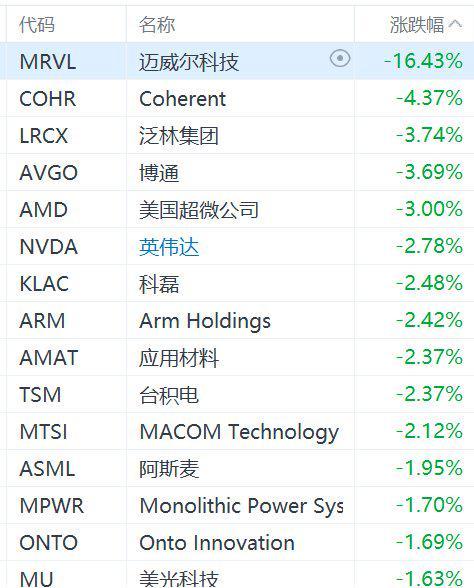
Core Viewpoint - The semiconductor sector in the US stock market experienced a significant decline, with the Philadelphia Semiconductor Index dropping by 2.5% at the beginning of trading [1] Company Performance - Marvell Technology saw a sharp decline of over 16% [1] - Other companies such as Lam Research, Broadcom, and AMD experienced declines of over 3% [1] - Major players like NVIDIA, ARM, Applied Materials, and TSMC fell by more than 2% [1] - ASML and Micron Technology also reported declines of over 1% [1]


应用材料:美国政府支持芯片制造商的举措不会改变公司的需求预测
Ge Long Hui A P P· 2025-08-29 02:16
Group 1 - The CFO of Applied Materials, Brice Hill, stated that U.S. government incentives for chip manufacturers will not alter the demand forecast for high-end chip manufacturing tools [1] - The U.S. government announced the acquisition of approximately 10% stake in Intel, which is a customer of Applied Materials [1] - Hill mentioned that while this support may change the location of factory construction, it will not increase overall demand [1] Group 2 - Increased competition may slightly reduce the average utilization rate of factories, but it is not expected to change Applied Materials' five-year forecast [1]
Applied Materials (AMAT) 2025 Conference Transcript
2025-08-28 19:02
Summary of the Conference Call Company and Industry Overview - The conference featured Bryce Hill, CFO of Applied Materials, discussing the semiconductor equipment industry, particularly focusing on DRAM and leading logic markets [1][2]. Key Points and Arguments Earnings and Market Outlook - Applied Materials reported record revenues and earnings per share in Q3, driven by strong demand in DRAM and leading logic, despite facing headwinds in the ICAPs segment, particularly in China [4][5]. - The company expected DRAM and leading logic to be the fastest-growing equipment markets over the next five years, with a projected growth rate of 26% [10][18]. - The leading edge market showed unexpected non-linear demand, primarily influenced by a significant customer and their factory timing [6][8]. China Market Dynamics - China’s market is experiencing slower growth, with a decrease of over 24% expected in the ICAP space, which is attributed to previous over-investments in 2023 and 2024 [5][18]. - The company has lost approximately $400 million in business due to restrictions on serving entity-listed customers in China, but anticipates potential recovery depending on future regulatory changes [25][28]. Technology and Innovation - The transition to advanced nodes, such as gate-all-around transistors, is expected to enhance power efficiency by 20% to 30%, making it a favorable choice for AI applications [6][14]. - Applied Materials is focusing on new applications and architectures as customers reevaluate their equipment needs during technology transitions [11][12]. DRAM and HBM Market Trends - High Bandwidth Memory (HBM) is projected to grow at a CAGR of 30% to 40%, with 15% of DRAM capacity currently allocated for HBM production [55]. - The overall DRAM market is expected to be one of the fastest-growing equipment markets, driven by multinationals compensating for lost business in China [56]. Services and Gross Margins - The services segment, particularly subscription-based revenues, is expected to grow at low double digits, supported by an increasing installed base and demand for expert technicians [61][64]. - Gross margins are projected at 48.1%, with improvements attributed to a better product mix and pricing strategies, despite challenges from tariffs [66][68]. Other Important Insights - The semiconductor industry is experiencing a shift in customer order patterns, with increased volatility and late commitments due to uncertainties in the market [22][23]. - The competitive landscape is evolving, with potential impacts from government incentives for foundries, but Applied Materials does not foresee significant changes in overall demand forecasts [30][35]. - The company is optimistic about the long-term growth potential in both DRAM and leading logic, despite short-term challenges in the China market and ICAPs segment [19][20].
全球半导体:《芯片法案 3》,中国资本支出持续增长,尽管面临挑战,迁移仍在推进Global Semis_ CHIPS Act 3_ China capex continues to grow; migration ongoing despite challenges
2025-08-28 02:12
Summary of Semiconductor Industry Conference Call Industry Overview - The conference call focuses on the **semiconductor industry in China**, particularly in the context of the **CHIPS Act** and its implications for capital expenditures (capex) and technology development [1][4][5]. Key Points Capital Expenditures (Capex) - China's semiconductor capex is projected to increase to **US$43 billion to US$46 billion** for the period **2025-2030**, up from previous estimates of **US$40 billion to US$44 billion** [4][16]. - A strong investment of **US$41 billion** was recorded in **2024**, representing a **19% year-over-year increase** [4][16]. - The investment focus is expected to shift towards **memory** and **advanced node technologies**, with local suppliers anticipated to contribute **26%** of wafer fabrication equipment procurement in **2025**, increasing to **36%** by **2030** [4][16]. Demand and Supply Chain Migration - The semiconductor supply chain in China is undergoing significant migration, with expansions in **CIS**, **automotive chips**, and **AI chips** [5]. - Local foundries and OSATs are enhancing their manufacturing technologies, driven by structural technology innovations and better services [5]. Lithography Demand - An estimated **2,261 additional lithography systems** will be required by **2035** to meet the projected chip demand in China, necessitating an investment of approximately **US$110 billion** [6][39]. - The breakdown of required lithography systems includes **212 EUVs**, **843 immersion DUVs**, and **2,564 dry DUV/UV systems** [39]. Market Dynamics - The semiconductor market in China is expected to see a **5% to 1%** growth in capex from **2025 to 2030**, driven primarily by foundries and memory players, which will account for about **80%** of the capex [16][22]. - Chinese semiconductor manufacturers are projected to capture **17%** of the semiconductor demand value in **2024**, increasing to **37%** by **2030** [33]. Equipment Market - The Wafer Fabrication Equipment (WFE) market in China is expected to reach **US$41 billion** by **2026**, with local suppliers increasing their market share from **17%** in **2024** to **36%** by **2027** [28][32]. - The growth in WFE revenues is attributed to the increasing semiconductor spending, with China expected to account for **37% to 38%** of global WFE spending in **2025-2027** [28]. Implications for Global Suppliers - US suppliers are expected to maintain a strong market share in China's WFE spending, despite facing challenges from local manufacturers and export controls [45]. - Japanese SPE manufacturers may see a gradual decline in their market share in China, although they will still benefit from the high capex environment [49]. Additional Insights - The semiconductor industry in China is characterized by a robust local ecosystem supported by ongoing technology development and a large home market [1][4]. - The demand for lithography systems is critical for meeting future chip production needs, highlighting the importance of investment in R&D and local manufacturing capabilities [6][39]. This summary encapsulates the key insights and projections regarding the semiconductor industry in China, emphasizing the growth in capital expenditures, the demand for advanced technologies, and the evolving dynamics of the supply chain.




先进封装设备厂商如何应对全球化市场挑战-How Do Advanced Packaging Equipment Vendors Tackle Challenges in a Globalized Market_
2025-08-27 15:20
Summary of Key Points from the Semiconductor Industry Research Industry Overview - The research focuses on the global semiconductor industry, particularly the front-end Wafer Fab Equipment (WFE) and back-end advanced packaging supply chains, highlighting the challenges posed by globalization and geopolitics [2][6][32]. Core Companies Involved - Major players in the semiconductor industry include TSMC, UMC, Samsung Electronics, Intel, ASML, Applied Materials (AMAT), Lam Research, Tokyo Electron (TEL), KLA, ASE, Amkor, JCET, Disco, Besi, ASMPT, K&S, Semes, Hanmi, Hanwha, EVG, SUSS, Teradyne, SCREEN, Canon, Nikon, and Lasertec [19][49]. Key Trends and Insights 1. **Advanced Packaging Demand**: The demand for advanced packaging technologies such as 2.5D/3D packaging, Hybrid Bonding, and CoWoS is surging due to the rise of AI and high-performance computing (HPC) applications [2][8][10]. 2. **Moore's Law and Packaging**: As Moore's Law slows, advanced packaging has become the primary pathway for sustaining semiconductor performance gains, with technologies like CoWoS and SoIC leading the way [3][38][49]. 3. **Geopolitical Challenges**: Geopolitical pressures and government policies, such as the CHIPS Act, are reshaping the supply chain dynamics, pushing companies to diversify their manufacturing and service locations [7][44][60]. 4. **Localization Trends**: There is a significant trend towards localization in the semiconductor supply chain, with companies establishing production bases in North America, Europe, Japan, and Southeast Asia to mitigate risks [7][32][60]. 5. **Material Innovation**: The shift from equipment-centric to materials-centric innovation is becoming critical, with new materials like UV resins, advanced thermal interface materials, and low-Dk dielectrics emerging as strategic differentiators [15][47][49]. Market Dynamics - The WFE market is projected to grow from approximately USD 13.3 billion in 2024 to USD 16.5 billion by 2029, with a significant portion of revenue coming from equipment shipments [49][72]. - The back-end packaging market is also expanding, with the TCB equipment market estimated at around USD 936 million and HB equipment projected at USD 397 million by 2030 [53]. Challenges and Opportunities 1. **Cost and Pricing Pressures**: Equipment suppliers face challenges related to cost, pricing, and sustainability, which are becoming critical factors in maintaining competitiveness [8][29][49]. 2. **Technological Integration**: The ability to integrate differentiated materials and technologies will increasingly define competitiveness in the semiconductor industry [39][49]. 3. **Sustainability Goals**: Companies are embedding sustainability into their operational metrics, with ESG (Environmental, Social, and Governance) goals becoming essential for process efficiency and cost competitiveness [45][49][69]. Conclusion - The semiconductor industry is undergoing significant transformations driven by technological advancements, geopolitical factors, and evolving market demands. Companies that can effectively navigate these challenges while innovating in materials and processes are likely to secure a competitive edge in the future [49][72].


