AMD(AMD)

Search documents
今夜,利空!跳水!
中国基金报· 2025-11-13 16:13
Core Viewpoint - The article discusses the recent decline in the U.S. stock market, driven by uncertainty surrounding the Federal Reserve's monetary policy and the impact of incomplete employment data due to a government shutdown [1][2][4]. Economic Data and Federal Reserve - The October employment report, which was supposed to be released on November 7, was not published due to the government shutdown, leading to a lack of unemployment rate data [3]. - Analysts express concerns that the absence of complete economic data complicates the Federal Reserve's decision-making process regarding interest rate cuts, contributing to a pessimistic outlook among investors [4][5]. - The market's expectation for a rate cut in December has shifted from being almost certain to a more uncertain stance, influenced by differing opinions among Federal Reserve officials [5]. Stock Market Performance - Major U.S. stock indices experienced significant declines, with the Dow Jones dropping approximately 300 points, the Nasdaq falling over 1.5%, and the S&P 500 decreasing by about 1% [2]. - Notable declines in individual stocks include Tesla down 5.73%, Arm down 5.36%, and Disney's stock plummeting nearly 10% despite better-than-expected earnings due to revenue shortfalls [6][7]. Market Sentiment - The article highlights a general sense of volatility in the market as investors react to the uncertain economic landscape and the Federal Reserve's potential policy shifts [4][5].





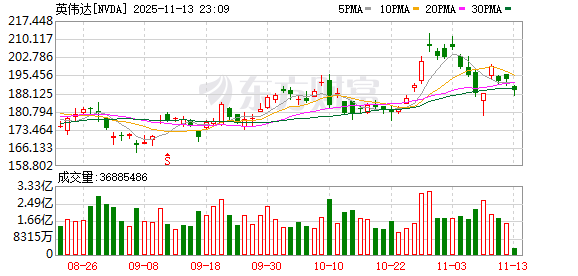
纳指大跌1.3% 明星科技股多数下跌 英伟达(NVDA.US)跌超3%





Mei Ri Jing Ji Xin Wen· 2025-11-13 15:10
Core Viewpoint - The U.S. stock market opened lower on Thursday, with significant declines in major indices, particularly the Nasdaq, which fell by 1.3% [2] Group 1: Market Performance - Major technology stocks experienced declines, with Nvidia (NVDA.US) and AMD (AMD.US) both dropping over 3% [2] - Tesla (TSLA.US) and Alphabet (GOOGL.US) saw declines of more than 2% [2] - Amazon (AMZN.US) fell by over 1%, while Apple (AAPL.US) and Meta (META.US) managed to rise against the trend [2]
美股开盘丨道指跌0.29% 阿里巴巴涨逾3%

Di Yi Cai Jing· 2025-11-13 14:51
Market Overview - U.S. stock market opened lower with the Dow Jones down 0.29%, Nasdaq down 0.61%, and S&P 500 down 0.42% [1] Technology Sector - Most technology stocks declined, with AMD dropping over 2%, Nvidia and Tesla each falling nearly 2%, while Cisco rose over 6% [1] Chinese Stocks - Majority of Chinese stocks experienced gains, with Canadian Solar increasing over 10%, Alibaba rising more than 3%, while Bilibili fell over 6% and Pony.ai dropped more than 3% [1]
Nvidia Or AMD: Which Stock To Bet On?
Forbes· 2025-11-13 14:00
Core Insights - Advanced Micro Devices (AMD) expects annual data center chip sales to reach $100 billion within the next five years, with earnings projected to more than triple [1] - NVIDIA (NVDA) shows stronger revenue growth and profitability compared to AMD, making it a potentially better investment choice [3][4] Financial Performance Comparison - NVDA's quarterly revenue growth stands at 55.6%, while AMD's is at 35.6% [3] - Over the last 12 months, NVDA's revenue growth is 71.6%, significantly higher than AMD's 31.8% [3] - NVDA's last twelve months profit margin is 58.1%, with a three-year average margin of 51.0%, indicating superior profitability compared to AMD [4] Investment Considerations - The comparison highlights the differences in growth, margins, momentum, and valuation multiples between AMD and NVDA [4] - Investing in individual stocks like AMD and NVDA carries inherent risks, suggesting a diversified portfolio may be a safer approach [8]

Quantum Announces 93% Gallium Recovery
Thenewswire· 2025-11-13 14:00
Core Insights - Quantum Critical Metals Corp. has achieved a significant milestone with a 93% gallium recovery from preliminary metallurgical tests on mica samples from its NMX East Project in Québec, positioning the company as a leader in North America's gallium supply chain [2][3][4] Company Overview - Quantum Critical Metals Corp. is focused on advancing critical minerals and has a growing portfolio of projects, including the NMX East Gallium-Rubidium-Cesium Project and others in Québec and British Columbia [10] - The company aims to establish Canada as a domestic gallium supplier, reducing reliance on Chinese exports and enhancing Western national security [7][4] Industry Context - Gallium is a critical metal used in various high-tech applications, including semiconductors and renewable energy, traditionally sourced as a byproduct of bauxite or zinc processing [3][5] - The successful direct recovery of gallium from mica represents a potential new source, which could significantly impact the supply chain amid global disruptions [4][3] Project Details - The NMX East Project is 100% owned by Quantum and has historically been explored for lithium, with recent studies focusing on gallium extraction feasibility [8] - The project is strategically located near other significant mining developments, highlighting the broader area's potential for polymetallic exploration [8][9]

Major analyst and enterprise forecasts on the AI market
Reuters· 2025-11-13 13:49
Technology executives and analysts expect artificial intelligence to generate hundreds of billions of dollars in value, yet forecasts for the market diverge significantly based on the underlying assum... ...

GFHK - 十一月电子月报
2025-11-13 13:40
Summary of Key Points from the Conference Call Industry Overview - **Sector**: Technology, specifically focusing on AI and semiconductor industries - **Market Dynamics**: The technology sector is experiencing a range-bound market with significant attention on memory and optical segments due to political uncertainties affecting semiconductors [1][2] Core Insights - **Memory Pricing**: - TrendForce has raised the 4Q25 DRAM pricing growth expectation to 18-23% QoQ, slightly below the previous estimates of 20-25% [1] - Anticipation of another 20-25% QoQ increase in 1Q26 [1] - The DRAM upcycle is expected to extend into at least 1H26, with pricing dynamics stronger than previously expected [9] - NAND contract prices are projected to increase by 20-25% in both 4Q25 and 1Q26 [9] - **AI Demand**: - AI is expected to drive significant demand in the semiconductor sector, with the total addressable market (TAM) for AI accelerators projected to reach $308 billion and $440 billion in 2026 and 2027, respectively, representing a YoY growth of +54% and +33% [3] - Companies like Nvidia, Google, and AWS are leading the demand for AI accelerators [11] - **Optical Sector Recovery**: - The optical sector has regained strength, with companies like Lumentum, Coherent, and Tower providing strong guidance [1] - A bullish outlook on 1.6T demand into 2026/2027 is maintained [1] Company-Specific Highlights - **TSMC**: - Reported October revenue of NT$367.5 billion, up 11% MoM and 16.9% YoY, driven by AI [14] - Full-year sales guidance raised to a 30% increase in USD terms [14] - Expected price hikes for leading nodes in 1Q26 [14] - **SanDisk**: - Strong FY1Q26 results with revenue at $2.3 billion and margin at 29.9% [8] - FY2Q26 guidance indicates a margin increase to 41-43% [8] - **Teradyne**: - Initiated with a Buy rating, expected revenue of $4.07 billion and $5.43 billion in 2026 and 2027, respectively [10] - Positioned well for AI market share gain [10] - **AMD**: - Inline results with solid guidance, focusing on the MI450 product ramp [12] - Expected EPS contribution of ~27% to 2027 [12] Risks and Considerations - **Market Risks**: - Concerns regarding alternative technologies and potential slowdowns in AI demand and capital expenditures [6] - Risks associated with product delays and IT demand slowdown [6] Additional Insights - **Consumer Electronics**: - The PC market is expected to see a 4% YoY increase in shipments in 2025, driven by commercial demand, but consumer concerns over memory pricing may pose risks [18] - **Smartphone Market**: - MediaTek reported a slight decline in sales, with expectations for a sequential increase in 4Q [19] - **Non-AI Semiconductor Performance**: - Companies like UMC and Vanguard are experiencing mixed results, with UMC showing a 6.9% MoM increase but a slight YoY decline [20] This summary encapsulates the key points discussed in the conference call, highlighting the current state of the technology sector, particularly in AI and semiconductors, along with company-specific performances and market risks.
AMD’s $350 Price Target Is In: This Options Trade Is the Data-Driven Winner
Yahoo Finance· 2025-11-13 13:33
Group 1 - AMD's stock has seen significant growth, rising from a target price of $200 to around $260, with a new high target price of $350 [1][2] - AMD has transitioned from an underdog in the AI chip market to a primary supplier, with data center revenue projected to grow by 60% annually over the next three years [2] - Despite AMD's market capitalization being $386.7 billion compared to Nvidia's $4.7 trillion, analysts remain optimistic about AMD's stock performance [2] Group 2 - The recent price movements and Q3 financials suggest a more favorable environment for selling options rather than buying deep in-the-money call options [3] - Understanding volatility is crucial in options trading, as it affects the pricing of options based on expected price movements of the underlying asset [4] - Historical Volatility (HV) reflects past stock movements, while Implied Volatility (IV) indicates market expectations for future movements, with higher IV leading to higher option prices [5][6]
AI Skeptics Could Be Wrong, and This Stock Still Has Room to Run
The Motley Fool· 2025-11-13 10:30
Core Insights - AMD has transformed from a gaming chip manufacturer to a key player in various computing sectors, including AI, data centers, and gaming [2] - The company reported a significant revenue increase of 36% year-over-year to $9.25 billion in Q3 2025, with net income rising 61% to $1.24 billion [3] - AMD's Client and Gaming segment saw a remarkable 73% revenue increase to $4 billion, driven by strong sales of Ryzen processors and Radeon GPUs [4] Financial Performance - AMD's data center segment generated $4.3 billion in revenue, up 22% year-over-year, largely due to demand for its 5th-generation EPYC processors and Instinct MI350 GPUs [3] - The Embedded segment, however, experienced an 8% decline, generating $857 million [4] - As of November 12, 2025, AMD's stock price is approximately $256, reflecting a year-to-date increase of about 112% [6] Market Position and Valuation - AMD currently trades at nearly 79 times its earnings, indicating strong market confidence in its growth potential [7] - The company is now considered one of the three major players in the chip industry, alongside Intel and Nvidia [2] Strategic Partnerships - AMD has formed a significant partnership with OpenAI, which will utilize up to 6 gigawatts of AMD GPUs for its AI infrastructure, marking a historic commitment in AI computing [9] - AMD has also granted OpenAI a warrant for up to 160 million shares, contingent on achieving specific milestones [10] - Additionally, AMD will power two next-generation supercomputers for the U.S. Department of Energy, representing a $1 billion investment project [12][13] Investment Outlook - Wall Street currently rates AMD stock with a consensus "Moderate Buy" rating, highlighting its unique strategy focused on high-performance design and strategic partnerships [14]
Dow Settles Above 48,000: Investor Sentiment Declines, Greed Index Remains In 'Fear' Zone
Benzinga· 2025-11-13 07:40
Market Overview - The CNN Money Fear and Greed index showed a slight increase in overall fear, remaining in the "Fear" zone with a reading of 34.1, down from 34.3 [5] - U.S. stocks had a mixed performance, with the Dow Jones gaining over 300 points during the session, closing higher by around 327 points to 48,254.82 [1][4] Company Performance - Advanced Micro Devices Inc. (NASDAQ:AMD) was a standout performer, surging 9% after projecting faster-than-expected sales growth during its analyst day [2] - On Holding (NYSE:ONON) shares jumped 18% after reporting upbeat third-quarter earnings and issuing FY2025 sales guidance above expectations [3] Sector Performance - Most sectors on the S&P 500 closed positively, with health care, financial, and materials stocks recording the biggest gains [3] - Energy and communication services stocks closed lower, bucking the overall market trend [3] Upcoming Earnings - Investors are awaiting earnings results from Walt Disney Co. (NYSE:DIS), Applied Materials Inc. (NASDAQ:AMAT), and JD.Com Inc. (NASDAQ:JD) [4]