
BANK OF CHINA(BACHY)

Search documents
中国银行获评“年度卓越养老金融银行”
Xin Lang Cai Jing· 2026-01-28 09:03
Core Insights - The "2025 (13th) Comprehensive Bank Evaluation" event organized by Sina Finance announced its award winners, with Bank of China recognized as the "Annual Outstanding Pension Financial Bank" [1][2]. Summary by Categories - **Event Overview** - The evaluation involved a comprehensive assessment of banking institutions from multiple fields and perspectives, highlighting industry leaders and trends [1][2]. - **Recognition and Achievements** - The awarded banks demonstrated exceptional comprehensive strength and professional quality over the past year, indicating their capability to contribute to the high-quality development of the banking industry and the construction of a financial powerhouse in the future [1][2].

中国银行获“年度最佳投资机构奖”
Xin Lang Cai Jing· 2026-01-28 08:23
本次评选活动从多领域、多视角对银行机构进行了综合评估,最终评选出多家行业佼佼者,充分体现了 银行业的发展趋势和行业标杆。本次获奖银行在过去一年的发展中展现了卓越的综合实力和优秀的专业 素养,期待在未来能够继续发挥自身优势,坚守初心和使命,为银行业高质量发展与金融强国建设贡献 更多力量。 责任编辑:曹睿潼 1月28日金融一线消息,由新浪财经主办的"2025(第十三届)银行综合评选"活动获奖名单今日正式揭 晓!中国银行获"年度最佳投资机构奖"。 本次评选活动从多领域、多视角对银行机构进行了综合评估,最终评选出多家行业佼佼者,充分体现了 银行业的发展趋势和行业标杆。本次获奖银行在过去一年的发展中展现了卓越的综合实力和优秀的专业 素养,期待在未来能够继续发挥自身优势,坚守初心和使命,为银行业高质量发展与金融强国建设贡献 更多力量。 1月28日金融一线消息,由新浪财经主办的"2025(第十三届)银行综合评选"活动获奖名单今日正式揭 晓!中国银行获"年度最佳投资机构奖"。 责任编辑:曹睿潼 ...
中国银行获评“年度最具影响力银行”
Xin Lang Cai Jing· 2026-01-28 07:54
本次评选活动从多领域、多视角对银行机构进行了综合评估,最终评选出多家行业佼佼者,充分体现了 银行业的发展趋势和行业标杆。本次获奖银行在过去一年的发展中展现了卓越的综合实力和优秀的专业 素养,期待在未来能够继续发挥自身优势,坚守初心和使命,为银行业高质量发展与金融强国建设贡献 更多力量。 责任编辑:曹睿潼 1月28日金融一线消息,由新浪财经主办的"2025(第十三届)银行综合评选"活动获奖名单今日正式揭 晓!中国银行获评"年度最具影响力银行"。 本次评选活动从多领域、多视角对银行机构进行了综合评估,最终评选出多家行业佼佼者,充分体现了 银行业的发展趋势和行业标杆。本次获奖银行在过去一年的发展中展现了卓越的综合实力和优秀的专业 素养,期待在未来能够继续发挥自身优势,坚守初心和使命,为银行业高质量发展与金融强国建设贡献 更多力量。 1月28日金融一线消息,由新浪财经主办的"2025(第十三届)银行综合评选"活动获奖名单今日正式揭 晓!中国银行获评"年度最具影响力银行"。 责任编辑:曹睿潼 ...
中国银行北京市分行落地北京市首笔民间投资专项担保计划业务
Bei Jing Shang Bao· 2026-01-28 06:30
Core Insights - The successful implementation of the first medium to long-term loan under the special guarantee plan for small and micro enterprises in Beijing is expected to accelerate the release of policy effectiveness and guide financial resources towards private investment [1][2] - The collaboration between Bank of China Beijing Branch and Guohua Guarantee Company aims to provide efficient financial services to small and micro enterprises, addressing their financing needs and reducing costs [1] Group 1 - The special guarantee plan provides a loan of 5 million yuan (approximately 0.7 million USD) for a duration of 24 months to Beijing Liufang Zhixin Security Technology Co., Ltd. to support its funding gap for new security technology research and system operation [1] - The loan is aimed at purchasing equipment and raw materials, offering preferential financing rates and guarantee fees to help the enterprise overcome development bottlenecks [1] - The rapid implementation of this plan is attributed to the long-term collaboration and resource accumulation between Bank of China Beijing Branch and Guohua Guarantee Company in the field of inclusive finance [1] Group 2 - Bank of China Beijing Branch plans to use this successful case as an opportunity to expand its service coverage and provide quality financial support to small and micro enterprises [2] - The initiative is positioned to contribute to the high-quality development of the capital's economy by supporting stable economic growth [2]
德宏金融监管分局核准周磊中国银行德宏州分行副行长任职资格
Jin Tou Wang· 2026-01-28 03:13
二、中国银行应要求上述核准任职资格人员严格遵守金融监管总局有关监管规定,自中国银行政许可决 定作出之日起3个月内到任,并按要求及时报告到任情况。未在上述规定期限内到任的,本批复文件失 效,由决定机关办理行政许可注销手续。 三、中国银行应督促上述核准任职资格人员持续学习和掌握经济金融相关法律法规,牢固树立风险合规 意识,熟悉任职岗位职责,忠实勤勉履职。 2026年1月26日,德宏金融监管分局发布批复称,《中国银行(601988)股份有限公司云南省分行关于 周磊任职资格核准的请示》(云中银报〔2025〕129号)收悉。经审核,现批复如下: 一、核准周磊中国银行德宏州分行副行长的任职资格。 ...
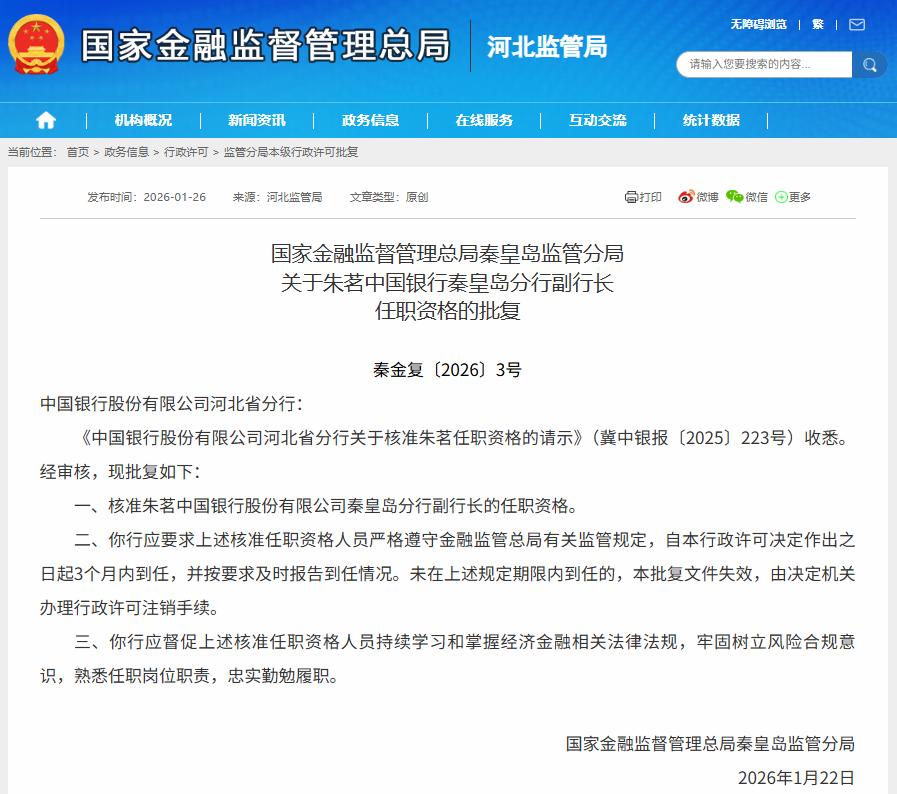
朱茗获准出任中国银行秦皇岛分行副行长
Xin Lang Cai Jing· 2026-01-27 01:52
据国家金融监督管理总局河北监管局的批复文件显示,秦皇岛监管分局同意朱茗出任中国银行秦皇岛分行副行长。 图源:国家金融监督管理总局网站 ...

现代牙科股东将股票由中国银行(香港)转入高盛(亚洲)证券 转仓市值5.08亿港元
Zhi Tong Cai Jing· 2026-01-27 00:59
Core Viewpoint - Recent transactions indicate a significant increase in shareholding of Modern Dental Group by Hillhouse Investment, reflecting growing interest in the company [1] Group 1: Shareholder Changes - On January 26, shares of Modern Dental (03600) were transferred from Bank of China (Hong Kong) to Goldman Sachs (Asia) Securities, with a market value of HKD 508 million, accounting for 10.5% of the shares [1] - Hillhouse Investment has acquired a minority stake in Modern Dental through block trading, increasing its shareholding from less than 1% to 17.24% [1] Group 2: Transaction Details - According to the Hong Kong Stock Exchange, XX-I SHT Holdings Limited purchased 161 million ordinary shares of Modern Dental at an average price of HKD 5.8 per share on January 19, totaling approximately HKD 935 million [1] - Following this acquisition, XX-I SHT Holdings Limited's total shareholding in Modern Dental rose to 161 million shares, with the ownership percentage increasing from 0.00% to 17.24% [1] Group 3: Related Parties - The transaction involved other related parties, including Hillhouse Investment Management, Ltd., Hillhouse Investment Management V, L.P., and Hillhouse Fund V, L.P. [1]
现代牙科(03600)股东将股票由中国银行(香港)转入高盛(亚洲)证券 转仓市值5.08亿港元
智通财经网· 2026-01-27 00:59
Group 1 - The core point of the article is that Hillhouse Investment has significantly increased its stake in Modern Dental Group from less than 1% to 17.24% through a block trade, indicating strong investor interest in the company [1] - On January 26, a transfer of shares worth HKD 508 million (approximately USD 65 million) occurred, with 10.5% of the shares being moved from Bank of China (Hong Kong) to Goldman Sachs (Asia) Securities [1] - XX-I SHT Holdings Limited acquired 161 million shares of Modern Dental at an average price of HKD 5.8 per share, totaling approximately HKD 935 million (around USD 120 million) [1] Group 2 - The transaction involved several related parties, including Hillhouse Investment Management, Ltd., Hillhouse Investment Management V, L.P., and Hillhouse Fund V, L.P. [1]
贝莱德(BlackRock)对中国银行的多头持仓比例降至5.93%
Xin Lang Cai Jing· 2026-01-26 09:17
据香港交易所披露,贝莱德(BlackRock)对中国银行股份有限公司 - H股的多头持仓比例于2026年1月 20日从6.03%降至5.93%。 ...

中国银行与房地产:2026 年 GCC 会议要点- 最糟糕的时期已过去?-China Banks and Property_ 2026 GCC takeaways_ Is the worst behind_
2026-01-26 02:49
Summary of Conference Call Notes Industry Overview - **Industry**: Chinese Banking and Property Sector - **Context**: Insights from the 2026 Greater China Conference (GCC) and subsequent macro, financial, and property tours Key Points on Economic Outlook - **2026 GDP Growth Target**: Expected to be set at 4.5-5.0%, with some experts optimistic about achieving close to 5% due to strong exports and easing deflationary pressures [2][8][10] - **Deflationary Pressure**: CPI expected to rise to 0.5%, while PPI may narrow its decline to a range of -1% to 0% [10] - **Consumption Growth**: Not seen as a key driver for 2026; trade-in subsidies are fading [2][19] Banking Sector Insights - **NIM Pressure**: Current stretched NIM levels are a constraint for rate cuts; a small rate cut of 10bps is anticipated [3][15] - **Loan Origination**: Decent loan origination observed in early January, primarily driven by corporate loans; retail loan recovery remains limited [5][48] - **Revenue Outlook**: Improved revenue outlook driven by less YoY NIM decline and ongoing fee income recovery; investment income may lag due to a less favorable bond market [5][50] Property Sector Outlook - **Bearish Sentiment**: Experts hold a bearish view on the property sector, expecting a 10% decline in property prices in 2026 and 5% in 2027 [4][27] - **Homebuyer Behavior**: Shift from buying to renting; potential 30-40% downside in property prices if rental yields align with mortgage rates [4][27] - **Policy Support**: Limited policy tools available to stabilize property prices; expectations for major new policies in 2026 are low [4][16][27] Specific Company Insights - **Chengdu MixC**: Strong sales growth with retail sales reaching approximately Rmb8.5 billion in 2025; proactive tenant changes attributed to outperformance [30] - **C&D Haiyao**: Luxury project demand remains, with a successful launch of a luxury residential project at an average price of over Rmb77,000 per sqm [31] Additional Considerations - **Geopolitical Risks**: Complicated geopolitical relations may impact export growth; however, solid external demand is expected [17] - **RMB Appreciation**: Potential for RMB to enter an appreciation cycle, with expectations of a 3-4% appreciation by the end of 2026 [18] - **Distressed Developers**: Many banks are allowing roll-over of existing project loans to distressed developers, delaying NPL recognition [22] Conclusion - The overall sentiment in the banking and property sectors is cautious, with expectations of limited growth and ongoing challenges. The focus remains on managing asset quality and navigating a complex macroeconomic environment.