GM(GM)

Search documents
Jianzhi to Hold Extraordinary General Meeting On July 17, 2025
Prnewswire· 2025-06-16 12:00
Core Viewpoint - Jianzhi Education Technology Group Company Limited will hold an extraordinary general meeting (EGM) for shareholders on July 17, 2025, to discuss company matters [1]. Group 1: EGM Details - The EGM will take place at the company's executive office in Beijing at 9:30 a.m. (Beijing time) [1]. - Shareholders holding ordinary shares as of June 13, 2025, are entitled to vote at the EGM [2]. - American depositary share (ADS) holders must act through The Bank of New York Mellon to exercise their voting rights [2]. Group 2: Company Overview - Jianzhi, established in 2011 and headquartered in Beijing, is a leading provider of digital educational content in China [4]. - The company focuses on developing high-quality professional development training resources and has built a comprehensive digital educational content database [4]. - Jianzhi offers educational content products and IT services to higher education institutions and individual customers, utilizing an omni-channel sales system [4].



《2025胡润制造业外企在华投资30强》发布:汽车制造业企业集中度最高,体现产业升级积极效果
Sou Hu Cai Jing· 2025-06-16 11:18
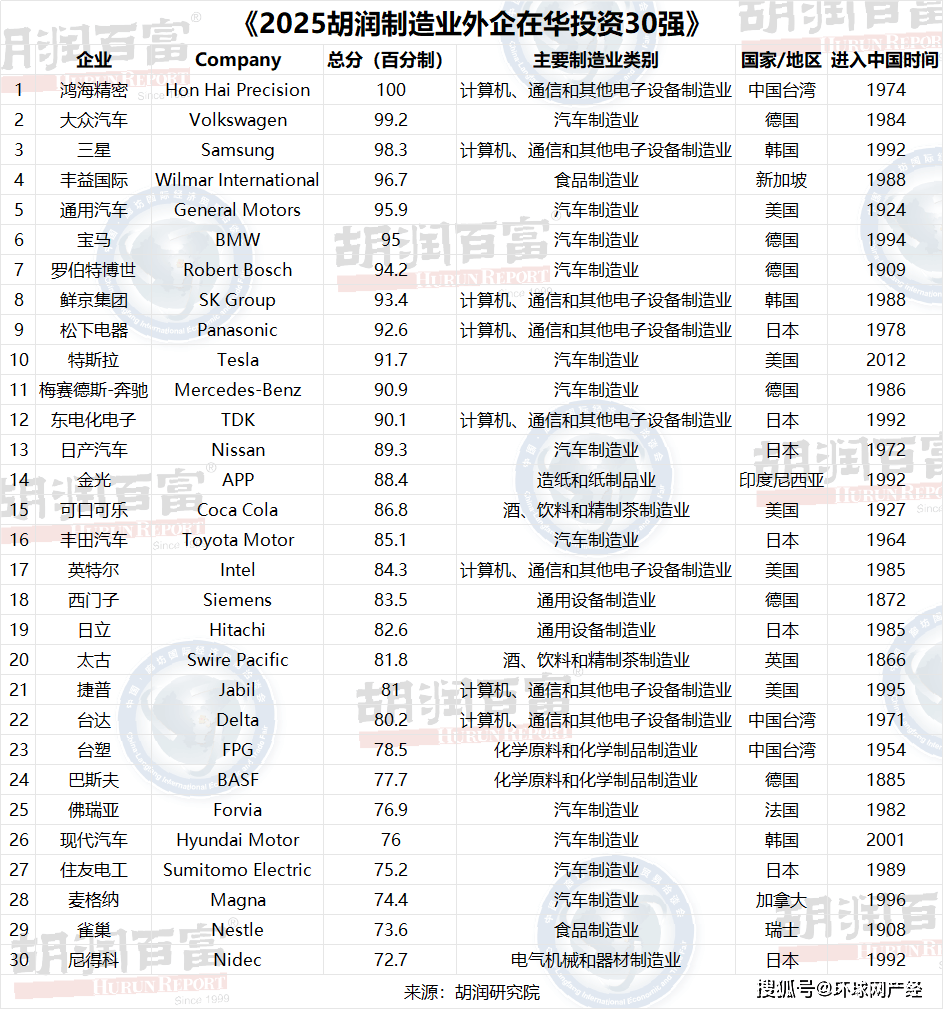
《2025胡润制造业外企在华投资30强》榜单。来源:胡润研究院,河北省商务厅 【环球网报道 记者 陈全】6月16日,中国·廊坊国际经济贸易洽谈会举办期间,胡润研究院联合河北省商务厅在廊坊发布《2025胡润制 造业外企在华投资30强》榜单(Hurun Largest Foreign & HK/Macau/Taiwan Manufacturing Companies in China 2025)。该榜单依据企业 最新财年在中国大陆的销售额和员工规模两大指标进行综合评估,列出了制造业领域最具代表性的30家在华外资企业。这是胡润研究 院首次发布该榜单。 | | | | 《2025胡润制造业外企在华投资30强》 | | | | | --- | --- | --- | --- | --- | --- | --- | | | | Company | 总分(自分制) | 主要制造业类别 | | 国家/地区 进入中国时间 | | 1 | 您要猜察 | Hon Hai Precision | 100 | 计算机、 通信和其他电子设备制造业 | 中国台湾 | 1974 | | 2 | 大众汽车 | Volkswagen | 99. ...


GM to invest $4B to boost U.S. manufacturing
Yahoo Finance· 2025-06-14 13:00
Production Expansion - GM will invest $4 billion to augment current plants to boost US production [1] - This investment will enable GM to assemble over 2 million vehicles annually [1] - The expansion is expected to create 3,000 to 4,000 union jobs [1] - Production of gas-powered Chevy Blazer and Chevy Equinox will increase in the US [1] - Production of some gas-powered full-size SUVs and light duty pickups like the Silverado will move to Michigan [2] Trade and Tariff Impact - The production shift is a response to 25% sector tariffs on autos and USMCA imports [3] - These moves are viewed as a long-term mitigation effort [3] - GM anticipates $4 billion to $5 billion in tariff costs [3]

Legal & General: Expecting Double-Digit Returns In The Next 3 Years, Buy Confirmed
Seeking Alpha· 2025-06-14 08:28
Group 1 - The share price of Legal & General Group Plc has increased by nearly 30% over the past year, with a total return exceeding 40% when including dividends [1] - The company has undergone a strategic doubling down, which has contributed to its recent performance [1] Group 2 - The analysis is conducted by buy-side hedge professionals focusing on fundamental, income-oriented, long-term analysis across sectors in developed markets [1]

Annaly Capital Management (NLY) Suffers a Larger Drop Than the General Market: Key Insights
ZACKS· 2025-06-13 23:16
Company Performance - Annaly Capital Management (NLY) experienced a decline of 1.54% in its stock price, closing at $19.18, which was less than the S&P 500's daily loss of 1.13% [1] - Over the past month, NLY shares have decreased by 1.17%, while the Finance sector gained 1.24% and the S&P 500 increased by 3.55% [1] Earnings Projections - The upcoming earnings per share (EPS) for Annaly Capital Management is projected to be $0.71, reflecting a 4.41% increase from the same quarter last year [2] - Revenue is expected to reach $411 million, indicating a significant growth of 667.36% compared to the corresponding quarter of the previous year [2] Annual Forecast - For the entire year, the Zacks Consensus Estimates forecast earnings of $2.87 per share and revenue of $1.47 billion, representing increases of 6.3% and 492.83%, respectively, compared to the previous year [3] Analyst Estimates - Recent changes to analyst estimates for Annaly Capital Management are important as they reflect evolving short-term business trends, with positive revisions indicating optimism about the business outlook [4] Valuation Metrics - Annaly Capital Management is currently trading at a Forward P/E ratio of 6.78, which is a discount compared to the industry average Forward P/E of 8.48 [7] - The company has a PEG ratio of 4.29, which is higher than the average PEG ratio of 1.76 for REIT and Equity Trust stocks [7] Industry Context - The REIT and Equity Trust industry, part of the Finance sector, has a Zacks Industry Rank of 157, placing it in the bottom 37% of over 250 industries [8] - The Zacks Industry Rank measures the strength of industry groups based on the average Zacks Rank of individual stocks, with top-rated industries outperforming the bottom half by a factor of 2 to 1 [8]

Harvest Gold Announces Annual General Meeting Results
Thenewswire· 2025-06-13 10:30
Company Overview - Harvest Gold Corporation is focused on exploring near surface gold deposits and copper-gold porphyry deposits in politically stable mining jurisdictions [2] - The board of directors, management team, and technical advisors have a collective geological and financing experience exceeding 400 years [2] AGM Results - The annual general meeting (AGM) held on June 12, 2025, resulted in all resolutions being approved with over 99% of votes cast in favor [1] - A total of 21,129,144 common shares were voted, representing 23.97% of the issued and outstanding common shares [1] Board Appointments - Len Brownlie was appointed as Chair of the board, with Edward Zablotny and Patrick Donnelly appointed to the Audit Committee, and Patrick Donnelly and Edward Zablotny to the Compensation Committee [2] - The number of Directors was set at five, with Richard Mark, Christopher P. Cherry, Edward Zablotny, Patrick Donnelly, and Len Brownlie elected as directors [6] Project Details - Harvest Gold has three active gold projects in the Urban Barry area, totaling 377 claims covering 20,016.87 hectares, located approximately 45-70 km west of the Gold Fields - Windfall Deposit [3] - The three properties, Mosseau, Urban-Barry, and LaBelle, cover over 50 km of favorable strike along mineralized shear zones [4] Auditor Re-appointment - Dale Matheson Carr-Hilton Labonte LLP was re-appointed as the auditor of the Company [6] Stock Options Plan - The Company's 10% Rolling Stock Options Plan was re-approved during the AGM [6]

Innovent to Present Multiple R&D Results of General Biomedicine Pipeline at the ADA's 85th Scientific Sessions
Prnewswire· 2025-06-13 01:00
Core Viewpoint - Innovent Biologics is set to present multiple clinical study results of mazdutide at the American Diabetes Association's 85th Scientific Sessions, highlighting its potential as a next-generation treatment for Type 2 Diabetes (T2D) and other metabolic diseases [1] Group 1: Clinical Studies and Presentations - The first Phase 3 study of mazdutide in Chinese adults with T2D (DREAMS-1) will be presented orally [1] - Multiple exploratory mechanism of action (MoA) analyses of mazdutide and a preclinical study of IBI3030 will be showcased in poster presentations [1] - The presentations include various studies on mazdutide's effects on liver fat accumulation, hyperuricemia, and cardiovascular risk markers [1][1][1] Group 2: Product Development and Regulatory Status - Mazdutide is currently under review with two New Drug Applications (NDAs) accepted by the National Medical Products Administration (NMPA) [4] - The drug is being evaluated in six Phase 3 clinical studies, with GLORY-1, DREAMS-1, and DREAMS-2 having met their primary endpoints [4] - Innovent has plans for several new clinical studies involving mazdutide, targeting conditions such as metabolic dysfunction-associated steatohepatitis (MASH) and heart failure with preserved ejection fraction (HFpEF) [7] Group 3: Company Overview and Partnerships - Innovent Biologics, founded in 2011, focuses on developing high-quality biopharmaceuticals for various diseases, including oncology and metabolic disorders [4] - The company has launched 15 products and has 3 new drug applications under regulatory review, with 4 assets in Phase III trials and 15 molecules in early clinical stages [4] - Innovent collaborates with over 30 global healthcare companies, including Eli Lilly, to enhance its product offerings and market reach [4]

First Hydrogen Corp. Provides Update on Canada Postal Negotiations and Voting at the Company's 2025 Annual General Meeting
Newsfile· 2025-06-12 23:10
Company Update - First Hydrogen Corp. is advising shareholders to vote by internet or phone due to ongoing Canada Postal negotiations and the proxy cut-off time of 10 a.m. Pacific Time on July 16, 2025, ahead of the annual general meeting on July 18, 2025 [2] - Detailed voting instructions are available on the company's website and shareholders must contact Computershare Trust Company of Canada for a control number before voting [3][4] Company Overview - First Hydrogen Corp. is focused on zero-emission vehicles and green hydrogen production and distribution, with operations in Vancouver, Montreal, Germany, and London [5] - The company has designed and built two hydrogen fuel-cell-powered light commercial vehicles (FCEV) that are road-legal in the UK, having completed 6,000 km of testing and achieving a range of over 630 kilometers on a single refueling [5]

Why Casey's General Stores Stock Skyrocketed This Week
The Motley Fool· 2025-06-12 17:38
Core Insights - Casey's General Stores experienced a 13% increase in share price following the announcement of strong fourth-quarter earnings, with EBITDA and earnings per share growth of 20% and 12% respectively, surpassing analysts' expectations [1][2] - The company announced a 14% increase in dividends, contributing to the rise in share price [2] - Casey's operates approximately 2,900 locations across 20 states, having expanded significantly since its inception in Iowa, and has shown a remarkable growth of 258 times since 1990 [3] Expansion and Growth Strategy - Management plans to grow the store count by 9% in 2025, indicating ongoing expansion efforts [5] - The company employs a mergers and acquisitions strategy focused on acquiring convenience stores lacking a strong food presence, subsequently enhancing profitability by introducing Casey's kitchen offerings [6] Valuation and Performance Comparison - Despite recent successes, Casey's valuation remains reasonable at 17 times cash from operations, especially when compared to Domino's Pizza, which has a higher valuation of 23 times cash from operations despite lower profit growth [7]


General Motors to Make an Investment of $4B in Three U.S. Plants
ZACKS· 2025-06-12 16:06
Core Insights - General Motors Company (GM) plans to invest approximately $4 billion across three U.S. assembly plants, shifting or expanding production of two vehicles currently made in Mexico amid ongoing trade negotiations and tariffs imposed by the Trump administration [1][3][10] Investment Plans - GM will begin producing gas-powered Chevrolet Blazer and Equinox at two U.S. plants, repurposing an idled Michigan plant for gas-powered SUVs and trucks starting in 2027 [2][5] - The investment will expand GM's U.S. production capacity to over two million vehicles annually by 2027, with specific plants focusing on both gas-powered and electric vehicles [4][10] Production Strategy - The production of the Blazer will fully relocate to the U.S., while Equinox output will supplement existing production in Mexico, which will continue to serve other markets [2][10] - GM's Factory ZERO in Detroit will focus exclusively on electric vehicles, while the Fairfax Assembly in Kansas will begin building the gas-powered Equinox by mid-2027 [4][5] Financial Outlook - GM maintains a capital spending forecast of $10–$11 billion for 2025 and anticipates annual spending of $10–$12 billion through 2027, reflecting a cautious approach to production plans in light of tariffs [6][10] - The company is taking a wait-and-see approach regarding regulatory clarity, with potential international trade agreements providing some reassurance [6] Market Position - GM currently holds a Zacks Rank of 5 (Strong Sell), while other auto stocks like CarGurus, Strattec Security Corporation, and Michelin have better rankings [7]