
新能源汽车产业

Search documents
汽车行业月报:淡季产销阶段性承压,车企陆续披露年报
Zhongyuan Securities· 2026-03-23 10:24
Investment Rating - The report maintains an investment rating of "Outperform the Market" for the automotive industry [4][6]. Core Insights - The automotive industry index has underperformed the Shanghai Composite Index by 5.08 percentage points, ranking 17th among 30 primary industries [4][11]. - The automotive production and sales in February 2026 were significantly impacted by seasonal factors and the Spring Festival, with production and sales down 31.7% and 23.1% month-on-month, and down 20.5% and 15.2% year-on-year, respectively [6][30]. - The market share of domestic brands in the passenger car segment has increased to 70.2%, reflecting a 3.33 percentage point rise [6][50]. - The report highlights a stable performance in the commercial vehicle market, with production and sales showing positive growth in the first two months of 2026 [6][56]. - The penetration rate of new energy vehicles reached 42.37% in February 2026, with production and sales down 21.8% and 14.2% year-on-year, respectively [6][63]. Industry Performance Review - As of March 20, 2026, the automotive industry index has decreased by 8.13%, underperforming the Shanghai Composite Index [11][20]. - The automotive sector has seen a decline in individual stock performance, with only 7% of stocks rising in March 2026 [16][17]. - The industry valuation has decreased, with a PE ratio of 31.51, ranking 15th among 30 primary industries [20][21]. Key Data Tracking - In February 2026, the automotive production and sales figures were 1.672 million and 1.805 million units, respectively, reflecting a significant decline due to various factors [6][30]. - The passenger car market faced challenges, with production and sales of 1.4 million and 1.536 million units, respectively, showing a year-on-year decline [44][50]. - The commercial vehicle market showed resilience, with production and sales of 273,000 and 270,000 units, respectively, maintaining positive growth in the first two months of 2026 [56][57]. - New energy vehicle production and sales in February 2026 were 695,000 and 765,000 units, respectively, with a year-on-year decline [63][67]. Important Company News - The report notes that NIO achieved its first quarterly profit in Q4 2025, with a significant improvement in financial health [83]. - Geely's revenue for 2025 reached 345.2 billion, with a net profit increase of 36%, driven by strong performance in its new energy brand [84]. - Chery reported a revenue of 300.3 billion for 2025, with a net profit growth of 34.6%, indicating a positive trend in its financial performance [84].

锂电池行业月报:销量短期回落,板块持续关注-20260316
Zhongyuan Securities· 2026-03-16 08:46
Investment Rating - The report maintains an "Outperform" rating for the lithium battery industry [1][7]. Core Insights - The lithium battery sector showed a strong performance in February 2026, with the lithium battery index rising by 6.21%, outperforming the Shanghai and Shenzhen 300 index, which only increased by 0.09% [4][11]. - In February 2026, China's new energy vehicle sales fell to 765,000 units, a year-on-year decrease of 14.24% and a month-on-month decline of 19.05%, primarily due to adjustments in the purchase tax policy and insufficient consumer willingness during the Spring Festival [7][17]. - The report highlights that the overall price trend of upstream raw materials is mixed, with battery-grade lithium carbonate prices at 158,000 CNY/ton, up 5.33% from early February 2026, while lithium hydroxide prices decreased by 3.77% [7][48]. - The report emphasizes the importance of monitoring raw material price trends, monthly sales, domestic and international policies, and advancements in solid-state batteries for investment opportunities in the sector [7][20]. Summary by Sections Market Review - In February 2026, the lithium battery index outperformed the Shanghai and Shenzhen 300 index by 6.12 percentage points, with 80 stocks in the lithium battery sector rising and 23 falling [11][14]. - The top five gainers in the lithium battery concept sector included companies like Far East Holdings and Xiamen Tungsten, with gains ranging from 19.86% to 24.19% [11][14]. New Energy Vehicle Sales and Industry Prices - In 2023, China's total new energy vehicle sales reached 9.448 million units, a year-on-year increase of 37.48% [16]. - The report notes that the sales of new energy vehicles in February 2026 accounted for 42.38% of total vehicle sales, reflecting a year-on-year increase of 1.32 percentage points [17][18]. - The report projects that the demand for energy storage lithium batteries will grow significantly, outpacing that of power batteries, as they play a crucial role in the construction of a new energy system [20]. Industry and Company News - The report mentions a partnership between LG Energy Solution and Hanwha Group for a 5GWh lithium-ion battery energy storage system for a U.S. project, highlighting ongoing developments in the industry [62]. - The Sichuan Provincial Development and Reform Commission has issued policies to encourage the replacement of old vehicles, which may impact the new energy vehicle market positively [62].

新能源汽车行业周报:美国取消部分电池材料关税,产业景气度迎来上行
Huaxin Securities· 2026-03-16 00:45
Investment Rating - The report maintains a "Recommended" rating for the new energy vehicle industry [2][3]. Core Insights - The supply-demand structure is continuously optimizing, with many product prices on the rise. In February, China's new energy vehicle production and sales reached 694,000 and 765,000 units, respectively, down 21.8% and 14.2% year-on-year. Cumulatively, from January to February, production and sales totaled 1.735 million and 1.71 million units, down 8.8% and 6.9% year-on-year. New energy vehicles accounted for 41.2% of total new car sales. The supply side is seeing new products from battery and main engine manufacturers, with positive feedback from demand, leading to a continuous optimization of the supply-demand structure. Prices are stabilizing and rising, particularly for lithium carbonate and lithium iron phosphate, with strong demand and tight supply [3][4][5]. Summary by Sections 1. Market Tracking - The new energy vehicle index, lithium battery index, fuel cell index, charging pile index, and energy storage index had weekly changes of +0.91%, +5.37%, -0.79%, -2.15%, and +5.55%, respectively. Notable performers included Foshan Technology, Hunan Youneng, and Penghui Energy, with increases of 29.9%, 22.6%, and 22.0% [4][24]. 2. Lithium Battery Industry Chain Price Tracking - Since the beginning of the year, lithium carbonate prices have increased by 33.1%, driving up lithium iron phosphate by 27.3%. This week, lithium carbonate was priced at 159,100 CNY/ton, up 2.5% from last week. Other materials like nickel and cobalt also saw slight increases [29][30][32]. 3. Production and Sales Data Tracking - In February, the production and sales of new energy vehicles were 694,000 and 765,000 units, respectively, with year-on-year declines of 21.8% and 14.2%. Cumulatively, from January to February, production and sales reached 1.735 million and 1.71 million units, with new energy vehicles making up 41.2% of total new car sales [45][49]. 4. Industry Dynamics - The U.S. has decided not to impose tariffs on battery materials imported from China, which is expected to positively impact the industry. Additionally, significant developments in the new energy sector were highlighted, including NIO's record quarterly profit and Li Auto's substantial revenue growth [71][68][69]. 5. Key Company Announcements - Companies like Shenling Environment and Jiebang Technology have made significant announcements regarding investments and shareholder changes, indicating active engagement in the market [73][74][75]. 6. Industry Rating and Investment Strategy - The report suggests focusing on high-potential areas such as data center liquid cooling, solid-state batteries, battery materials, robotics, and autonomous driving, while maintaining a positive outlook on the new energy vehicle industry [3][4].


瑞达期货碳酸锂产业日报-20260302
Rui Da Qi Huo· 2026-03-02 08:39
Report Industry Investment Rating - Not provided in the content Core Viewpoints - The lithium carbonate market is in a stage of increasing supply and demand. Short - term demand growth may lead to a slight reduction in industrial inventory. It is recommended to conduct light - position oscillating trading and control risks by paying attention to trading rhythm [2] - The options market sentiment is bearish, and the implied volatility is decreasing [2] Summary by Directory Futures Market - The closing price of the main contract is 172,020 yuan/ton, down 4,020 yuan; the net position of the top 20 is - 129,918 hands, up 2,610 hands; the position of the main contract is 378,336 hands, down 3,216 hands; the spread between near and far - month contracts is - 2,060 yuan/ton, up 1,960 yuan; the Guangzhou Futures Exchange warehouse receipt is 38,196 hands/ton, down 265 hands [2] Spot Market - The average price of battery - grade lithium carbonate is 172,500 yuan/ton, up 500 yuan; the average price of industrial - grade lithium carbonate is 169,000 yuan/ton, up 500 yuan; the basis of the Li₂CO₃ main contract is 480 yuan/ton, up 4,520 yuan [2] Upstream Situation - The average price of spodumene concentrate (6% CIF China) is 2,155 US dollars/ton, unchanged; the average price of amblygonite is 15,050 yuan/ton, down 300 yuan; the price of lithium mica (2 - 2.5%) is 7,963 yuan/ton, unchanged [2] Industry Situation - The monthly output of lithium carbonate is 59,470 tons, up 2,650 tons; the monthly import volume is 23,988.66 tons, up 1,933.47 tons; the monthly export volume is 911.90 tons, up 152.66 tons; the enterprise start - up rate is 49%, up 2 percentage points; the monthly output of power batteries is 168,000 MWh, down 33,700 MWh [2] Downstream and Application Situation - The prices of manganese acid lithium, lithium hexafluorophosphate, cobalt acid lithium, and various ternary materials remain unchanged. The start - up rates of ternary cathode materials and lithium iron phosphate cathode are 0%, down 50 and 60 percentage points respectively. The monthly output of new energy vehicles is 1,041,000, down 677,000; the monthly sales volume is 945,000, down 765,000; the cumulative sales penetration rate is 40.28%, down 7.65 percentage points; the cumulative sales volume is 945,000, up 1,000; the monthly export volume is 302,000, up 2,000; the cumulative export volume is 302,000, up 152,000 [2] Option Situation - The total call position is 139,017, up 7,365; the total put position is 171,353, up 11,910; the put - call ratio of total positions is 123.26%, up 2.15 percentage points; the at - the - money IV implied volatility is 0.69, down 0.0293 [2] Industry News - In February 2026, the inventory warning index of Chinese automobile dealers was 56.2%, down 0.7 percentage points year - on - year and 3.2 percentage points month - on - month [2] - Shenzhen's plan supports automobile scrapping and renewal, with different subsidy standards for new - energy and fuel vehicles [2] - In Pudong New Area, personal consumers buying new cars can get district - level subsidies of up to 5,000 yuan from March 1, 2026 [2] - Some new - energy vehicle manufacturers released February delivery data and March purchase discount activities [2] - The 2025 National Economic and Social Development Statistical Bulletin shows that GDP increased by 5.0%, national total income increased by 5.1%, etc. [2]
比亚迪,出口首超国内!
DT新材料· 2026-03-01 16:05
Group 1 - The article discusses the February 2023 delivery data of various car manufacturers, highlighting significant sales figures for electric vehicles [2][3]. - BYD achieved a total of 190,190 electric vehicle sales in February, with 100,600 units exported, marking the first time exports surpassed domestic sales [3][4]. - Other manufacturers such as Leap Motor, Li Auto, and NIO reported deliveries of 28,067, 26,421, and 20,797 units respectively, with NIO showing a year-on-year growth of 57.6% [3][4]. Group 2 - The China Association of Automobile Manufacturers (CAAM) forecasts total vehicle sales in 2026 to reach 34.75 million units, a 1% increase year-on-year, with electric vehicle sales projected at 19 million units, reflecting a 15.2% growth [5]. - The article emphasizes the importance of recent government policies aimed at stimulating market demand and supporting the automotive industry during a critical transition period towards high-quality development [5].

春节假期高速公路充电量激增,为何充电焦虑却缓解了?
Xin Lang Cai Jing· 2026-02-28 01:39
Core Insights - The significant increase in electric vehicle (EV) usage and charging during the recent Spring Festival highlights advancements in China's EV technology and charging infrastructure [1][2][3] Group 1: Electric Vehicle Usage and Charging Data - During the Spring Festival from February 15 to February 23, there were 6.021 million charging instances, with a total charging volume of 14,976.75 million kilowatt-hours, averaging 1,664.08 million kilowatt-hours per day, representing a 52.01% increase compared to the previous year [1] - The number of electric vehicle charging guns at highway service areas reached 71,500, covering over 98% of service areas, with approximately 10,000 high-power charging facilities [2] Group 2: Technological Advancements - The range of mainstream pure electric models in China typically falls between 400 to 700 kilometers, with some high-end models exceeding 800 kilometers [2] - The introduction of 800V high-voltage platforms and the establishment of ultra-fast charging networks have enabled charging capabilities of 80% in just 15 minutes, significantly alleviating range anxiety for EV owners [2] Group 3: Infrastructure and Service Improvements - The Ministry of Transport and the National Energy Administration have implemented a Spring Festival support plan, which includes identifying busy charging service areas and deploying mobile emergency charging equipment [3] - The upgraded "e Road Smooth" app provides real-time charging station information, enhancing resource utilization by allowing charging stations to direct vehicles [3] Group 4: Future Infrastructure Plans - According to the "Three-Year Doubling Action Plan for Electric Vehicle Charging Facility Service Capacity (2025-2027)," by the end of 2027, 28 million charging facilities will be established nationwide, providing over 300 million kilowatts of public charging capacity to meet the needs of over 80 million electric vehicles [4]
加码本土供应链!欧盟出台新规:电动汽车本土生产比例达70%才能享受补贴【附新能源汽车出口情况分析】
Xin Lang Cai Jing· 2026-02-20 10:22
Group 1 - The European Commission plans to implement the "Industrial Acceleration Act" on February 25, which will set a strict localization threshold of 70% for electric vehicles to qualify for government subsidies [2] - As of November 2025, Chinese automakers hold a 12.8% market share in the EU's pure electric vehicle market, marking a historical high [2] - The EU's actions are seen as a response to the competitive pricing advantages of Chinese electric vehicles, with high anti-subsidy tariffs imposed on Chinese imports starting from October 2024 [2] Group 2 - China has emerged as the world's largest market and exporter of new energy vehicles (NEVs), with exports skyrocketing from $338 million in 2018 to $22.907 billion in 2022, reflecting a compound annual growth rate of 186.92% [3] - By 2025, China is projected to export 3.43 million NEVs, a 70% increase year-on-year, accounting for 41% of total vehicle exports [3] - The export value is expected to reach 516.05 billion yuan, representing a 51.7% year-on-year growth, achieving a historical high [3] Group 3 - China is the only country with a complete NEV industry chain, from raw material processing to core component manufacturing and vehicle assembly, achieving over 70% of global power battery installations [5] - Key materials for batteries have a domestic production rate exceeding 90%, and China has established advantages in high-voltage platforms and integrated battery systems [5] - The country supports an annual production capacity of over 16 million NEVs, becoming a core supply base for global automotive electrification [5] Group 4 - The president of Changan Automobile believes that the high-quality development of the global NEV industry is irreversible, with China exploring a successful path for the industry's growth [8] - By 2022, China's NEV market share reached 24.4%, the highest globally, driven by a large market size and continuous technological advancements [9] - This development model of "using the market to foster technology and using technology to strengthen the industry" provides a replicable and promotable example for the global automotive industry's transformation [9]
百吨级电动矿卡即将启航海外 武汉智汽园新春序曲“热辣滚烫”
Chang Jiang Ri Bao· 2026-02-11 00:52
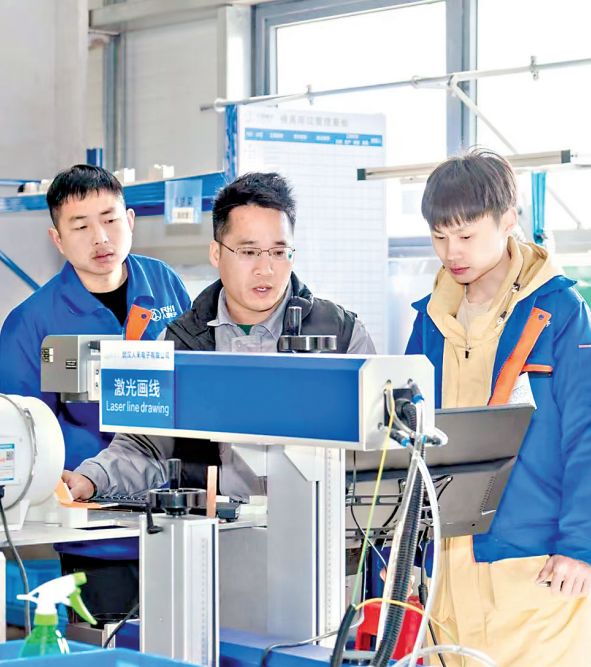
Core Viewpoint - The Wuhan Intelligent Connected and Electric Vehicle Industrial Park (referred to as "智汽园") is experiencing robust growth and development, with significant advancements in production capacity, community infrastructure, and strategic investments aimed at establishing a leading position in the new energy vehicle industry. Group 1: Production and Capacity - The 博雷顿 (Boreton) factory in Wuhan is focusing on large-tonnage unmanned electric mining trucks, with plans to launch the first 145-ton unmanned electric mining truck in November 2025 after its production base starts operations in May 2024 [1] - The factory has achieved a breakthrough by exporting 105-ton pure electric mining trucks to Africa, marking the first large-scale overseas shipment from Wuhan [1] - Current production capacity is 4 to 5 vehicles per day, which is expected to increase to 8 to 10 vehicles per day with the addition of a second production line in March [1] Group 2: Community and Infrastructure Development - The new materials industrial park within the 智汽园 has completed the first phase with 10 factory buildings, 9 of which are already occupied by companies, and the second phase is expected to be completed by September [2][3] - The park has signed leases for over 57,000 square meters, achieving a 33% occupancy rate, and is developing community facilities including shared meeting rooms, sports areas, and residential apartments [3] - A total of 1,842 housing units are planned to accommodate up to 9,000 residents, with 5 buildings already leased to various enterprises [3][4] Group 3: Economic Performance and Future Goals - In 2025, the park is projected to add 4,110 new market entities, with total revenue from "四上" enterprises exceeding 100 billion yuan and industrial output reaching 55.8 billion yuan, a 14% increase year-on-year [4] - The park aims for a target of 40 billion yuan in new output value, over 300,000 vehicle production, and attracting no less than 30 billion yuan in investments for 2026 [4] - The park is also focusing on technological advancements and the development of future projects such as flying cars, enhancing its industrial cohesion and talent attraction [4][5]
新能车ETF(515700)红盘向上,1月新能源车销量亮眼
Xin Lang Cai Jing· 2026-02-04 06:50
Group 1 - The core viewpoint of the news highlights the positive performance of the new energy vehicle (NEV) sector, with significant sales growth reported for various manufacturers in January, including a 65.6% year-on-year increase in deliveries for Huawei's HarmonyOS vehicles [1] - The China Securities New Energy Vehicle Industry Index (930997) rose by 0.51% as of February 4, 2026, with notable increases in stock prices for companies such as Yinlun Technology (up 10.01%) and CATL (up 4.91%) [1] - Open Source Securities emphasizes the importance of high-end development in the NEV market, particularly in light of the expected impact of reduced purchase tax exemptions and new vehicle replacement subsidies on mainstream NEV sales [1] Group 2 - The New Energy Vehicle ETF (515700) closely tracks the China Securities New Energy Vehicle Industry Index, which includes 50 listed companies involved in various aspects of the NEV industry, reflecting the overall performance of leading companies in this sector [2] - As of January 30, 2026, the top ten weighted stocks in the index accounted for 54.51% of the total, with major players including BYD and CATL [2] - The ETF has several connection options for investors, including different classes of shares for the New Energy Vehicle ETF [2]
我国建成全球最大电动汽车充电网络 充电设施数量突破2000万大关
Jing Ji Ri Bao· 2026-01-29 06:59
Core Insights - China's electric vehicle charging infrastructure has reached 20.092 million units by the end of December 2025, including 4.717 million public charging facilities and 15.375 million private ones, supporting the charging needs of over 40 million new energy vehicles [1][3] Group 1: Infrastructure Development - The rapid development of charging infrastructure in China has transformed from a functional guarantee to a scene economy, as evidenced by the Yangcheng Lake service area, which now has 84 charging guns, significantly reducing wait times from 2 hours to a more efficient process [1] - The total charging power at the Yangcheng Lake service area has been increased to 5,120 kW, which is 21 times higher than five years ago, showcasing significant upgrades in capacity [1] - The Jiangsu Electric Power Company has implemented a health management system for charging facilities, utilizing digital twin and AI technologies for real-time monitoring and diagnostics, covering over 100 charging stations and thousands of charging piles [1] Group 2: Upgrades in Popular Areas - Charging facilities at popular tourist sites, such as the Tongli Ancient Town in Jiangsu, have been upgraded to enhance charging speed by 167%, reducing the time to charge from 10% to 90% battery capacity from 50 minutes to approximately 20 minutes [2] - A special upgrade plan initiated by the State Grid Suzhou Electric Power Company aims to enhance 698 charging piles in key areas and replace 558 old charging piles to eliminate "range anxiety" and improve urban green travel networks [2] Group 3: Future Goals and Trends - The development of charging facilities in China is characterized by rapid growth, with the number of charging stations reaching 10 million in just 18 months, compared to 5 years for the previous million [3] - Charging efficiency has improved, with the average charging power of public stations reaching 46.5 kW, a 33% year-on-year increase, enhancing the overall charging service experience [3] - By the end of 2027, China aims to establish 28 million charging facilities with over 300 million kW of public charging capacity, meeting the needs of over 80 million electric vehicles, effectively doubling the service capacity [3] Group 4: Industry Perspective - Experts indicate that the charging network is essential for the electric vehicle industry, ensuring that every electric vehicle can charge efficiently, thereby expanding the development space for China's new energy vehicle sector [4]