Alphabet(GOOG)

Search documents
深度解析谷歌版「豆包手机」:Android 的统治者下了一盘什么棋?
3 6 Ke· 2026-02-27 01:47
Core Insights - The article discusses the evolution of AI in hardware design, particularly focusing on the collaboration between Google and Samsung in developing the Gemini AI capabilities for the Galaxy S26 series, which aims to enhance user interaction with smartphones [1][2][3]. Group 1: AI Integration in Hardware - AI is beginning to reshape hardware design, with devices like the Galaxy S26 incorporating new functionalities that allow for automated tasks through voice commands [3][5]. - The Gemini AI can perform tasks such as ordering food or booking rides by mimicking human interactions with apps, showcasing a significant advancement in user experience [8][9]. Group 2: Collaboration and Ecosystem - The partnership between Google and Samsung is pivotal, as Google, being the owner of the Android operating system, brings substantial influence to the integration of AI into mobile devices [6][20]. - The introduction of the AppFunctions framework allows developers to expose specific app functionalities for AI assistants to utilize, enhancing compatibility and user experience across various applications [20][23]. Group 3: Future Directions and Challenges - Google plans to expand the capabilities of Gemini beyond smartphones to other devices like smart glasses and cars, indicating a broader vision for AI integration in daily life [35][36]. - The article highlights potential challenges, including privacy concerns and competition among hardware manufacturers, AI model providers, and application platforms, which could complicate the implementation of AI automation [36][38].



数据中心互联技术专题:AI变革推动OCS新技术快速发展
Guoxin Securities· 2026-02-27 00:45
Investment Rating - The report maintains an "Outperform" rating for the industry [2] Core Viewpoints - Optical Circuit Switch (OCS) technology enables direct switching of optical signals between fiber ports without optical-electrical-optical (O/E/O) conversion, significantly reducing latency and power consumption, with potential power savings of over 30% for AI computing clusters and data center interconnects [3][4][92] - The OCS market is expected to grow rapidly, with a projected market size exceeding $2.5 billion by 2029, driven by increasing demand from AI data centers and enhanced customer penetration [4][81] - The report highlights four main technology routes for OCS: MEMS, liquid crystal, piezoelectric, and silicon waveguide, with MEMS technology currently leading the market [4][14][92] Summary by Sections 1. OCS as a New Photonic Interconnect Technology - OCS technology allows for high bandwidth capabilities and low latency, making it suitable for modern data center demands [13] - The technology is transparent to rate and protocol, allowing for seamless upgrades without hardware replacement [13] - OCS can be incrementally deployed and expanded, reducing initial capital investment [13] 2. OCS Applications for AI Data Centers - Google has been at the forefront of developing ASIC chips, with the latest TPU generation utilizing OCS technology for enhanced interconnectivity [51][64] - The TPU architecture requires a significant number of ports, indicating a growing demand for OCS solutions [71] 3. OCS Industry Chain Company Layout - Various companies are positioned within the OCS industry chain, including Silex, Tengjing Technology, and Zhongji Xuchuang, each focusing on different aspects of OCS technology and components [83][84] - The report emphasizes the importance of collaboration between domestic manufacturers and leading global firms to capitalize on the OCS market growth [84] 4. Investment Recommendations - The report suggests focusing on companies within the OCS supply chain, particularly those with established partnerships with leading international firms, as they are likely to benefit from the industry's growth [4][90]


24小时环球政经要闻全览 | 2月27日
Ge Long Hui A P P· 2026-02-27 00:40
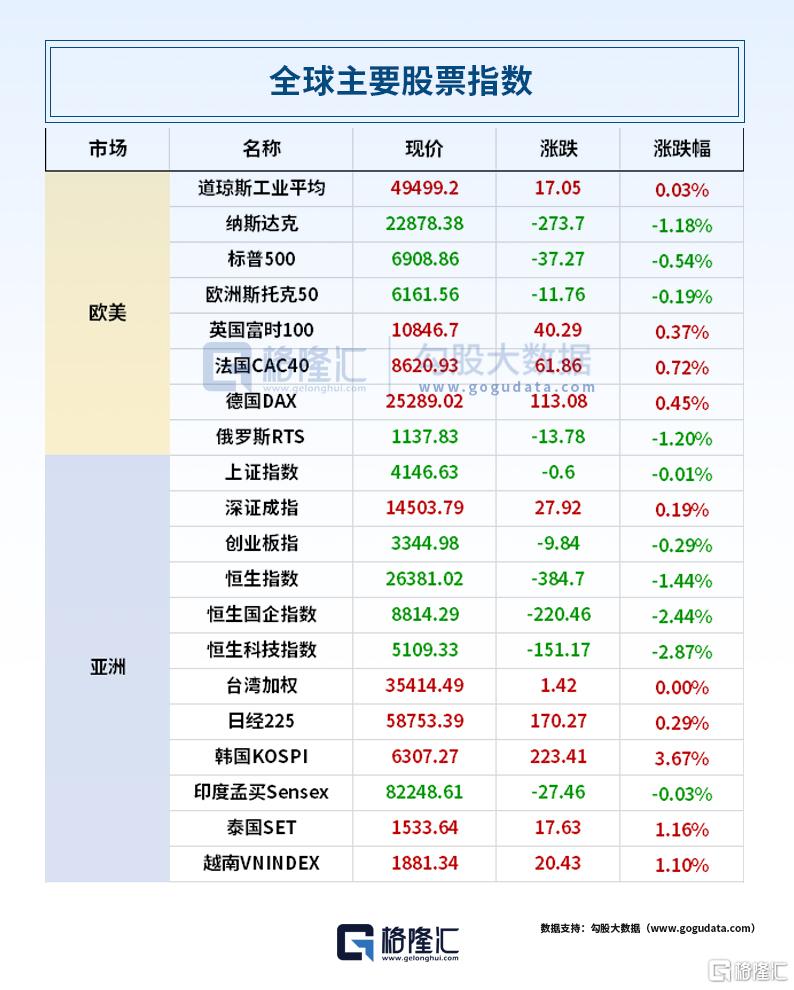
Market Overview - Major global stock indices showed mixed performance, with the Dow Jones Industrial Average up by 17.05 points (0.03%) to 49,499.2, while the Nasdaq fell by 273.7 points (-1.18%) to 22,878.38 [1] - The S&P 500 decreased by 37.27 points (-0.54%) to 6,908.86, while the European Stoxx 50 dropped by 11.76 points (-0.19%) to 6,161.56 [1] - In Asia, the Hang Seng Index fell by 220.46 points (-2.44%) to 8,814.29, while the Nikkei 225 rose by 170.27 points (0.29%) to 58,753.39 [1] Geopolitical Developments - Tensions escalated between Pakistan and Afghanistan following intense border clashes, with Pakistan conducting airstrikes in response to casualties and territorial losses [2] - Significant progress was reported in US-Iran nuclear negotiations, with plans for further discussions in Vienna, aimed at de-escalating regional tensions [3] - The US Treasury proposed new regulations to cut off Swiss MBaer Bank from the US financial system due to alleged support for illegal activities related to Russia and Iran [3] Technology and Innovation - DeepSeek, in collaboration with Tsinghua and Peking University, released a paper on the DualPath model inference system, enhancing offline inference by up to 1.87 times and online service by 1.96 times [4] - ASML confirmed that its next-generation EUV lithography machines are ready for mass production, which will significantly impact advanced semiconductor manufacturing [5] - Broadcom announced the shipment of the industry's first 3.5D face-to-face computing SoC, utilizing 2nm technology to support next-generation AI computing needs [6] Corporate Actions - Netflix rejected a bid to increase its offer for Warner Bros. Discovery, citing financial concerns, and announced a stock buyback plan, leading to a 10% increase in its after-hours stock price [5]



全球大公司要闻 | 李嘉诚再售英国资产,苹果接受三星内存报价翻倍
Wind万得· 2026-02-27 00:31
Group 1 - Nvidia's CEO Jensen Huang stated that the demand for computing is growing exponentially, and the adoption rate of Agentic AI is experiencing explosive growth, with clients accelerating investments in AI computing power [2] - Baidu projects total revenue of 129.1 billion yuan by 2025, with AI business revenue of 40 billion yuan and a net profit of 5.6 billion yuan, driven by growth in core AI new businesses [2] - Cheung Kong Infrastructure, Power Assets, and CK Hutchison announced the sale of their UK Power Networks stake to Engie for over 110 billion HKD, indicating plans for future investments and acquisitions [2] Group 2 - NIO's chip subsidiary Anhui Shenji Technology completed its first round of financing, raising over 2.2 billion yuan, with a post-investment valuation nearing 10 billion yuan [5] - iQIYI expects total revenue of 6.79 billion yuan in Q4 2025, with a net loss of 5.8 million yuan, while annual revenue is projected at 27.29 billion yuan [6] - JD.com launched a "100 Billion Supermarket" channel on its app, planning to invest over 20 billion yuan in subsidies over the next three years to boost sales [7] Group 3 - Amazon plans to invest $50 billion in OpenAI, contingent on two triggers: an IPO or achieving AGI [10] - Apple has accepted a 100% price increase for Samsung's storage chips for the iPhone 17, which may significantly raise production costs [10] - Tesla China is offering promotional financing options for its vehicles, including zero-interest loans for certain models [11] Group 4 - Samsung Electronics reported DRAM sales of $19.3 billion in Q4, regaining a 36% market share, and confirmed plans for silicon-carbon anode batteries for smartphones [15] - Toyota plans to sell approximately $19 billion in cross-shareholdings to advance governance reforms, while January production in Japan fell by 6.1% [15] - LG Energy Solution has reached an agreement with Tesla to produce lithium iron phosphate batteries in the U.S., investing 5.94 trillion KRW [15]




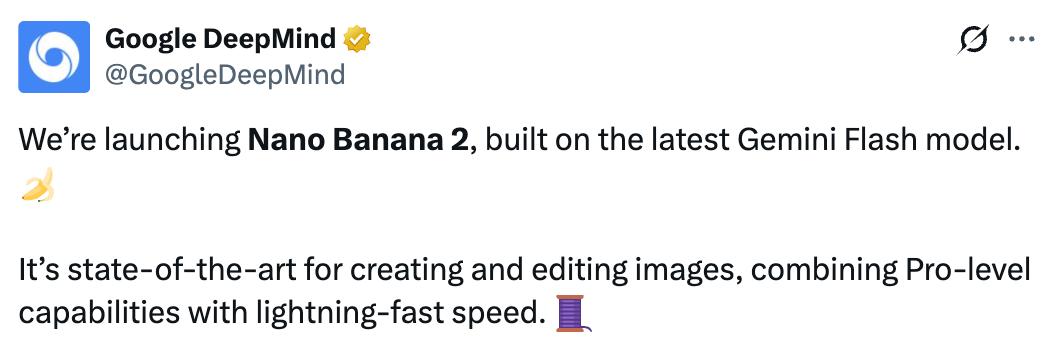
谷歌生图新王Nano Banana 2深夜突袭,性能屠榜速度飞升,价格腰斩
3 6 Ke· 2026-02-27 00:15
Core Insights - Google has officially launched its latest image generation and editing model, Nano Banana 2 (Gemini 3.1 Flash Image), which is now integrated across its product line including Gemini applications, search, and AI Studio [1][2]. Performance and Features - Nano Banana 2 combines professional-level features with flash-speed performance, achieving significant upgrades in world knowledge, image quality, reasoning ability, and subject consistency, outperforming leading models like GPT-Image 1.5 and Seedream 5.0 Lite in benchmark tests [2][4]. - The model generates images with enhanced detail realism and improved instruction execution, particularly in rendering text and understanding traditional Chinese culture [4][12]. Pricing and Accessibility - Despite its enhanced capabilities, the pricing for Nano Banana 2 has decreased, with input image costs dropping from $2 to $0.5 and output image costs halving from $0.134 to $0.067 on the Google AI Studio platform [8][10]. - Nano Banana 2 has replaced Nano Banana Pro in various Google applications, while Pro and Ultra subscription users can still opt to use Nano Banana Pro for specific tasks [10][40]. Technical Upgrades - The model features advanced world knowledge, allowing it to accurately present specific themes and create infographics, as well as improved text rendering and translation capabilities [32]. - It maintains subject consistency across multiple characters and objects, enhancing narrative creation and storyboard development [35]. Applications and Use Cases - Google has developed several demonstration applications utilizing Nano Banana 2, including "Window Seat," which creates realistic window views inspired by global locations and real-time weather data, and "Global Ad Localizer," which translates advertisements for international markets [37][38]. - The model supports various resolutions from 512px to 4K, optimizing efficiency and allowing for quick iterations in high-load processing workflows [39]. Industry Context - The global AI image generation competition is intensifying, with Google shifting focus from mere image quality to integrating world knowledge, precise instruction execution, and production efficiency [42]. - The launch of Nano Banana 2 marks a strategic move in Google's product matrix, positioning the Pro version for professional accuracy while targeting broader applications with the Flash version's speed and affordability [42].
Meta据悉与谷歌达成AI芯片租用协议
Xin Lang Cai Jing· 2026-02-27 00:10
Core Insights - Meta has signed a multi-year agreement to lease Google's artificial intelligence chips, specifically tensor processing units, for the development of new AI models [1][1] - The deal is reported to be worth several billion dollars [1][1] Company Summary - Meta is leveraging Google's advanced AI technology to enhance its AI model development capabilities [1] - The partnership indicates a significant investment in AI infrastructure by Meta, reflecting the growing importance of AI in the tech industry [1] Industry Summary - The agreement highlights the competitive landscape in the AI sector, where companies are increasingly collaborating to access cutting-edge technology [1] - The financial commitment of several billion dollars underscores the high stakes and potential returns associated with AI advancements [1]

Meta signs multi-billion-dollar deal to rent Google AI chips, The Information reports
Yahoo Finance· 2026-02-26 23:28
Group 1 - Meta Platforms has signed a multi-billion dollar deal with Google to rent AI chips for developing new AI models, reflecting the increasing investment in AI infrastructure by companies [1] - Advanced Micro Devices announced it would sell up to $60 billion in AI chips to Meta, and Meta has also signed a deal with Nvidia for current and future AI chips [2] - Google is working to make its Tensor Processing Units (TPUs) a competitive alternative to Nvidia's GPUs, with TPU sales becoming a significant growth driver for Google's cloud revenue [3] Group 2 - Meta is reportedly in discussions with Google to purchase TPUs for its data centers, with potential agreements expected as early as next year [3] - Google has entered into an agreement with a large investment firm to fund a joint venture that will lease TPUs to other customers [4]
Google signs multibillion-dollar AI chip deal with Meta, Information reports
Reuters· 2026-02-26 23:28
Group 1 - Meta Platforms has signed a multi-year deal with Google to rent AI chips, specifically tensor processing units, for the development of new AI models [1] - The deal is reported to be worth billions of dollars, indicating a significant investment in AI technology by Meta [1]

Concentrating On Concentration
Seeking Alpha· 2026-02-26 21:39
Core Insights - The US stock market is significantly dominated by a few technology companies, referred to as the "Magnificent Seven," which include Apple, Microsoft, Nvidia, Amazon, Alphabet, Meta, and Tesla, collectively representing over 30% of the total market value [1] Group 1: Market Concentration - The "Magnificent Seven" are all technology firms, highlighting the concentration of market value within this sector [1] Group 2: Industry Expert Background - Victor Haghani has 30 years of experience in markets and financial innovation, starting his career in 1984 at Salomon Brothers and later becoming a founding partner of LTCM [1] - After a decade away from investing, Haghani founded Elm Wealth in 2011 to assist investors in managing their savings effectively and capturing long-term returns [1] - His research primarily focuses on trade sizing, portfolio choice, and lifetime consumption, with a notable TEDx talk titled "Where are all the billionaires, and why should we care?" [1]




Google Gemini Image Upgrade Pressures Adobe, Figma Shares Thursday
Benzinga· 2026-02-26 21:37
Group 1 - Google's Gemini team launched Nano Banana 2, offering high-quality image generation for free, which could disrupt Adobe's Creative Cloud offerings [2][3] - The introduction of a free alternative from Google may pressure Adobe's ability to sell Firefly credits and premium services, raising concerns about potential slowdowns in growth within its Digital Media segment [3] - Figma's browser-based design suite may face competition from Gemini, as teams could generate images and layouts for free, potentially impacting Figma's paid services and requiring discounts or increased investment in proprietary models [4] Group 2 - Adobe shares closed at $259.04, up by 0.48%, while Figma shares fell by 3.27% to $30.22 on the same day [5]