Alphabet(GOOG)

Search documents
Alphabet Printed The Best Hyperscaler Quarter, And The Market Still Found A Reason To Sell
Seeking Alpha· 2026-02-21 07:19
Core Viewpoint - The individual investor adopts a contrarian investment style, focusing on stocks that have recently experienced sell-offs due to non-recurrent events, particularly when insiders are buying shares at lower prices [1] Group 1: Investment Strategy - The investment portfolio is split approximately 50%-50% between shares and call options, indicating a balanced approach to risk and return [1] - The investor's timeframe for holding positions typically ranges from 3 to 24 months, suggesting a medium-term investment horizon [1] - Fundamental analysis is employed to assess the health of companies, including their leverage and financial ratios compared to sector and industry averages [1] Group 2: Stock Selection Criteria - The investor screens thousands of stocks, primarily in the US, looking for those that have undergone recent sell-offs [1] - A key criterion for stock selection is insider buying at the new lower price, which may indicate confidence in the company's future [1] - Professional background checks are conducted on insiders who purchased shares after the sell-off, adding a layer of due diligence [1] Group 3: Technical Analysis - Technical analysis is utilized to optimize entry and exit points, with a focus on support and resistance levels on weekly charts [1] - Multicolor lines are used for visualizing support and resistance, and trend lines are drawn to identify patterns [1]



反转!巨佬卖飞7倍牛股,押中这家巨头
Sou Hu Cai Jing· 2026-02-21 07:15
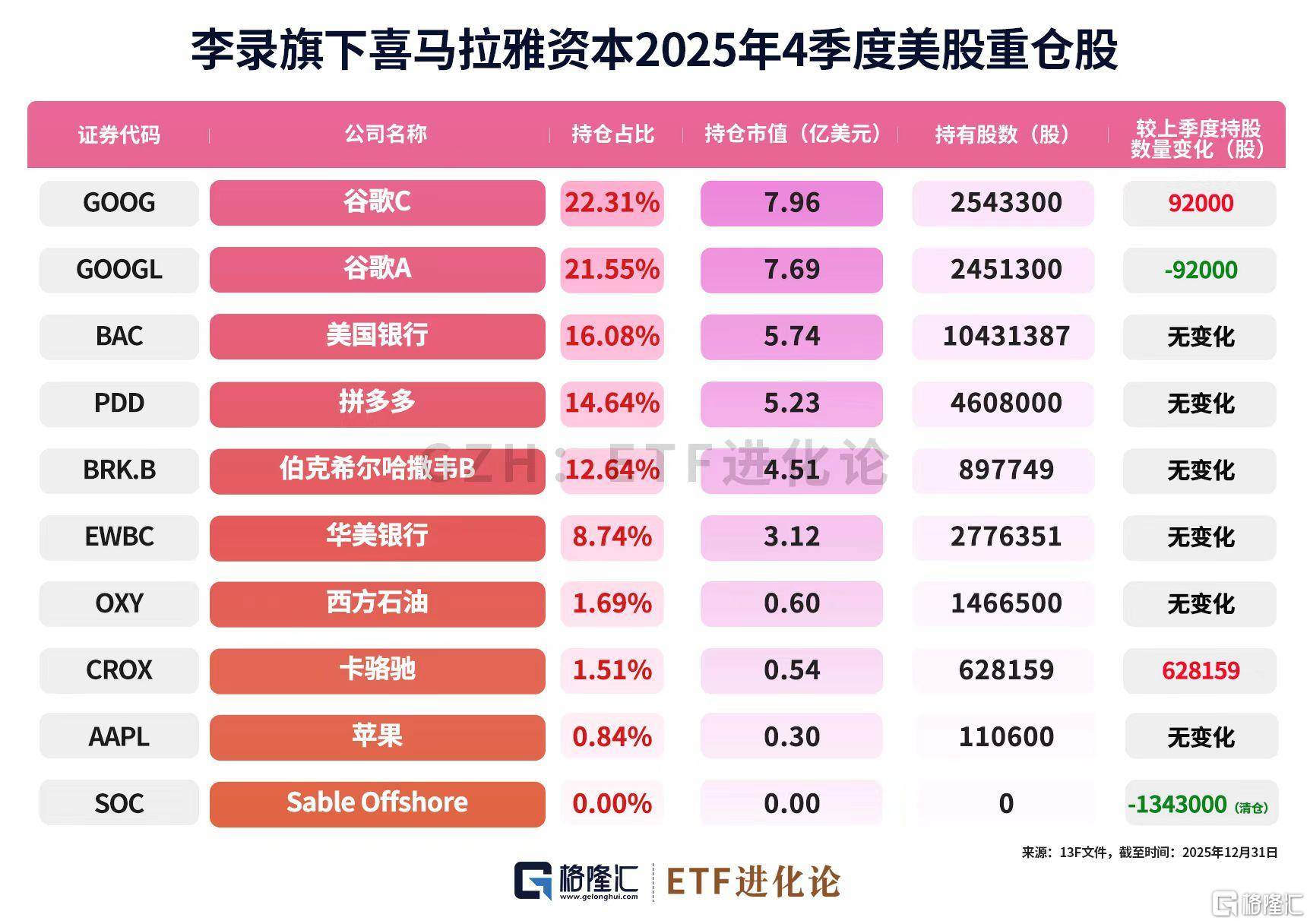
Core Viewpoint - The article discusses the investment strategies of Li Lu, a prominent investor, highlighting his focus on concentrated positions in a few companies and his ability to pivot quickly to new opportunities, particularly in the context of the AI boom and the performance of Micron Technology and Google. Group 1: Investment Strategy - Li Lu's investment style is characterized by a concentrated approach, often focusing heavily on a few companies [2][13] - He previously held a significant position in Micron Technology but sold before its substantial price increase, demonstrating a willingness to pivot [4][5] - Following the sale of Micron, he quickly shifted his focus to another company, which turned out to be Google, a core player in the AI space [8][9] Group 2: Portfolio Composition - As of the latest disclosures, Google's stock constitutes over 43% of Li Lu's portfolio, making it the largest holding [12][15] - The top five holdings in his portfolio account for approximately 95.96% of the total, indicating a highly concentrated investment strategy [14] - The portfolio includes eight stocks, with the remaining holdings being significantly smaller in proportion [14][15] Group 3: Historical Context and Performance - Li Lu introduced Warren Buffett to BYD in 2008, which led to significant returns over 17 years [3] - The article notes that Li Lu's ability to identify and invest in high-potential companies has been a hallmark of his investment philosophy [19] - His approach emphasizes understanding a company's long-term potential and the importance of selecting undervalued stocks [14][19] Group 4: Insights on Value Investing - Li Lu believes that successful investing is more about temperament than intelligence or experience, highlighting the importance of patience and decisiveness [20][22] - He advocates for a deep understanding of businesses and encourages investors to think like owners rather than traders [19][20] - The article emphasizes the significance of compounding returns and maintaining a long-term perspective in investing [24]
万亿外资巨头调仓!贝莱德调仓曝光:增持英伟达、苹果、微软等
Sou Hu Cai Jing· 2026-02-21 02:14
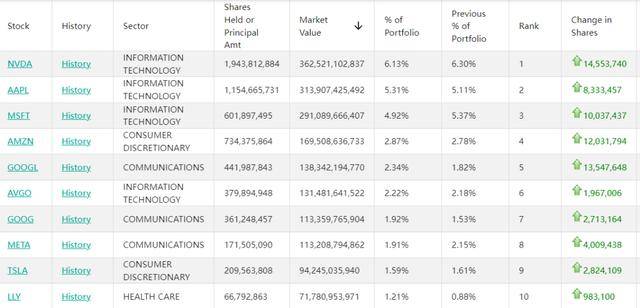
Core Insights - BlackRock, a major asset management firm, reported a total portfolio value of $5.92 trillion for Q4 2025, reflecting a 3.67% quarter-over-quarter increase [1] - The firm added 247 new stocks to its portfolio while liquidating 165 stocks during the same period [1] - The top ten holdings accounted for 30.41% of the total portfolio value [1] Group 1: Major Stock Movements - The top five stocks purchased by BlackRock included Google-A, Google-C, Eli Lilly, Micron, and Apple [1] - The top five stocks sold were SPDR S&P 500 ETF CALL, ServiceNow, MicroStrategy, AT&T, and Kellanova [1] Group 2: Technology Sector Focus - BlackRock's top ten holdings are heavily weighted in technology, including Nvidia, Apple, Microsoft, Amazon, Google-A, Broadcom, Google-C, Meta, Tesla, and Eli Lilly [2] - Nvidia saw a 0.75% increase in shares held, totaling approximately 1.94 billion shares valued at about $362.52 billion, making it the largest holding at 6.13% of the portfolio [2][4] - Apple shares increased by 0.73%, with approximately 1.15 billion shares valued at about $313.91 billion, representing 5.31% of the portfolio [2][4] - Microsoft holdings increased by 1.70%, totaling around 601.90 million shares valued at approximately $291.09 billion, accounting for 4.92% of the portfolio [2][4] - Amazon's holdings rose by 1.67%, with about 734.38 million shares valued at approximately $169.51 billion, making up 2.87% of the portfolio [2][4] Group 3: New Investments in Materials and Chemicals - BlackRock has diversified into new materials and chemicals, with new positions in Solstice Advanced Materials valued at approximately $838 million and Qnity Electronics valued at around $1.3 billion [6] - In the electric vehicle sector, BlackRock significantly increased its holdings in NIO and Xpeng, while slightly reducing its position in Li Auto [6] - NIO shares were increased by 337,590 to 5.58 million shares, reflecting a 153% increase in holdings valued at approximately $2.85 million [6] - Xpeng shares were increased by 77,980 to 2.87 million shares, with a total value of approximately $5.82 million [6] - Li Auto shares were reduced by 61,400 to 826,200 shares, with a total value of approximately $1.40 million [6]


Nvidia Earnings Loom: A Closer Look at the Mag 7 Earnings Picture
ZACKS· 2026-02-21 01:50
Group 1 - Recent sentiment towards the Magnificent 7 and software stocks has been negative, leading to significant underperformance in these sectors, primarily due to concerns related to artificial intelligence developments [1][2] - The Magnificent 7 companies, including Amazon, Alphabet, and Microsoft, are recognized as AI leaders, but there are market concerns regarding their increasing capital expenditures, with Amazon planning to spend $200 billion in capital expenditures by 2026, up from $132 billion in 2025 and $83 billion in 2024 [2][3] - The anticipated peak in capital expenditures for 2026 may be premature, as management emphasizes the critical nature of these investments, which could lead to ongoing spending beyond initial expectations [3] Group 2 - Microsoft has seen a three-month performance decline of 15.5%, while the Magnificent 7 group as a whole has decreased by 2.7%, contrasting with the Zacks Tech sector's growth of 1.8% and the S&P 500's increase of 3.9% [4] - Total earnings for 427 S&P 500 companies that have reported are up 12.8% year-over-year, with revenues increasing by 8.8%, indicating a positive trend in overall market performance [6][18] - Nvidia is expected to report significant growth, with projected Q4 earnings of $1.52 per share on revenues of $65.56 billion, reflecting year-over-year growth rates of 70.8% and 66.7%, respectively [10][12] Group 3 - The Magnificent 7 group's earnings are projected to increase by 24.2% in Q4 compared to the previous year, with revenues expected to rise by 18.9%, following a previous growth of 28.3% in earnings and 18.1% in revenues in Q3 2025 [13] - The Magnificent 7 is expected to account for 25.5% of all S&P 500 earnings in 2025, up from 23.2% in 2024 and 18.3% in 2023, highlighting their growing influence in the market [17] - The overall earnings picture for the S&P 500 indicates double-digit earnings growth is expected in 2025 and 2026, suggesting a positive outlook for the market [28]

美股科技股拉升,谷歌涨超4%
2 1 Shi Ji Jing Ji Bao Dao· 2026-02-21 01:45
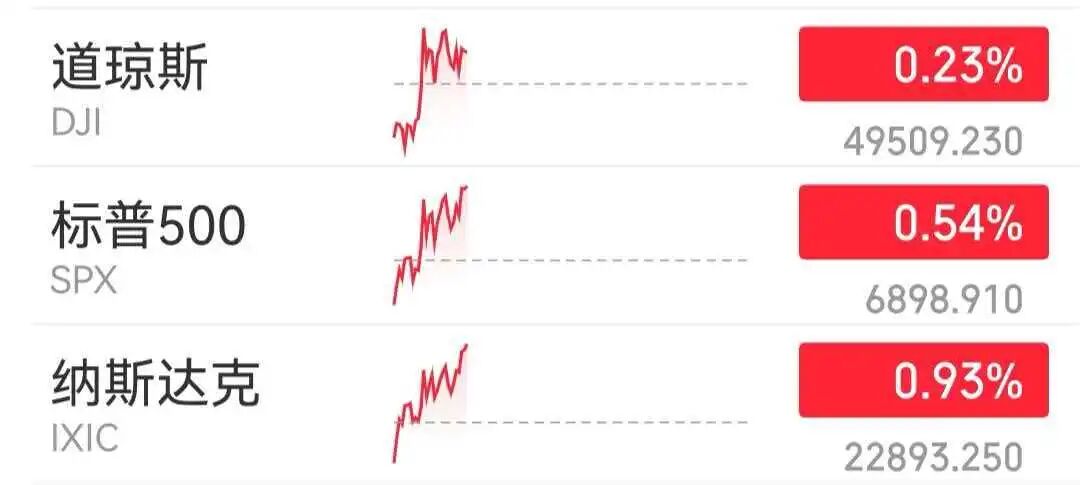
Group 1 - The core viewpoint of the article highlights the positive performance of the US stock market, with major indices showing gains on February 20, including a 0.47% increase in the Dow Jones, a 0.69% rise in the S&P 500, and a 0.9% uptick in the Nasdaq [1] - Major US tech stocks experienced significant increases, with the index tracking the seven largest US tech companies rising by 1.57%, and Google seeing a rise of over 4% following the release of its new foundational model, Gemini 3.1 Pro [1] - The new Gemini model reportedly doubles the inference performance compared to its predecessor, Gemini 3 Pro, which was released in November of the previous year [1] Group 2 - Other notable tech stocks also saw gains, with Netflix and Amazon both increasing by over 2%, while Apple, Nvidia, and Meta rose by more than 1% [1]
深夜突发,三大指数盘中直线拉升!美国最高法院裁定特朗普政府大规模关税政策违法,美国或需退还1750亿美元!特朗普:判决可耻
Mei Ri Jing Ji Xin Wen· 2026-02-21 01:02
Group 1 - Major tech stocks showed mixed performance, with Google rising by 3.5% following the release of its latest foundational model, Gemini 3.1 Pro, which has doubled its inference performance compared to the previous version released in November [2] - The Nasdaq China Golden Dragon Index opened lower but turned positive, currently up by 0.06% [2] - Significant fluctuations were observed in gold and silver prices [2] Group 2 - The U.S. Supreme Court ruled that the large-scale tariff measures implemented by the Trump administration under the International Emergency Economic Powers Act lacked clear legal authorization, with a 6-3 vote [4] - The court's decision indicates that Trump's global tariff policies, including "reciprocal" tariffs and targeted import taxes aimed at combating fentanyl smuggling, exceeded his authority [4] - The Supreme Court did not address the issue of tariff refund eligibility, leaving this complex legal matter to lower courts [4] Group 3 - Market predictions indicate a 66% probability that the court will order Trump to refund tariffs by July 2026, a significant increase from the previous estimate of around 30% [5] - Trump criticized the ruling as "shameful" and mentioned he is considering alternative options to address the implications of the Supreme Court's decision [5] - The U.S. government may explore other trade laws to reinstate related tariffs if those under the International Emergency Economic Powers Act are deemed illegal [5] Group 4 - The U.S. economy is projected to grow by 2.2% in 2025, down from 2.8% in 2024, according to the Bureau of Economic Analysis [5] - The overall price index for personal consumption expenditures (PCE) is expected to rise by 2.6% in 2025, consistent with 2024, while the core PCE index is projected to increase by 2.8%, slightly lower than the 2.9% in 2024 [5] - Preliminary estimates show that the U.S. GDP growth rate for Q4 2025 is expected to be 1.4%, significantly below market expectations and down from 4.4% in Q3 [6] - The growth in Q4 GDP is primarily driven by increased consumer spending and investment, although declines in government spending and exports partially offset this growth [6]
Alphabet Stock Climbs as Friday's Trump Tariff Ruling Lifts Digital-Advertising Shares
Investopedia· 2026-02-20 23:35
Core Insights - The Supreme Court's ruling against most of President Trump's tariffs has positively impacted digital advertising stocks, including Alphabet, Pinterest, and Meta, leading to significant gains in their share prices [1][1][1] Digital Advertising Impact - Digital advertisers are expected to benefit from the easing of tariffs, as clients may redirect refunds into increased advertising spending, according to marketing research firm EMARKETER [1][1] - Shares of Pinterest rose by 6%, while Alphabet's stock climbed by 4%, marking them among the best performers on the S&P 500 and Nasdaq [1][1] - Companies like Snap and Pinterest have faced challenges due to reduced ad spending from retail clients affected by higher costs from tariffs, with both stocks losing approximately half their value over the past year [1][1] Competitive Landscape - Meta and Alphabet have reported strong ad sales and have not experienced the same level of pressure as Pinterest, which has a higher proportion of large retail clients [1][1] - Analysts at Bank of America noted that Pinterest may have lost market share to larger competitors, while companies like Meta are investing in AI-enhanced advertising to mitigate tariff-related challenges [1][1]

Stocks Rise, Bonds Fall After Tariff Ruling | Closing Bell
Youtube· 2026-02-20 21:50
Market Overview - The market reaction to the Supreme Court ruling against Liberation Day tariffs was relatively muted, indicating ongoing investor uncertainty [2][4]. - The Dow Jones Industrial Average ended the day up by about 0.5%, while the S&P 500 increased by approximately 0.7% [7]. - The Russell 2000, which includes small-cap stocks, finished unchanged, reflecting a divergence in market performance [8]. Sector Performance - The communications services sector was the biggest gainer, up by about 2.7%, driven by Alphabet [9]. - Energy and healthcare sectors were the only ones to finish in the red, with energy down about 0.7% and healthcare down about 0.3% [10]. - Overall, 334 names in the S&P 500 saw gains, with 169 declining [8]. Individual Stock Highlights - FDX (Comfort Systems) was the top gainer in the S&P 500, hitting an all-time high with a gain of about 6.5% [11]. - General Electric also reached an all-time high, closing up about 2.5% [13]. - Alphabet was the top gainer in the NASDAQ 100, increasing by about 4%, as the company explores new markets for its AI chips [15]. Company-Specific News - Blue Owl shares fell by 4% due to concerns over liquidity in private credit, following the restriction of withdrawals from one of its funds [17]. - Wal-Mart's stock decreased by 1.5% after a recommendation cut from HSBC, despite solid fourth-quarter results [20]. - CoreWeave shares dropped by 8% amid fears regarding financing for a $4 billion data project [22].



2月21日美股成交额前20:据传英伟达接近向OpenAI投资300亿美元
Xin Lang Cai Jing· 2026-02-20 21:41
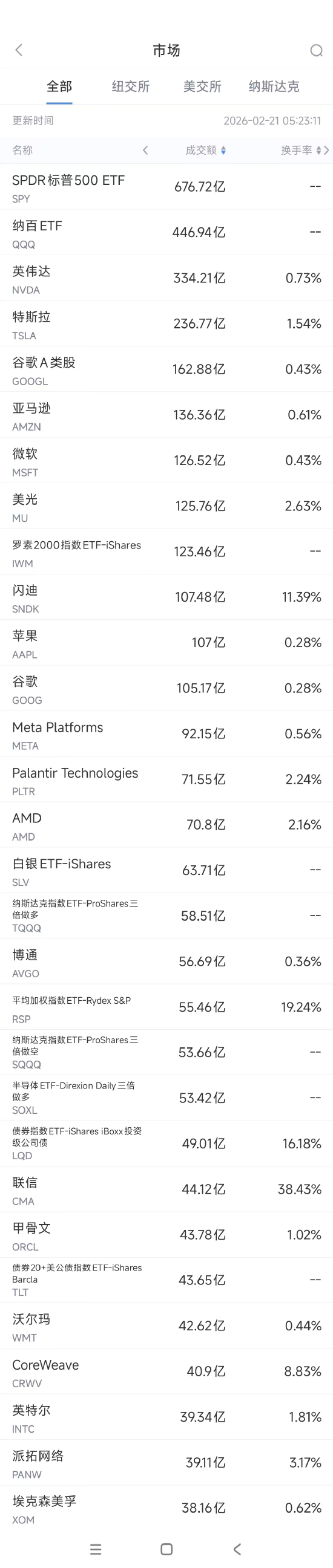
Group 1: Nvidia - Nvidia's stock rose by 1.02%, with a trading volume of $33.421 billion. The company is reportedly close to investing $30 billion in OpenAI as part of a long-anticipated funding round, with previous reports indicating an investment of $20 billion in this round [1][10] - This investment will replace a previously planned larger agreement, which was initially reported to be up to $100 billion but was stalled due to CEO Jensen Huang's private criticisms of OpenAI [10] Group 2: Tesla - Tesla's stock increased by 0.03%, with a trading volume of $23.677 billion. A federal judge upheld a $243 million judgment against Tesla related to a fatal 2019 accident involving a Model S equipped with the Autopilot system [10][11] - Analyst Baird upgraded Tesla's stock rating to "outperform" with a target price of $548, noting that recent quarterly performances have not deterred investor focus on Tesla's future [11] Group 3: Google - Google's Class A shares rose by 4.08%, with a trading volume of $16.288 billion. The company is exploring new ways to expand its AI chip market to better compete with Nvidia [10][12] - Google's chips are gaining wider adoption for AI workloads, but the company faces challenges such as manufacturing partner capacity constraints and limited interest from cloud computing competitors [12] Group 4: Amazon - Amazon's stock increased by 2.59%, with a trading volume of $13.636 billion. Morgan Stanley maintains Amazon as a preferred stock, believing its cloud services and retail business are undervalued beneficiaries of generative AI [12] - Analysts noted that Amazon's current stock price corresponds to a 19x GAAP EPS for 2027, with an implied forward growth rate of about 20%, and a 40% discount compared to peers on a PEG basis [12][3] Group 5: Micron and SanDisk - Micron's stock rose by 2.59%, with a trading volume of $12.576 billion, as the storage sector saw a general increase [13] - SanDisk's stock increased by 4.65%, with a trading volume of $10.748 billion [14] Group 6: Meta Platforms - Meta Platforms' stock rose by 1.69%, with a trading volume of $9.215 billion. The company has reduced the stock option grants for most employees by about 5%, following a previous reduction of 10% the prior year [14] - The compensation structure for Meta employees includes base salary, annual bonuses, and equity refreshers, with the company aiming to maintain competitive compensation [14] Group 7: Oracle and CoreWeave - Oracle's stock fell by 5.40%, with a trading volume of $4.378 billion, marking a cumulative decline of 7.5% for the week and over 23% year-to-date [14] - CoreWeave's stock dropped by 8.12%, with a trading volume of $4.09 billion. The CEO disclosed the sale of shares valued at approximately $7.72 million [14][15]




EasyMarkets易信:“AI资本风暴”
Sou Hu Cai Jing· 2026-02-20 21:00
Group 1 - The core viewpoint is that global tech giants are entering a new wave of investment in artificial intelligence infrastructure, with annual capital expenditures reaching historical highs. Companies are focusing their funds on data center expansion, high-performance chip procurement, and cloud computing platform upgrades to rapidly expand computing resources in response to the growing demand for generative AI [1][5]. Group 2 - Companies like Amazon, Alphabet, Microsoft, and Meta have identified AI as a core strategic direction and significantly increased their capital expenditure budgets. Some companies are even expanding debt financing to support long-term construction plans, leading to a simultaneous expansion of their balance sheets [5]. - Nvidia has emerged as a key beneficiary in this round of computing power upgrades, while Apple is adopting a more cautious approach by collaborating with external technology partners to enhance its AI capabilities and reduce the pressure of one-time heavy asset investments [5]. - Despite the market's general recognition of AI's long-term potential, investors remain cautious about the pace of return realization. Current revenue growth from AI-related activities has not yet matched the massive scale of capital expenditures, and future profitability will require time to validate [5]. Group 3 - In terms of regional competition, Europe is strengthening its local computing power infrastructure and data compliance systems to enhance its autonomy in the global AI landscape. Local companies like Mistral AI are accelerating financing expansions, and semiconductor equipment leader ASML is actively participating in related layouts [6]. - However, there remains a significant gap in overall funding scale compared to US tech giants. The trend of centralized computing resources may further exacerbate industry differentiation in the coming years [6]. Group 4 - This capital race in AI is fundamentally a dual test of technological innovation and capital efficiency. In the short term, large-scale investments will continue to support the prosperity of the industry chain and increase volatility in related tech assets. However, in the medium to long term, the true determinants of winning will be commercial capabilities and cost control levels [6]. - Investors need to assess the degree of valuation and risk matching while focusing on growth opportunities [6].