Infosys(INFY)

Search documents
Infosys (INFY) Collaborates with Incora to Modernize Global Supply Chain with AI
Yahoo Finance· 2026-03-18 20:26
Group 1 - Infosys Limited has entered a multi-year strategic collaboration with Incora to integrate AI into Incora's global supply chain operations across more than 60 countries [1][2] - The partnership aims to modernize Incora's multi-ERP landscape by deploying AI-enabled capabilities, enhancing resilience and responsiveness in the aerospace and defense sectors [1][3] - The collaboration will utilize Infosys Topaz and the EdgeVerve AI Next Platform to harmonize data and processes, facilitating non-intrusive orchestration of complex environments [2][3] Group 2 - This alliance signifies a broader trend in the aerospace and defense industry towards scalable, AI-enabled operating models that tackle fragmented data and legacy systems [3] - Executives from both companies emphasized that combining advanced AI platforms with a global supply chain will establish new benchmarks for efficiency and operational excellence [3] - Infosys provides a range of services including consulting, technology, outsourcing, and digital services across various regions including North America, Europe, and India [4]

Ethisphere recognizes Infosys among 2026 World's Most Ethical Companies®
Prnewswire· 2026-03-18 13:19
Core Insights - Infosys has been recognized as one of the 2026 World's Most Ethical Companies® by Ethisphere, marking its sixth consecutive year of receiving this honor [2][3][5] - The recognition highlights Infosys's commitment to business integrity through strong ethics, compliance, and governance programs [2][4] Company Recognition - In 2026, a total of 138 companies were honored across 17 countries and 40 industries, with Infosys being one of the select few in the Technology sector [3] - The evaluation was based on the Ethisphere Ethics Quotient®, which includes 240 proof points related to ethics culture, ESG practices, and compliance programs [3][6] Leadership Statements - Salil Parekh, CEO of Infosys, emphasized the importance of trust, transparency, and accountability in delivering impactful results, reflecting the company's focus on ethical conduct and governance [5] - Erica Salmon Byrne, Ethisphere's Chief Strategy Officer, noted that companies with strong ethics are better positioned for long-term performance [4] Methodology - The assessment process involves a comprehensive evaluation of documented practices supporting ethics and compliance, including governance structure, training, risk assessment, and social impact [6][7]


Infosys, Wipro, Coforge, other IT stocks drop up to 6% to fresh record lows: Here’s why
The Economic Times· 2026-03-17 05:03
Group 1: Nvidia's AI Chip Revenue Potential - Nvidia announced that the revenue opportunity for its artificial intelligence chips may reach at least $1 trillion through 2027, highlighting a significant growth potential in the AI sector [1] - CEO Jensen Huang emphasized that "the inference inflection has arrived" and noted that demand for AI technology continues to increase [1] Group 2: Market Reactions and IT Sector Impact - Following Nvidia's announcements, Wall Street experienced a positive reaction, with the S&P 500 climbing 1% to end at 6,699, marking its strongest one-day gain in over a month [2] - The Indian IT sector faced declines, with shares of major companies like Coforge dropping around 6%, and Tata Consultancy Services (TCS) and HCL Technologies falling nearly 2%, contributing to a more than 2% drop in the Nifty IT index [6][8] Group 3: Investor Sentiment and Future Outlook - Investors are closely monitoring the upcoming US Federal Reserve's FOMC meeting, as its outcome is expected to influence sentiment around IT stocks, particularly since many Indian IT companies derive a significant portion of their revenue from the US market [4][5] - Nuvama noted that the recent sharp correction in IT stocks, attributed to fears of AI-led disruption, has made valuations attractive, suggesting that the Indian IT services industry is not facing an existential threat from generative AI [9]



Infosys: A Solid Company At An Attractive Discount, If One Can Hedge For The Rupee Depreciation
Seeking Alpha· 2026-03-13 08:15
Group 1 - Infosys, based in Bengaluru, is recognized as one of the largest IT services providers globally [1] - Recent concerns have emerged regarding the impact of AI on Infosys's business model, particularly following a significant market correction [1] Group 2 - The article does not provide any additional relevant content regarding the company or industry [2][3]

Incora and Infosys Collaborate to Advance AI-Enabled Supply Chain Operations
Prnewswire· 2026-03-10 12:23
Core Insights - Infosys and Incora have announced a strategic collaboration to enhance AI-enabled supply chain operations in the aerospace and defense industry, leveraging Infosys' AI technologies to modernize Incora's supply chain across over 60 countries [1][1][1] Group 1: Collaboration Details - The multi-year alliance aims to implement AI capabilities that improve visibility, accuracy, and responsiveness in Incora's operations [1][1] - Infosys will design and deploy a non-intrusive AI platform that integrates with Incora's existing systems without disrupting daily operations [1][1] - The collaboration reflects a broader industry trend towards scalable, AI-enabled operating models to address legacy systems and fragmented data [1][1] Group 2: Expected Outcomes - The partnership is expected to deliver significant efficiency gains and set new benchmarks for digital transformation in the aerospace and defense sector [1][1] - By combining Infosys' AI-first platforms with Incora's supply chain expertise, the collaboration aims to reduce operational friction and enable faster decision-making [1][1]

Infosys, TCS, Wipro and other IT stocks in focus after sharp rally in US tech shares despite US-Iran war
The Economic Times· 2026-03-05 03:15
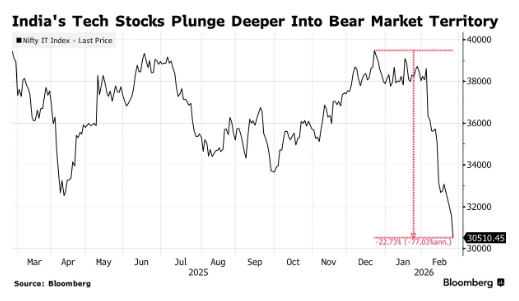
Group 1 - The Nasdaq Composite rose 1.29%, remaining positive since the US-Israeli strike on Iran, driven by gains in chipmakers Nvidia and AMD, while Amazon increased by 4% despite challenges in its Middle East data center operations [1][8] - US services activity expanded at its fastest pace since mid-2022, with 14 industries reporting growth and new orders reaching a one-year high, while inflation at service providers eased to the lowest level in a year [2][8] - The Nifty IT index fell just 1% since the beginning of the conflict, while the broader 50-share Nifty index dropped nearly 3% during the same period, indicating relative resilience in the IT sector [3][8] Group 2 - The Indian Rupee fell 69 paise to an all-time low of 92.18 against the US dollar amid rising crude oil prices, which is beneficial for Indian IT companies as most revenue is in foreign currencies [4][8] - The Nifty IT index experienced a sharp correction last month, tumbling around 20% in February, marking its steepest decline since the 2008 financial crisis, influenced by concerns over AI-led automation following Anthropic's introduction of new plug-ins [7][8]


Infosys and Intel Deepen Strategic Collaboration to Unlock AI Value for Enterprises Globally
Prnewswire· 2026-03-03 10:07
Core Insights - The collaboration between Infosys and Intel aims to transition enterprises from AI pilots to large-scale production deployments, leveraging Intel's high-performance computing platforms and Infosys Topaz Fabric [1][2][5] Group 1: Collaboration Objectives - The partnership focuses on creating a secure, modular architecture that enhances open standards across the edge-to-cloud stack, facilitating scalable and cost-efficient enterprise AI deployments [2] - The collaboration emphasizes the design and optimization of AI workloads across various Intel products, including Xeon processors and Gaudi AI accelerators, to achieve balanced performance and security [3] Group 2: Technological Integration - The combined solution integrates data management, model oversight, performance monitoring, and security features, enabling organizations to effectively transition AI from pilot projects to real-world applications [4] - Advanced AI agents developed through this collaboration will be capable of accessing enterprise data and coordinating tasks securely within complex environments [4] Group 3: Leadership Statements - Infosys CEO Salil Parekh highlighted the commitment to embedding AI responsibly within enterprise operations, aiming to unlock AI value securely and cost-effectively [5] - Intel CEO Lip-Bu Tan emphasized the collaboration's role in delivering optimized and energy-efficient AI solutions that can be deployed across various environments, including data centers and cloud [5]


Infosys, TCS, other IT stocks rise up to 3% as Wall Street's AI rally loses steam
The Economic Times· 2026-02-27 03:48
Core Insights - The Indian IT sector has experienced a significant decline of approximately 20% in February 2023, driven by concerns over potential disruptions from artificial intelligence technologies [3][6] - Despite the recent downturn, experts suggest that Indian IT companies may benefit from increased AI spending as they serve as implementation partners and system integrators for enterprise-scale AI adoption [7][8] Market Performance - The tech-heavy Nasdaq index closed 1% lower, influenced by a 5% drop in Nvidia's share price following its strong quarterly earnings report [1][8] - Indian IT stocks, including Infosys and TCS, saw gains of up to 2.5% on Friday, although US-listed ADRs of Infosys and Wipro increased by 3% and 2% respectively despite the overall negative sentiment in the tech sector [8] Employment Data - The US labor department reported a marginal increase in jobless claims, with initial claims rising by 4,000 to 212,000 for the week ending February 21, slightly above the forecast of 215,000 [2][8] Expert Opinions - Analysts indicate that the IT sector has underperformed relative to benchmark indices over the past year, with stretched valuations potentially leading to rating changes [6] - Sushovon Nayak from Anand Rathi believes the AI technology cycle is in its early monetization phase, predicting high volumes of legacy modernization and data engineering work for Indian IT players [7][9] - Investors are advised to consider gradually accumulating select IT stocks, particularly during price declines of 5-7%, as the current weakness may be nearing a bottom [8][9]

Infosys, TCS lead IT rebound; stocks jump up to 5% after five-day rout
The Economic Times· 2026-02-25 03:19
Company Developments - Anthropic hosted its enterprise agents event, unveiling several collaborations that alleviated investor concerns regarding potential disruptions from AI in the software sector [1][9] - The company introduced updates to its Claude Cowork platform, enabling businesses to integrate the productivity tool with various enterprise applications, including Salesforce's Slack, Intuit, DocuSign, LegalZoom, FactSet, and Google's Gmail [1][9] - Organizations will have the ability to deploy customizable plugins tailored for functions such as financial analysis, engineering, and human resources [2][9] Market Reactions - Following the announcements from Anthropic, shares of IT companies like Infosys, Wipro, and Tata Consultancy Services rallied up to 5%, recovering from five days of significant selling pressure [9] - The Dow Jones Industrial Average rose by 370 points, recovering nearly 50% of the losses recorded on Monday, while the S&P 500 and Nasdaq Composite gained 0.7% and 1.1%, respectively [2][9] Industry Trends - The Nifty IT index experienced a sharp decline, ending 4.74% lower after heavy selling pressure, marking a more than 20% drop in February, the worst monthly decline since the 2008 global financial crisis [9] - Many IT stocks are now considered to be in "oversold" territory, with seven of the ten constituents of the Nifty IT index dropping 20% or more in the first two months of the year [6][7] - The Nifty IT index is currently trading at an eight-year low relative to the Nifty 500, attracting contrarian investors seeking value [7] Technical Analysis - Anand James, Chief Market Strategist at Geojit Investments, noted that oscillators have turned oversold and are showing early signs of positive divergence [8] - The Nifty IT index has fallen below the reaction low of 31,422 from February 13, with momentum indicators suggesting potential further downside [8] - Standard deviation studies indicate support levels at 29,961, followed by 28,800 and 27,200, while immediate reversal levels are at 30,300 intraday and 31,300 on a closing basis, with 36,200 as a major resistance level [8]

一份假想报告砸崩印度IT!AI冲击担忧发酵 印度软件股遭遇大规模抛售
智通财经网· 2026-02-24 07:13
Core Viewpoint - The market's concern over the impact of artificial intelligence (AI) on related companies has intensified, leading to a significant sell-off in Indian software service stocks, particularly highlighted by a report from Citrini Research [1][3]. Group 1: Market Reaction - The Nifty IT index in India experienced a drop of nearly 5% on Tuesday, marking its potential fifth consecutive day of decline [1]. - Since the beginning of the month, Indian tech stocks have cumulatively fallen by approximately 20%, resulting in a market capitalization loss exceeding $54 billion [3]. Group 2: Report Insights - Citrini Research's report outlines potential risks posed by AI to various sectors of the global economy, including scenarios of white-collar job losses and economic contraction by 2028, although it clarifies that these are merely hypothetical scenarios and not predictions [1]. - The report specifically mentions that companies such as Tata Consultancy Services (TCS), Infosys (INFY.US), and Wipro (WIT.US) may face an acceleration in contract cancellations by 2027 [1]. Group 3: Competitive Landscape - The report indicates that the entire business model of Indian IT relies on a core advantage: the significantly lower cost of Indian developers compared to their American counterparts. However, the marginal cost of AI programming assistants has now dropped to a level comparable to just electricity costs [3]. - The negative sentiment surrounding Indian IT services has also affected the U.S. market, with logistics, payment, and software stocks generally declining, and IBM (IBM.US) experiencing its largest single-day drop in 25 years [3].