
JOINN(JNNLY)

Search documents
“猴茅”昭衍新药股东清仓离场
Guo Ji Jin Rong Bao· 2026-03-23 07:21
Core Viewpoint - The stock price of Zhaoyan New Drug plummeted following a significant share reduction announcement by major shareholders, raising concerns about the company's future prospects and the impact of emerging technologies on its core business [1][7]. Group 1: Shareholder Actions - On March 16, major shareholders Gu Xiaolei and Gu Meifang announced a plan to reduce their holdings by 30.74 million shares, approximately 4.1% of the total share capital, leading to a sharp decline in stock prices [1][3]. - The shareholders later clarified that they would only reduce their holdings by 3%, amounting to about 700 million yuan, but the stock price continued to fall [1][7]. Group 2: Company Background - Zhaoyan New Drug, founded in 1995, is China's first private drug evaluation laboratory and specializes in non-clinical safety evaluation services, with its core business expected to account for 95% of revenue in 2024 [3][4]. - The company has invested 1.8 billion yuan in acquiring experimental monkey resources, which has earned it the nickname "Monkey Mao" in the CRO industry [3]. Group 3: Industry Challenges - The CRO industry is facing significant challenges, including an overall decline in the biopharmaceutical investment market, increased competition, and a drop in the prices of experimental monkeys, leading to a projected net loss of over 100 million yuan in biological asset value for 2024 [8][10]. - The company's revenue is expected to decline by 15.07% in 2024, with a significant drop in net profit by 81.34% [8]. Group 4: Emerging Technologies - The rise of organoid technology poses a threat to Zhaoyan New Drug's traditional animal testing business, as regulatory changes in the U.S. encourage the use of AI and organoid models over animal experiments [10][11]. - The global organoid market is projected to grow significantly, with estimates suggesting a compound annual growth rate of around 18.8% from 2025 to 2034, indicating a potential shift in industry standards that could impact Zhaoyan's operations [11].
百亿“香塘系”套现离场,昭衍新药的“猴子生意”还灵吗?
Xin Lang Cai Jing· 2026-03-20 09:44
Core Viewpoint - The recent "liquidation-style" share reduction by major shareholders of Zhaoyan New Drug has significantly impacted the company's stock price, leading to a market reaction that resulted in a substantial loss in market capitalization [2][25]. Group 1: Shareholder Actions - On March 16, Zhaoyan New Drug announced that shareholders Gu Xiaolei and Gu Meifang planned to reduce their holdings by a total of 30.74 million shares, representing 4.1% of the company's total shares, due to personal financial needs [2][25]. - Following the announcement, Zhaoyan's A-shares hit the daily limit down on March 17, closing at 29.32 yuan per share, while H-shares fell by 11.73% to 16.78 HKD [2][25]. - The company later revised the planned reduction from 4.1% to 3% in a corrective announcement, but this did not prevent further declines, with the A-share price dropping to 28.1 yuan by March 20, resulting in a market cap loss of approximately 9.1 billion yuan [2][25][28]. Group 2: Company Background and Business Model - Zhaoyan New Drug, established in 1995, is a leading Contract Research Organization (CRO) specializing in drug research services, with a focus on non-clinical research and clinical services [9][31]. - The company has gained notoriety in the market for its supply of experimental monkeys, which are critical for drug development, with prices for these monkeys skyrocketing from under 7,000 yuan to 160,000 yuan in recent years [10][11][31]. - The company reported a projected revenue decline of 13.9% to 22.1% for 2025, estimating revenues between 1.573 billion and 1.738 billion yuan, while net profit is expected to surge by 214% to 371%, largely due to the increase in the fair value of biological assets (experimental monkeys) [12][32]. Group 3: Financial Strategies and Risks - Zhaoyan New Drug is diversifying its income streams by investing up to 2 billion yuan in financial products, indicating a shift towards financial investments alongside its core business [13][33]. - The company faces challenges from regulatory changes, particularly from the FDA, which is promoting alternatives to animal testing, potentially impacting the demand for its core services [14][34]. - Analysts have noted that the company's reliance on the sale of experimental animals and financial investments to sustain profitability highlights a structural risk in its business model, as its core laboratory services are currently underperforming [14][34]. Group 4: Shareholder Structure and Historical Context - The recent share reduction has brought attention to the significant shareholders, particularly the Xiang Tang Group, which has been closely associated with Zhaoyan New Drug for nearly two decades [16][36]. - The Xiang Tang Group has a diverse investment portfolio, with substantial assets and revenues, indicating a robust financial background that has historically supported Zhaoyan New Drug [22][41]. - The group's strategic investments in the biopharmaceutical sector have positioned it as a key player in the industry, with a network of over 29 directly invested companies and more than 669 indirectly invested entities [20][39].

股东清仓吓崩股价?昭衍新药连夜修改减持计划!
Sou Hu Cai Jing· 2026-03-18 10:19
Group 1 - The core issue revolves around two shareholders, who are heirs of a prominent private enterprise, announcing a reduction in their holdings, which led to a significant drop in the stock price of the leading CRO company, Zhaoyan Pharmaceutical, hitting the daily limit down [1] - Following the announcement, the company quickly revised its plan to reduce the total shareholding from 4.1% to no more than 3%, primarily through block trades, which helped stabilize the stock price [1] - Historically, the term "reduction" has negatively impacted Zhaoyan's stock price, with previous instances of share reductions leading to immediate declines of 5.7%, 7%, and 6% in stock price [1] Group 2 - Since the second half of last year, a total of nine shareholders have exited their positions, raising questions about the timing and reasons behind this trend, with speculation that it reflects a lack of confidence in the company's future [2] - Zhaoyan's stock price surged over 110% in 2025, climbing from around 20 yuan to 46 yuan, significantly outperforming other companies in the CRO sector [2] - The company has benefited from a surge in demand for experimental monkeys, with prices rising sharply, contributing to inflated profits that are not necessarily tied to operational performance, as the main business revenue has been declining for two consecutive years [2] - By early this year, Zhaoyan's price-to-earnings ratio reached 97, significantly higher than the 20-30 range of industry peers, raising concerns about the sustainability of this inflated valuation [2]
昭衍新药二股东减持吓崩股价 男实控人已共套现14.8亿
Zhong Guo Jing Ji Wang· 2026-03-18 09:22
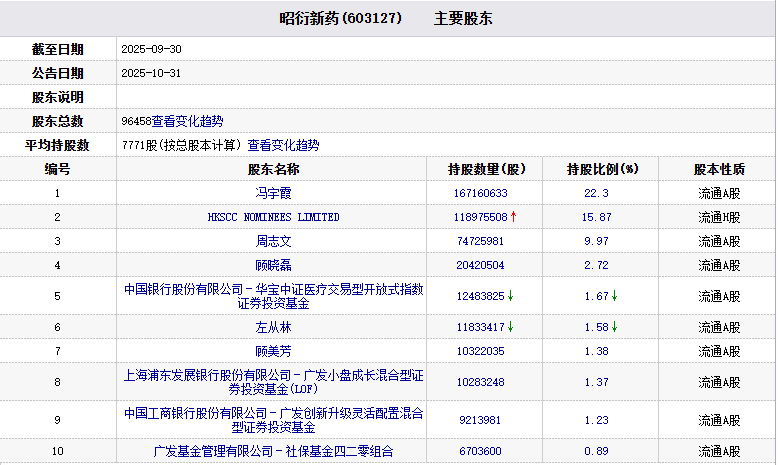
Core Viewpoint - The stock price of Zhaoyan New Drug (603127.SH) has significantly declined due to shareholders' plans for a large-scale reduction in holdings, leading to a drop in both A-shares and H-shares [1][2]. Shareholder Reduction Plans - Shareholder Gu Xiaolei plans to reduce holdings by up to 15,061,800 shares, which is 2.01% of the total share capital, through a combination of centralized bidding and block trading [2]. - Shareholder Gu Meifang intends to reduce holdings by up to 7,418,400 shares, representing 0.99% of the total share capital, also using centralized bidding and block trading methods [2]. - The total reduction by Gu Xiaolei and Gu Meifang combined will not exceed 3% of the company's total share capital [2]. Shareholding Structure - As of September 30, 2025, Gu Xiaolei holds 2.72% of the shares, making him the fourth largest shareholder, while Gu Meifang holds 1.38%, ranking as the seventh largest shareholder [3]. - The actual controllers of Zhaoyan New Drug are Feng Yuxia and Zhou Zhiwen, with Gu Meifang and Gu Xiaolei being the largest shareholders after them [3]. Recent Stock Performance - On March 17, 2023, Zhaoyan New Drug's stock price fell to a limit down, closing at 29.32 yuan, a decrease of 10.01% [1]. - The stock price reached a new low of 28.60 yuan on the same day, marking the lowest point since 2026 [1].
昭衍新药(603127) - H股公告:董事会召开日期
2026-03-18 09:15
JOINN LABORATORIES (CHINA) CO., LTD. 北京昭衍新藥研究中心股份有限公司 (於 中 華 人 民 共 和 國 註 冊 成 立 的 股 份 有 限 公 司) (股 份 代 號:6127) 香港交易及結算所有限公司及香港聯合交易所有限公司對本公告的內容概不 負 責,對 其 準 確 性 或 完 整 性 亦 不 發 表 任 何 聲 明,並 明 確 表 示,概 不 對 因 本 公 告 全部或任何部份內容而產生或因倚賴該等內容而引致的任何損失承擔任何責 任。 承董事會命 北京昭衍新藥研究中心股份有限公司 主 席 馮宇霞 中 國,北 京 2026年3月18日 於 本 公 告 日 期,董 事 會 包 括 主 席 兼 執 行 董 事 馮 宇 霞 女 士、執 行 董 事 高 大 鵬 先 生、孫 雲 霞 女 士、羅 樨 女 士 及 顧 靜 良 先 生,獨 立 非 執 行 董 事 張 帆 先 生、楊 福 全 先 生、陽 昌 雲 先 生 及 應 放 天 先 生,及 職 工 董 事 李 葉 女 士。 董事會召開日期 北京昭衍新藥研究中心股份有限公司(「本公司」及其附屬公司統稱為「本集團」) 之董事會(「董 ...
昭衍新药拟3月30日举行董事会会议审批年度业绩
Ge Long Hui· 2026-03-18 08:55
Group 1 - The company, Zhaoyan New Drug (06127.HK), announced a board meeting scheduled for March 30, 2026, to consider and approve the annual performance for the year ending December 31, 2025 [1] - The board will also discuss the proposal for a final dividend distribution, if applicable, along with other matters [1]
昭衍新药(06127.HK)拟3月30日举行董事会会议审批年度业绩
Ge Long Hui· 2026-03-18 08:47
Group 1 - The company, Zhaoyan New Drug (06127.HK), announced a board meeting scheduled for March 30, 2026, to consider and approve the annual performance for the year ending December 31, 2025 [1] - The board will also discuss the proposal for a final dividend distribution, if any, along with other matters [1]
昭衍新药(06127) - 董事会召开日期
2026-03-18 08:31
(於 中 華 人 民 共 和 國 註 冊 成 立 的 股 份 有 限 公 司) (股 份 代 號:6127) 香港交易及結算所有限公司及香港聯合交易所有限公司對本公告的內容概不 負 責,對 其 準 確 性 或 完 整 性 亦 不 發 表 任 何 聲 明,並 明 確 表 示,概 不 對 因 本 公 告 全部或任何部份內容而產生或因倚賴該等內容而引致的任何損失承擔任何責 任。 JOINN LABORATORIES (CHINA) CO., LTD. 北京昭衍新藥研究中心股份有限公司 主 席 馮宇霞 中 國,北 京 2026年3月18日 於 本 公 告 日 期,董 事 會 包 括 主 席 兼 執 行 董 事 馮 宇 霞 女 士、執 行 董 事 高 大 鵬 先 生、孫 雲 霞 女 士、羅 樨 女 士 及 顧 靜 良 先 生,獨 立 非 執 行 董 事 張 帆 先 生、楊 福 全 先 生、陽 昌 雲 先 生 及 應 放 天 先 生,及 職 工 董 事 李 葉 女 士。 董事會召開日期 北京昭衍新藥研究中心股份有限公司(「本公司」及其附屬公司統稱為「本集團」) 之董事會(「董事會」)兹通告謹定於2026年3月30日(星 ...
股东拟“清仓式”减持吓崩股价 昭衍新药相关股东忙调整减持计划
Bei Jing Shang Bao· 2026-03-17 13:35
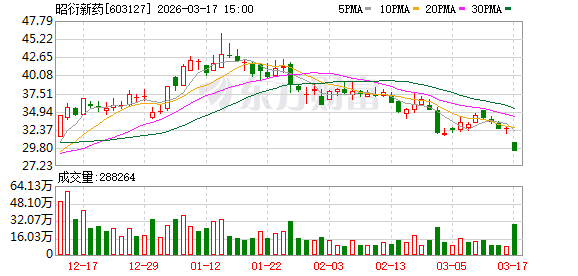
Core Viewpoint - The stock price of Zhaoyan New Drug (603127) plummeted due to shareholders' proposed significant reduction in holdings, leading to a trading halt in A-shares and a substantial drop in H-shares [2][3]. Shareholder Reduction Plan - On March 17, Zhaoyan New Drug announced a correction regarding the proposed reduction by shareholders Gu Xiaolei and Gu Meifang, adjusting the reduction from a maximum of 4.1% to 3%, and changing the method to a combination of centralized bidding and block trading [2][3]. - As of the announcement date, Gu Xiaolei and Gu Meifang held 20.42 million shares (2.73%) and 10.32 million shares (1.38%) respectively, indicating an initial intent for a significant sell-off [3]. Market Reaction - Following the announcement, Zhaoyan New Drug's A-shares closed at the limit down price of 29.32 yuan per share, a decline of 10.01%, while H-shares fell by 11.73% to 16.78 HKD per share [3]. - The adjustment in the reduction plan is viewed as a measure to mitigate market impact, although it still represents a significant sell-off, and the stock's future performance will depend on the company's fundamentals and industry conditions [3]. Previous Reduction Announcements - This is not the first instance of Zhaoyan New Drug announcing shareholder reductions; the actual controller Zhou Zhiwen had previously disclosed a plan to reduce holdings by up to 2% of the total share capital, having already reduced 14.979 million shares (approximately 2%) before terminating the plan early [4]. - Since the beginning of 2025, Zhaoyan New Drug's A-share price had risen significantly, but it has been in a continuous decline since reaching a peak in mid-January [4]. Financial Performance - Zhaoyan New Drug reported a substantial increase in expected net profit for 2025, projected to be between 233 million to 349 million yuan, representing a year-on-year increase of approximately 214% to 371% [4]. - The increase in profit is attributed to rising market prices of biological assets and natural growth value, although the company noted a decrease in revenue and gross margin from contract fulfillment due to intense prior industry competition [4].
遭股东“清仓式”减持,昭衍新药A股跌停
Huan Qiu Lao Hu Cai Jing· 2026-03-17 12:58
Core Viewpoint - The major shareholder of Zhaoyan New Drug has announced a significant reduction plan, which has led to a sharp decline in the company's stock prices, indicating potential concerns about the company's financial health and market position [1][2]. Group 1: Shareholder Reduction Plan - The shareholder Gu Xiaolei and his associate Gu Meifang plan to reduce their holdings by up to 30.74 million shares within three months, which represents 4.1026% of the company's total shares [1]. - Following the announcement, Zhaoyan New Drug's A-shares and H-shares experienced a significant drop, with A-shares closing at 29.32 yuan per share, down to a total market value of 21.97 billion yuan [1]. Group 2: Company Background and Business Operations - Zhaoyan New Drug, established in 1995, is a leading provider of drug research and development outsourcing services in China, primarily focusing on non-clinical safety evaluation services [2]. - The company is recognized for its substantial reserves of experimental monkeys, making it a prominent player in the industry, often referred to as "Monkey King" in the secondary market [2]. Group 3: Financial Performance - The company's revenue has been declining due to intensified industry competition and falling market prices for biological assets (experimental monkeys), with revenues recorded at 2.268 billion yuan, 2.376 billion yuan, and 2.018 billion yuan from 2022 to 2024 [2]. - For 2025, the company anticipates revenues between 1.573 billion yuan and 1.738 billion yuan, representing a year-on-year decrease of approximately 13.9% to 22.1%, while net profit is expected to increase significantly by 214% to 371% [3]. - The increase in net profit is attributed to rising market prices for biological assets and natural growth appreciation, despite a decline in profit contributions from laboratory services due to previous intense competition [3].