Kraft Heinz(KHC)

Search documents
泡沫、壁垒、裁员
Xin Hua She· 2025-11-25 00:25
Group 1: AI Bubble Concerns - The performance of major companies in the AI sector has been robust, with firms like Nvidia exceeding revenue and profit expectations, yet concerns about an AI bubble are growing among analysts [2][3] - Major tech companies, including Amazon, Alphabet, and Microsoft, have raised their capital expenditure forecasts, collectively expecting to exceed $380 billion in investments this year, but market reactions to these investments have varied [2] - A survey by Bank of America indicates that over half of fund managers believe there is a bubble in AI stocks, particularly among the "Tech Giants," suggesting an over-concentration of market funds [3] Group 2: Impact of Tariff Barriers - The impact of U.S. tariff policies has become more pronounced in Q3, negatively affecting the earnings and forecasts of export-oriented companies in Europe and Japan [4][5] - European luxury goods companies have reported significant revenue declines, with LVMH's fashion and leather goods division seeing a roughly 8% drop and Kering's Gucci brand experiencing a 22% decline in revenue [4] - Japanese automakers have collectively faced a 2.5% drop in net profits, with estimates suggesting that U.S. tariffs on imported vehicles could lead to losses of approximately 1.5 trillion yen for major Japanese car manufacturers [4] Group 3: Consumer Sentiment and Layoffs - U.S. consumer sentiment is notably low, with major companies announcing significant layoffs, contributing to a bleak economic outlook [7] - The disparity in consumer spending is evident, as affluent consumers maintain or increase their spending while lower-income consumers are forced to cut back [7] - The number of layoffs in the U.S. has reached nearly 1 million in the first nine months of the year, the highest since 2020, raising concerns about potential economic recession [7]


Why Kraft Mac & Cheese went hypercontextual for ‘Best Thing Ever’ push
Marketing Dive· 2025-11-24 11:00
Core Insights - Kraft Mac & Cheese has launched a new campaign titled "Best Thing Ever," which represents the brand's largest media investment to date, aimed at reinforcing its market position amidst competition from private labels and premium brands [1][2] - The campaign emphasizes Kraft Mac & Cheese as an experience rather than just a product, focusing on its cultural relevance, taste, value, and convenience [2][4] Marketing Strategy - The campaign features a series of 15-second ads voiced by comedian John Mulaney, positioning the product as dependable and enjoyable in various consumer contexts [2][5] - "Best Thing Ever" includes over 70 distinct assets and employs a hypercontextual approach to engage a diverse consumer base through various media channels, including TV, YouTube, and social media [2][7] Brand Evolution - The new campaign marks a shift from previous marketing strategies, moving from a focus on comfort food during the pandemic to a broader appeal that includes joy and celebration [3][4] - Kraft Mac & Cheese has undergone rebranding efforts, including a name change and a focus on "positive comfort," to better compete with new market entrants [3][4] Product Innovation - In 2025, Kraft Mac & Cheese introduced five new flavors and product formats, which contributed to an increase in new buyers and households [7][8] - The brand aims to leverage these innovations to connect with social and cultural trends while attracting new audiences [8] Company Context - Kraft Heinz is facing significant challenges, with CEO Carlos Abrams-Rivera noting "one of the worst consumer sentiments" in decades, and plans to split into two companies by the second half of 2026 [9]

Kraft Mac & Cheese Proves it's the 'Best Thing Ever' in Bold New Creative Platform
Businesswire· 2025-11-24 11:00
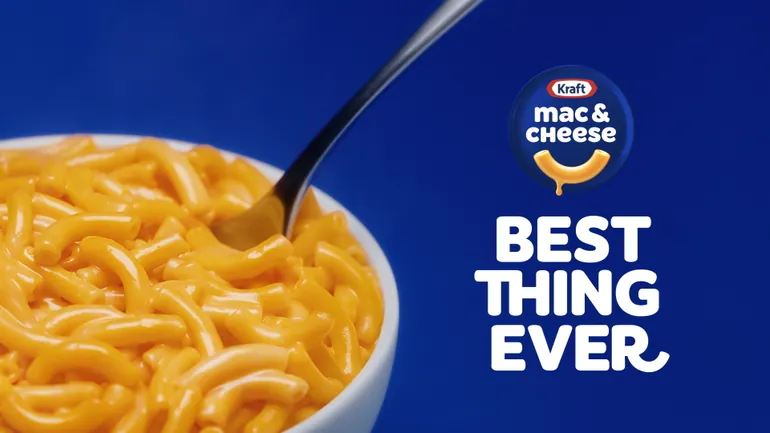
Core Insights - Kraft Mac & Cheese has launched a new creative platform called "Best Thing Ever," emphasizing its unique position in American culture for nearly 90 years [1] - The campaign aims to celebrate the brand's legacy by asserting that nothing compares to a bowl of Kraft Mac & Cheese, regardless of the context [1] Company Summary - The new campaign highlights Kraft Mac & Cheese's longstanding presence in the market and its emotional connection with consumers [1] - The initiative is designed to reinforce brand loyalty and recognition among consumers by showcasing the product's unparalleled appeal [1] Industry Context - The launch of the "Best Thing Ever" campaign reflects a broader trend in the food industry where brands seek to strengthen their identity and connection with consumers through nostalgic marketing [1] - By celebrating its heritage, Kraft Mac & Cheese positions itself competitively in a market that values both tradition and innovation [1]

Read This Before Buying Kraft Heinz Stock
Yahoo Finance· 2025-11-24 10:15
Core Insights - The article discusses Warren Buffett's admission of mistakes in his investment decisions, particularly regarding Kraft Heinz, highlighting the importance of acknowledging errors in investment strategies [2][3]. Company Overview - Berkshire Hathaway, in collaboration with 3G Capital, acquired Heinz for $23 billion in 2013 and later merged it with Kraft in a $40 billion deal, which Buffett now considers too costly [3]. - Kraft Heinz has seen a significant decline in its stock value, losing approximately two-thirds of its value over the past decade [3]. Strategic Moves - Kraft Heinz plans to spin off a division called Global Taste Elevation Co., which will focus on faster-growing brands like Kraft Mac & Cheese and Heinz [5]. - Buffett has expressed disappointment in the spinoff plan, particularly regarding the lack of a shareholder vote on the split [6]. Market Sentiment - There is skepticism among investors regarding the planned spinoff, especially given Buffett's critical stance [6][7]. - The company aims to improve revenue growth by separating its faster-growing sauces and spreads from the slower-growth North American Grocery Co. [7]. Consumer Trends - Shifting consumer preferences pose challenges for Kraft Heinz, with a survey indicating that 30% of respondents view processed foods as unhealthy [10]. - Investor enthusiasm for the spinoff remains low, reflecting concerns about the company's ability to adapt to changing consumer tastes [9][10].
Is Kraft Heinz's 6.4%-Yielding Dividend Safe?
The Motley Fool· 2025-11-19 09:07
Core Viewpoint - Kraft Heinz is undergoing a business breakup, raising concerns about the sustainability of its dividend and overall business performance [1][6][10] Dividend Analysis - Kraft Heinz offers a dividend yield of approximately 6.4%, significantly higher than the S&P 500 average of 1.2%, providing recurring income for investors [1] - The stock has declined over 20% in the past year, and total returns, including dividends, are negative at -16% [2] - The company's earnings per share for the most recent quarter were $0.52, exceeding the quarterly dividend of $0.40, resulting in a payout ratio of around 77%, which is considered manageable [4] - Free cash flow for Kraft Heinz over the trailing 12 months was $3.6 billion, well above the $1.9 billion paid in dividends, indicating that the dividend appears safe for now [5] Business Breakup and Future Outlook - Kraft Heinz is splitting into two entities, focusing on sauces and spreads, and core food brands, with completion expected by mid-2026 [6][7] - The company reported revenue of $25.8 billion last year, a decline of 3% from the previous year, highlighting struggles in generating growth [7] - Despite the breakup, the company intends to maintain its current dividend level, but future growth initiatives may pressure dividend payments if results do not improve [8] - Over the past five years, Kraft Heinz's stock has declined by about 23%, with total returns remaining negative at -3% even with dividends [10]

巴菲特公开批评后仍选择坚守 卡夫亨氏(KHC.US)分拆昭示新时代到来?
Zhi Tong Cai Jing· 2025-11-17 13:24
Core Viewpoint - Kraft Heinz's plan to split into two independent publicly traded companies has disappointed Warren Buffett, but Berkshire Hathaway has not reduced its stake in Kraft Heinz, maintaining a 27.5% ownership [1][2] Group 1: Company Split Details - Kraft Heinz's board approved a spin-off plan to create two separate companies, one focusing on global flavor enhancement with projected sales of approximately $15.4 billion in 2024, and the other on North American staples with estimated net sales of about $10.4 billion [1] - The split aims to simplify operations, allowing each new entity to focus on its growth objectives and improve capital allocation while retaining necessary scale for competitiveness [1] Group 2: Market Reactions and Analyst Insights - Wall Street views Kraft Heinz's split as a calculated move, anticipating that Berkshire will ultimately accept the plan despite Buffett's public criticism regarding the lack of shareholder consultation [2] - Analysts suggest that both new entities must demonstrate their ability to operate independently and maintain brand strength in a rapidly changing food industry, with expectations for the global flavor enhancement company to achieve over 3% organic sales growth in the long term [2] Group 3: Historical Context and Performance - Buffett has acknowledged past mistakes in the investment in Kraft Heinz, including overpaying during the acquisition, which began in 2013 with a total deal value of $28 billion [3] - Kraft Heinz's stock has declined nearly 16% this year, with a significant drop of over 62% from its peak of $65.87 in 2017, reflecting challenges in adapting to changing consumer preferences for healthier food options [3]
Heinz Ignites a Citywide Takeover to Celebrate the Launch of Heinz Zero
Prnewswire· 2025-11-17 05:00
Core Insights - Heinz launched its first-ever ketchup with zero sugar and zero salt, named Heinz Ketchup Zero, through a citywide campaign in Dubai [1][7] - The campaign featured interactive elements such as the Heinz Zero Fridge and a midnight e-commerce activation, aiming to engage consumers both physically and digitally [2][3][7] Group 1: Campaign Details - The Heinz Zero Fridge was a central feature of the campaign, where participants engaged in challenges to win free Heinz Ketchup Zero and vouchers, with over 700 bottles distributed and AED 33,000 in vouchers given away [2][5] - A unique midnight e-commerce activation on Carrefour Now rewarded shoppers with AED 100 vouchers for purchasing Heinz Ketchup Zero during a specific one-minute window [3][7] - An exclusive "Heinz Zero Burger" pop-up at Vegan Burger in Dubai Mall offered free burgers to the first 50 fans on two nights, enhancing the campaign's reach [4][7] Group 2: Marketing Strategy - The campaign emphasized that zero sugar and zero salt do not compromise flavor or enjoyment, as stated by the Head of Marketing at Kraft Heinz MEA [5] - The overall strategy combined experiential marketing, e-commerce innovation, and playful digital storytelling to create cultural buzz and engagement [7] Group 3: Company Overview - Kraft Heinz Company reported approximately $26 billion in net sales for 2024, focusing on growing its iconic and emerging food and beverage brands globally [6] - The company aims to make a sustainable and ethical impact while promoting healthy eating [6]
Can Kraft Heinz Pull Off a Three-Step Comeback?
The Motley Fool· 2025-11-15 10:15
Core Viewpoint - Kraft Heinz is pursuing a breakup strategy as part of its revival plan, focusing on brand relevance, profitability, and execution to turn around its performance [1][2][14] Group 1: Brand Relevance - The primary challenge for Kraft Heinz is reconnecting with consumers, particularly younger demographics, as years of cost-cutting have led to a reactive rather than proactive approach to market trends [3] - The upcoming spinoff of Global Taste Elevation Co. is critical, as it will focus on faster-growing brands and emphasize flavor, innovation, and international expansion [4] - To achieve growth, Kraft Heinz must shift from merely defending shelf space to winning consumer loyalty through healthier and premium product offerings [5] Group 2: Profitability - Kraft Heinz faces margin pressures due to inflation and logistics costs, necessitating a focus on smarter operations to maintain profitability [7] - Current gross margins are around 32.3%, down from 34.7% in 2024, and a recovery to 34-35% could indicate a successful turnaround [9] - The company is leveraging data for pricing and promotions, streamlining supply chains, and optimizing product mix to enhance margins [8] Group 3: Execution - The planned separation of Kraft Heinz is a pivotal decision, with the potential for each entity to focus on distinct goals: growth for the global arm and stability for the North American division [11] - Management anticipates approximately $300 million in additional costs from the separation, which poses a risk if performance does not improve [12] - Successful execution of the split is essential to avoid repeating past disappointments, requiring transparency and measurable progress [13] Group 4: Investor Implications - If Kraft Heinz successfully reignites brand loyalty, rebuilds margins, and executes the split effectively, it could signal a significant turnaround [14] - The company is positioned as a value reset play, with potential for steady cash flow and modest growth, appealing to contrarian investors [15]
Why the Bears Are Pessimistic About Kraft Heinz Stock
The Motley Fool· 2025-11-15 09:10
Core Viewpoint - Kraft Heinz's decision to split into two stand-alone companies is seen by some as a necessary move to unlock value, while others remain skeptical about its effectiveness in addressing underlying issues [1][4]. Group 1: Company Performance - Kraft Heinz has experienced stagnation in sales since the 2015 merger, with organic revenue down approximately 2% year-over-year in the latest quarterly earnings report [4][3]. - The company faces a structural decline rather than cyclical weakness, as consumer preferences shift away from processed foods towards fresher and healthier options [3][4]. - The brand power of Kraft Heinz has weakened, with younger consumers showing indifference towards traditional brands and favoring private-label products [6][7]. Group 2: Market Dynamics - Private-label sales are growing faster than branded packaged foods across major grocery channels, indicating a shift in consumer behavior [7]. - Kraft Heinz's incremental responses, such as cleaner labels and new flavors, are viewed as insufficient to drive innovation and meet changing consumer trends [8]. Group 3: Breakup Implications - The planned breakup will create two public companies, but there are concerns about execution risks and potential "dis-synergies" that could arise from duplicated functions and restructuring costs [9][10]. - While the split aims to improve focus, it may lead to chaos and low market valuations if investors perceive weaknesses in both new entities [10][11]. Group 4: Investment Considerations - Kraft Heinz's current price-to-book (P/B) ratio of 0.7 and a dividend yield of 6.6% may appear attractive, but there are concerns that the stock could be a value trap without real top-line growth [12][13]. - The long-term outlook remains challenging, as the company must innovate and recover market share to avoid declining relevance in a changing market [14][15].
伯克希尔最新调仓动向曝光!首次建仓谷歌母公司
Ge Long Hui· 2025-11-15 03:41
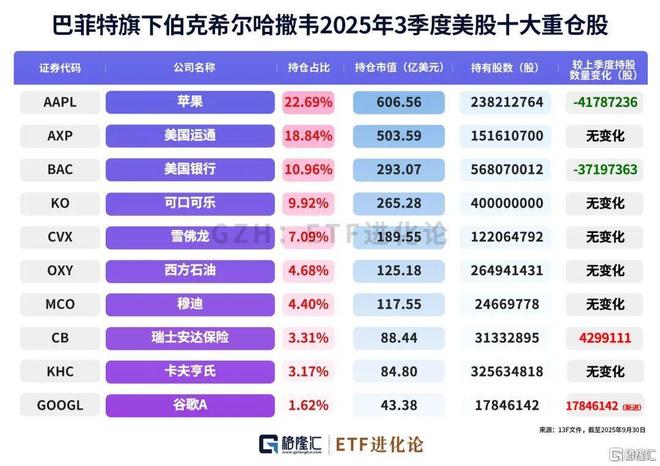
Group 1 - Berkshire Hathaway's latest investment strategy reveals a total of 41 stocks held in the U.S. market, with a combined market value of $267 billion as of the end of Q3 [1] - In Q3, Berkshire purchased 17.85 million shares of Alphabet, with a holding value of approximately $4.34 billion, making it the 10th largest position in the portfolio [1] - Berkshire has reduced its stake in Apple by selling 41.79 million shares in Q3, more than doubling the amount sold compared to Q2, yet still holds over 238 million shares valued at approximately $60.66 billion, maintaining Apple as its largest holding [1][2] Group 2 - The top ten holdings of Berkshire Hathaway account for 87% of its portfolio, including Apple, American Express, Bank of America, Coca-Cola, Chevron, Occidental Petroleum, Moody's, Chubb, Kraft Heinz, and Alphabet [2][3] - Chubb is the only stock among the top ten that saw an increase in holdings, with an additional 4.29 million shares acquired, raising its holding percentage to 3.31% [3] Group 3 - Warren Buffett's annual letter to shareholders reflects on his life and investment philosophy, emphasizing the importance of kindness and philanthropy, while also announcing plans to convert more Berkshire A shares into B shares for charitable donations [4][5] - Buffett reassures shareholders of his confidence in the U.S. economy and Berkshire's resilience, stating that volatility is not risk, but panic is [5]