Lyft(LYFT)

Search documents
Lyft(LYFT) - 2025 Q2 - Quarterly Report
2025-08-06 22:31
[FORM 10-Q Filing Information](index=1&type=section&id=FORM%2010-Q) [Registrant Information](index=1&type=section&id=Registrant%20Information) This section details Lyft, Inc.'s identification for its Q2 2025 Form 10-Q, including incorporation, executive offices, and stock exchange listing - Lyft, Inc. is incorporated in Delaware with its principal executive offices in San Francisco, California[3](index=3&type=chunk) Class A Common Stock Listing Information | Title of each class | Trading Symbol(s) | Name of each exchange on which registered | | :------------------ | :---------------- | :----------------------------------------| | Class A common stock, par value of $0.00001 per share | LYFT | Nasdaq Global Select Market | - As of August 1, 2025, **397,910,877 shares of Class A common stock** and **8,530,629 shares of Class B common stock** were outstanding[5](index=5&type=chunk) [Filing Status](index=1&type=section&id=Filing%20Status) Lyft, Inc. confirms SEC filing compliance, having filed all required reports and being classified as a large accelerated filer - The registrant has filed all required reports under Section 13 or 15(d) of the Securities Exchange Act of 1934 during the preceding 12 months and has been subject to such filing requirements for the past 90 days[4](index=4&type=chunk) - The registrant has submitted electronically every Interactive Data File required by Rule 405 of Regulation S-T during the preceding 12 months[4](index=4&type=chunk) Registrant Filer Status | Large accelerated filer | ☒ | | :---------------------- | :---| | Non-accelerated filer | ☐ | | Emerging growth company | ☐ | [Table of Contents](index=2&type=section&id=Table%20of%20Contents) [Note About Forward-Looking Statements](index=3&type=section&id=NOTE%20ABOUT%20FORWARD-LOOKING%20STATEMENTS) [Forward-Looking Statements Disclaimer](index=3&type=section&id=Forward-Looking%20Statements%20Disclaimer) This section cautions that the Form 10-Q contains forward-looking statements subject to substantial risks and uncertainties, with actual results potentially differing materially - Forward-looking statements relate to future events or financial/operating performance and are identified by words like 'may,' 'will,' 'expect,' 'plan,' 'anticipate,' 'could,' 'intend,' 'target,' 'project,' 'contemplate,' 'believe,' 'estimate,' 'predict,' 'potential' or 'continue'[10](index=10&type=chunk) - Key areas covered by forward-looking statements include future financial performance, restructuring actions, liquidity, demand for the platform, ability to attract/retain drivers/riders, new offerings, competition, pricing, litigation, regulatory effects, risk management, and macroeconomic conditions[12](index=12&type=chunk) - The outcome of these statements is subject to risks, uncertainties, and other factors, including those described in the 'Risk Factors' section, and actual results may differ materially[13](index=13&type=chunk) [PART I – FINANCIAL INFORMATION](index=5&type=section&id=PART%20I%20%E2%80%93%20FINANCIAL%20INFORMATION) [Item 1. Financial Statements](index=5&type=section&id=Item%201.%20Financial%20Statements) This section presents Lyft, Inc.'s unaudited condensed consolidated financial statements, including balance sheets, statements of operations, comprehensive income, equity, and cash flows, with detailed notes [Condensed Consolidated Balance Sheets](index=5&type=section&id=Condensed%20Consolidated%20Balance%20Sheets) Lyft's balance sheets show total assets decreased from **$5.44 billion** to **$5.37 billion**, driven by changes in cash, investments, and convertible notes Condensed Consolidated Balance Sheets (in thousands) | Metric | June 30, 2025 (in thousands) | December 31, 2024 (in thousands) | Change (in thousands) | | :-------------------------------- | :--------------------------- | :----------------------------- | :-------------------- | | Cash and cash equivalents | $913,845 | $759,319 | $154,526 | | Short-term investments | $878,319 | $1,225,124 | $(346,805) | | Restricted cash and cash equivalents | $461,267 | $186,721 | $274,546 | | Total assets | $5,369,367 | $5,435,069 | $(65,702) | | Insurance reserves | $1,947,865 | $1,701,393 | $246,472 | | Convertible senior notes, current | $— | $390,175 | $(390,175) | | Total liabilities | $4,636,691 | $4,668,053 | $(31,362) | | Total stockholders' equity | $732,676 | $767,016 | $(34,340) | [Condensed Consolidated Statements of Operations](index=6&type=section&id=Condensed%20Consolidated%20Statements%20of%20Operations) Lyft's profitability significantly improved, with net income for the three months surging over **700% to $40.3 million** and turning profitable for the six months at **$42.9 million** Condensed Consolidated Statements of Operations (in thousands) | Metric | Three Months Ended June 30, 2025 | Three Months Ended June 30, 2024 | Six Months Ended June 30, 2025 | Six Months Ended June 30, 2024 | | :-------------------------------- | :------------------------------- | :------------------------------- | :----------------------------- | :----------------------------- | | Revenue | $1,588,183 | $1,435,846 | $3,038,355 | $2,713,047 | | Total costs and expenses | $1,585,753 | $1,463,072 | $3,064,774 | $2,803,224 | | Income (loss) from operations | $2,430 | $(27,226) | $(26,419) | $(90,177) | | Net income (loss) | $40,314 | $5,014 | $42,881 | $(26,521) | | Basic EPS | $0.10 | $0.01 | $0.10 | $(0.07) | | Diluted EPS | $0.10 | $0.01 | $0.10 | $(0.07) | - Net income increased by **704%** for the three months ended June 30, 2025, compared to the same period in 2024[21](index=21&type=chunk) - For the six months ended June 30, 2025, net income was **$42.9 million**, a significant improvement from a net loss of **$26.5 million** in the prior year period[21](index=21&type=chunk) [Condensed Consolidated Statements of Comprehensive Income (Loss)](index=7&type=section&id=Condensed%20Consolidated%20Statements%20of%20Comprehensive%20Income%20(Loss)) Lyft's comprehensive income significantly improved to **$43.7 million** for three months and **$46.0 million** for six months, driven by net income and foreign currency adjustments Condensed Consolidated Statements of Comprehensive Income (Loss) (in thousands) | Metric | Three Months Ended June 30, 2025 | Three Months Ended June 30, 2024 | Six Months Ended June 30, 2025 | Six Months Ended June 30, 2024 | | :-------------------------------- | :------------------------------- | :------------------------------- | :----------------------------- | :----------------------------- | | Net income (loss) | $40,314 | $5,014 | $42,881 | $(26,521) | | Foreign currency translation adjustment | $3,568 | $(1,012) | $3,671 | $(505) | | Unrealized loss on marketable securities | $(157) | $(488) | $(592) | $(2,319) | | Other comprehensive income (loss) | $3,411 | $(1,500) | $3,079 | $(2,824) | | Comprehensive income (loss) | $43,725 | $3,514 | $45,960 | $(29,345) | - Comprehensive income for the three months ended June 30, 2025, increased to **$43.7 million** from **$3.5 million** in the prior year[24](index=24&type=chunk) - For the six months ended June 30, 2025, comprehensive income was **$46.0 million**, a significant improvement from a loss of **$29.3 million** in the prior year period[24](index=24&type=chunk) [Condensed Consolidated Statements of Stockholders' Equity](index=8&type=section&id=Condensed%20Consolidated%20Statements%20of%20Stockholders'%20Equity) Stockholders' equity decreased from **$767.0 million** to **$732.7 million**, primarily due to **$201.4 million** in share repurchases and **$61.5 million** in net share settlements Changes in Stockholders' Equity (in thousands) - Six Months Ended June 30, 2025 | Item | Amount | | :------------------------------------ | :-------| | Balance as of December 31, 2024 | $767,016 | | Shares withheld related to net share settlement | $(61,495) | | Stock-based compensation | $175,260 | | Repurchase and retirement of common stock | $(201,369) | | Net income | $42,881 | | Balance as of June 30, 2025 | $732,676 | Changes in Stockholders' Equity (in thousands) - Six Months Ended June 30, 2024 | Item | Amount | | :------------------------------------ | :-------| | Balance as of December 31, 2023 | $541,518 | | Shares withheld related to net share settlement | $(8,898) | | Stock-based compensation | $165,837 | | Repurchase and retirement of common stock | $(50,000) | | Purchase of capped call | $(47,886) | | Net loss | $(26,521) | | Balance as of June 30, 2024 | $577,628 | [Condensed Consolidated Statements of Cash Flows](index=10&type=section&id=Condensed%20Consolidated%20Statements%20of%20Cash%20Flows) Lyft's operating cash flow increased **46% to $631.0 million**, investing activities provided **$496.3 million**, and financing used **$699.3 million** due to debt repayment and share repurchases Condensed Consolidated Statements of Cash Flows (in thousands) | Cash Flow Activity | Six Months Ended June 30, 2025 | Six Months Ended June 30, 2024 | | :------------------------------------ | :------------------------------- | :------------------------------- | | Net cash provided by operating activities | $630,962 | $432,379 | | Net cash provided by (used in) investing activities | $496,262 | $(317,157) | | Net cash used in financing activities | $(699,272) | $(66,883) | | Net increase in cash, cash equivalents and restricted cash and cash equivalents | $429,072 | $47,838 | - Operating cash flows increased by **$198.6 million YoY**, driven by net income improvement and changes in working capital, particularly insurance reserves[32](index=32&type=chunk)[239](index=239&type=chunk) - Investing activities saw a positive shift, primarily from proceeds from sales and maturities of marketable securities (**$2.1 billion**) offsetting purchases (**$1.6 billion**)[32](index=32&type=chunk)[241](index=241&type=chunk) - Financing cash outflows significantly increased due to the repayment of **$390.7 million** in 2025 Notes and **$200.0 million** in Class A common stock repurchases[32](index=32&type=chunk)[243](index=243&type=chunk) [Notes to Condensed Consolidated Financial Statements](index=12&type=section&id=Notes%20to%20Condensed%20Consolidated%20Financial%20Statements) These notes detail Lyft's business, accounting policies, and financial line items, covering revenue, investments, leases, legal proceedings, debt, equity, income taxes, and the Freenow acquisition [1. Description of Business and Basis of Presentation](index=12&type=section&id=1.%20Description%20of%20Business%20and%20Basis%20of%20Presentation) Lyft operates multimodal transportation networks in the US and Canada, primarily ridesharing, with financial statements prepared under GAAP and SEC rules - Lyft operates multimodal transportation networks in the United States and Canada, primarily facilitating peer-to-peer ridesharing[36](index=36&type=chunk) - Other transportation options include bikes, scooters, Express Drive vehicle rentals (via Flexdrive), Lyft Business offerings (Concierge, Lyft Pass), and revenue from licensing, data access, and advertising services[37](index=37&type=chunk) - Financial statements are prepared under GAAP and SEC rules, with estimates for items like insurance claims, fair value of assets/liabilities, goodwill, leases, and legal contingencies[38](index=38&type=chunk)[40](index=40&type=chunk)[41](index=41&type=chunk) [2. Summary of Significant Accounting Policies](index=13&type=section&id=2.%20Summary%20of%20Significant%20Accounting%20Policies) Lyft's accounting policies are consistent with its 2024 10-K, operating as a single segment, with new accounting pronouncements pending adoption - No material changes to significant accounting policies since the Annual Report on Form 10-K for the year ended December 31, 2024[42](index=42&type=chunk) - Lyft operates as one operating segment, with the CEO (CODM) reviewing consolidated net income (loss) for decision-making[43](index=43&type=chunk) - Upcoming accounting pronouncements include ASU No. 2023-09 (Income Tax Disclosures, effective after Dec 15, 2024), ASU 2024-03 (Disaggregation of Income Statement Expenses, effective after Dec 15, 2026), and ASU 2024-04 (Induced Conversions of Convertible Debt, effective after Dec 15, 2025)[44](index=44&type=chunk)[45](index=45&type=chunk)[46](index=46&type=chunk) [3. Revenue](index=13&type=section&id=3.%20Revenue) Lyft's revenue primarily stems from its ridesharing marketplace (ASC 606), supplemented by rental and other services, totaling **$1.59 billion** for Q2 2025 - Substantially all (**85% or more**) of Lyft's revenue is from its ridesharing marketplace, recognized under ASC 606[47](index=47&type=chunk) - Other revenue streams include licensing, data access, subscription fees, bike/bike station sales, advertising, and rental revenue (Flexdrive, bikes/scooters) recognized under ASC 842[47](index=47&type=chunk) Disaggregation of Revenue (in thousands) | Revenue Source | Three Months Ended June 30, 2025 | Three Months Ended June 30, 2024 | Six Months Ended June 30, 2025 | Six Months Ended June 30, 2024 | | :-------------------------------- | :------------------------------- | :------------------------------- | :----------------------------- | :----------------------------- | | Revenue from contracts with customers (ASC 606) | $1,477,121 | $1,321,830 | $2,851,310 | $2,531,568 | | Rental revenue (ASC 842) | $111,062 | $114,016 | $187,045 | $181,479 | | Total revenue | $1,588,183 | $1,435,846 | $3,038,355 | $2,713,047 | [4. Cash Equivalents and Investments](index=14&type=section&id=4.%20Cash%20Equivalents%20and%20Investments) Lyft's cash equivalents and investments decreased to **$3.12 billion**, primarily comprising money market funds and debt securities, with **$78.6 million** in interest income Total Unrestricted and Restricted Cash Equivalents and Investments (in thousands) | Date | Cost or Amortized Cost | Unrealized Gains | Unrealized Losses | Estimated Fair Value | | :---------------- | :--------------------- | :--------------- | :---------------- | :------------------- | | June 30, 2025 | $3,124,742 | $1,008 | $(817) | $3,124,933 | | December 31, 2024 | $3,393,351 | $1,948 | $(1,167) | $3,394,132 | - Interest income for the three months ended June 30, 2025, was **$39.0 million**, and for the six months, it was **$78.6 million**[52](index=52&type=chunk) - The company classifies debt securities as short-term investments, even those with maturity dates beyond one year, as they are available for current operations[51](index=51&type=chunk) [5. Fair Value Measurements](index=17&type=section&id=5.%20Fair%20Value%20Measurements) Lyft measures **$2.84 billion** in financial assets at fair value using Level 1 and Level 2 inputs, also holding non-marketable equity securities on a non-recurring basis Total Financial Assets Measured at Fair Value (in thousands) | Date | Level 1 | Level 2 | Level 3 | Total | | :---------------- | :------ | :-------- | :------ | :-------- | | June 30, 2025 | $224,782 | $2,615,118 | $— | $2,839,900 | | December 31, 2024 | $232,538 | $2,854,684 | $— | $3,087,222 | - Level 1 inputs reflect quoted prices for identical assets in active markets, while Level 2 inputs use observable market data[67](index=67&type=chunk) - Non-marketable equity securities are measured at fair value on a non-recurring basis, based on observable transactions or for impairment, with changes recorded in other income, net[63](index=63&type=chunk) [6. Supplemental Financial Statement Information](index=18&type=section&id=6.%20Supplemental%20Financial%20Statement%20Information) Prepaid expenses remained stable at **$965.4 million**, while accrued liabilities increased to **$1.84 billion** due to higher insurance and ride-related accruals, and a reinsurance agreement was executed Prepaid Expenses and Other Current Assets (in thousands) | Item | June 30, 2025 | December 31, 2024 | | :-------------------------------- | :-------------- | :---------------- | | Prepaid insurance | $363,101 | $428,884 | | Enterprise and trade receivables, net | $359,940 | $334,843 | | Total prepaid expenses and other current assets | $965,418 | $966,090 | Accrued and Other Current Liabilities (in thousands) | Item | June 30, 2025 | December 31, 2024 | | :-------------------------------- | :-------------- | :---------------- | | Insurance-related accruals | $834,598 | $763,842 | | Legal and tax related accruals | $301,281 | $333,979 | | Ride-related accruals | $263,409 | $178,114 | | Total accrued and other current liabilities | $1,839,940 | $1,666,278 | - Lyft's subsidiary, PVIC, entered into a Loss Portfolio Transfer Reinsurance Agreement for **$120.5 million** of legacy auto insurance liabilities, with a premium of **$85.1 million**, largely on a funds withheld basis[70](index=70&type=chunk) [7. Leases](index=19&type=section&id=7.%20Leases) Lyft manages operating leases for real estate (**$167.3 million**) and finance leases for Flexdrive vehicles (**$68.7 million**), with total lease costs of **$39.7 million** for H1 2025 - Lyft has approximately **60 real estate operating leases** with terms up to nine years, and Flexdrive operates finance leases for rental vehicles with terms up to four years[72](index=72&type=chunk)[73](index=73&type=chunk) Lease Liabilities and Terms (in thousands, except years and rates) | Metric | June 30, 2025 | December 31, 2024 | | :-------------------------------- | :-------------- | :---------------- | | Total operating lease liabilities | $167,336 | $177,266 | | Total finance lease liabilities | $68,708 | $85,619 | | Weighted-average remaining operating lease term (years) | 7.3 | 7.7 | | Weighted-average remaining finance lease term (years) | 2.3 | 2.6 | | Weighted-average operating lease discount rate | 6.6% | 6.6% | | Weighted-average finance lease discount rate | 6.4% | 6.4% | Total Lease Cost (in thousands) | Period | Three Months Ended June 30, 2025 | Three Months Ended June 30, 2024 | Six Months Ended June 30, 2025 | Six Months Ended June 30, 2024 | | :-------------------------------- | :------------------------------- | :------------------------------- | :----------------------------- | :----------------------------- | | Total lease cost | $19,605 | $21,397 | $39,690 | $42,590 | [8. Commitments and Contingencies](index=22&type=section&id=8.%20Commitments%20and%20Contingencies) Lyft faces diverse legal and regulatory challenges, including driver classification lawsuits, tax disputes, and patent litigation, with the California Supreme Court upholding Proposition 22 - Lyft maintains **$60.7 million** in outstanding letters of credit as of June 30, 2025, under its Revolving Credit Facility[84](index=84&type=chunk) - The California Supreme Court unanimously upheld Proposition 22 on July 25, 2024, affirming drivers' independent contractor status, despite ongoing legal challenges in other coordinated cases[91](index=91&type=chunk) - Lyft reached a resolution with the Massachusetts Attorney General on June 27, 2024, to dismiss litigation regarding driver classification, providing new benefits while maintaining independent contractor flexibility[93](index=93&type=chunk) - The company is involved in administrative audits with state employment agencies (Oregon, Wisconsin, Illinois, New York, Pennsylvania, New Jersey, California EDD) regarding driver classification for unemployment insurance, with accruals recorded for probable and estimable losses[97](index=97&type=chunk)[98](index=98&type=chunk)[99](index=99&type=chunk)[100](index=100&type=chunk) - Lyft is disputing San Francisco's application of gross receipts taxes to rideshare, filing a suit for a refund of approximately **$100 million** for tax years 2019-2023[102](index=102&type=chunk) - In July 2024, Lyft successfully defended against a class action alleging ADA violations regarding wheelchair accessible vehicle (WAV) offerings, with the district court ruling in its favor on September 30, 2024[105](index=105&type=chunk) [9. Debt](index=26&type=section&id=9.%20Debt) Lyft's long-term debt decreased to **$573.2 million** due to the **$390.7 million** settlement of 2025 Convertible Senior Notes, with **$460.0 million** in 2029 Notes and an undrawn **$420.0 million** credit facility Outstanding Debt Obligations (in thousands) | Debt Type | June 30, 2025 | December 31, 2024 | | :-------------------------------- | :-------------- | :---------------- | | Convertible senior notes due 2025 | $— | $390,175 | | Convertible senior notes due 2029 | $451,227 | $450,081 | | Non-revolving Loan | $154 | $510 | | Master Vehicle Loan | $121,800 | $154,281 | | Total long-term debt, including current maturities | $573,181 | $995,047 | - The 2025 Notes matured on May 15, 2025, and the outstanding **$390.7 million** principal amount was fully settled in cash[112](index=112&type=chunk) - The 2029 Notes, issued in February 2024, have a principal amount of **$460.0 million**, mature on March 1, 2029, and have an initial conversion price of approximately **$21.08 per share**[113](index=113&type=chunk)[116](index=116&type=chunk) - Lyft has a **$420.0 million** Revolving Credit Facility, maturing November 3, 2027, with no amounts drawn as of June 30, 2025, and **$60.7 million** reduced by letters of credit[138](index=138&type=chunk)[142](index=142&type=chunk)[250](index=250&type=chunk) [10. Common Stock](index=31&type=section&id=10.%20Common%20Stock) Lyft's board authorized a **$750.0 million** share repurchase program, with **$200.0 million** executed, and **$251.1 million** in unrecognized compensation cost for unvested equity awards - Lyft's board authorized a share repurchase program of up to **$750.0 million**, increasing from an initial **$500.0 million**[143](index=143&type=chunk) - During the six months ended June 30, 2025, Lyft repurchased **12.8 million shares** of Class A common stock for **$200.0 million**, with **$550.0 million** remaining under authorization[144](index=144&type=chunk) Restricted Stock Unit (RSU) Activity (in thousands, except per share data) | Metric | Amount | | :-------------------------------- | :-------| | Unvested units as of December 31, 2024 | 26,194 | | Granted | 22,496 | | Vested | (9,489) | | Canceled | (2,706) | | Unvested units as of June 30, 2025 | 36,495 | - Total unrecognized compensation cost for unvested awards was **$251.1 million** as of June 30, 2025, expected to be recognized over approximately one year[151](index=151&type=chunk) [11. Income Taxes](index=32&type=section&id=11.%20Income%20Taxes) Lyft recorded **$7.4 million** in income tax expense for H1 2025, with a **14.76%** effective tax rate, primarily impacted by a valuation allowance on deferred tax assets Income Tax Expense and Effective Tax Rate (in thousands) | Period | Income Tax Expense | Effective Tax Rate | | :-------------------------------- | :----------------- | :----------------- | | Three Months Ended June 30, 2025 | $4,073 | 9.18% | | Three Months Ended June 30, 2024 | $1,851 | 26.96% | | Six Months Ended June 30, 2025 | $7,424 | 14.76% | | Six Months Ended June 30, 2024 | $4,444 | (20.13)% | - The effective tax rate differs from the U.S. statutory rate primarily due to a valuation allowance on deferred tax assets, as it is more likely than not that some or all will not be realized[155](index=155&type=chunk) - Lyft is assessing the impact of the recently enacted One Big Beautiful Bill Act (OBBBA) on its financial statements[158](index=158&type=chunk) [12. Net Income (Loss) Per Share Attributable to Common Stockholders](index=33&type=section&id=12.%20Net%20Income%20(Loss)%20Per%20Share%20Attributable%20to%20Common%20Stockholders) Lyft reported basic and diluted net income per share of **$0.10** for both three and six months ended June 30, 2025, a significant improvement from the prior year Net Income (Loss) Per Share Attributable to Common Stockholders | Metric | Three Months Ended June 30, 2025 | Three Months Ended June 30, 2024 | Six Months Ended June 30, 2025 | Six Months Ended June 30, 2024 | | :-------------------------------- | :------------------------------- | :------------------------------- | :----------------------------- | :----------------------------- | | Net income (loss) attributable to common stockholders, basic and diluted | $40,314 | $5,014 | $42,881 | $(26,521) | | Basic net income (loss) per share | $0.10 | $0.01 | $0.10 | $(0.07) | | Diluted net income (loss) per share | $0.10 | $0.01 | $0.10 | $(0.07) | - Potentially dilutive common stock equivalents, including RSUs, PSUs, and 2029 Notes, are excluded from diluted EPS when their effect is anti-dilutive[159](index=159&type=chunk)[161](index=161&type=chunk) [13. Variable Interest Entities](index=34&type=section&id=13.%20Variable%20Interest%20Entities) Lyft consolidates one bikes and scooters Variable Interest Entity (VIE) where it is the primary beneficiary, while other JVs are accounted for under the equity method - Lyft is the primary beneficiary of one bikes and scooters VIE (**80% equity interest**) and consolidates its assets, liabilities, revenues, and operating results[164](index=164&type=chunk) - Other bikes and scooters JVs and a privately held company investment are accounted for under the equity method, as Lyft does not direct their most significant economic activities[165](index=165&type=chunk)[167](index=167&type=chunk) - The profits and losses of unconsolidated VIEs were not material to the condensed consolidated statements of operations for the three and six months ended June 30, 2025[165](index=165&type=chunk) [14. Subsequent Events](index=35&type=section&id=14.%20Subsequent%20Events) Lyft acquired Intelligent Apps GmbH (Freenow), a European multi-mobility app, for approximately **€204.1 million** in cash on July 31, 2025, marking its first expansion outside North America - Lyft acquired Intelligent Apps GmbH (Freenow), a European multi-mobility app, on July 31, 2025[169](index=169&type=chunk) - The acquisition cost was approximately **€204.1 million** in cash, inclusive of closing adjustments[169](index=169&type=chunk) - This acquisition marks Lyft's first expansion outside of North America, beyond bikes and scooters[173](index=173&type=chunk) [Item 2. Management's Discussion and Analysis of Financial Condition and Results of Operations](index=36&type=section&id=Item%202.%20Management's%20Discussion%20and%20Analysis%20of%20Financial%20Condition%20and%20Results%20of%20Operations) Management discusses Lyft's financial condition and operational results, highlighting improved revenue and profitability, key metrics, cash flow, liquidity, and strategic initiatives like the Freenow acquisition [Our Business](index=36&type=section&id=Our%20Business) Lyft operates a global multi-mobility platform across four continents, with ridesharing as its primary revenue source, supplemented by various other transportation and business offerings - Lyft operates a global mobility platform offering diverse transportation options including rideshare, taxis, bikes, and scooters across four continents[171](index=171&type=chunk) - Substantially all revenue is generated from the ridesharing marketplace, with additional revenue from licensing, data access, bike/bike station sales, advertising, and Express Drive vehicle rentals[172](index=172&type=chunk) [Recent Developments](index=36&type=section&id=Recent%20Developments) Lyft completed the acquisition of Intelligent Apps GmbH (Freenow) on July 31, 2025, for approximately **€204.1 million**, marking its first expansion into European multi-mobility - Lyft completed the acquisition of Intelligent Apps GmbH (Freenow) on July 31, 2025[173](index=173&type=chunk) - The acquisition, for approximately **€204.1 million** in cash, represents Lyft's first expansion outside of North America for its multi-mobility offerings[173](index=173&type=chunk) [Financial and Operational Results for the Three Months Ended June 30, 2025 and 2024](index=37&type=section&id=Financial%20and%20Operational%20Results%20for%20the%20Three%20Months%20Ended%20June%2030%2C%202025%20and%202024) Lyft achieved strong Q2 2025 growth, with revenue up **11% to $1.59 billion**, net income surging **704% to $40.3 million**, and Active Riders increasing **10% to 26.1 million** Key Financial and Operational Results (Three Months Ended June 30) | Metric | 2025 (in millions) | 2024 (in millions) | % Change | | :-------------------------------- | :----------------- | :----------------- | :------- | | Revenue | $1,588.2 | $1,435.8 | 11% | | Net income | $40.3 | $5.0 | 704% | | Active Riders | 26.1 | 23.7 | 10% | | Rides | 234.8 | 205.3 | 14% | | Gross Bookings | $4,490.1 | $4,018.9 | 12% | | Adjusted EBITDA | $129.4 | $102.9 | 26% | | Free cash flow | $329.4 | $256.4 | 28% | - Net income as a percentage of revenue increased from **0.3%** in Q2 2024 to **2.5%** in Q2 2025[174](index=174&type=chunk) - Adjusted EBITDA margin (as a percentage of Gross Bookings) improved from **2.6%** to **2.9%**[174](index=174&type=chunk) [Definitions of Key Metrics](index=38&type=section&id=Definitions%20of%20Key%20Metrics) Lyft defines Active Riders, Rides, and Gross Bookings as key metrics reflecting platform scale, usage, and financial performance, indicating improved marketplace health and engagement - Active Riders are unique riders who have taken at least one ride during the quarter, with the definition updated in Q1 2025 for simplification and better alignment with future business scaling[177](index=177&type=chunk)[178](index=178&type=chunk) - Rides represent the total number of rides (rideshare, bike, scooter) completed on the platform that contribute to revenue, increasing due to improved marketplace health and ride frequency[180](index=180&type=chunk)[181](index=181&type=chunk) - Gross Bookings is the total dollar value of transactions invoiced to rideshare riders (excluding tips) and other offerings, increasing due to Rides growth and improved marketplace health[183](index=183&type=chunk)[184](index=184&type=chunk) [Components of Results of Operations](index=38&type=section&id=Components%20of%20Results%20of%20Operations) This section details Lyft's revenue components, primarily ridesharing, and expense categories including cost of revenue, operations and support, R&D, sales and marketing, and general and administrative - Revenue is primarily from ridesharing fees, Concierge platform fees, subscription fees, bike/bike station sales, licensing/data access, and advertising services, with rental revenue from Flexdrive and bikes/scooters[186](index=186&type=chunk)[187](index=187&type=chunk) - Cost of revenue includes insurance, payment processing, hosting, personnel, depreciation, and Flexdrive-related costs (vehicle lease, remarketing)[189](index=189&type=chunk) - Operating expenses are broken down into Operations and support (local teams, fleet ops, background checks), Research and development (personnel, facilities), Sales and marketing (rider/driver incentives, advertising), and General and administrative (personnel, professional services, legal/tax accruals, insurance claims admin fees)[190](index=190&type=chunk)[191](index=191&type=chunk)[192](index=192&type=chunk)[193](index=193&type=chunk) [Results of Operations](index=40&type=section&id=Results%20of%20Operations) Lyft's revenue grew **11-12%** to **$1.59 billion** (Q2) and **$3.04 billion** (H1), driven by increased Rides and Active Riders, while net income significantly improved despite rising cost of revenue Revenue (in thousands) | Period | 2025 | 2024 | % Change | | :-------------------------------- | :--------- | :--------- | :------- | | Three Months Ended June 30, | $1,588,183 | $1,435,846 | 11% | | Six Months Ended June 30, | $3,038,355 | $2,713,047 | 12% | - Revenue growth was primarily driven by a **14%** increase in Rides and **10%** in Active Riders for the three months, and a **15%** increase in Rides for the six months, reflecting improved marketplace health[200](index=200&type=chunk)[201](index=201&type=chunk) Cost of Revenue (in thousands) | Period | 2025 | 2024 | % Change | | :-------------------------------- | :--------- | :--------- | :------- | | Three Months Ended June 30, | $935,734 | $819,518 | 14% | | Six Months Ended June 30, | $1,798,608 | $1,574,880 | 14% | - Cost of revenue increased primarily due to higher insurance costs (**$107.8 million** for three months, **$207.4 million** for six months) and transaction fees, driven by increased ride volume and costs per mile[203](index=203&type=chunk)[204](index=204&type=chunk) General and Administrative Expenses (in thousands) | Period | 2025 | 2024 | % Change | | :-------------------------------- | :--------- | :--------- | :------- | | Three Months Ended June 30, | $232,339 | $252,643 | (8)% | | Six Months Ended June 30, | $447,639 | $488,896 | (8)% | - General and administrative expenses decreased due to a net decrease in loss contingencies (legal and tax accruals) and lower stock-based compensation, partially offset by increased accruals for self-retained general business liabilities and consulting costs[212](index=212&type=chunk)[213](index=213&type=chunk) Net Income (Loss) (in thousands) | Period | 2025 | 2024 | % Change | | :-------------------------------- | :--------- | :--------- | :------- | | Three Months Ended June 30, | $40,314 | $5,014 | 704% | | Six Months Ended June 30, | $42,881 | $(26,521) | 262% | [Non-GAAP Financial Measures](index=44&type=section&id=Non-GAAP%20Financial%20Measures) Lyft utilizes non-GAAP measures like Adjusted EBITDA, which increased **45% to $235.9 million** for H1 2025, and Free Cash Flow, which rose **59% to $610.2 million**, to assess performance and liquidity Key Non-GAAP Financial Measures (in millions) | Metric | Three Months Ended June 30, 2025 | Three Months Ended June 30, 2024 | Six Months Ended June 30, 2025 | Six Months Ended June 30, 2024 | | :-------------------------------- | :------------------------------- | :------------------------------- | :----------------------------- | :----------------------------- | | Gross Bookings | $4,490.1 | $4,018.9 | $8,652.5 | $7,712.1 | | Adjusted EBITDA | $129.4 | $102.9 | $235.9 | $162.3 | | Adjusted EBITDA margin (calculated as a percentage of Gross Bookings) | 2.9% | 2.6% | 2.7% | 2.1% | | Free cash flow | $329.4 | $256.4 | $610.2 | $383.5 | - Adjusted EBITDA is calculated as net income (loss) adjusted for interest expense, other income (net), provision for income taxes, depreciation and amortization, stock-based compensation, payroll tax expense, sublease income, and costs related to acquisitions/divestitures[224](index=224&type=chunk)[225](index=225&type=chunk) - Free cash flow is defined as net cash provided by operating activities less purchases of property and equipment and scooter fleet[230](index=230&type=chunk) [Cash Flows](index=47&type=section&id=Cash%20Flows) Lyft's operating cash flow increased to **$631.0 million**, investing activities provided **$496.3 million**, and financing activities used **$699.3 million** for H1 2025 Summary of Cash Flows (in thousands) | Cash Flow Activity | Six Months Ended June 30, 2025 | Six Months Ended June 30, 2024 | | :------------------------------------ | :------------------------------- | :------------------------------- | | Net cash provided by operating activities | $630,962 | $432,379 | | Net cash provided by (used in) investing activities | $496,262 | $(317,157) | | Net cash used in financing activities | $(699,272) | $(66,883) | | Net change in cash, cash equivalents and restricted cash and cash equivalents | $429,072 | $47,838 | - Operating cash flows increased by **$198.6 million YoY**, driven by net income improvement and changes in working capital, including a rise in insurance reserves[239](index=239&type=chunk) - Investing activities shifted to a net cash inflow, primarily from **$2.1 billion** in proceeds from sales and maturities of marketable securities, partially offset by **$1.6 billion** in purchases[241](index=241&type=chunk) - Financing cash outflows were significantly higher due to the **$390.7 million** repayment of 2025 Notes and **$200.0 million** in Class A common stock repurchases[243](index=243&type=chunk) [Liquidity and Capital Resources](index=48&type=section&id=Liquidity%20and%20Capital%20Resources) Lyft held **$1.8 billion** in unrestricted liquidity, including **$913.8 million** cash and **$878.3 million** short-term investments, plus an undrawn **$420.0 million** credit facility, after settling **$390.7 million** in notes and repurchasing **$200.0 million** in stock Liquidity Position (in millions) | Metric | June 30, 2025 | | :-------------------------------- | :------------ | | Cash and cash equivalents | $913.8 | | Short-term investments | $878.3 | | Restricted cash and cash equivalents and restricted investments | $1,700.0 | | Revolving Credit Facility (undrawn) | $420.0 | - Lyft fully settled **$390.7 million** of 2025 Notes at maturity in Q2 2025[250](index=250&type=chunk) - The board authorized a total share repurchase program of up to **$750.0 million**, with **$200.0 million** executed by June 30, 2025, and **$550.0 million** remaining[252](index=252&type=chunk) [Contractual Obligations and Commitments](index=49&type=section&id=Contractual%20Obligations%20and%20Commitments) No material changes to contractual obligations and commitments have occurred since the 2024 Annual Report on Form 10-K - No material changes to contractual obligations and commitments since the Annual Report on Form 10-K for the year ended December 31, 2024[254](index=254&type=chunk) [Critical Accounting Estimates](index=49&type=section&id=Critical%20Accounting%20Estimates) Lyft's critical accounting estimates, involving significant management judgment, remain unchanged from its 2024 Annual Report on Form 10-K - No material changes to critical accounting estimates since the Annual Report on Form 10-K for the year ended December 31, 2024[256](index=256&type=chunk) [Recent Accounting Pronouncements](index=49&type=section&id=Recent%20Accounting%20Pronouncements) Details on recently issued accounting pronouncements not yet adopted are provided in Note 2 to the condensed consolidated financial statements - Refer to Note 2 for details on recently issued accounting pronouncements not yet adopted[257](index=257&type=chunk) [Item 3. Quantitative and Qualitative Disclosures About Market Risk](index=49&type=section&id=Item%203.%20Quantitative%20and%20Qualitative%20Disclosures%20About%20Market%20Risk) Lyft faces market risks from interest rate and foreign currency fluctuations, but a hypothetical **100 basis points** interest rate change or **10%** currency change would not materially impact financials - Lyft's primary market risks are interest rate and foreign currency exchange fluctuations, which have not been significant[258](index=258&type=chunk) - A hypothetical **100 basis points** change in interest rates would not materially impact financial condition or results of operations[260](index=260&type=chunk) - A hypothetical **10%** change in foreign currency exchange rates would not materially impact condensed consolidated financial statements[261](index=261&type=chunk) [Item 4. Controls and Procedures](index=50&type=section&id=Item%204.%20Controls%20and%20Procedures) Lyft's disclosure controls and procedures were effective as of June 30, 2025, with no material changes in internal control over financial reporting during the quarter - Disclosure controls and procedures were effective at a reasonable assurance level as of June 30, 2025[262](index=262&type=chunk) - No material changes in internal control over financial reporting occurred during the quarter ended June 30, 2025[263](index=263&type=chunk) - Control systems have inherent limitations, providing only reasonable assurance, and may not prevent all errors or fraud[264](index=264&type=chunk) [PART II - OTHER INFORMATION](index=51&type=section&id=PART%20II%20-%20OTHER%20INFORMATION) [Item 1. Legal Proceedings](index=51&type=section&id=Item%201.%20Legal%20Proceedings) This section refers to Note 8 of the condensed consolidated financial statements for detailed information on Lyft's legal proceedings and regulatory investigations - For information on legal proceedings, refer to Note 8 to the condensed consolidated financial statements in Part I, Item 1[266](index=266&type=chunk) [Item 1A. Risk Factors](index=51&type=section&id=Item%201A.%20Risk%20Factors) This section outlines significant risks to Lyft's business, including operational, economic, regulatory, legal, financing, and governance factors, which could materially impact financial results [Risk Factor Summary](index=51&type=section&id=Risk%20Factor%20Summary) Lyft faces numerous risks, including operational challenges, intense competition, regulatory and legal uncertainties, financing risks, and governance issues like its dual-class stock structure - Operational risks include limited operating history, inability to maintain profitability, intense competition, unpredictability of results, and challenges in attracting/retaining drivers and riders[268](index=268&type=chunk) - Regulatory and legal risks encompass evolving laws, driver classification challenges, intellectual property litigation, privacy regulations, and the costs of operating as a public company[269](index=269&type=chunk)[271](index=271&type=chunk) - Financing and transactional risks involve future capital requirements, debt servicing, and the ability to successfully integrate acquisitions[270](index=270&type=chunk)[271](index=271&type=chunk) - Governance risks include the dual-class common stock structure concentrating voting power with Co-Founders and potential stock price volatility[274](index=274&type=chunk) [Risks Related to Operational Factors](index=53&type=section&id=Risks%20Related%20to%20Operational%20Factors) Operational risks include limited operating history, profitability challenges, intense competition, driver/rider retention, insurance management, brand protection, new offering development, platform security, and reliance on third-party providers - Lyft's evolving business and limited operating history make future prospects and risk assessment difficult, requiring continuous adaptation in pricing, platform features, and cost structure[272](index=272&type=chunk)[273](index=273&type=chunk) - The company may not achieve or maintain profitability due to increasing expenses from new offerings, fluctuating costs (insurance, driver pay), and potential adverse outcomes from driver classification litigation[277](index=277&type=chunk)[278](index=278&type=chunk) - Intense competition from Uber and other mobility providers, coupled with the need to attract and retain drivers and riders through incentives and competitive pricing, poses a significant risk to market share and financial results[280](index=280&type=chunk)[289](index=289&type=chunk)[291](index=291&type=chunk) - Risks related to insurance include insufficient coverage, potential insolvency of providers, and actual losses exceeding reserves, exacerbated by rising costs in the automotive insurance industry[293](index=293&type=chunk)[295](index=295&type=chunk)[297](index=297&type=chunk)[299](index=299&type=chunk) - Reputation and brand are vulnerable to negative publicity, illegal activities by users, and failures in user support or fraud detection, which could deter platform usage[302](index=302&type=chunk)[304](index=304&type=chunk)[363](index=363&type=chunk)[364](index=364&type=chunk) - Challenges in developing and implementing autonomous vehicle technology, managing the supply chain for bikes/scooters, and ensuring platform interoperability with third-party services could adversely affect business growth and financial performance[316](index=316&type=chunk)[319](index=319&type=chunk)[320](index=320&type=chunk)[379](index=379&type=chunk) - The use of AI and machine learning introduces risks related to algorithm flaws, biased data, and an evolving regulatory environment, potentially leading to discriminatory outcomes or legal liabilities[355](index=355&type=chunk) [Risks Related to General Economic Factors](index=76&type=section&id=Risks%20Related%20to%20General%20Economic%20Factors) Lyft's business is highly susceptible to macroeconomic downturns, inflation, and increased costs, alongside disruptions from natural disasters, public health crises, and political instability - Deteriorating macroeconomic conditions (recession, inflation, high interest rates, increased fuel/vehicle costs) are likely to decrease discretionary spending and reduce demand for Lyft's platform[390](index=390&type=chunk) - Inflation has increased medical and vehicle repair costs, leading to higher insurance costs for Lyft and increased costs for drivers[390](index=390&type=chunk) - Natural disasters, public health crises (like pandemics), and political crises (such as war) can disrupt operations, cause driver supply/rider demand imbalances, decrease demand, and increase costs[391](index=391&type=chunk)[392](index=392&type=chunk) [Risks Related to Regulatory and Legal Factors](index=77&type=section&id=Risks%20Related%20to%20Regulatory%20and%20Legal%20Factors) Lyft navigates a complex regulatory landscape, facing risks from evolving laws on worker classification, privacy, and taxes, alongside intellectual property claims and the costs of public company operation - Lyft is subject to a wide range of evolving laws and regulations across federal, state, and municipal levels, covering TNCs, worker classification, labor, payments, privacy, and more, with non-compliance posing significant risks[393](index=393&type=chunk)[394](index=394&type=chunk) - Challenges to driver classification as independent contractors, including ongoing lawsuits and administrative audits (e.g., NLRB, U.S. Department of Labor, California PAGA), could lead to monetary exposure, injunctions, claims for employee benefits, and require significant business model alterations[400](index=400&type=chunk)[401](index=401&type=chunk)[402](index=402&type=chunk)[403](index=403&type=chunk) - Claims of intellectual property infringement by third parties, or failure to protect its own IP, could result in substantial damages, injunctions, costly litigation, and diversion of management attention[404](index=404&type=chunk)[407](index=407&type=chunk) - Compliance with privacy and data protection laws (CCPA, CPRA, HIPAA, GDPR) is costly and complex, with potential for significant fines, litigation, and reputational harm from actual or perceived breaches[410](index=410&type=chunk)[411](index=411&type=chunk)[413](index=413&type=chunk)[415](index=415&type=chunk) - Operating as a public company incurs substantial legal, accounting, and compliance costs, demanding significant management attention and exposing the company to stockholder activism and increased scrutiny[436](index=436&type=chunk)[437](index=437&type=chunk)[438](index=438&type=chunk) - Changes in U.S. and foreign tax laws (e.g., Inflation Reduction Act's excise tax, OECD Pillar Two) and challenges from taxing authorities regarding indirect taxes (e.g., San Francisco gross receipts tax) could materially impact financial results[429](index=429&type=chunk)[430](index=430&type=chunk)[431](index=431&type=chunk)[433](index=433&type=chunk) - Emerging climate-related regulations (e.g., California's Clean Miles Standard, SB 253/261/219) impose EV and greenhouse gas requirements, increasing compliance costs and potentially impacting operations and reputation[439](index=439&type=chunk)[440](index=440&type=chunk) [Risks Related to Financing and Transactional Factors](index=85&type=section&id=Risks%20Related%20to%20Financing%20and%20Transactional%20Factors) Lyft faces financing risks from potential capital needs, acquisition integration, substantial debt servicing, restrictive covenants, and counterparty risk from capped call transactions - Lyft may require additional capital for growth and operations, but financing may not be available on acceptable terms, potentially leading to equity dilution or increased fixed debt obligations[441](index=441&type=chunk)[442](index=442&type=chunk)[443](index=443&type=chunk) - Acquisitions and investments (e.g., Freenow) involve risks such as integration difficulties, failure to realize anticipated benefits, diversion of resources, and unidentified liabilities[444](index=444&type=chunk)[445](index=445&type=chunk) - Servicing current and future debt (**$573.2 million** outstanding as of June 30, 2025) requires significant cash flow, and restrictive covenants in debt agreements could limit operational flexibility[449](index=449&type=chunk)[450](index=450&type=chunk)[453](index=453&type=chunk)[455](index=455&type=chunk) - Lyft is exposed to counterparty risk with respect to its 2029 Capped Calls, as a default by an option counterparty could lead to adverse tax consequences and increased stock dilution[457](index=457&type=chunk)[458](index=458&type=chunk) - The ability to use net operating loss (NOL) carryforwards (**$7.2 billion** federal, **$6.2 billion** state as of Dec 31, 2024) may be limited by ownership changes (Section 382) or state legislation, potentially impacting future taxable income offsets[459](index=459&type=chunk)[460](index=460&type=chunk) [Risks Related to Governance and Ownership of our Capital Stock Factors](index=89&type=section&id=Risks%20Related%20to%20Governance%20and%20Ownership%20of%20our%20Capital%20Stock%20Factors) Lyft's dual-class stock structure concentrates voting power with Co-Founders, leading to potential stock price volatility and limiting stockholder influence, further impacted by anti-takeover provisions - The dual-class common stock structure (Class B: **20 votes/share**, Class A: **1 vote/share**) concentrates voting power with Co-Founders, allowing them to significantly influence stockholder-approved matters[461](index=461&type=chunk) - The trading price of Class A common stock may be volatile due to market fluctuations, company performance, analyst coverage, competitive announcements, litigation, and macroeconomic conditions[463](index=463&type=chunk) - Delaware law and company bylaws include anti-takeover provisions (e.g., classified board, no written consent, undesignated preferred stock) that could discourage or delay changes in control[466](index=466&type=chunk)[469](index=469&type=chunk) - Exclusive forum provisions in bylaws designate Delaware courts for internal corporate disputes and federal district courts for Securities Act claims, potentially limiting stockholders' choice of judicial forum[468](index=468&type=chunk)[470](index=470&type=chunk) [Item 2. Unregistered Sales of Equity Securities and Use of Proceeds](index=90&type=section&id=Item%202.%20Unregistered%20Sales%20of%20Equity%20Securities%20and%20Use%20of%20Proceeds) Lyft repurchased **12.8 million shares** of Class A common stock for **$200.0 million** under its **$750.0 million** share repurchase program, with **$550.0 million** remaining Share Repurchase Activity (Three Months Ended June 30, 2025) | Period | Total Number of Shares Purchased (in thousands) | Average Price Paid per Share | Total Number of Shares Purchased as Part of Publicly Announced Program (in thousands) | Approximate Dollar Value of Shares that May Yet Be Purchased Under the Program (in thousands) | | :---------------- | :-------------------------------------------- | :--------------------------- | :---------------------------------------------------------------------------------- | :------------------------------------------------------------------------------------------ | | April 1 - 30, 2025 | — | $— | — | $500,000 | | May 1 -31, 2025 | 4,771 | $16.23 | 4,771 | $672,583 | | June 1 -30, 2025 | 8,002 | $15.32 | 8,002 | $550,000 | | Total | 12,773 | | 12,773 | | - The board authorized an increase to the share repurchase program, totaling **$750.0 million**, with **$550.0 million** remaining as of June 30, 2025[473](index=473&type=chunk) [Item 3. Defaults Upon Senior Securities](index=92&type=section&id=Item%203.%20Defaults%20Upon%20Senior%20Securities) This item is not applicable to Lyft for the current reporting period - This item is not applicable[474](index=474&type=chunk) [Item 4. Mine Safety Disclosures](index=92&type=section&id=Item%204.%20Mine%20Safety%20Disclosures) This item is not applicable to Lyft for the current reporting period - This item is not applicable[475](index=475&type=chunk) [Item 5. Other Information](index=92&type=section&id=Item%205.%20Other%20Information) This section discloses Rule 10b5-1 trading arrangements adopted by Lyft's CFO, CLO, and Co-Founders for selling Class A common stock - CFO Erin Brewer adopted a Rule 10b5-1 plan to sell up to **30,000 shares** of Class A common stock from RSU vesting, effective until June 1, 2026[476](index=476&type=chunk) - CLO Lindsay Llewellyn adopted a Rule 10b5-1 plan to sell up to **304,887 shares** from RSU vesting, **225,646 shares** from PSU vesting, and additional RSU shares, effective until August 31, 2026[477](index=477&type=chunk) - Co-Founders Logan Green and John Zimmer adopted Rule 10b5-1 plans to sell Class A common stock, including shares from RSU vesting and Class B stock conversion, with plans effective until June 1, 2026, and September 29, 2026, respectively[478](index=478&type=chunk)[479](index=479&type=chunk)[480](index=480&type=chunk) [Item 6. Exhibits](index=94&type=section&id=Item%206.%20Exhibits) This section lists exhibits filed with the Form 10-Q, including certifications from executive officers and XBRL interactive data files - Exhibit 31.1 and 31.2 are certifications of the Principal Executive Officer and Principal Financial Officer, respectively, pursuant to Exchange Act Rules 13a-14(a) and 15d-14(a)[485](index=485&type=chunk) - Exhibit 32.1 contains certifications of the Principal Executive Officer and Principal Financial Officer pursuant to 18 U.S.C. Section 1350, furnished but not filed[484](index=484&type=chunk)[485](index=485&type=chunk) - XBRL Instance Document, Taxonomy Extension Schema, Calculation Linkbase, Definition Linkbase, and Label Linkbase Documents are included as Exhibits 101.INS, 101.SCH, 101.CAL, 101.DEF, and 101.LAB, respectively[485](index=485&type=chunk) [Signatures](index=95&type=section&id=Signatures) [Report Signatures](index=95&type=section&id=Report%20Signatures) The Quarterly Report on Form 10-Q was signed on August 6, 2025, by CEO John David Risher and CFO Erin Brewer on behalf of Lyft, Inc - The report was signed on August 6, 2025[488](index=488&type=chunk)[489](index=489&type=chunk) - Signatories include John David Risher, Chief Executive Officer, and Erin Brewer, Chief Financial Officer[488](index=488&type=chunk)[489](index=489&type=chunk)

Lyft(LYFT) - 2025 Q2 - Earnings Call Transcript
2025-08-06 22:02
Financial Data and Key Metrics Changes - Q2 2025 was a record-breaking quarter for Lyft, achieving all-time highs in gross bookings, adjusted EBITDA, and free cash flows for the first time in company history [6] - The company repurchased $200 million worth of stock, marking the first reduction in share count in its history [6] - Adjusted EBITDA increased by 26% year-over-year [22] - Free cash flow reached $993 million over a trailing twelve-month period [85] Business Line Data and Key Metrics Changes - Rides reached an all-time high of almost $235 million, marking the ninth consecutive quarter of double-digit year-over-year growth [8] - Active riders increased by 10%, and ride frequency grew in the mid-single digits [21] - The driver cancellation rate improved significantly from about 15% to approximately 4.7% [13] Market Data and Key Metrics Changes - Lyft's marketplace is thriving, with over 1 million drivers spending record hours on the platform, averaging 40 more hours each compared to pre-COVID levels [7] - The company is expanding its total addressable market (TAM) and diversifying its offerings, including innovations like Lyft Silver for older Americans [8] Company Strategy and Development Direction - Lyft is focusing on operational excellence, innovation, and partnerships to drive growth and affordability [19][20] - The company is positioned to benefit from the addition of autonomous vehicles (AVs) to its platform, which is expected to be transformational [9] - Lyft aims to maintain competitive pricing while enhancing value for customers through partnerships and innovative offerings [19][20] Management's Comments on Operating Environment and Future Outlook - Management expressed confidence in achieving long-term targets and anticipates accelerated growth in Q3 2025 [6][7] - The competitive landscape is evolving, with a focus on affordability becoming increasingly important across the industry [11][19] - Management highlighted the importance of maintaining strong relationships with regulators, especially in Europe, to facilitate AV deployment [58] Other Important Information - Lyft's partnerships with companies like United Airlines and Chase are expected to drive significant growth and enhance customer value [30][32] - The acquisition of FreeNow is seen as a growth opportunity, with plans to leverage Lyft's technology to improve service and efficiency [75][76] Q&A Session Summary Question: Can you discuss the scaling of your product offerings focused on affordability and the competitive landscape? - Management emphasized that growth is driven by operational excellence, innovation, and partnerships, with a focus on providing value beyond just pricing [12][19] Question: What is the expected contribution from FreeNow to the Q3 gross bookings guide? - Management noted that Q3 guidance includes two months of FreeNow activity, with expectations for continued strong rider and driver engagement [28] Question: Can you elaborate on the Baidu partnership and its economic model? - Management expressed excitement about the partnership, highlighting Baidu's expertise in AV technology and Lyft's strong regulatory relationships in Europe [66][68] Question: How does Lyft plan to invest in Europe following the FreeNow acquisition? - Management indicated that the focus will be on leveraging FreeNow's existing strengths and improving efficiencies, with minimal additional investment required [104][106] Question: Is Lyft considering becoming part of larger subscription bundles? - Management acknowledged the potential for partnerships with larger subscription services, emphasizing the importance of mutual benefits for riders and drivers [110][118]

Lyft(LYFT) - 2025 Q2 - Earnings Call Transcript
2025-08-06 22:00
Financial Data and Key Metrics Changes - Q2 2025 was a record-breaking quarter for Lyft, achieving all-time highs in gross bookings, adjusted EBITDA, and free cash flows for the first time in company history [6][8] - The company repurchased $200 million worth of stock, marking the first reduction in share count in its history [6] - Adjusted EBITDA increased by 26% year-over-year [24] Business Line Data and Key Metrics Changes - Rides reached an all-time high of almost $235 million, marking the ninth consecutive quarter of double-digit year-over-year growth [8] - Active riders increased by 10%, and ride frequency grew in the mid-single digits [23] - The driver cancellation rate improved significantly from about 15% to approximately 4.7% [14] Market Data and Key Metrics Changes - Lyft's marketplace is thriving, with over 1 million drivers spending a record amount of hours on the platform, averaging 40 more hours each compared to pre-COVID levels [7] - The company is expanding its total addressable market (TAM) and diversifying its offerings, including innovations like Lyft Silver for older Americans [8] Company Strategy and Development Direction - Lyft is focusing on operational excellence, innovation, and partnerships to drive growth and affordability [14][18] - The company is positioned to benefit from the addition of autonomous vehicles (AVs) to its platform across North America and Europe, which is expected to be transformational [8][48] - Lyft aims to maintain competitive pricing while enhancing value for customers through partnerships and innovative offerings [20][24] Management's Comments on Operating Environment and Future Outlook - Management expressed confidence in continued strong growth, with expectations for Q3 gross bookings to increase by 13% to 17% [27] - The company highlighted the importance of partnerships in driving growth and expanding its market presence [32][34] - Management acknowledged the challenges posed by regulatory environments but emphasized strong relationships with regulators as a competitive advantage [60] Other Important Information - Lyft's partnership with Baidu for AV technology is expected to expand its market presence in Europe, with initial deployments planned [70][72] - The acquisition of FreeNow is anticipated to enhance Lyft's growth opportunities in the European market, leveraging existing customer bases and technology [78][80] Q&A Session Summary Question: Scaling affordability and rider growth - Management discussed the importance of operational excellence and innovation in driving rider growth and frequency, highlighting improvements in driver cancellation rates and the introduction of pricing strategies like Price Lock [14][20] Question: Contribution from FreeNow to Q3 guidance - Management clarified that Q3 guidance includes two months of FreeNow activity, noting that the taxi business typically experiences seasonal fluctuations [30] Question: Update on impactful partnership deals - Management provided insights into partnerships with United Airlines, Chase, and DoorDash, emphasizing their role in driving growth and enhancing customer value [34][38] Question: Building AV use case and regulatory processes - Management outlined the demand for AVs and the company's capabilities in fleet management and regulatory relationships, which are crucial for successful AV deployment [48][60] Question: Investment in Europe post-FreeNow acquisition - Management indicated that the FreeNow acquisition presents significant growth opportunities in Europe, with plans to leverage existing technology and partnerships [108][110] Question: Free cash flow breakdown - Management confirmed that the strong free cash flow number was not influenced by any unusual one-time items, attributing it to consistent business growth and effective cash management [88][89] Question: Differentiation in product development - Management reiterated the importance of continuous innovation and maintaining a competitive edge, noting that Lyft's market share is at its highest point in two and a half years [99][100]
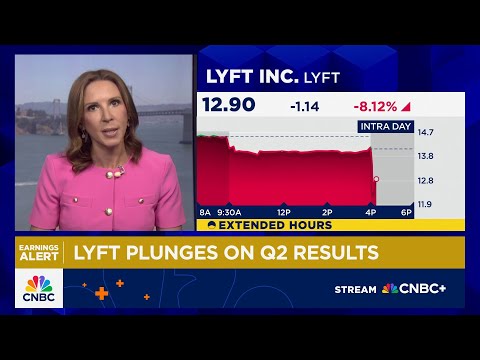
Lyft shares tumble more than 8% on Q2 results
CNBC Television· 2025-08-06 21:18
Financial Performance - Lyft's EPS exceeded expectations at 10 cents versus the analyst estimate of 4 cents [1] - Revenue slightly missed expectations at $159 billion versus the expected $161 billion [1] - Gross bookings were basically in line at $449 billion [1] - Adjusted EBITDA hit $129 million, topping estimates [1] Guidance - Lyft is guiding gross bookings between $465 billion and $48 billion for Q3, ahead of expectations [2] - Adjusted EBITDA is expected to be roughly in line with street expectations [2] Market Reaction - Lyft's shares are plunging post close, around 9% lower [1] - Investors are not liking what they're seeing, with shares down around 75% [2]

Lyft(LYFT) - 2025 Q2 - Earnings Call Presentation
2025-08-06 21:00
Q2 2025 Performance Highlights - Lyft's active riders reached 261 million, a 10% year-over-year increase and an all-time high[7, 23, 24] - Total rides amounted to 2348 million, a 14% year-over-year increase and an all-time high[7, 26, 27] - Gross bookings reached $45 billion, a 12% year-over-year increase and an all-time high[7, 30] - Adjusted EBITDA reached $129 million, resulting in a 29% margin of gross bookings, marking an all-time high[7, 32, 33] - Free cash flow for the trailing twelve months was $993 million[7, 35, 37] Growth Strategy & Partnerships - Over 50 million rides were connected to a partnership in Q2'25, an increase of over 25% year-over-year[10] - Riders connected to a partner were 15x more likely to choose a high-value mode and took rides that are 13x longer, on average, during Q2[11] Q3 2025 Guidance - Gross bookings are projected to be approximately $465 billion to $480 billion, representing a 13% to 17% year-over-year increase[38] - Adjusted EBITDA is expected to be between $125 million and $145 million[38] - Adjusted EBITDA margin is anticipated to be approximately 27% to 30% of gross bookings[38] Financial Efficiency - Marketplace incentives continue to deliver leverage, with the company on track to deliver its 2024 to 2027 target of 10% annual incentive efficiencies[41]
Lyft Stock Drops After Q2 Results: Here's Why
Benzinga· 2025-08-06 20:30
Core Insights - Lyft reported a quarterly earnings of 10 cents per share, surpassing the analyst consensus estimate of 4 cents [1] - Quarterly revenue was $1.58 billion, slightly below the Street estimate of $1.61 billion [1] Financial Performance - Record gross bookings reached $4.5 billion, reflecting a 12% year-over-year increase [5] - Revenue increased by 11% year-over-year to $1.6 billion [5] - Net income for the quarter was $40.3 million, a significant rise from $5 million in Q2'24 [5] - Net income as a percentage of gross bookings improved to 0.9% from 0.1% in Q2'24 [5] - Adjusted EBITDA reached a record $129.4 million, up 26% year-over-year compared to $102.9 million in Q2'24 [5] Strategic Outlook - For Q3, Lyft anticipates rides growth in the mid-teens year-over-year and gross bookings between $4.65 billion and $4.8 billion [4] - CEO David Risher emphasized the company's strong performance and expanding total addressable market (TAM) with partnerships, including those with Baidu and United Airlines [3]

Lyft(LYFT) - 2025 Q2 - Quarterly Results
2025-08-06 20:09
[Q2 2025 Performance Overview](index=1&type=section&id=Q2%202025%20Performance%20Overview) Lyft achieved record Q2 2025 financial results, highlighted by strategic partnerships and strong progress towards long-term targets [Key Announcements](index=1&type=section&id=Key%20Announcements) Lyft announced record financial results for the second quarter ended June 30, 2025, highlighting partnerships with United Airlines, accelerating growth in Q3, and being on track for long-term targets - Lyft reported **record financial results** for Q2 2025, ended June 30, 2025[1](index=1&type=chunk) - Key announcements include partnering with United Airlines, accelerating growth in Q3, and being on track to deliver long-term targets[1](index=1&type=chunk) [Management Commentary](index=1&type=section&id=Management%20Commentary) CEO David Risher emphasized "off-the-charts performance," a thriving marketplace, TAM expansion with Freenow, and meaningful partnerships. CFO Erin Brewer highlighted record Rides, Gross Bookings, and cash flow, underscoring operational excellence and strategic partnerships for accelerated growth - CEO David Risher stated Q2 was Lyft's "**strongest quarter ever**" with a thriving marketplace, expanding Total Addressable Market (TAM) due to the Freenow acquisition, and new partnerships with Baidu and United Airlines[2](index=2&type=chunk) - CFO Erin Brewer highlighted "**all-time record Rides, Gross Bookings, and cash flow generation**," attributing success to operational excellence and customer obsession, and expressed readiness to accelerate growth with market expansion and strategic partnerships[2](index=2&type=chunk) [Second Quarter 2025 Highlights](index=1&type=section&id=Second%20Quarter%202025%20Highlights) Lyft reported record financial and operational performance in Q2 2025, driven by significant growth in Gross Bookings, Rides, and Active Riders, alongside strategic share repurchases [Financial Highlights](index=1&type=section&id=Second%20Quarter%202025%20Financial%20Highlights) Lyft achieved record Gross Bookings of $4.5 billion (up 12% YoY), revenue of $1.6 billion (up 11% YoY), and a significant increase in net income to $40.3 million from $5.0 million in Q2'24. Adjusted EBITDA also reached a record $129.4 million, up 26% YoY, with an improved margin of 2.9%. The company also repurchased $200 million in shares Financial Performance | Metric | Q2 2025 | Q2 2024 | YoY Change | | :----- | :------ | :------ | :--------- | | Gross Bookings | $4.5 billion | N/A | +12% | | Revenue | $1.6 billion | N/A | +11% | | Net Income | $40.3 million | $5.0 million | +$35.3 million | | Net Income % of Gross Bookings | 0.9% | 0.1% | +0.8 pp | | Adjusted EBITDA | $129.4 million | $102.9 million | +26% | | Adjusted EBITDA Margin % of Gross Bookings | 2.9% | 2.6% | +0.3 pp | | Net cash provided by operating activities | $343.7 million | $276.2 million | +$67.5 million | | Free cash flow | $329.4 million | $256.4 million | +$73.0 million | - Lyft repurchased **12.8 million shares for $200 million** in Q2'25 via its share repurchase program[5](index=5&type=chunk) [Operational Highlights](index=1&type=section&id=Second%20Quarter%202025%20Operational%20Highlights) Operationally, Lyft achieved an all-time high of 234.8 million Rides, growing 14% YoY, marking the ninth consecutive quarter of double-digit growth. Active Riders also reached an all-time high of 26.1 million, up 10% YoY. The company strengthened its dual-app driver preference and introduced new business traveler benefits Operational Metrics | Metric | Q2 2025 | YoY Growth | | :----- | :------ | :--------- | | Rides | 234.8 million | 14% | | Active Riders | 26.1 million | 10% | - Dual-app driver preference for Lyft continues to increase, now **29 percentage points**, up from 6 percentage points a year ago[5](index=5&type=chunk) - Lyft Silver is exceeding expectations, with nearly **1 in 5 activations** coming from new users and a strong retention rate of nearly **80%**[5](index=5&type=chunk) - Announced upcoming partnerships with Baidu, BENTELER Mobility, and United Airlines while strengthening existing partnerships with Alaska Airlines, Chase, and DoorDash[5](index=5&type=chunk) [Third Quarter 2025 Outlook](index=2&type=section&id=Third%20Quarter%202025%20Outlook) Lyft projects continued strong growth for Q3 2025, with anticipated mid-teens Rides growth and increased Gross Bookings and Adjusted EBITDA, incorporating the Freenow acquisition [Third Quarter 2025 Outlook](index=2&type=section&id=Third%20Quarter%202025%20Outlook) For Q3 2025, Lyft anticipates mid-teens year-over-year Rides growth, Gross Bookings between $4.65 billion and $4.80 billion (up 13% to 17% YoY), and Adjusted EBITDA of $125 million to $145 million, with an Adjusted EBITDA margin of 2.7% to 3.0%. The outlook includes two months of combined company results following the Freenow acquisition - The Q3 2025 outlook includes two months of combined company results due to the Freenow acquisition closing on July 31[6](index=6&type=chunk) Q3 2025 Projections | Metric | Q3 2025 Outlook | YoY Growth | | :----- | :-------------- | :--------- | | Rides Growth | Mid-teens | N/A | | Gross Bookings | $4.65 billion - $4.80 billion | 13% - 17% | | Adjusted EBITDA | $125 million - $145 million | N/A | | Adjusted EBITDA Margin | 2.7% - 3.0% | N/A | [Detailed Financial and Operational Results](index=2&type=section&id=Financial%20and%20Operational%20Results) This section provides a comprehensive tabular overview of Lyft's financial and operational performance across multiple quarters, demonstrating consistent growth and improved profitability [Financial and Operational Results Table](index=2&type=section&id=Financial%20and%20Operational%20Results%20Table) This section provides a detailed tabular breakdown of Lyft's key financial and operational metrics for Q2 2025, Q1 2025, and Q2 2024, showing consistent growth across Active Riders, Rides, Gross Bookings, Revenue, Net Income, and cash flow metrics Key Financial and Operational Metrics (in millions, except Active Riders) | Metric | June 30, 2025 | March 31, 2025 | June 30, 2024 | | :--------------------------------------- | :------------ | :------------- | :------------ | | Active Riders (millions) | 26.1 | 24.2 | 23.7 | | Rides (millions) | 234.8 | 218.4 | 205.3 | | Gross Bookings (millions) | $4,490.1 | $4,162.4 | $4,018.9 | | Revenue (millions) | $1,588.2 | $1,450.2 | $1,435.8 | | Net income (millions) | $40.3 | $2.6 | $5.0 | | Net income as a percentage of Gross Bookings | 0.9% | 0.1% | 0.1% | | Net cash provided by operating activities (millions) | $343.7 | $287.2 | $276.2 | | Adjusted EBITDA (millions) | $129.4 | $106.5 | $102.9 | | Adjusted EBITDA margin (% of Gross Bookings) | 2.9% | 2.6% | 2.6% | | Free cash flow (millions) | $329.4 | $280.7 | $256.4 | [Definitions of Key Metrics](index=2&type=section&id=Definitions%20of%20Key%20Metrics) This section clarifies the definitions of key operational and financial metrics, including Active Riders, Rides, Gross Bookings, and Adjusted EBITDA Margin, used in Lyft's reporting [Active Riders](index=2&type=section&id=Active%20Riders%20Definition) Active Riders are defined as unique riders who have taken at least one ride during the quarter. The definition was updated in Q1 2025 to simplify and align with business scaling, now identifying riders via a unique internal identifier instead of phone number - Active Riders are defined as all unique riders who have taken at least one ride during the quarter[9](index=9&type=chunk) - In Q1 2025, Lyft updated the definition of Active Riders to simplify it and better align with future business scaling, now using a unique internal identifier instead of phone number[10](index=10&type=chunk) [Rides](index=2&type=section&id=Rides%20Definition) Rides represent the total number of completed rides (rideshare, bike, scooter) that contribute to revenue. Each unique segment of a Shared Ride is counted as a single ride, though Lyft has largely shifted away from Shared Rides - Rides are defined as the total number of rides, including rideshare and bike/scooter rides, completed using Lyft's multimodal platform that contribute to revenue[11](index=11&type=chunk) - Each unique segment of a Shared Ride is considered a single Ride, but Lyft has largely shifted away from Shared Rides, now offering them only in limited markets[11](index=11&type=chunk)[13](index=13&type=chunk) [Gross Bookings](index=3&type=section&id=Gross%20Bookings%20Definition) Gross Bookings indicate the scale and impact of Lyft's platform, representing the total dollar value of transactions invoiced to rideshare riders (including taxes, tolls, fees, excluding tips) and amounts invoiced for other offerings like rentals, subscriptions, and partnerships - Gross Bookings represent the total dollar value of transactions invoiced to rideshare riders (including any applicable taxes, tolls and fees excluding tips to drivers) and amounts invoiced for other offerings, including Express Drive vehicle rentals, bike and scooter rentals, and subscriptions[14](index=14&type=chunk) [Adjusted EBITDA Margin](index=3&type=section&id=Adjusted%20EBITDA%20margin%20(calculated%20as%20a%20percentage%20of%20Gross%20Bookings)%20Definition) Adjusted EBITDA margin is calculated by dividing Adjusted EBITDA by Gross Bookings for the same period and is considered a key metric for assessing operating performance - Adjusted EBITDA margin (calculated as a percentage of Gross Bookings) is calculated by dividing Adjusted EBITDA for a period by Gross Bookings for the same period and is considered a key metric[15](index=15&type=chunk) [Company Information & Disclosures](index=3&type=section&id=Company%20Information%20%26%20Disclosures) This section outlines Lyft's corporate information, including webcast details, company overview, public disclosure practices, forward-looking statements, non-GAAP measures, and contact information [Webcast Information](index=3&type=section&id=Webcast) Lyft will host a webcast on August 6, 2025, at 2:00 p.m. Pacific Time to discuss financial results and business highlights, with supplemental materials available on its Investor Relations page - Lyft will host a webcast on August 6, 2025, at 2:00 p.m. Pacific Time (5:00 p.m. Eastern Time) to discuss financial results and business highlights, with supplemental materials available on its Investor Relations page[16](index=16&type=chunk) [About Lyft](index=3&type=section&id=About%20Lyft) Founded in 2012, Lyft is a global mobility platform operating across 4 continents and nearly 1,000 cities, offering rideshare, taxis, private hire vehicles, car sharing, bikes, and scooters, driven by its purpose to serve and connect - Founded in 2012, Lyft is a global mobility platform offering a mix of rideshare, taxis, private hire vehicles, car sharing, bikes, and scooters across 4 continents and nearly 1,000 cities[17](index=17&type=chunk) [Available Information](index=3&type=section&id=Available%20Information) Lyft publicly discloses material information through SEC filings, press releases, conference calls, its investor relations website, social media accounts (X, LinkedIn), and blogs to ensure broad distribution and compliance with Regulation FD - Lyft announces material information through SEC filings, press releases, public conference calls, webcasts, its investor relations website (investor.lyft.com), X accounts (@lyft and @davidrisher), CEO's LinkedIn, and blogs[18](index=18&type=chunk) [Forward-Looking Statements](index=3&type=section&id=Forward%20Looking%20Statements) This section contains standard forward-looking statements regarding future events, financial performance, guidance, share repurchase programs, strategic partnerships, and the anticipated impact of the Freenow acquisition, subject to various risks and uncertainties - Forward-looking statements include Lyft's guidance and outlook for Q3 2025, expectations for its share repurchase program, plans for new and existing strategic partnerships, and the anticipated impact of the Freenow acquisition on TAM, international operations, and financial results[19](index=19&type=chunk) - These statements are subject to risks and uncertainties, including macroeconomic environment and forecasting ability, as described in SEC filings. Lyft disclaims any obligation to update these statements, except as required by law[19](index=19&type=chunk)[20](index=20&type=chunk) [Non-GAAP Financial Measures](index=4&type=section&id=Non-GAAP%20Financial%20Measures) Lyft uses non-GAAP measures like Adjusted EBITDA, Adjusted EBITDA margin, and free cash flow to supplement GAAP information, defining them and explaining adjustments for items such as sublease income and acquisition-related costs. These measures are used for performance assessment, budgeting, and communication, but have limitations and may not be comparable to other companies - Lyft uses non-GAAP financial measures including Adjusted EBITDA, Adjusted EBITDA margin (calculated as a percentage of Gross Bookings), and free cash flow to supplement GAAP financial information[21](index=21&type=chunk) - Adjusted EBITDA is net income (loss) adjusted for interest expense, other income, taxes, depreciation, amortization, stock-based compensation, payroll tax, sublease income, restructuring charges, and acquisition-related costs. Free cash flow is GAAP net cash provided by operating activities less purchases of property and equipment and scooter fleet[21](index=21&type=chunk) - These non-GAAP measures are used for overall performance assessment, budgeting, evaluating business strategies, and communicating with the board, but have limitations and may not be comparable to other companies[24](index=24&type=chunk)[25](index=25&type=chunk) [Contacts](index=4&type=section&id=Contacts) Contact information for investor relations (Aurélien Nolf) and media (Stephanie Rice) is provided - Investor Relations contact: Aurélien Nolf (investor@lyft.com). Media contact: Stephanie Rice (press@lyft.com)[26](index=26&type=chunk) [Condensed Consolidated Financial Statements](index=5&type=section&id=Condensed%20Consolidated%20Financial%20Statements) This section presents Lyft's condensed consolidated balance sheets, statements of operations, and cash flows, offering a detailed view of the company's financial health and performance [Condensed Consolidated Balance Sheets](index=5&type=section&id=Condensed%20Consolidated%20Balance%20Sheets) The balance sheet presents Lyft's financial position as of June 30, 2025, and December 31, 2024, detailing assets, liabilities, and stockholders' equity. Total assets decreased slightly, while total liabilities also saw a minor reduction Condensed Consolidated Balance Sheets (in thousands) | Metric (in thousands) | June 30, 2025 | December 31, 2024 | Change | | :-------------------- | :------------ | :---------------- | :----- | | Total current assets | $2,757,582 | $2,950,533 | -$192,951 | | Total assets | $5,369,367 | $5,435,069 | -$65,702 | | Total current liabilities | $3,916,737 | $3,880,742 | +$35,995 | | Total liabilities | $4,636,691 | $4,668,053 | -$31,362 | | Total stockholders' equity | $732,676 | $767,016 | -$34,340 | - Cash and cash equivalents increased from **$759,319 thousand** at December 31, 2024, to **$913,845 thousand** at June 30, 2025[28](index=28&type=chunk) [Condensed Consolidated Statements of Operations](index=6&type=section&id=Condensed%20Consolidated%20Statements%20of%20Operations) The income statement shows Lyft's financial performance for the three and six months ended June 30, 2025, and 2024. Revenue increased significantly, and the company reported net income for both periods in 2025, a notable improvement from a net loss in the six months ended June 30, 2024 Condensed Consolidated Statements of Operations (in thousands) | Metric (in thousands) | Three Months Ended June 30, 2025 | Three Months Ended June 30, 2024 | Six Months Ended June 30, 2025 | Six Months Ended June 30, 2024 | | :-------------------- | :------------------------------- | :------------------------------- | :----------------------------- | :----------------------------- | | Revenue | $1,588,183 | $1,435,846 | $3,038,355 | $2,713,047 | | Income (loss) from operations | $2,430 | $(27,226) | $(26,419) | $(90,177) | | Net income (loss) | $40,314 | $5,014 | $42,881 | $(26,521) | | Basic Net income (loss) per share | $0.10 | $0.01 | $0.10 | $(0.07) | | Diluted Net income (loss) per share | $0.10 | $0.01 | $0.10 | $(0.07) | - Total costs and expenses for the three months ended June 30, 2025, were **$1,585,753 thousand**, compared to **$1,463,072 thousand** in the prior year period[30](index=30&type=chunk) [Condensed Consolidated Statements of Cash Flows](index=7&type=section&id=Condensed%20Consolidated%20Statements%20of%20Cash%20Flows) The cash flow statement details cash flows from operating, investing, and financing activities for the six months ended June 30, 2025, and 2024. Net cash provided by operating activities significantly increased, while investing activities shifted from a net use to a net provision of cash Condensed Consolidated Statements of Cash Flows (in thousands) | Metric (in thousands) | Six Months Ended June 30, 2025 | Six Months Ended June 30, 2024 | | :-------------------- | :----------------------------- | :----------------------------- | | Net cash provided by operating activities | $630,962 | $432,379 | | Net cash provided by (used in) investing activities | $496,262 | $(317,157) | | Net cash used in financing activities | $(699,272) | $(66,883) | | Net increase in cash, cash equivalents and restricted cash | $429,072 | $47,838 | | End of period cash, cash equivalents and restricted cash | $1,375,112 | $819,624 | - Non-cash investing and financing activities included **$21,962 thousand** for financed vehicles acquired and **$10,178 thousand** for purchases of property and equipment not yet settled in the six months ended June 30, 2025[34](index=34&type=chunk) [GAAP to Non-GAAP Reconciliations](index=9&type=section&id=GAAP%20to%20Non-GAAP%20Reconciliations) This section provides detailed reconciliations of GAAP net income to Adjusted EBITDA and net cash from operating activities to free cash flow, explaining non-GAAP adjustments [Adjusted EBITDA Reconciliation](index=9&type=section&id=Adjusted%20EBITDA%20Reconciliation) This section provides a reconciliation of net income to Adjusted EBITDA for the three months ended June 30, 2025, March 31, 2025, and June 30, 2024, detailing adjustments for interest expense, other income, taxes, depreciation, stock-based compensation, and acquisition-related costs Adjusted EBITDA Reconciliation (in millions) | Metric (in millions) | June 30, 2025 | March 31, 2025 | June 30, 2024 | | :------------------- | :------------ | :------------- | :------------ | | Net income | $40.3 | $2.6 | $5.0 | | Adjustments: | | | | | Interest expense | $6.2 | $7.5 | $9.4 | | Other income, net | $(47.0) | $(40.9) | $(41.9) | | Provision for income taxes | $4.1 | $3.4 | $1.9 | | Depreciation and amortization | $30.6 | $33.6 | $37.7 | | Stock-based compensation | $82.1 | $93.2 | $85.7 | | Payroll tax expense related to stock-based compensation | $3.9 | $4.0 | $4.2 | | Sublease income | $0.1 | $0.1 | $1.0 | | Costs related to acquisitions, divestitures and other corporate matters | $9.1 | $3.2 | $0.0 | | **Adjusted EBITDA** | **$129.4** | **$106.5** | **$102.9** | | Adjusted EBITDA margin (% of Gross Bookings) | 2.9% | 2.6% | 2.6% | - Acquisition-related costs, which are unpredictable and not reflective of ongoing core operations, were **$9.1 million** in Q2 2025 and **$3.2 million** in Q1 2025[36](index=36&type=chunk)[37](index=37&type=chunk) [Free Cash Flow Reconciliation](index=9&type=section&id=Free%20cash%20flow%20Reconciliation) This section reconciles net cash provided by operating activities to free cash flow for the trailing twelve months ended June 30, 2025, and for the individual quarters, highlighting the deduction of purchases of property and equipment and scooter fleet Free Cash Flow Reconciliation (in millions) | Metric (in millions) | Trailing Twelve Months Ended June 30, 2025 | Three Months Ended June 30, 2025 | Three Months Ended March 31, 2025 | Three Months Ended December 31, 2024 | Three Months Ended September 30, 2024 | Three Months Ended June 30, 2024 | | :------------------- | :--------------------------------------- | :------------------------------- | :-------------------------------- | :----------------------------------- | :------------------------------------ | :------------------------------- | | Net cash provided by operating activities | $1,048.3 | $343.7 | $287.2 | $153.4 | $264.0 | $276.2 | | Less: purchases of property and equipment and scooter fleet | $(55.4) | $(14.3) | $(6.5) | $(13.4) | $(21.2) | $(19.8) | | **Free cash flow** | **$993.0** | **$329.4** | **$280.7** | **$140.0** | **$242.8** | **$256.4** |
Waymo's Expansion Spooks Uber — Is Lyft The Smarter AV Play?
Benzinga· 2025-08-05 15:19
Core Viewpoint - The announcement of Waymo's robotaxi rollout in Dallas without Uber has raised concerns among investors, leading to a decline in Uber's stock, while Lyft continues to pursue a strategic partnership approach in the autonomous vehicle (AV) space [1][2]. Group 1: Company Strategies - Uber has historically relied on partnerships with companies like Waymo and GM Cruise to integrate robotaxis into its platform, but the recent exclusion from Waymo's Dallas expansion has created uncertainty [1][5]. - Lyft is adopting a more diversified partnership strategy, collaborating with Mobileye, May Mobility, Marubeni, and Baidu to establish its AV future, with planned rollouts in Dallas, Atlanta, and Europe [3][6]. - Lyft's establishment of the Driver Autonomous Forum in Atlanta indicates a long-term, inclusive approach to planning its AV rollout, leveraging experienced drivers for insights [4]. Group 2: Investment Considerations - Uber's market position is characterized by strong brand recognition but is vulnerable to being sidelined by Waymo, which could impact investor confidence [5]. - Lyft's leaner operational model and diversified partnerships may build greater trust among investors, presenting a more balanced risk profile as it scales its AV deployment [5][6]. - As the robotaxi market matures, Lyft's methodical approach could offer potentially higher rewards for investors compared to Uber's reliance on a single partner [6].


被Reddit反超后,百度联手Lyft,在欧洲按下自动驾驶“重启键”
美股研究社· 2025-08-05 10:57
Core Viewpoint - The strategic partnership between Baidu and Lyft to launch Robotaxi services in Europe by 2026 marks a significant step for Baidu's autonomous driving business and reflects the company's shift towards new growth engines amid challenges in its traditional advertising business [1][10]. Group 1: Partnership Details - Baidu will provide its sixth-generation RT6 electric autonomous vehicles, while Lyft will oversee operations and market integration, enhancing Lyft's role in Europe's evolving mobility landscape [4]. - This collaboration is seen as a critical move for Baidu's Apollo system, representing its first large-scale international expansion [2][4]. - The partnership aligns with Lyft's recent acquisition of FreeNow, which operates in 180 cities across nine European countries, providing a ready-made regulatory and operational framework [5]. Group 2: Market Context and Challenges - Baidu's dual alliance strategy, partnering with both Lyft and Uber, allows it to cover key markets across three continents, reducing dependency risks and facilitating technology adaptation [5][10]. - The European Robotaxi market is highly competitive, with players like Waymo and local automotive alliances also vying for market share, presenting significant challenges for Baidu [9][10]. - Regulatory hurdles in Europe, particularly in Germany and the UK, pose compliance challenges that Baidu must navigate, including data protection and safety certification [8][9]. Group 3: Technological and Financial Aspects - Baidu has invested over 100 billion yuan in autonomous driving since 2013, achieving over 11 million autonomous rides globally, indicating a mature technology base [6][7]. - The RT6 model features a full-stack technology approach with 38 sensors and a computing platform capable of L4 autonomous driving, showcasing Baidu's technological capabilities [7]. - The shift to a mixed network strategy, combining autonomous and human-driven services, is viewed as a pragmatic approach to mitigate risks associated with market entry [5][10].

萝卜快跑牵手Lyft,无人驾驶网约车将率先落地英国、德国
Nan Fang Du Shi Bao· 2025-08-05 10:42
Core Insights - The collaboration between Luobo Kuaiyun and Lyft aims to provide autonomous driving services in Europe, starting with Germany and the UK by 2026, marking a significant milestone in Luobo Kuaiyun's global strategy [1][3] - Lyft will be responsible for operations and marketing, while Baidu will supply vehicles, technology validation, and comprehensive technical support, continuing Lyft's strategy of being the preferred platform for fleet owners and technology suppliers [3][4] Group 1: Strategic Partnership - Luobo Kuaiyun's sixth-generation autonomous vehicles will be deployed in Europe, with plans to scale up to thousands of vehicles [1] - Lyft's CEO emphasized the importance of customer experience and the advantages of autonomous driving, including safety, reliability, and privacy protection for millions of European users [3] - The partnership is part of Lyft's "human-machine collaborative mobility network" strategy, integrating autonomous vehicles with human drivers to meet passenger needs [3] Group 2: Market Context - Lyft has established a strong presence in North America and Europe, operating in nearly 1,000 cities and supporting bike-sharing in 16 countries [3] - The acquisition of FREENOW will accelerate the deployment of autonomous vehicles in Europe, leveraging established relationships with local regulators and taxi operators [4] - The European market is seen as favorable for the large-scale deployment of autonomous vehicles due to its well-developed road infrastructure and high level of digitalization [7] Group 3: Global Expansion - In July, Luobo Kuaiyun announced a partnership with Uber to deploy thousands of autonomous vehicles in multiple global markets, with initial deployments in Asia and the Middle East by the end of the year [7] - Luobo Kuaiyun has already deployed over 1,000 autonomous vehicles globally, providing over 11 million rides and accumulating more than 170 million kilometers of safe driving [7]