
Robotaxi(无人驾驶出租车)

Search documents
Robo.ai 宣布收购加诚汽车控股权,提速 "AI + 智能硬件" 商业化落地
Huan Qiu Wang Zi Xun· 2026-02-26 06:43
Core Insights - Robo.ai Inc. has signed a share purchase agreement to acquire 51% of the shares of Al Ghurair Automotive Trading Company, enhancing its strategic position in the automotive sector [1][3]. Group 1: Strategic Synergy - Al Ghurair Automotive, located in the Jebel Ali Free Zone, has an annual sales revenue exceeding 100 million dirhams and operates a comprehensive automotive business including sales, leasing, service, after-sales, and finance [3]. - The acquisition allows Robo.ai to leverage Al Ghurair's established trade channels to create a global distribution and service hub for its AI hardware, significantly reducing costs and time barriers associated with building channels from scratch [3][4]. - The efficient reuse of channel resources is expected to lower costs and enhance efficiency, supporting Robo.ai's transition to an "AI + smart hardware manufacturer" strategic identity [3]. Group 2: Channel Iteration - The acquisition transforms Al Ghurair's mature trade network in the Middle East into a global distribution hub for Robo.ai, significantly shortening the market entry cycle for smart hardware [4]. - Robo.ai's commercial vehicle project, RoBUS, will utilize Al Ghurair to establish a "manufacturing + distribution" dual-drive system, accessing over 20 established channels across Central Asia, North Africa, and Eastern Europe [4]. - The integration of JW Group's manufacturing capabilities with Al Ghurair's logistics advantages aims to create an efficient supply chain from production lines to global endpoints, facilitating the delivery of various AI-driven products [4]. Group 3: Management Commentary - The CEO of Robo.ai stated that acquiring Al Ghurair is a crucial step in the company's strategy to shift from virtual to real assets, emphasizing the need for physical carriers and distribution networks to maximize commercial value [5]. - Future plans include assisting Al Ghurair in expanding high-value services such as auto parts, after-sales service, and supply chain finance, creating a comprehensive smart asset operation platform [5]. Group 4: Company Background - Al Ghurair Automotive is a Canadian-owned automotive import and export trading company based in Dubai, leveraging the UAE's re-export trade advantages to provide efficient automotive supply chain solutions across over 20 countries [6]. - Robo.ai Inc. is a technology company focused on building a leading global AI machine economy platform, aiming to integrate smart terminals through "AI software, smart hardware, and smart assets" to create a unified AI operating system and blockchain-enabled ecosystem [7].


港股IPO关键期!601777,重要变动
Zhong Guo Ji Jin Bao· 2026-02-12 12:26
Group 1 - Qianli Technology (601777) plans to add a co-chairman and has nominated Zhao Ming, former CEO of Honor, as a non-independent director candidate [1][2] - Zhao Ming has over 25 years of experience in global technology management and is recognized for his leadership in brand restructuring and market expansion [2][4] - The company aims to accelerate its AI commercialization efforts with Zhao Ming's expertise, particularly in integrating resources and advancing business operations [4][5] Group 2 - Since initiating its "AI+" strategic transformation in 2025, Qianli Technology has made significant strides in smart driving, smart cockpits, and Robotaxi services [3][4] - The company has appointed key figures such as Yin Qi, founder of Megvii Technology, as chairman, and Wang Jun, former president of Huawei's smart automotive solutions, as co-president [3] - The strategic focus will see Yin Qi concentrating on AI technology development while Zhao Ming will focus on closing the AI business model loop [5]

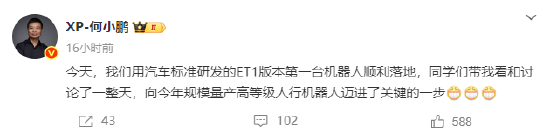
何小鹏:汽车标准ET1版本首台机器人落地
Xin Lang Cai Jing· 2026-01-20 02:11
Group 1 - The chairman of XPeng Motors, He Xiaopeng, announced the successful landing of the first robot developed using automotive standards, marking a significant step towards mass production of high-level humanoid robots this year [1][3] - During the global product launch on January 8, He Xiaopeng stated that by 2026, XPeng will achieve the implementation and mass production of physical AI, including the operation of Robotaxi (autonomous taxis), humanoid robots, and flying cars [2][4]


小鹏汽车发布四款新车 2026年将规模量产人形机器人和飞行汽车
Zhi Tong Cai Jing· 2026-01-08 09:43
Core Viewpoint - XPeng Motors held its 2026 global product launch event on January 8, introducing four new models, including the 2026 XPeng P7+, G7 Super Extended Range, and upgraded versions of the 2026 G6 and G9 [1] Group 1: New Product Launch - The 2026 XPeng P7+ will be launched in Brussels, Belgium on January 9, and the XPeng manufacturing base will be open to the public [1] - All four new vehicles will feature XPeng's second-generation VLA (Vision-Language-Action) large model, which is the industry's first physical world model achieving L4-level initial capabilities [1] Group 2: Future Plans - In 2026, XPeng plans to implement physical AI and scale production, including the operation of Robotaxi (autonomous taxis), humanoid robots, and flying cars [1] Group 3: 2025 Performance Review - In 2025, XPeng achieved cumulative global deliveries of 429,000 units, a year-on-year increase of 126%, with overseas markets contributing 45,000 units, up 96%, ranking first among new force brands in 10 overseas countries from January to November [1] - XPeng is positioned in the top tier of global new energy brand sales, with nine global R&D centers and three localized production projects overseas [1] - The global charging network of XPeng covers 31 countries and regions, with over 2.66 million charging piles connected [1]
小鹏开年发布四款新车,今年将规模量产人形机器人和飞行汽车
Xin Lang Cai Jing· 2026-01-08 07:50
Core Insights - Xpeng Motors launched four new vehicles, including the new Xpeng G6 electric version, new Xpeng G9 electric version, Xpeng G7 range-extended version, and Xpeng P7+ in both electric and range-extended versions [1] - CEO He Xiaopeng announced that all four new models will feature the second-generation VLA (Vision-Language-Action) large model, which is the industry's first physical world model achieving L4-level initial capabilities [1] - In 2025, Xpeng Motors aims to deliver 429,000 vehicles globally, representing a year-on-year growth of 126% [1] - Xpeng has entered 60 countries and regions globally, with total deliveries of 45,000 vehicles in overseas markets [1] Product Launch - The four new models include: - New Xpeng G6 electric version - New Xpeng G9 electric version - Xpeng G7 range-extended version - Xpeng P7+ in both electric and range-extended versions [1] Technology Advancement - The second-generation VLA model will enable advanced features in the new vehicles, marking a significant technological advancement in the industry [1] - The company plans to operationalize Robotaxi services and scale production of humanoid robots and flying cars this year [1]
汽车行业2026十大趋势:国央企整车企业迎来发展机遇、具身智能进入量产前夜
Xin Hua Cai Jing· 2026-01-08 07:18
Core Viewpoint - The Chinese automotive industry is at a critical juncture in the transition towards electric and intelligent vehicles, with three distinct industry curves coexisting: traditional fuel vehicles, electric intelligent vehicles, and future industries represented by autonomous driving. The year 2026 is anticipated to be a pivotal turning point for the industry, characterized by structural transformation driven by policy, market growth, technological breakthroughs, and global competition [1]. Group 1: Trends in the Automotive Industry - Trend 1: The "old-for-new" policy is expected to become a normalized tool, addressing the growing gap in vehicle replacement as the annual scrappage rate remains significantly lower than new car sales. This policy is projected to enhance market demand and support steady domestic consumption and industrial production [2]. - Trend 2: New automotive players are driving an upgrade in export structure, with Chinese automotive exports experiencing significant growth, becoming a "second growth curve." These companies are shifting from single vehicle exports to localized production, enhancing China's brand value and technological image in the global market [3]. - Trend 3: A clear differentiation is emerging between "mass-market pure electric" and "high-end range-extended" vehicles, with structural changes in market demand as the penetration rate of new energy vehicles exceeds 50%. The mainstream configuration for high-end SUVs/MPVs remains "large battery long-range range-extended" [4]. Group 2: Market Dynamics and Competitive Landscape - Trend 4: The industry is transitioning to a "late-stage mass market," where consumers prioritize brand reputation, after-sales support, and residual value certainty. Resources are increasingly consolidating around leading technology firms, enhancing conversion efficiency in mainstream price segments [5]. - Trend 5: State-owned enterprises are poised for growth opportunities as regulatory bodies strengthen the assessment of their new energy businesses, driving resources towards electric intelligence. These enterprises hold advantages in manufacturing systems and compliance, particularly in the realm of conditional autonomous driving [6]. - Trend 6: The penetration of new energy commercial vehicles is accelerating, with heavy-duty and light-duty trucks entering a rapid growth phase. The total cost of ownership for heavy trucks is now within a 1.5-2 year recovery period, while urban electric vehicle infrastructure is fully mature [7]. Group 3: Technological Advancements and Future Prospects - Trend 7: High-perception intelligent cockpit configurations are reshaping purchasing decisions, with smart features becoming a core competitive differentiator. The integration of advanced displays and intelligent seating systems is driving a new wave of competition in the market [8]. - Trend 8: Intelligent driving architecture is transitioning to an "end-to-end" model, enhancing the integration of perception and decision-making processes. The "equalization of intelligent driving" is facilitating advanced driving assistance features in lower-priced models [9][10]. - Trend 9: Three major commercial scenarios for autonomous driving are on the verge of mass production, including Robotaxi, mining autonomous vehicles, and unmanned logistics vehicles, with significant cost reductions and operational efficiencies being realized [11]. - Trend 10: Embodied intelligence is approaching mass production, with humanoid robots transitioning to dual-core intelligence. The automotive industry is well-suited for this technology due to the high degree of technical reuse, with several manufacturers planning to launch production in 2025 [12]. Overall, the Chinese automotive industry is expected to exhibit characteristics of multiple technological pathways, market structure differentiation, and accelerated intelligence implementation, supported by policy guidance and technological innovation, leading to high-quality development [13].
鲍威尔时代将落幕,AI泡沫论甚嚣尘上,2026最大悬念是什么?
Jin Shi Shu Ju· 2026-01-02 12:33
Group 1 - The end of Jerome Powell's era as Federal Reserve Chairman is anticipated by 2026, with speculation about his political legacy and the economic environment he will leave behind [3] - The upcoming SpaceX IPO is expected to be a significant event, potentially marking the largest IPO in history, providing Elon Musk with additional funding for his ambitions [6] - The success of SpaceX could mitigate any negative impacts from potential delays in the anticipated rollout of Tesla's Robotaxi in 2026 [6] Group 2 - Despite discussions about an AI bubble, major tech companies continue to thrive due to their profitable businesses in advertising, e-commerce, software, and cloud services, which provide a buffer for their investments in unprofitable AI models [2] - The growth of prediction markets, exemplified by Coinbase's partnership with Kalshi, reflects a novel way to gauge public sentiment, although it has sparked concerns about gambling and the influence of new financial tools [4] - The expansion of the "Musk trade" is expected to continue, with the SpaceX IPO providing shareholders another avenue to support Musk, even as it may dilute excitement around Tesla [5][6]

小马智行王皓俊:财务指标不全反映技术价值,2023年或成商业化验证年
Zhi Tong Cai Jing· 2025-12-17 07:24
Core Insights - The announcement of the first batch of conditional L3 autonomous vehicle permits by the Ministry of Industry and Information Technology marks a clearer path for autonomous driving commercialization, particularly in the Robotaxi sector [1] - Companies like Mercedes, Stellantis, and Tesla are making significant advancements in Robotaxi testing and operations, with Waymo reporting a trip volume exceeding 14 million since 2025, and Xiaoma Zhixing achieving single-vehicle profitability [1][2] Group 1: Company Developments - Xiaoma Zhixing aims to achieve breakeven by 2030, emphasizing that financial metrics do not fully reflect technological value, and that profitability depends on cost control and revenue scale [2] - The company plans to operate fully autonomous Robotaxis in major cities, with an operational area exceeding 2,000 square kilometers and a projected 55 million kilometers of global autonomous driving testing mileage [2] - As of now, Xiaoma Zhixing has over 961 Robotaxi vehicles, with a target to exceed 1,000 by the end of 2025 and expand to over 3,000 by the end of 2026 [2] Group 2: Financial Performance - In Q3 2025, Xiaoma Zhixing reported total revenue of $25.4 million (approximately 181 million RMB), a 72% increase from $14.8 million in Q3 2024, driven by strong demand for autonomous driving services [3] - The gross margin improved to 18.4% in Q3 2025, up from 9.2% in the same period of 2024, attributed to an increase in high-margin autonomous driving service revenue [3] - The revenue from autonomous driving services grew by 89.5% year-on-year, with passenger fare income surging over 200% [3] Group 3: Autonomous Trucking Initiatives - Xiaoma Zhixing has accelerated its autonomous truck business, currently operating around 200 trucks and achieving over 1 billion ton-kilometers in freight transport [3][4] - The company has partnered with SANY Heavy Truck and Dongfeng Liuzhou Motor to develop a fourth generation of autonomous trucks, with plans for mass production of two models by 2026 [4] - The current scale of 200 trucks is strategically significant for meeting data needs for technological iteration, with plans for commercial scaling after 2-3 years of technology validation [4]
摩根士丹利两年多来首次下调特斯拉评级
美股IPO· 2025-12-09 07:15
Core Viewpoint - Tesla's stock experienced a significant decline of 3.39% on December 8, closing at $439.58, marking its largest single-day drop in a week, influenced by Morgan Stanley's downgrade from "Overweight" to "Neutral" [1][3]. Group 1: Financial Performance - Tesla's projected P/E ratio for the next 12 months is approximately 210, ranking second among S&P 500 constituents, significantly higher than Palantir Technologies at 186 and lower only than Warner Bros. Discovery at 220 [3]. - For Q3 2025, Tesla reported revenue of $28.1 billion, a year-over-year increase of 12%, achieving a historical high for the period. However, net profit fell to $1.373 billion, a 37% decline, with an operating margin of only 5.8%, the lowest in nearly five years [3]. - Adjusted net profit was reported at $1.77 billion, down 29% year-over-year, attributed to increased operational costs driven by sales, general administrative expenses, R&D for AI, and a decrease in one-time Full Self-Driving (FSD) revenue recognition [3]. Group 2: Strategic Developments - Tesla is preparing to expand its Texas Gigafactory, planning to build a dedicated facility for mass production of its humanoid robot, Optimus, aiming for an annual production capacity of 10 million units [4]. - CEO Elon Musk indicated that the company's Robotaxi fleet is expected to double in size next month, although no specific timeline for commercialization has been provided for these initiatives [4]. Group 3: Market Sentiment and Analyst Ratings - Notable short-seller Michael Burry criticized Tesla's valuation as "absurdly high," suggesting that this situation has persisted for a considerable time [5]. - Tesla's stock has seen a cumulative increase of about 10% this year, underperforming the S&P 500's 16% gain, ending a two-year trend of doubling or high growth [5]. - Morgan Stanley raised Tesla's target price from $410 to $425 based on expectations for its automotive, robotaxi, network services, and humanoid robot businesses, with the Optimus project potentially valued at $60 per share [5]. - Currently, Wall Street analysts have assigned Tesla 28 "Buy," 19 "Hold," and 16 "Sell" ratings, indicating a potential reevaluation of the company's valuation logic amid increasing industry competition and profit pressures [5].
元戎启行周光:已量产交付20万辆,预计明年破百万目标
Bei Ke Cai Jing· 2025-11-20 09:33
Core Insights - Yuanrong Qixing showcased multiple models equipped with combined assisted driving solutions at the 2025 Guangzhou Auto Show, with CEO Zhou Guang announcing the delivery of 200,000 mass-produced vehicles featuring the urban NOA (Navigation Assisted Driving) system [1] - Since the launch of mass production models equipped with the Yuanrong Qixing urban NOA system in September 2024, the company has achieved a nearly 40% market share in the third-party urban NOA market within just over a year, delivering 10 models [1] Business Development - Yuanrong Qixing is accelerating the rollout of its Robotaxi business, having signed a strategic agreement with the Wuxi municipal government in October to establish a testing and R&D base, with plans to launch consumer-grade mass-produced Robotaxi models by the end of this year [1] - In 2026, Yuanrong Qixing will focus on three core businesses: mass-produced vehicle assisted driving, Robotaxi, and RoadAGI, aiming to expand its cooperative vehicle and customer system to achieve cumulative deliveries exceeding 1 million vehicles [1] - The Robotaxi business will be expedited for commercial rollout, aiming to create a replicable commercial Robotaxi system, while the RoadAGI business will continue to push for commercialization in key applications such as last-mile delivery [1]