Merck(MRK)

Search documents
Merck Announces New Data from Phase 3 Trials Evaluating the Investigational, Once-Daily, Oral, Two-Drug Regimen of Doravirine/Islatravir (DOR/ISL) in Adults with Virologically Suppressed HIV-1 Infection
Businesswire· 2025-10-15 10:45
Core Insights - Merck announced new data from Phase 3 trials evaluating the investigational two-drug regimen of doravirine/islatravir (DOR/ISL) for adults with virologically suppressed HIV-1 infection, showing minimal changes in weight and body composition, and no clinically meaningful effects on fasting lipids and insulin resistance [1][3][4] Group 1: Trial Results - In trial MK-8591A-052, adults switching to DOR/ISL from BIC/FTC/TAF exhibited minimal changes in weight at Week 48, with a mean weight change of -0.03 kg for DOR/ISL compared to +0.28 kg for BIC/FTC/TAF [5] - The percentage of participants experiencing a 5% weight gain was 14.6% for DOR/ISL and 16.0% for BIC/FTC/TAF, indicating comparable outcomes [5] - Both trials showed no clinically meaningful changes in fasting lipids or insulin resistance, with similar results across treatment groups [3][6] Group 2: Safety and Efficacy - Drug-related adverse events were similar between DOR/ISL and BIC/FTC/TAF, with 10.2% for DOR/ISL and 9.4% for BIC/FTC/TAF [10] - Rates of serious adverse events were also comparable, with 7.3% for DOR/ISL and 7.6% for BIC/FTC/TAF [10] - The trials reported no treatment-emergent resistance to DOR or ISL, reinforcing the safety profile of the investigational regimen [1][4] Group 3: Regulatory Status - The FDA accepted the New Drug Application (NDA) for DOR/ISL, with a target action date set for April 28, 2026 [7] Group 4: Demographics and Study Design - The MK-8591A-052 trial included 513 adults with a median age of 47 years, with 21.4% assigned female sex at birth and 30.8% identifying as Black or African American [8] - The MK-8591A-051 trial involved 551 adults, with a median age of 51 years, and a similar demographic distribution [11][12]

Can $10,000 in Merck Stock Turn Into $50,000 by 2030?
Yahoo Finance· 2025-10-14 10:15
Core Viewpoint - Merck faces significant challenges in achieving a compound annual growth rate (CAGR) of 38% needed to turn $10,000 into $50,000 in five years, primarily due to impending patent cliffs and declining sales in key products [1][6]. Group 1: Growth Drivers - Merck's primary growth drivers are the cancer drug Keytruda and the HPV vaccine franchise, Gardasil and Gardasil 9, both of which are currently facing challenges [2]. - Keytruda is expected to encounter a patent cliff by 2028, leading to potential biosimilar competition that could significantly impact its sales [2]. - Sales of Gardasil and Gardasil 9 have declined this year, largely attributed to reduced demand in China [2]. Group 2: Financial Performance - In the second quarter, Merck's revenue decreased by 2% year over year to $15.8 billion, reflecting the challenges faced by the company [3]. - The stock performance has lagged behind the market this year due to these headwinds [3]. Group 3: Strategic Developments - Merck has received approval for a subcutaneous version of Keytruda, which will benefit from patent protection beyond 2028 and is expected to be a more efficient option for patients and physicians [4][5]. - The company is addressing the issues with Gardasil and Gardasil 9 and anticipates a rebound in vaccine sales over the next few years [5]. Group 4: Future Outlook - Despite new approvals, including Winrevair for treating pulmonary arterial hypertension, the challenges facing Merck are likely to hinder its ability to outperform the market through 2030 [6]. - For long-term, dividend-seeking investors, Merck remains an attractive option, but it is not suitable for those seeking a CAGR of 38% by 2030 [6].
Here's Why Merck (MRK) is a Strong Momentum Stock
ZACKS· 2025-10-13 14:51
Company Overview - Merck & Co. is based in Kenilworth, NJ, and has over six blockbuster products, with Keytruda being a PD-L1 inhibitor approved for various cancers, accounting for approximately 50% of its pharmaceutical sales [11] - Keytruda has significantly contributed to Merck's steady revenue growth in recent years, although there are concerns regarding the company's heavy reliance on this drug and the need for product diversification [11] Investment Ratings - Merck is currently rated as 3 (Hold) on the Zacks Rank, with a VGM Score of B [12] - The stock has a Momentum Style Score of A, and its shares have increased by 3.8% over the past four weeks [12] Earnings Estimates - For fiscal 2025, three analysts have revised their earnings estimates upwards in the last 60 days, with the Zacks Consensus Estimate rising to $8.94 per share [12] - Merck has an average earnings surprise of +3.9%, indicating a positive trend in earnings performance [12] Investment Considerations - With a solid Zacks Rank and high Momentum and VGM Style Scores, Merck is recommended for investors' consideration [13]


Merck: An Undervalued Stock In An Expensive Market
Seeking Alpha· 2025-10-13 14:00
Group 1 - The article emphasizes the importance of enabling Javascript and cookies in browsers to prevent access issues [1] - It highlights that users with ad-blockers may face restrictions when trying to access content [1]

从强生爽身粉到“减肥神药”,盘点潜藏致癌风险的健康产品
Jing Ji Guan Cha Wang· 2025-10-13 13:52
Group 1 - Johnson & Johnson was ordered to pay $966 million (approximately 6.88 billion RMB) in a lawsuit related to its talc-based baby powder, marking the highest compensation awarded to a single plaintiff in 15 years of litigation [1] - The lawsuit was initiated by the family of May Moore, who died from mesothelioma, alleging that the baby powder contained asbestos fibers, which are linked to the rare cancer [1] - Johnson & Johnson has acknowledged that it was aware of the potential presence of asbestos in its talc products since the 1970s but did not disclose this risk to the public [1] Group 2 - Merck's Rofecoxib (Vioxx) was withdrawn from the market in 2004 due to increased cardiovascular risks, leading to a settlement of $48.5 billion for thousands of lawsuits related to heart disease and other conditions [2] - The FDA had approved Rofecoxib in 1999, but long-term studies indicated potential links to colorectal cancer, prompting Merck to take action [2] Group 3 - Sanofi's Zantac (Ranitidine) faced lawsuits after a laboratory found potential carcinogen NDMA in the drug, leading to a significant drop in stock value and potential losses of $45 billion for the companies involved [3] - By 2024, Sanofi agreed to settle approximately 4,000 personal injury claims related to Zantac, while over 75,000 cases remained pending in Delaware [3] Group 4 - Eisai's Belviq was withdrawn from the market in 2020 after studies indicated a slightly higher cancer occurrence rate among users, affecting around 8 million patients [5] - The FDA issued a safety warning advising patients to discontinue use and consult their doctors following the withdrawal of Belviq [5]


Merck Completes $10B Acquisition of Verona Pharma, Adds COPD Drug Ohtuvayre
Yahoo Finance· 2025-10-13 13:28
Group 1 - Merck & Co. has completed the acquisition of Verona Pharma for approximately $10 billion, making Verona a wholly-owned subsidiary [1][3] - The acquisition enhances Merck's cardio-pulmonary portfolio by adding Ohtuvayre, a first-in-class drug approved for the maintenance treatment of chronic obstructive pulmonary disease (COPD) [2][3] - Ohtuvayre represents the first novel inhaled mechanism for COPD maintenance treatment in over 20 years and is also being evaluated for non-cystic fibrosis bronchiectasis [3] Group 2 - Merck operates globally as a healthcare company, providing human health pharmaceuticals, veterinary pharmaceuticals, vaccines, and health management solutions [4]
Merck Initiates Three New Phase 2b Trials for Investigational Inflammatory Drug Tulisokibart
Yahoo Finance· 2025-10-13 12:43
Core Insights - Merck & Co. Inc. is initiating three new Phase 2b trials for its investigational drug tulisokibart, targeting immune-mediated inflammatory diseases [1][2][3] Group 1: Trial Initiation and Focus - The three new global Phase 2b trials are for moderate to severe hidradenitis suppurativa, radiographic axial spondyloarthritis, and rheumatoid arthritis, with a total recruitment target of over 640 patients [2] - Tulisokibart is now being investigated in a total of six diseases, including two Phase 3 studies for inflammatory bowel disease and a Phase 2 study for systemic sclerosis-associated interstitial lung disease [3] Group 2: Mechanism and Target - Tulisokibart is a humanized monoclonal antibody that targets tumor necrosis factor/TNF-like cytokine 1A/TL1A, which is associated with inflammation and fibrosis [3]
进口单抗最高超3000一针!呼吸道合胞病毒进入高发期,国内外药企竞相布局
Bei Jing Shang Bao· 2025-10-13 12:13
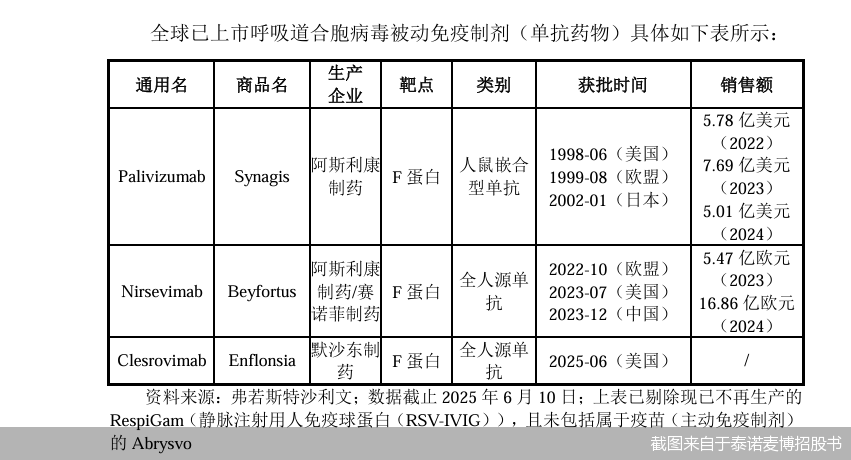
Core Insights - The Respiratory Syncytial Virus (RSV) is experiencing a surge in infections, particularly among infants and the elderly, leading to increased public health concerns and discussions on social media [1][3] - Currently, there are limited treatment options for RSV, with only one monoclonal antibody, Nirsevimab, approved for use in China, while several other pharmaceutical companies are actively developing RSV-related therapies [1][5] Industry Overview - RSV is a leading cause of respiratory infections in children under five globally, with no specific antiviral treatments available, primarily relying on symptomatic care [1][4] - The global market for passive immunization against RSV in infants is projected to grow significantly, with an estimated compound annual growth rate (CAGR) of 78.4% from 2024 to 2028, reaching approximately 2.99 billion yuan [5] Drug Development - Three RSV preventive drugs have been approved globally: Palivizumab, Nirsevimab, and Clesrovimab, with Nirsevimab being the only one currently available in China [5][6] - Nirsevimab is priced at over 3,000 yuan for children weighing over 5 kg, with two formulations available based on weight [6] - Domestic companies like TaenoMabo are developing their own RSV treatments, such as TNM001, which is currently in clinical trials [7][8] Market Demand - The demand for effective RSV prevention and treatment is expected to rise due to the increasing population of infants and the aging population in China, highlighting a significant market opportunity [8] - Companies are encouraged to focus on innovation and differentiation in drug development to meet diverse patient needs and improve drug accessibility [8]

Will Keytruda Continue to Aid Merck's Top Line in Q3 Earnings?
ZACKS· 2025-10-10 17:01
Core Insights - Merck holds a strong position in the oncology market, primarily driven by its PD-L1 inhibitor, Keytruda, which accounted for over 50% of the company's pharmaceutical sales in the first half of 2025 [1][9] - Keytruda's sales increased approximately 7% in the first half of 2025, and the company anticipates continued growth, particularly in early lung cancer indications [2][3] Sales Performance - The Zacks Consensus Estimate for Keytruda's sales in Q3 2025 is $8.50 billion, with an internal estimate of $8.51 billion [3] - Keytruda is expected to continue being the primary revenue driver in the second half of 2025, supported by the Animal Health segment and new product launches [3] Regulatory Developments - The FDA approved a subcutaneous formulation of Keytruda, known as Keytruda Qlex, which enhances patient convenience and extends patent protection beyond 2028 [4][9] Competitive Landscape - Keytruda faces competition from other PD-L1 inhibitors such as Bristol-Myers' Opdivo, Roche's Tecentriq, and AstraZeneca's Imfinzi, which have also shown strong sales growth [6][7] - Opdivo generated $4.82 billion in sales in the first half of 2025, up 9% year-over-year, while Tecentriq and Imfinzi reported CHF 1.7 billion and $2.72 billion in sales, respectively [6][7] Financial Performance - Year-to-date, Merck's shares have declined by 12.1%, underperforming the industry, sector, and S&P 500 [8] - Merck's shares trade at a price/earnings ratio of 9.15, which is lower than the industry average of 15.88 and its 5-year mean of 12.66, indicating attractive valuation [10] Earnings Estimates - The Zacks Consensus Estimate for 2025 earnings per share has slightly increased from $8.92 to $8.93, while the estimate for 2026 has decreased from $9.61 to $9.58 over the past 60 days [11]

High Margins, Lower Price: Is This Merck Stock's Buying Window?
Forbes· 2025-10-10 13:10
Core Viewpoint - Merck (MRK) stock is highlighted for its monopoly-like high margins available at a discounted price, making it an attractive investment opportunity [1] Financial Performance - Revenue growth for Merck is reported at 1.8% for the last twelve months (LTM) and an average of 3.7% over the last three years [8] - Recent profitability metrics include approximately 29.1% operating cash flow margin and 31.2% operating margin for LTM [8] - Long-term profitability averages show about 27.2% operating cash flow margin and 22.6% operating margin over the last three years [8] - The stock is currently offered at a price-to-sales (P/S) multiple of 3.5, representing a 22% discount compared to one year ago [8] Investment Strategy - The Trefis High Quality Portfolio, which includes Merck, has a record of outperforming benchmark indices, including the S&P 500, S&P mid-cap, and Russell 2000 [11] - The selection process for stocks focuses on those with market capitalizations over $10 billion, high cash flow from operations margins, and those that have significantly decreased in value over the past year [6] Market Dynamics - The average 12-month forward returns for selected stocks are close to 19%, with a win rate of around 72% for positive returns [9]