NETDRAGON(NDWTY)

Search documents
网龙(00777) - 截至二零二六年二月二十八日止之股份发行人的证券变动月报表
2026-03-05 07:25
截至月份: 2026年2月28日 狀態: 新提交 致:香港交易及結算所有限公司 公司名稱: 網龍網絡控股有限公司 呈交日期: 2026年3月5日 I. 法定/註冊股本變動 | 1. 股份分類 | 普通股 | 股份類別 | 不適用 | | | 於香港聯交所上市 (註1) | | 是 | | | --- | --- | --- | --- | --- | --- | --- | --- | --- | --- | | 證券代號 (如上市) | 00777 | 說明 | | | | | | | | | | | 法定/註冊股份數目 | | | 面值 | | | 法定/註冊股本 | | | 上月底結存 | | | 1,000,000,000 | USD | | 0.01 | USD | | 10,000,000 | | 增加 / 減少 (-) | | | | | | | USD | | | | 本月底結存 | | | 1,000,000,000 | USD | | 0.01 | USD | | 10,000,000 | 本月底法定/註冊股本總額: USD 10,000,000 FF301 股份發行人及根據《上市規則》第 ...
ETF盘中资讯|三重压力,恒生科技继续回调,南向资金逆势“抄底”,机构:互联网龙头静待修复
Sou Hu Cai Jing· 2026-03-04 03:21
Core Viewpoint - The Hong Kong stock market is experiencing a downturn, particularly in the technology sector, with significant declines in major internet stocks, while southbound capital continues to increase its holdings in these companies [1][2]. Group 1: Market Performance - The Hang Seng Index and the Hang Seng Tech Index both fell over 1% in early trading on March 4, with the Hong Kong Internet ETF (513770) reaching a new low since July 2025 [1]. - Major internet companies like Alibaba-W and Meituan-W saw declines of over 3% and nearly 2%, respectively, while Tencent Holdings fell by 0.88% [1]. Group 2: Investment Trends - Despite the market downturn, southbound capital has shown a net inflow in 27 out of 36 trading days this year, totaling a net inflow of 181.8 billion HKD [2]. - Southbound capital has significantly increased its holdings in major internet companies, with Tencent's market value exceeding 540 billion HKD and Alibaba's exceeding 320 billion HKD [2]. Group 3: Sector Analysis - Concerns about high expenditures on delivery subsidies and AI initiatives are causing competitive pressures among companies [2]. - The emergence of new AI players like Zhipu and MiniMax is raising doubts about the technological advantages of established internet giants [2]. - Analysts suggest that the current market correction presents a buying opportunity in the Hong Kong internet sector, supported by favorable policies and liquidity conditions [2][3]. Group 4: Future Outlook - Analysts from various firms, including Industrial Securities, believe that the downturn in the Hong Kong tech sector may present investment opportunities, particularly as AI support from the government continues to strengthen [2][3]. - The Hong Kong Internet ETF (513770) and its associated funds are positioned to benefit from the growth of AI and the unique advantages of Hong Kong internet companies [3].

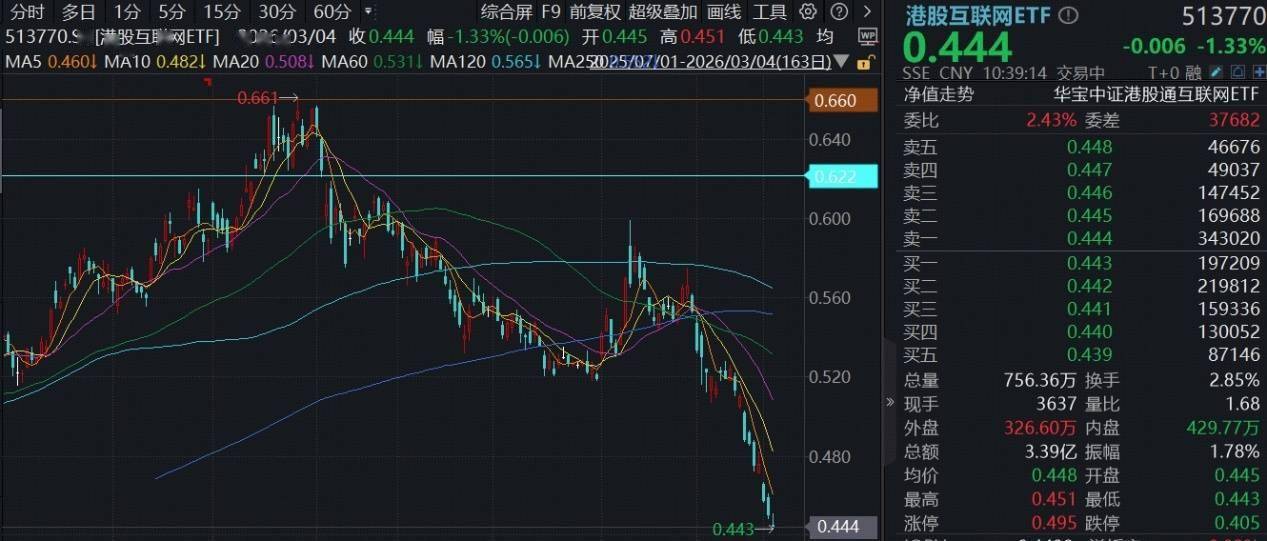
三重压力,恒生科技继续回调,南向资金逆势“抄底”,机构:互联网龙头静待修复
Xin Lang Cai Jing· 2026-03-04 03:00
Core Viewpoint - The Hong Kong stock market is experiencing a significant adjustment, particularly in the technology sector, driven by concerns over high expenditures, competition from new AI players, and liquidity pressures due to changing Federal Reserve interest rate expectations [3][11]. Market Performance - On March 4, the Hong Kong stock market opened lower, with the Hang Seng Index and Hang Seng Tech Index both dropping over 1%. The Hong Kong Internet ETF (513770) fell by 1.33%, reaching a new low since July 2025. Major internet companies like Alibaba-W, Meituan-W, and Tencent Holdings saw declines of over 3%, nearly 2%, and 0.88%, respectively [1][9]. Investment Trends - Despite the market downturn, southbound capital has been consistently increasing. As of March 3, there were 27 net inflow trading days out of 36 this year, totaling a net inflow of 181.8 billion HKD. Major internet companies have seen significant increases in holdings, with Tencent's market value exceeding 540 billion HKD and Alibaba's over 320 billion HKD [3][11]. Sector Analysis - Analysts suggest that the current deep adjustment in the Hong Kong tech sector is due to three main pressures: concerns over high spending on delivery subsidies and AI initiatives, competition from emerging AI companies, and liquidity pressures from revised Federal Reserve interest rate expectations [3][11]. - Investment opportunities are emerging in the Hong Kong Internet sector as policies supporting AI development are expected to enhance the growth of internet companies [3][11]. ETF Insights - The Hong Kong Internet ETF (513770) and its linked funds are designed to track the CSI Hong Kong Internet Index, with the top ten holdings including major players like Alibaba-W, Tencent Holdings, and Xiaomi Group, collectively accounting for over 76% of the index [4][12]. - For investors looking to reduce volatility while still gaining exposure to technology, the Hong Kong Large Cap 30 ETF (520560) is recommended, combining high-growth tech stocks with stable dividend-paying companies [14].
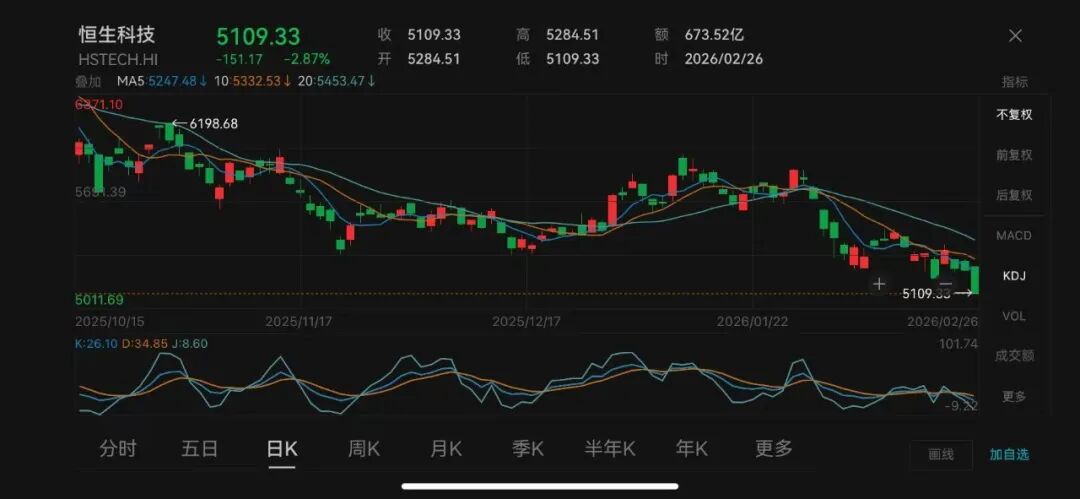
恒生科技重挫2.87%,自去年高点累计回调超20%,多个互联网龙头大跌!主板千股飘绿,南向资金净流出74亿港元
Mei Ri Jing Ji Xin Wen· 2026-02-26 10:03
Core Viewpoint - The Hong Kong stock market experienced a decline, with the Hang Seng Index falling by 1.44% and the Hang Seng Tech Index dropping by 2.87%, indicating a bearish trend in the market [1][2]. Market Performance - Over 1,000 stocks in the Hong Kong main board fell, and there was a net outflow of HKD 7.4 billion from southbound funds [1]. - The Hang Seng Tech Index has seen a cumulative decline of over 20% since its peak on October 2 of the previous year [5]. Key Stock Movements - Major tech stocks experienced significant declines: Alibaba down 3.57%, Baidu down 4.27%, Tencent down 2%, Meituan down 2.72%, JD down 2.62%, and Xiaomi down 1.18% [2][4]. - The performance of other notable stocks included XPeng down 5.06%, Huahong Semiconductor down 4.82%, and Li Auto down 4.45% [4]. Sector Analysis - The semiconductor sector showed some resilience, with stocks like Days Smart Chip rising over 20% [7][8]. - Other sectors, including construction materials, electrical equipment, and pharmaceuticals, also faced declines, with respective drops of 4.85%, 4.32%, and 4.12% [7].
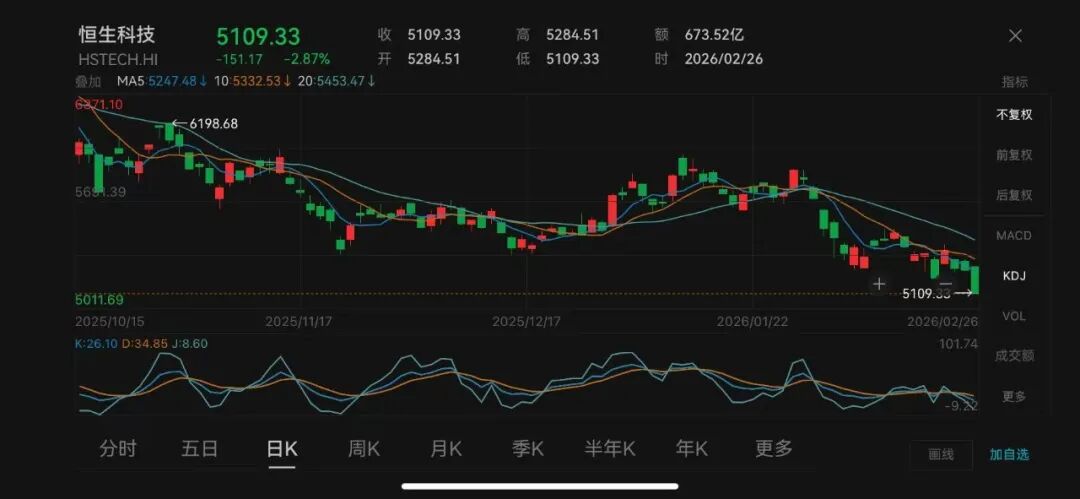
恒生科技重挫2.87%,自去年高点累计回调超20%,多个互联网龙头大跌!主板千股飘绿,南向资金净流出74亿港元|港股收盘
Mei Ri Jing Ji Xin Wen· 2026-02-26 09:57
Core Viewpoint - The Hong Kong stock market experienced a significant decline, with the Hang Seng Index dropping by 1.44% and the Hang Seng Tech Index falling by 2.87%, indicating a bearish trend in the market [1]. Market Performance - Over 1,000 stocks on the Hong Kong main board declined, with a net outflow of HKD 7.4 billion from southbound funds [1]. - The Hang Seng Tech Index has seen a cumulative decline of over 20% since its peak on October 2 of the previous year [3]. Key Stock Movements - Major tech stocks experienced notable declines: Alibaba down 3.57%, Baidu down 4.27%, Tencent down 2%, Meituan down 2.72%, JD.com down 2.62%, and Xiaomi down 1.18% [1][3]. - Specific stocks within the tech sector showed significant drops, with XPeng Motors down 5.06%, Hua Hong Semiconductor down 4.82%, and Bilibili down 4.63% [3]. Sector Analysis - The semiconductor sector was one of the few to show gains, with Tensun Intelligent Chip rising over 20% [5][6]. - Other sectors, including construction materials, electrical equipment, and pharmaceuticals, also faced declines, with respective drops of 4.85%, 4.32%, and 4.12% [5].
网龙(00777) - 2025 - 年度业绩
2026-02-13 14:30
Cryptocurrency Transactions - The company acquired a total of 27,996.18 Ether for a total consideration of $80,205,987 from January 2024 to October 2025[5][6]. - The company sold a total of 54,205,987 USDT/USDC and 15,297.58 Ether for a total consideration of $54,205,987 and $51,705,817 respectively[8]. - The company expects to recognize a profit of approximately RMB 121.0 million from the sale of Ethereum, excluding transaction costs, which represents the difference between the proceeds from the sale and the acquisition cost of the sold Ethereum[16]. - The company holds approximately 13,000 units of Ethereum as of the announcement date, indicating a significant investment in this cryptocurrency[15]. - The board views the acquisition and sale of cryptocurrencies as a strategic move to diversify the investment portfolio, particularly with the optimistic outlook on the cryptocurrency market[15]. - The transactions involving the acquisition and sale of cryptocurrencies are considered fair and conducted under normal commercial terms, aligning with the interests of the company and its shareholders[16]. Risk Management and Compliance - The company has a risk management policy that limits exposure to any single cryptocurrency to no more than 10% of total net assets[12]. - The company’s investment policy allows for a maximum risk exposure of 25% of available net assets at any given time[11]. - The company has not fully complied with disclosure requirements regarding certain transactions as per listing rules[4][7]. - The company has implemented immediate remedial actions to ensure compliance with listing rules regarding cryptocurrency transactions, including appointing a compliance department to oversee all related transactions[19]. - The compliance department will calculate applicable percentage ratios for any cryptocurrency transactions before they are executed, ensuring adherence to listing regulations[20]. - The company will seek legal and professional advice as necessary to ensure compliance with relevant listing rules[20]. - The board will report any proposed cryptocurrency transactions exceeding 5% in applicable percentage ratios to ensure prior approval is obtained[20]. - The company acknowledges a previous oversight regarding the timely disclosure of transactions exceeding 5% and has taken steps to prevent future occurrences[17]. Operational Strategy - The company aims to maintain a minimum cash reserve equivalent to at least 12 months of operating funds[12]. - The company does not intend to become a digital asset management company but seeks to provide exposure to digital assets[11]. - The company has established a structured due diligence process for selecting trading platforms, focusing on financial stability and compliance[13]. - The company utilizes the OSL exchange for cryptocurrency transactions due to its robust regulatory credentials[12]. - The company plans to use the proceeds from the Ethereum sale for general operating funds or to make other investments at an opportune time[16]. - The company operates in three main sectors: gaming and application services, overseas education, and property development[10].
网龙(00777) - 截至二零二六年一月三十一日止之股份发行人的证券变动月报表
2026-02-02 08:43
股份發行人及根據《上市規則》第十九B章上市的香港預託證券發行人的證券變動月報表 截至月份: 2026年1月31日 狀態: 新提交 致:香港交易及結算所有限公司 公司名稱: 網龍網絡控股有限公司 呈交日期: 2026年2月2日 I. 法定/註冊股本變動 | 1. 股份分類 | 普通股 | 股份類別 | 不適用 | | | 於香港聯交所上市 (註1) | | 是 | | | --- | --- | --- | --- | --- | --- | --- | --- | --- | --- | | 證券代號 (如上市) | 00777 | 說明 | | | | | | | | | | | 法定/註冊股份數目 | | | 面值 | | | 法定/註冊股本 | | | 上月底結存 | | | 1,000,000,000 | USD | | 0.01 | USD | | 10,000,000 | | 增加 / 減少 (-) | | | | | | | USD | | | | 本月底結存 | | | 1,000,000,000 | USD | | 0.01 | USD | | 10,000,000 | 本月底法定/註冊股本 ...
网龙携手泰国政府推进AI计划 赋能该国未来人才体系建设
Zhi Tong Cai Jing· 2026-02-02 05:42
Core Viewpoint - NetDragon (00777) and its subsidiary EDA (Thailand) are collaborating on an AI initiative supported by the Thai government, aimed at creating an AI-driven "Learn-to-Career" ecosystem to enhance education, skills development, and productivity in Thailand [1][4]. Group 1: AI Initiative Overview - The collaboration was officially launched in Bangkok, highlighting the Thai government's increasing policy support for AI as a key driver for workforce upgrading and economic competitiveness [4]. - The initiative aims to address Thailand's challenges in talent development amidst the rapid transformation of the labor market due to AI technology [4][5]. Group 2: Strategic Cooperation - A Memorandum of Understanding (MOU) was signed to establish a long-term cooperation mechanism for promoting AI-driven learning, skills assessment, and talent development in Thailand [5]. - The partnership will develop AI-enabled learning platforms, competency assessment frameworks, and career transition mechanisms to align talent cultivation with actual employment needs [5]. Group 3: Employment Preparation - The core of the collaboration is to redefine "employment readiness" in the AI era, embedding AI throughout the talent development process, from skills assessment to personalized learning paths and career matching [7]. - The initiative focuses on quantifiable outcomes to ensure alignment between learners, educational institutions, and employers with evolving job market demands [7]. Group 4: Global Industry Insights - NetDragon's Vice Chairman Dr. Liang Nianjian emphasized that AI is reshaping industry structures and social frameworks at an unprecedented pace, urging the government to play a proactive role in ensuring the benefits of AI technology reach society as a whole [8]. - Dr. Liang noted that policy-driven models in Asia have effectively accelerated AI application across industries, drawing parallels with China's top-down approach [9]. Group 5: Impact on SMEs - The collaboration highlights AI's potential to create a fair competitive environment, particularly benefiting small and medium-sized enterprises (SMEs) that are crucial to Thailand's economy [11]. - AI is viewed as an important equalizing tool for SMEs, significantly enhancing productivity and narrowing the development gap with larger enterprises [11]. Group 6: Future Prospects - The partnership is expected to serve as a replicable model for other emerging economies in Asia, demonstrating how government-business collaboration can accelerate AI application while focusing on workforce development outcomes [12]. - NetDragon and EDA (Thailand) plan to expand the reach and accessibility of AI-enabled learning, deepen cross-sector collaboration, and build a resilient talent pool to support sustainable economic growth in Thailand [12].
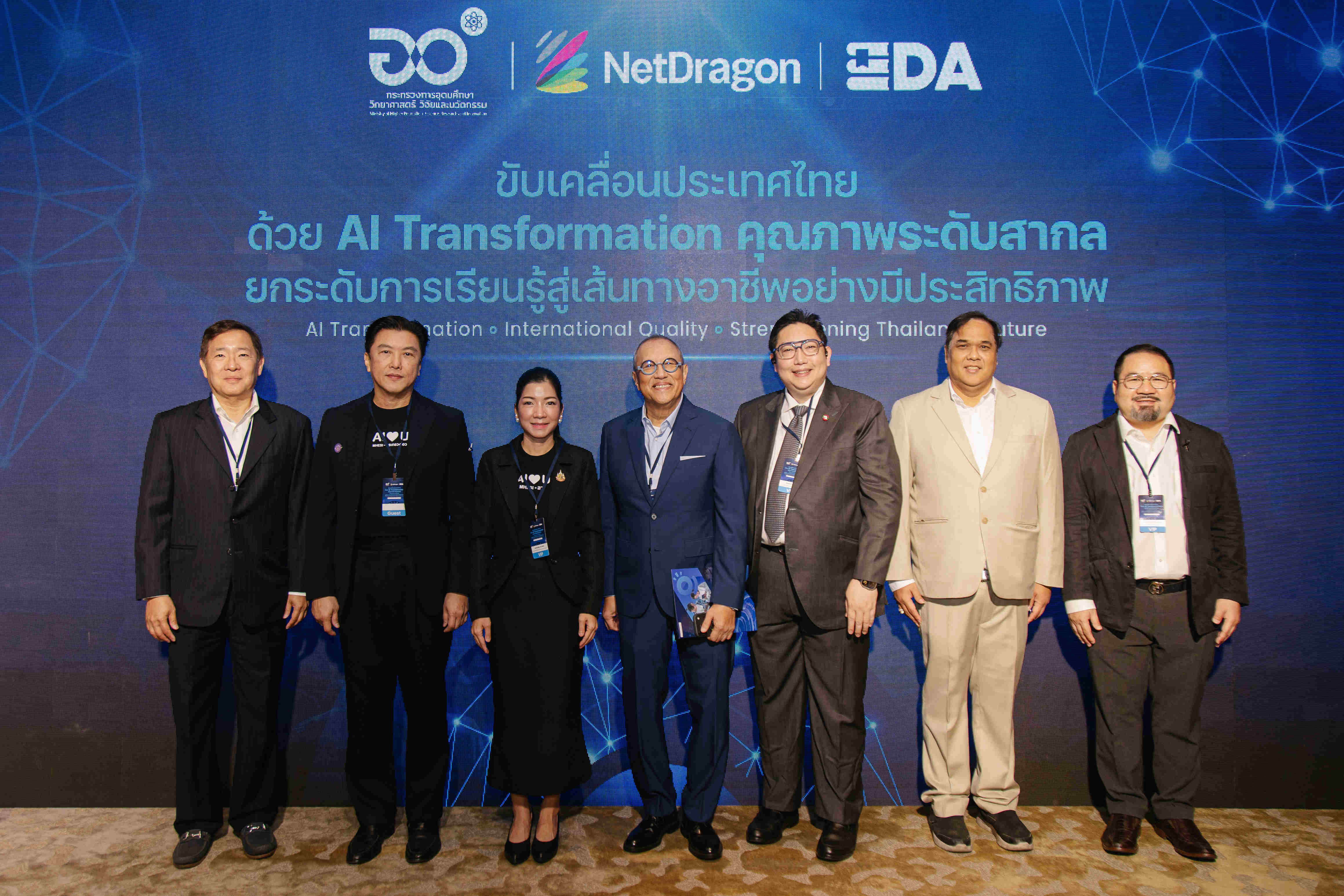
网龙(00777)携手泰国政府推进AI计划 赋能该国未来人才体系建设
智通财经网· 2026-02-02 05:39
Core Insights - NetDragon (00777) collaborates with its subsidiary EDA (Thailand) to promote an AI initiative supported by the Thai government, aiming to create an AI-driven "Learn-to-Career" ecosystem that connects education, skills development, and productivity enhancement [1][4] Group 1: AI Initiative Overview - The collaboration was officially launched in Bangkok, highlighting the increasing policy support from the Thai government for AI, which is seen as a key engine for workforce upgrading and economic competitiveness [4] - The initiative aims to address Thailand's challenges in talent development amidst the rapid transformation of the labor market due to AI technology [4][5] Group 2: Strategic Cooperation - A Memorandum of Understanding (MOU) was signed to establish a long-term cooperation mechanism for developing AI-enabled learning platforms, competency assessment frameworks, and career transition mechanisms [5] - The MOU reflects a commitment to integrate AI throughout the "Learn-to-Career" process, ensuring that skills training translates into measurable productivity and employment competitiveness [5][7] Group 3: Employment Preparation - The core of the collaboration is to redefine "employment readiness" in the AI era, embedding AI into the entire talent development process, from skills assessment to personalized learning paths and career matching [7] - The initiative focuses on quantifiable outcomes to ensure alignment between learners, educational institutions, and employers with the evolving job market [7] Group 4: Global Industry Insights - NetDragon's Vice Chairman Dr. Liang Nianjian emphasized that AI is reshaping industry structures and social frameworks at an unprecedented pace, urging the government to play a proactive role in ensuring the benefits of AI reach society as a whole [8] - Dr. Liang noted that policy-driven models in Asia, such as China's top-down approach, have effectively accelerated AI application across industries, and Thailand's current direction is similarly encouraging [9] Group 5: Impact on SMEs - The collaboration highlights AI's potential to create a fair competitive environment, particularly benefiting SMEs, which are crucial to Thailand's economy [11] - AI is viewed as an important equalizing tool that can significantly enhance productivity and reduce the development gap between SMEs and larger enterprises [11] Group 6: Future Prospects - The partnership is expected to serve as a replicable model for other emerging economies in Asia, demonstrating how government-business collaboration can accelerate AI adoption while focusing on workforce development outcomes [12] - NetDragon and EDA (Thailand) plan to expand the reach and accessibility of AI-enabled learning, deepen cross-sector collaboration, and build a resilient talent pool to support sustainable economic growth in Thailand [12]
NetDragon Leads Government-Backed AI Push to Build Thailand's Future Workforce
Prnewswire· 2026-02-02 04:09
Core Insights - NetDragon Websoft Holdings Limited, in collaboration with its subsidiary EDA (Thailand), is launching a government-backed AI initiative to enhance Thailand's workforce readiness through an AI-driven Learn-to-Career Ecosystem [1][2][3] Group 1: Initiative Overview - The collaboration aims to position AI as a central element for workforce readiness, economic competitiveness, and productivity across various industries in Thailand [2][3] - A Memorandum of Understanding (MOU) has been signed to establish a framework for advancing AI-driven learning, skills assessment, and workforce development [4][5] - The initiative seeks to prepare Thai talent for the labor market by developing AI-enabled learning platforms and competency measurement frameworks [5][6] Group 2: Educational Approach - The Learn-to-Career approach integrates AI throughout the talent journey, from skills assessment to career matching, redefining "job readiness" in the AI era [7][8] - The initiative is designed to deliver measurable outcomes that align skills development with evolving workforce demands [8] Group 3: Industry Perspectives - Dr. Simon Leung, Vice Chairman of NetDragon, highlighted the rapid pace of AI transformation and the necessity for government involvement to ensure societal benefits [9] - He noted that policy-driven approaches in Asia, particularly in China, have accelerated AI adoption, and Thailand's current direction is promising [10] Group 4: Impact on SMEs - The initiative emphasizes AI's role as a productivity equalizer for small and medium-sized enterprises (SMEs), which are crucial to Thailand's economy [11] - By providing AI-enabled skills frameworks, the initiative aims to help SMEs access AI-ready talent and enable workers to showcase relevant capabilities [12] Group 5: Regional Scalability - The collaboration is viewed as a scalable model for other emerging economies in Asia, demonstrating how public-private partnerships can enhance AI adoption while focusing on workforce outcomes [13] - NetDragon and EDA (Thailand) are committed to expanding access to AI-enabled learning and building a resilient talent pipeline for sustainable economic growth [14]