Navitas Semiconductor (NVTS)

Search documents
暴涨160%!纳微半导体(NVTS.US)牵手英伟达(NVDA.US) 是机遇还是泡沫
Zhi Tong Cai Jing· 2025-05-23 07:42
Core Insights - Nanwei Semiconductor (NVTS) experienced a significant stock surge of over 160% following the announcement of a strategic partnership with AI giant Nvidia (NVDA), which could mark a pivotal development for the company [1][4]. Company Business Analysis - Nanwei Semiconductor focuses on next-generation power electronics, specializing in GaN (Gallium Nitride) and SiC (Silicon Carbide) semiconductors, which offer advantages over traditional silicon chips, such as faster switching speeds, higher efficiency, and smaller size, particularly suited for high-performance computing and data centers [2]. Partnership Details - The partnership involves deep collaboration on Nvidia's next-generation AI chips, including the Rubin Ultra. They jointly developed an 800V high-voltage direct current (HVDC) power architecture that will support Nvidia's "Kyber" rack systems, enhancing energy efficiency by 5% and reducing maintenance and cooling costs by 70% [3]. Financial Impact Assessment - In 2024, Nanwei Semiconductor's revenue is projected to be only $8 million, but the partnership with Nvidia could significantly alter the company's growth trajectory. Nvidia's data center business generated over $47 billion in revenue over the past 12 months, indicating substantial potential for Nanwei [5]. Valuation Analysis - Prior to the announcement, Nanwei's stock was trading near its book value, but it surged to a price-to-book ratio of 2.8 and a price-to-sales ratio exceeding 10 following the news [8]. The valuation metrics suggest a significant increase in market expectations, but the sustainability of this valuation depends on the continued expansion of the AI market and Nanwei's technological edge [9].


Why Navitas Semiconductor Is Skyrocketing Today (Hint: Nvidia Has a New Partner)
The Motley Fool· 2025-05-22 18:27
Core Viewpoint - Navitas Semiconductor's stock surged by 156% following the announcement of a partnership with Nvidia to power next-generation AI data center systems [1] Group 1: Partnership Announcement - Navitas has been selected by Nvidia to assist in developing its next-generation AI data center systems, which will feature the upcoming Rubin chips, the successor to the Blackwell chips [2] - This partnership is significant as it highlights Navitas' role in the AI sector and positions the company as a key player in the semiconductor industry [2] Group 2: Technology and Innovation - Navitas' gallium nitride (GaN) and silicon carbide (SiC) technologies are expected to address critical scaling issues related to power supply for Nvidia's powerful AI chips, enhancing reliability and efficiency [3] - The technologies provide high-efficiency, scalable power delivery for next-generation AI workloads, simplifying infrastructure complexity [3] Group 3: Market Validation - The partnership with Nvidia serves as a major validation for Navitas' technology, reinforcing its credibility within the semiconductor industry [5] - Gene Sheridan, CEO of Navitas, emphasized the importance of this collaboration, noting that it opens new market opportunities in AI data centers and electric vehicles [5] - The deal is anticipated to generate significant revenue for Navitas, further solidifying its financial position, which is characterized by minimal debt [5]
隔夜美股全复盘(5.22) | 纳微半导体盘后暴涨超200%,和英伟达共同开发数据中心供电架构
Ge Long Hui· 2025-05-21 23:42
Market Overview - The three major U.S. stock indices closed lower, with the Dow Jones down 1.91%, Nasdaq down 1.41%, and S&P 500 down 1.61% [1] - The VIX index rose 15.42% to 20.88, indicating increased market volatility [1] - The U.S. dollar index fell 0.42% to 99.61, while the yield on the 10-year Treasury bond increased to 4.601% [1] - Gold prices rose 0.78% to $3,215.14 per ounce, and Brent crude oil fell 1.46% to $64.64 [1] Industry & Stocks - All 11 sectors of the S&P 500 closed lower, with declines ranging from 0.75% in Communications to 2.65% in Real Estate [2] - Chinese concept stocks mostly fell, with KWEB down 1.22%, Alibaba down 1.25%, and JD.com down 0.88% [2] - Li Auto rose 3.08%, while XPeng surged 13% [2] - Navitas Semiconductor saw a post-market surge of over 202% after announcing a collaboration with NVIDIA on data center power architecture [6][7] Company Highlights - Xpeng Motors reported Q1 revenue of 15.81 billion yuan, a year-on-year increase of 141.5%, exceeding market expectations [8] - The company delivered 94,008 vehicles in Q1, surpassing the forecast of 90,592 [8] - Xpeng expects Q2 revenue between 17.5 billion and 18.7 billion yuan, with vehicle deliveries projected to be between 102,000 and 108,000, representing a year-on-year increase of 237.7% to 257.5% [8] - OpenAI's largest data center in Texas received $11.6 billion in financing to expand its capacity, which is crucial for enhancing its computational capabilities [8]



NVIDIA Selects Navitas to Collaborate on Next Generation 800 V HVDC Architecture
Globenewswire· 2025-05-21 20:17
Core Viewpoint - Navitas Semiconductor's GaN and SiC technologies have been selected to support NVIDIA's next-generation 800 V HVDC data center power infrastructure, which is designed to enhance power delivery for AI workloads and support 1 MW IT racks and beyond [1][15]. Group 1: Technology Collaboration - The collaboration between Navitas and NVIDIA focuses on the 800 V HVDC architecture, which aims to provide high-efficiency and scalable power delivery for AI workloads, improving reliability and reducing infrastructure complexity [2][4]. - Navitas' GaNFast™ and GeneSiC™ technologies will enable the powering of NVIDIA's GPUs, such as the Rubin Ultra, directly from the 800 V HVDC system [1][6]. Group 2: Advantages of 800 V HVDC - The existing data center architecture, which uses traditional 54 V in-rack power distribution, is limited to a few hundred kilowatts and faces physical limitations as power demand increases [3]. - The 800 V HVDC system allows for a reduction in copper wire thickness by up to 45%, significantly decreasing the amount of copper needed to power a 1 MW rack, which is crucial for meeting the gigawatt power demands of modern AI data centers [5][6]. - This architecture eliminates the need for additional AC-DC converters, directly powering IT racks and enhancing overall system efficiency [6][13]. Group 3: Performance and Efficiency - NVIDIA's 800 V HVDC architecture is expected to improve end-to-end power efficiency by up to 5%, reduce maintenance costs by 70% due to fewer power supply unit (PSU) failures, and lower cooling costs by connecting HVDC directly to IT and compute racks [13]. - Navitas has introduced several high-efficiency power supply units (PSUs), including a 12 kW PSU that meets 98% efficiency, showcasing the company's commitment to innovation in power delivery for AI data centers [12]. Group 4: Company Background - Navitas Semiconductor, founded in 2014, specializes in next-generation power semiconductors, focusing on GaN and SiC technologies for various markets, including AI data centers and electric vehicles [17]. - The company holds over 300 patents and is recognized for its commitment to sustainability, being the first semiconductor company to achieve CarbonNeutral® certification [17].
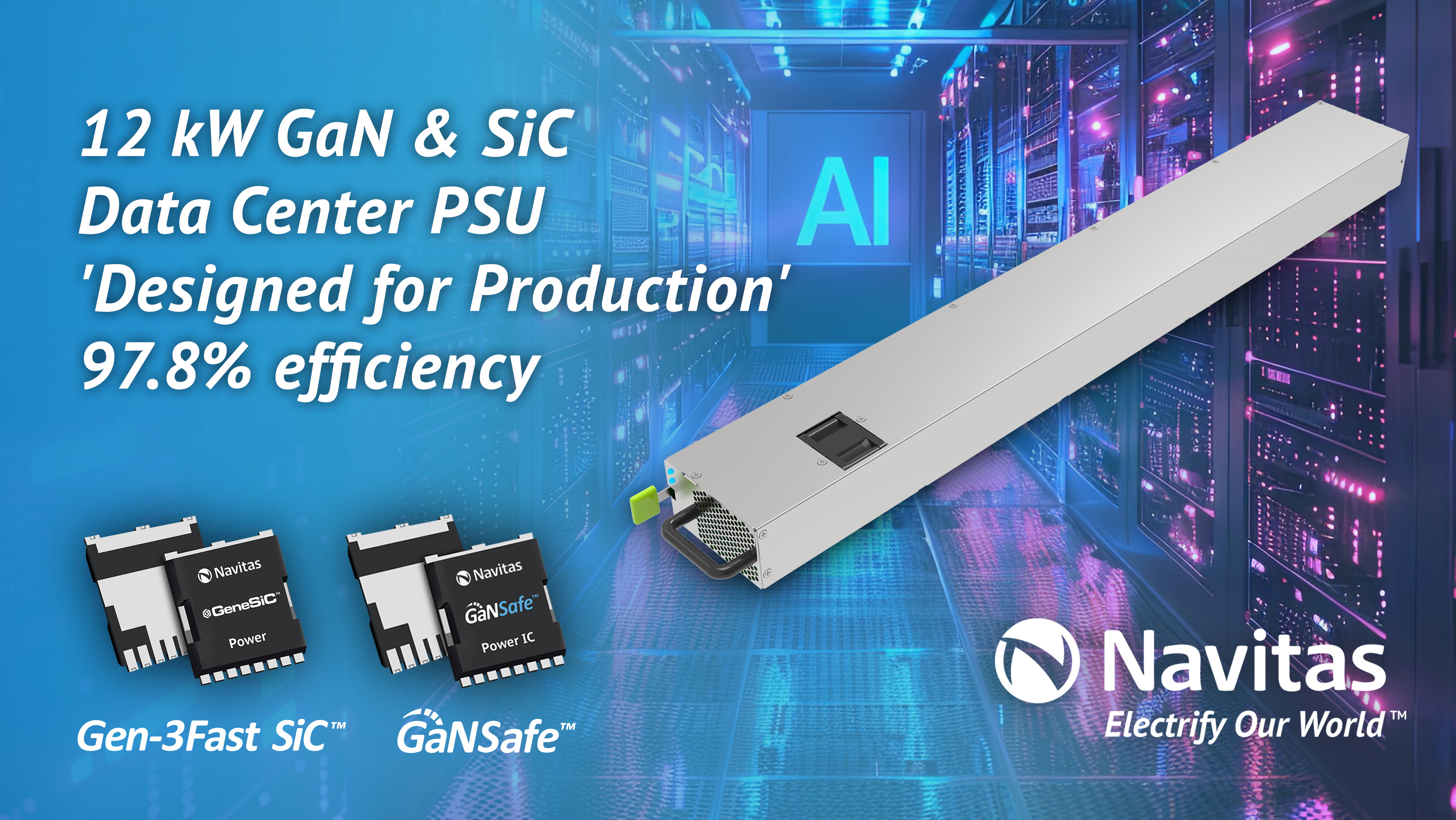
Navitas Launches Industry-Leading 12kW GaN & SiC Platform, Achieving 97.8% Efficiency for Hyperscale AI Data Centers
Globenewswire· 2025-05-21 12:30
Core Insights - Navitas Semiconductor has launched a next-generation 12 kW power supply unit (PSU) designed for hyperscale AI data centers, achieving compliance with Open Rack v3 and Open Compute Project guidelines [1][2][7] - The PSU utilizes advanced technologies including Gen-3 Fast SiC MOSFETs and GaNSafe ICs, ensuring high efficiency and performance with a reported efficiency of 97.8% [10][2] Technology and Design - The PSU features a 3-phase interleaved totem-pole power factor correction (TP-PFC) powered by Gen-3 Fast SiC MOSFETs, which enhances performance and robustness, supporting faster charging for electric vehicles and more powerful AI data centers [3][5] - The IntelliWeave digital control system employs a hybrid control strategy, resulting in a 30% reduction in power losses compared to traditional Continuous Conduction Mode solutions [4][5] - The PSU's design includes a 3-phase interleaved full-bridge LLC topology, integrating control, drive, sensing, and protection features for enhanced reliability [5][6] Specifications and Features - The PSU dimensions are 790 x 73.5 x 40 mm, with an input voltage range of 180 – 305 VAC, capable of delivering 12 kW at input voltages above 207 VAC and 10 kW below this [6] - It includes multiple protection features such as active current sharing, over-current, over-voltage, under-voltage, and over-temperature protections, with an operating temperature range of -5 to 45°C [6] - The PSU is designed for applications ranging from 1 kW to 22 kW, with GaNSafe ICs available in various configurations [5][8] Market Position and Future Outlook - Navitas Semiconductor has seen a significant increase in output power from 2.7 kW to 12 kW in just over 24 months, highlighting its leadership in the AI power roadmap [7] - The company aims to provide efficient, simple, and cost-effective solutions to meet the growing power demands of modern data centers [7][8]
Navitas Hosts “AI Tech Night” to Reveal Next Generation Platform for Hyperscale Data Centers
Globenewswire· 2025-05-15 12:30
Core Insights - Navitas Semiconductor is showcasing its latest AI data center power supply unit (PSU) platform, which utilizes GaNSafe™, GeneSiC™, and IntelliWeave™ technologies to achieve industry-leading efficiency and power density for hyperscale data centers [1][10] - The company is addressing the growing power demands of AI and hyperscale data centers, with traditional power supply technologies struggling to keep pace due to the rapid increase in GPU power and AI cluster computing demand [2][5] Company Developments - Navitas has developed a series of next-generation PSUs, starting with a 2.7 kW common redundant power supply (CRPS) that offers 2x higher power density and a 30% reduction in energy loss, followed by a 3.2 kW CRPS that is 40% smaller than legacy silicon solutions [3] - The latest PSU, an 8.5 kW model, achieves 98% efficiency and complies with Open Compute Project (OCP) and Open Rack v3 (ORv3) specifications, marking a significant advancement in power supply technology [3] - The introduction of IntelliWeave, a patented digital control technique, enables peak efficiencies of 99.3% and reduces power losses by 30% compared to existing solutions [3] Industry Context - The exponential growth of AI computing power presents significant challenges for data center infrastructure, necessitating innovations in power supply technologies to enhance efficiency and power density [5] - Navitas' GaN and SiC solutions are positioned to break through conventional architectural limitations, facilitating more efficient and sustainable data center development [2][5] Upcoming Events - Navitas will host an "AI Tech Night" event in Taipei, Taiwan, on May 21, 2025, to discuss advancements in AI data center infrastructure and showcase its latest technologies [5][8]

Navitas Semiconductor Appoints Cristiano Amoruso to Board of Directors
Globenewswire· 2025-05-14 20:15
Core Insights - Navitas Semiconductor has appointed Cristiano Amoruso to its board of directors, effective immediately, which is seen as a strategic move to enhance corporate governance and accelerate profitability [1][3] - Amoruso has a strong background in the technology and renewable energy sectors, having previously served as CEO of Suniva, Inc. and as a partner at Lion Point Capital, L.P. [2] - The company aims to leverage Amoruso's experience to capture significant market opportunities in the gallium nitride (GaN) and silicon carbide (SiC) sectors, particularly in power-intensive applications [3] Company Overview - Navitas Semiconductor is a pure-play, next-generation power semiconductor company, founded in 2014, specializing in GaN and SiC technologies [6] - The company offers GaNFast™ power ICs and GeneSiC™ power devices, focusing on markets such as data centers, electric vehicles, solar energy, and energy storage [6] - Navitas holds over 300 patents and was the first semiconductor company to achieve CarbonNeutral® certification [6]

Navitas Semiconductor (NVTS) - 2025 Q1 - Quarterly Report
2025-05-09 20:57
Part I - Financial Information This section presents unaudited financial statements, management's analysis, market risks, and internal control procedures [Item 1. Financial Statements (unaudited)](index=4&type=section&id=Item%201.%20Financial%20Statements%20(unaudited)) Presents Navitas Semiconductor's unaudited consolidated financial statements, including balance sheets, operations, equity, cash flows, and notes [Condensed Consolidated Balance Sheets](index=3&type=section&id=Condensed%20Consolidated%20Balance%20Sheets) Presents Navitas Semiconductor's condensed consolidated balance sheets for March 31, 2025, and December 31, 2024 | (In thousands) | March 31, 2025 | December 31, 2024 | | :--- | :--- | :--- | | **ASSETS** | | | | Cash and cash equivalents | $75,132 | $86,737 | | Total current assets | $108,300 | $120,266 | | Total assets | $370,830 | $389,978 | | **LIABILITIES AND STOCKHOLDERS' EQUITY** | | | | Total current liabilities | $19,309 | $21,144 | | Total liabilities | $29,010 | $41,965 | | Total stockholders' equity | $341,820 | $348,013 | | Total liabilities and stockholders' equity | $370,830 | $389,978 | [Condensed Consolidated Statements of Operations](index=4&type=section&id=Condensed%20Consolidated%20Statements%20of%20Operations) Details Navitas Semiconductor's condensed consolidated statements of operations for Q1 2025 and Q1 2024 | (In thousands, except per share amounts) | Three Months Ended March 31, 2025 | Three Months Ended March 31, 2024 | | :--- | :--- | :--- | | NET REVENUES | $14,018 | $23,175 | | COST OF REVENUES | $8,711 | $13,660 | | Research and development | $12,668 | $20,229 | | Selling, general and administrative | $11,740 | $16,087 | | Amortization of intangible assets | $4,734 | $4,774 | | Restructuring expense | $1,469 | $— | | Total operating expenses | $30,611 | $41,090 | | LOSS FROM OPERATIONS | $(25,304) | $(31,575) | | Total other income, net | $8,837 | $27,964 | | LOSS BEFORE INCOME TAXES | $(16,467) | $(3,611) | | INCOME TAX PROVISION | $82 | $70 | | Equity method investment loss | $(280) | $— | | NET LOSS | $(16,829) | $(3,681) | | Basic net loss per share attributable to common stockholders | $(0.09) | $(0.02) | | Diluted net loss per share attributable to common stockholders | $(0.09) | $(0.02) | [Condensed Consolidated Statements of Stockholders' Equity](index=5&type=section&id=Condensed%20Consolidated%20Statements%20of%20Stockholders%27%20Equity) Presents Navitas Semiconductor's condensed consolidated statements of stockholders' equity for March 31, 2025 and 2024 | (In thousands, except shares) | Shares (March 31, 2025) | Total Stockholders' Equity (March 31, 2025) | Shares (March 31, 2024) | Total Stockholders' Equity (March 31, 2024) | | :--- | :--- | :--- | :--- | :--- | | Balance at December 31, 2024/2023 | 188,114 | $348,013 | 179,196 | $380,617 | | Issuance of common stock under employee stock option and stock award plans | 3,649 | $3,979 | 3,801 | $10,734 | | Costs for the issuance of common stock/At-the-market offering | — | $(346) | — | — | | Stock-based compensation expense | — | $7,003 | — | $10,247 | | Net loss | — | $(16,829) | — | $(3,681) | | Balance at March 31, 2025/2024 | 191,763 | $341,820 | 182,997 | $397,917 | [Condensed Consolidated Statements of Cash Flow](index=6&type=section&id=Condensed%20Consolidated%20Statements%20of%20Cash%20Flow) Presents Navitas Semiconductor's condensed consolidated statements of cash flow for Q1 2025 and Q1 2024 | (In thousands) | Three Months Ended March 31, 2025 | Three Months Ended March 31, 2024 | | :--- | :--- | :--- | | Net cash used in operating activities | $(13,533) | $(19,783) | | Net cash used in investing activities | $(41) | $(5,398) | | Net cash provided by financing activities | $949 | $2,024 | | NET INCREASE (DECREASE) IN CASH | $(12,625) | $(23,157) | | CASH, CASH EQUIVALENTS, AND RESTRICTED CASH AT END OF PERIOD | $75,615 | $129,682 | [Condensed Notes to Consolidated Financial Statements](index=7&type=section&id=Condensed%20Notes%20to%20Consolidated%20Financial%20Statements) Provides detailed notes to Navitas Semiconductor's condensed consolidated financial statements, explaining key accounting policies [1. ORGANIZATION AND BASIS OF PRESENTATION](index=7&type=section&id=1.%20ORGANIZATION%20AND%20BASIS%20OF%20PRESENTATION) Describes Navitas Semiconductor's business, fabless model, global operations, and recent At-The-Market Offering Agreement - Navitas Semiconductor Corporation designs, develops, and markets next-generation power semiconductors, including gallium nitride (GaN) power integrated circuits (ICs), silicon carbide (SiC) devices, and associated high-speed silicon system controllers and digital isolators, used in fast chargers, consumer electronics, data centers, solar products, and electric vehicles[24](index=24&type=chunk) - The Company operates a fabless business model, contracting manufacturing to partner suppliers globally, with operations across the US, Europe, and Asia[24](index=24&type=chunk) - On March 19, 2025, Navitas entered into an At-The-Market Offering Agreement with Jefferies LLC to sell up to **$50.0 million** of Class A common stock, with no shares sold as of March 31, 2025[26](index=26&type=chunk) [2. SIGNIFICANT ACCOUNTING POLICIES AND RECENT ACCOUNTING PRONOUNCEMENTS](index=8&type=section&id=2.%20SIGNIFICANT%20ACCOUNTING%20POLICIES%20AND%20RECENT%20ACCOUNTING%20PRONOUNCEMENTS) Outlines Navitas Semiconductor's significant accounting policies and recent accounting pronouncements - The Company reclassified 'Dividend income' from 'interest income (expense), net' in prior period statements to conform to the current presentation, with no impact on net loss or retained earnings[30](index=30&type=chunk) - New accounting standards, ASU No. 2024-03 (expense disaggregation) and ASU 2023-09 (income tax disclosures), are being evaluated by the Company for future impact[31](index=31&type=chunk)[32](index=32&type=chunk) - Navitas adopted ASC 2023-07, Segment Reporting, in 2024, requiring disclosure of segment profit/loss measures and significant segment expenses, as detailed in Note 14[33](index=33&type=chunk) [3. ACCOUNTS RECEIVABLE](index=8&type=section&id=3.%20ACCOUNTS%20RECEIVABLE) Details Navitas Semiconductor's accounts receivable, including gross amounts, unbilled receivables, and credit loss allowance | (In thousands) | March 31, 2025 | December 31, 2024 | | :--- | :--- | :--- | | Accounts receivable, gross | $11,970 | $12,578 | | Unbilled receivables | $938 | $1,539 | | Allowance for credit losses | $(481) | $(135) | | Accounts receivable, net | $12,427 | $13,982 | | (In thousands) | Allowance for Credit Losses | | :--- | :--- | | Balance at December 31, 2024 | $(135) | | Provision for credit losses | $(346) | | Accounts written-off | $— | | Balance at March 31, 2025 | $(481) | [4. INVENTORIES](index=9&type=section&id=4.%20INVENTORIES) Presents Navitas Semiconductor's inventory breakdown, including raw materials, work-in-process, and finished goods | (In thousands) | March 31, 2025 | December 31, 2024 | | :--- | :--- | :--- | | Raw materials | $2,545 | $2,422 | | Work-in-process | $12,979 | $10,465 | | Finished goods | $538 | $2,590 | | Total | $16,062 | $15,477 | [5. PROPERTY AND EQUIPMENT, NET](index=9&type=section&id=5.%20PROPERTY%20AND%20EQUIPMENT,%20NET) Details Navitas Semiconductor's property and equipment, net, and associated depreciation expense | (In thousands) | March 31, 2
Navitas Semiconductor Corporation (NVTS) Reports Q1 Loss, Lags Revenue Estimates
ZACKS· 2025-05-05 22:25
Navitas Semiconductor Corporation (NVTS) came out with a quarterly loss of $0.06 per share in line with the Zacks Consensus Estimate. This compares to loss of $0.06 per share a year ago. These figures are adjusted for non-recurring items.A quarter ago, it was expected that this company would post a loss of $0.06 per share when it actually produced a loss of $0.06, delivering no surprise.Over the last four quarters, the company has not been able to surpass consensus EPS estimates.Navitas Semiconductor, which ...