
QFIN(QFIN)

Search documents
陆家嘴财经早餐2025年11月1日星期六
Wind万得· 2025-10-31 22:34
Group 1 - The U.S. Treasury Secretary indicated that a U.S.-China trade agreement could be signed as early as next week, with China expressing willingness to work with the U.S. to implement the consensus reached by the two heads of state [1] - The public fund industry in China, valued at over 36 trillion yuan, is undergoing significant reforms, including guidelines for performance benchmarks that may lead to reduced compensation for fund managers whose long-term performance falls below benchmarks [1] Group 2 - The State Council is focusing on deepening reforms in key areas and expanding institutional openness, aiming to enhance market access and optimize regulatory frameworks for factor markets [2] - The People's Bank of China is working on optimizing the monetary policy framework and addressing market "herding effects," while also preparing policy tools to respond to macroeconomic and financial market fluctuations [2] - The Ministry of Finance plans to utilize special bonds and long-term government bonds effectively to encourage private capital participation in major projects and improve income distribution [2] Group 3 - The National Development and Reform Commission announced that 2 trillion yuan of the 5 trillion yuan local government debt limit will be allocated for new special bonds to support investment in certain provinces [3] - China's manufacturing PMI for October was reported at 49%, a decrease of 0.8 percentage points from the previous month, while the non-manufacturing PMI rose slightly to 50.1 [3] - A new action plan for smart city development aims to establish over 50 fully digital transformation cities by the end of 2027 [3] Group 4 - The China Securities Regulatory Commission (CSRC) is emphasizing the need for a more inclusive and adaptable capital market system during the 14th Five-Year Plan period, including reforms in the Sci-Tech Innovation Board and the Growth Enterprise Market [5] - The CSRC has taken a strict stance against misinformation in the capital market, reinforcing a "zero tolerance" policy towards false information dissemination [5] - A-shares experienced a decline, with the Shanghai Composite Index closing down 0.81% at 3954.79 points, while small-cap stocks saw a rebound [6] Group 5 - The Hong Kong Hang Seng Index closed down 1.43%, with technology stocks continuing to struggle, while healthcare stocks performed well [6] - The Shanghai Stock Exchange reported a year-on-year increase in net profit for listed companies in Q3, with significant growth in mergers and acquisitions since the introduction of new policies [6] - The Hong Kong Stock Exchange announced an expansion of the "Southbound ETF Connect" list, increasing the number of ETFs available for trading [7] Group 6 - The Ministry of Housing and Urban-Rural Development is reforming the real estate development and sales system to prevent delivery risks and protect buyers' rights [10] - The top 100 real estate companies in China reported a sales amount of 253 billion yuan in October, reflecting a year-on-year decrease of 41.9% [10] - The China Automotive Dealers Association reported an increase in the inventory warning index for October, indicating improved conditions in the automotive circulation industry [11]



中国资产深夜拉升 乐信飙涨26% 亚马逊市值大增1.9万亿元
2 1 Shi Ji Jing Ji Bao Dao· 2025-10-31 15:46
Group 1: Amazon - Amazon's stock price surged by 12.2% at opening, with market capitalization increasing by $274.2 billion (approximately ¥1.95 trillion) [2] - In Q3, Amazon reported net sales of $180.2 billion, a 13% year-over-year increase, surpassing market expectations of $177.8 billion; net profit reached $21.2 billion, up nearly 40% [4] - AWS cloud business revenue grew by 20% year-over-year to $33 billion, exceeding analyst expectations and marking the strongest growth since 2022, alleviating concerns about AWS lagging in the AI competition [4] Group 2: Apple - Apple reached a historical high in stock price before a short-term decline; Q4 revenue was $102.47 billion, exceeding $100 billion and marking a year-over-year increase of 8% [5] - Net profit for Q4 was $27.47 billion, a significant year-over-year increase of 86%, with diluted earnings per share rising by 91% to $1.85 [5] - Despite overall strong performance, revenue from Greater China declined by 3.6%, becoming the only region with negative growth [5] Group 3: Cryptocurrency - Most cryptocurrencies saw an increase, with Bitcoin returning to the $110,000 mark, up 2.81%, Ethereum at $3,874, up 2.39%, and Dogecoin rising over 3% [7] Group 4: Gold Market - The World Gold Council noted that geopolitical tensions, persistent inflation, and uncertainty in global trade policies have driven demand for gold as a safe-haven asset [6] - The outlook for the gold market remains optimistic, supported by a weakening dollar, expectations of rate cuts, and the risk of stagflation, indicating further potential for gold price increases [6]





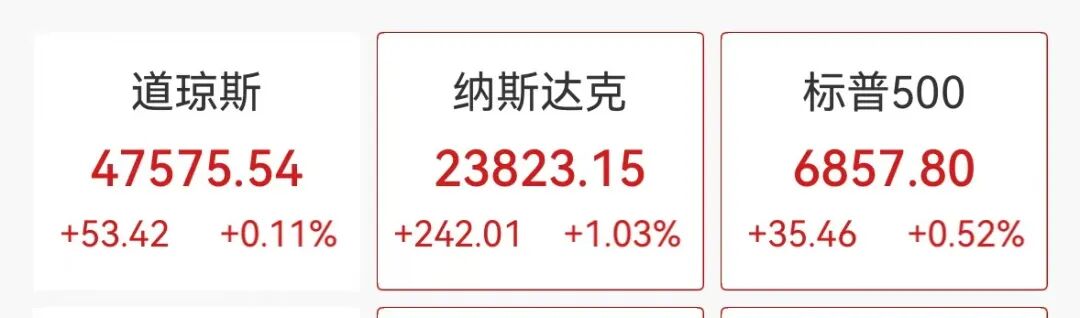
中国资产深夜拉升,乐信飙涨26%,多股涨超10%,亚马逊市值大增1.9万亿元
2 1 Shi Ji Jing Ji Bao Dao· 2025-10-31 15:28
Group 1 - Amazon's stock surged by 12.2%, increasing its market value by $274.2 billion (approximately 1.95 trillion RMB) [3] - Amazon's Q3 net sales reached $180.2 billion, a 13% year-over-year increase, surpassing market expectations of $177.8 billion. Net profit was $21.2 billion, up nearly 40% [5] - AWS cloud business revenue grew by 20% year-over-year to $33 billion, marking the strongest growth since 2022 and alleviating concerns about AWS lagging in the AI competition [5] Group 2 - Nvidia's stock rose over 1.6%, with its market value returning to $500 billion. Nvidia announced a collaboration with the South Korean government and major companies to deploy over 260,000 GPUs for national AI infrastructure [5] - Apple's Q4 revenue reached $102.47 billion, a historical high for the period, with a year-over-year growth of 8%. Net profit was $27.47 billion, up 86% [6] - Apple's total revenue for the fiscal year reached $416.16 billion, with net profit exceeding $112 billion, continuing its growth trend. However, revenue from Greater China declined by 3.6%, marking it as the only region with negative growth [6] Group 3 - The Nasdaq Golden Dragon Index saw a shift from decline to increase, with notable stock performances: Lexin surged by 26%, and several other stocks rose over 10% [6][7] - International oil prices experienced a short-term increase, with both Brent and WTI crude oil rising nearly 1% [8] - Gold prices fell below $4,020 per ounce, with Morgan Stanley predicting gold prices could reach $4,500 per ounce by mid-2026 due to geopolitical tensions and inflation pressures [11]




Qfin (QFIN) Hits 52-Week Low. Here’s Why
Yahoo Finance· 2025-10-29 14:28
Core Insights - Qfin Holdings, Inc. (NASDAQ:QFIN) has recently experienced significant stock price decline, hitting a 52-week low of $20.45 before closing at $21.40, down 13.92% on the day [1][2] - The decline is attributed to a hedge fund manager's negative outlook on Chinese financial stocks, with specific mention of Qfin not being recommended [2] - The company operates as an AI-empowered credit-tech platform in China, providing a range of technology services for financial institutions and SMEs throughout the loan lifecycle [3] Company Performance - Qfin's stock performance has been notably poor, with a significant drop in value leading to a 52-week low [1][2] - The stock's intra-day trading saw a low of $20.45, indicating a lack of investor confidence [1] Market Sentiment - Investor sentiment has turned negative, influenced by the absence of new developments from the company and a broader skepticism towards Chinese financial stocks [2] - Jim Cramer, a former hedge fund manager, expressed a lack of interest in Chinese financial companies, further impacting market perception of Qfin [2] Industry Context - Qfin is positioned within the AI-driven financial technology sector, which is recognized for its potential but faces competition from other AI stocks that may offer better returns with lower risk [4] - The company provides essential services that support the loan lifecycle, indicating its role in the financial technology landscape [3]
消费金融系列报告(五):助贷新规靴子落地,关注居民消费修复
Ping An Securities· 2025-10-29 10:27
Investment Rating - The industry investment rating is "Outperform the Market" [1] Core Viewpoints - The implementation of new lending regulations introduces uncertainty, but the impact on leading companies is relatively controllable. The new regulations may reduce the enthusiasm of financial institutions to participate in the lending market, affecting industry liquidity and profitability for high-priced clients [2][5] - Loan growth has slowed, and asset quality risks are a concern. In Q2, the loan volume increased by 13.0% year-on-year, but the growth rate declined by 3.6 percentage points compared to Q1. Smaller platforms are leading in loan growth, indicating a strategic move to enhance competitiveness before the new regulations take effect [2][17] - Revenue performance varies among companies, with a slight increase in uncertainty regarding profitability. In Q2, the sample credit technology platforms saw a revenue growth rate of 18.8%, with net profit increasing by 36.7% year-on-year. However, some companies, like Yirendai, reported negative net profit growth [2][29] Summary by Sections New Regulations and Industry Ecology - The new lending regulations, effective from October 1, 2025, clarify the upper limit on loan interest rates and require transparency in service fees. This may lead to a contraction in financial supply for high-risk clients [5][6] - The regulations emphasize centralized management by banks and strict compliance, which may reduce the willingness of financial institutions to engage in the lending market [6][9] Loan Growth and Asset Quality - In Q2, the average overdue rate for 90 days or more decreased by 4 basis points to 2.20%. However, some companies, like Qifu and Xinye, saw an increase in early overdue rates, indicating potential asset quality deterioration [18][26] - The overall loan volume for sample companies grew by 13.0% year-on-year, but the growth rate declined compared to Q1, suggesting a cautious approach to lending amid regulatory changes [19][17] Revenue and Profitability - The revenue growth rate for sample credit technology platforms in Q2 was 18.8%, with significant contributions from companies like Xiaoying and Jiayin, which reported growth rates of 65.6% and 27.8%, respectively [27][29] - The net profit for the sample companies increased by 36.7% year-on-year, with leading companies like Lexin and Jiayin showing substantial growth rates [29][36] Credit Cost and Investor Returns - Credit impairment provisions increased by 17.6% year-on-year, reflecting heightened caution due to regulatory uncertainties. This may impact profitability in the short term [33][29] - Many credit technology platforms have initiated stock buyback plans, with Qifu's buyback amount reaching $227 million as of August 14, 2025, indicating a focus on shareholder returns [36][37]



As Chinese Economy Recovers, Qfin Holdings Looks Shockingly Cheap
Seeking Alpha· 2025-10-29 04:46
Group 1 - Fintech companies are revolutionizing consumer finance by enabling the movement of large sums of money without the need for traditional bank branches [1] - These companies have significantly reduced the historical barriers to entry in the financial services sector, allowing for greater accessibility and efficiency [1] Group 2 - The article highlights the author's extensive experience in investment analysis, particularly focusing on deep-discount value plays and underappreciated companies [1] - The author's investment philosophy is influenced by contrarian strategies, aiming to identify companies that can return value to investors [1]

Jim Cramer on Qfin: “China Financials, Not for Me”
Yahoo Finance· 2025-10-26 11:24
Company Overview - Qfin Holdings, Inc. (NASDAQ:QFIN) operates an AI-driven credit technology platform under the Qifu Jietiao brand, providing services such as borrower matching, credit assessment, loan facilitation, and post-loan services for financial institutions, consumers, and small businesses [1]. Market Sentiment - Jim Cramer recently commented on QFIN during a lightning round, expressing a preference for Alibaba over QFIN, indicating a cautious stance on Chinese financial stocks [1]. - There is a belief that while QFIN has potential as an investment, other AI stocks may offer greater upside potential and carry less downside risk [2].
Wall Street Bullish on Qfin Holdings (QFIN), Here’s Why
Yahoo Finance· 2025-10-09 14:47
Core Viewpoint - Qfin Holdings, Inc. (NASDAQ:QFIN) is considered an oversold financial stock with bullish sentiment from Wall Street following the release of its unaudited fiscal second quarter results for 2025 [1] Financial Performance - The company reported total revenue of RMB5,215.9 million for Q2 2025, an increase from RMB4,690.7 million in Q1 2025, reflecting a quarter-over-quarter growth [2] - Net income decreased from RMB1,796.6 million in Q1 2025 to RMB1,730.5 million in Q2 2025 [2] - The platform experienced an 11.4% increase in consumers, growing from 247.6 million last year to 275.8 million consumers [2] - The cumulative number of approved credit lines improved by 12.3% year-over-year during the quarter [2] Analyst Ratings - Analysts have maintained a bullish outlook on Qfin Holdings, with DBS reiterating a Buy rating on August 18, while lowering the price target from $55.6 to $52.6 [3] - J.P. Morgan's Katherine Lei also reiterated a Buy rating on September 10, reducing the price target from $50 to $45 [3] - Qfin Holdings, Inc. operates as an investment holding company providing credit technology services [3]
美股异动|奇富科技盘前涨超1% 获交银国际纳入10月中资股推介股份名单
Ge Long Hui· 2025-10-09 08:47
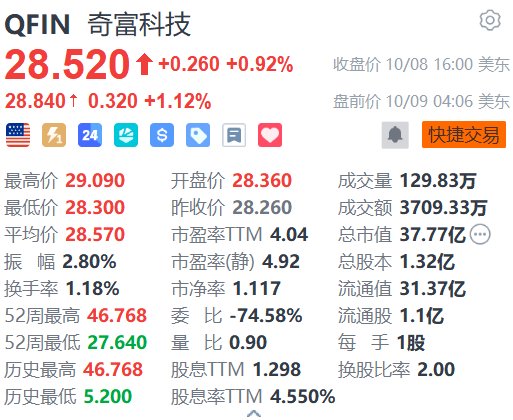
Group 1 - The core viewpoint of the article highlights that QFIN Technology (QFIN.US) has seen a pre-market increase of 1.12%, reaching a price of $28.84, following a report from CCB International recommending several Chinese stocks, including QFIN Technology and Alibaba, with a "Buy" rating [1] - CCB International has set a target price of $58 for QFIN Technology, indicating a significant upside potential from its current trading price [1] - The stock's performance metrics include a closing price of $28.52, a market capitalization of $3.777 billion, and a price-to-earnings ratio of 4.92, reflecting its valuation in the market [1] Group 2 - The trading volume for QFIN Technology was reported at 1.2983 million shares, with a price range between a high of $29.09 and a low of $28.30 during the trading session [1] - The stock has a 52-week high of $46.768 and a 52-week low of $27.640, indicating its price volatility over the past year [1] - The average trading price was noted at $28.57, with a turnover rate of 1.18%, suggesting moderate trading activity [1]
Qfin Holdings, Inc. (QFIN) Sees Minor Stake Trim
Yahoo Finance· 2025-09-29 23:08
Group 1 - Qfin Holdings, Inc. (NASDAQ:QFIN) is recognized as one of the best low-priced growth stocks currently available for investment [1] - The Public Employees Retirement System of Ohio reduced its stake in Qfin Holdings by 4.3%, selling 17,319 shares, and now holds 382,175 shares valued at approximately $16,571,000 [1] - The CEO of Qfin Holdings, Mr. Haisheng Wu, represented the company at the UN General Assembly High-Level Week, discussing the theme "Digital for Good: For People and Prosperity" [2][3] Group 2 - Mr. Wu emphasized the importance of responsible technological innovation for achieving inclusive and sustainable development through digital technology [3] - Qfin Holdings operates an AI-driven credit-tech platform, founded in 2016, focusing on enhancing accessibility through credit-driven and platform services [3] - There are opinions suggesting that while QFIN has potential, other AI stocks may offer greater upside potential with less downside risk [4]