
Starbucks(SBUX)

Search documents
Starbucks(SBUX) - 2025 Q3 - Earnings Call Transcript
2025-07-29 21:15
Financial Data and Key Metrics Changes - Total company net revenue for Q3 fiscal year 2025 was $9.5 billion, reflecting a 3% increase year-over-year, driven by 6% net new company-operated store growth, partially offset by a 2% decline in comparable store sales [39][40] - Global operating margin was 10.1%, a decrease of 650 basis points from the prior year, primarily due to deleverage and investments in the Back to Starbucks strategy [47] - Earnings per share (EPS) for Q3 was $0.50, down 45% from the prior year, mainly reflecting the impact of expense deleverage and investments in the Back to Starbucks strategy [49] Business Line Data and Key Metrics Changes - In North America, comparable sales in the U.S. declined by 2%, while Canada experienced low single-digit sales growth, driven by product innovation [7][43] - The college and university license business saw year-over-year comparable sales growth in the low double digits, indicating renewed brand engagement among younger customers [10] - The delivery business achieved over 25% year-over-year transaction growth, contributing positively to overall performance [11] Market Data and Key Metrics Changes - Internationally, the segment posted over $2 billion in quarterly revenue for the first time, with seven out of the top ten markets showing positive comparable sales, particularly in the UK and Mexico [27][44] - In China, comparable store sales grew by 2%, driven by a 6% improvement in transactions, supported by successful product innovation and marketing campaigns [45][28] - The UK and Turkey markets showed continued momentum with improving comparable sales performance, while Latin America maintained double-digit year-over-year growth in system sales [30][31] Company Strategy and Development Direction - The company is focused on the "Back to Starbucks" strategy, which aims to enhance customer experience and operational efficiency, with significant investments in labor and service standards [5][6] - The rollout of the Green Apron service model is a key initiative aimed at establishing consistent and scalable customer service standards across all U.S. stores [15][72] - Future innovations will include a robust menu pipeline and enhancements to the Starbucks Rewards program, aimed at increasing customer loyalty and engagement [23][26] Management's Comments on Operating Environment and Future Outlook - Management expressed confidence in the turnaround strategy, noting early signs of progress in partner engagement and customer satisfaction metrics [32][52] - The company anticipates that investments in operational improvements will yield healthier margins over time, despite current margin pressures [49][53] - An Investor Day is planned for early 2026 to provide further insights into long-term growth strategies and financial performance expectations [34][65] Other Important Information - The company is conducting a comprehensive evaluation of its store portfolio to ensure alignment with brand and customer expectations, with plans to complete this by the end of the fiscal year [46][21] - The introduction of new product innovations, such as Protein Cold Foam, is expected to enhance customer offerings and drive sales [24][25] Q&A Session Summary Question: What are the cost offsets related to the $500 million investment in labor hours? - Management indicated that they are working across the entire P&L to identify cost structure efficiencies, with both short-term and long-term strategies in place [59][60] Question: Can the company return to pre-COVID margin levels? - Management views 2019 margins as a reasonable benchmark and is focused on driving top-line growth while establishing a cost structure that supports profitability [65][66] Question: How quickly will the Green Apron service model be implemented across stores? - The rollout will begin mid-August, with a focus on ensuring proper staffing and operational consistency before full implementation [72][73] Question: What is driving the sequential improvement in transactions? - Management attributed improvements to better marketing efforts and operational progress, with a focus on enhancing customer experience [78][79] Question: What changes are expected in the rewards program? - The rewards program will be reimagined to better recognize customer loyalty and engagement, moving away from a one-size-fits-all discounting approach [86][87]


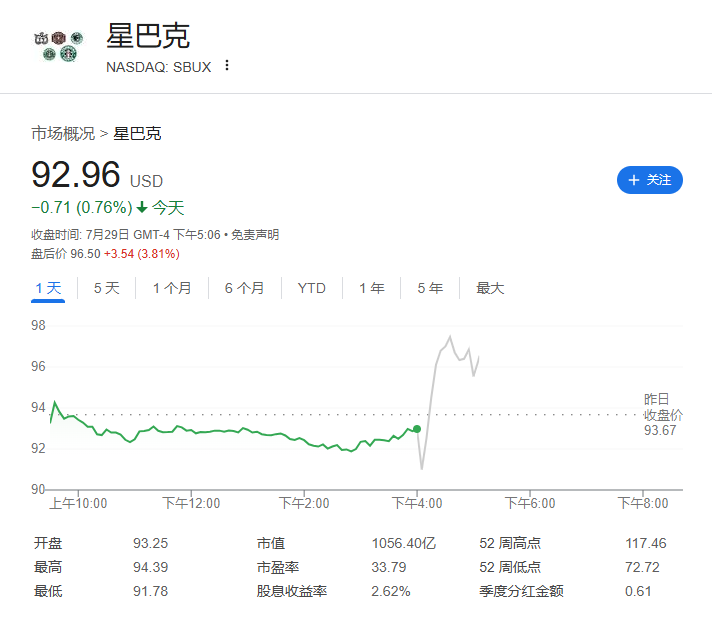
星巴克:希望在中国业务中保留较多的股份。超过20方对中国业务感兴趣。
news flash· 2025-07-29 20:44
Group 1 - The core viewpoint is that Starbucks aims to retain a significant stake in its Chinese operations amidst interest from over 20 parties [1]
Starbucks beats earnings expectations
CNBC Television· 2025-07-29 20:41
Hey, Morgan. Starbucks reporting a revenue beat here for Q3. Nine and a half billion.That's better than the 9.31% billion estimated by analysts. EPS50 cents adjusted. We're not going to be comparing that to estimates due to an 11cent charge from a nonrecurring significant investment in its recent leadership experience conference and a non-discreet item.Same store sales down 2%. That's a bit worse than the 1.3% drop the street was expecting the sixth quarter of sales contractions in a row. North America sale ...
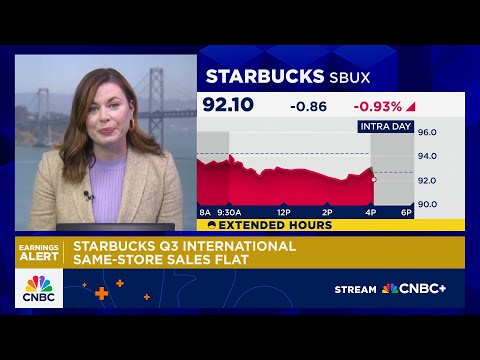
Starbucks still struggling as coffee giant's same-store sales drop for 6th straight quarter
New York Post· 2025-07-29 20:39
Core Insights - Starbucks reported a larger-than-expected decline in third-quarter global comparable sales, with same-store sales down 2%, marking the sixth consecutive quarterly contraction [1][4] - The decline was greater than analysts' average estimate of a 1.19% dip, indicating cautious consumer spending affecting demand [1] Sales Performance - Same-store sales in North America also fell by 2%, consistent with the previous year's decline [6] - Customer visits decreased by an average of 0.1% from April to June, an improvement compared to a 0.9% drop in the prior three months, suggesting early signs of recovery from the "Back to Starbucks" initiative [6] Strategic Initiatives - CEO Brian Niccol has implemented a simplified menu, introduced freshly baked food items, and emphasized quicker service as part of a brand reset since taking over in August [2] - The company plans to increase staffing investments in all 10,000-plus Starbucks-owned US stores by the end of summer [4][7] Financial Impact - CFO Cathy Smith noted that a significant non-recurring investment in the Leadership Experience 2025 and a discrete tax item negatively impacted Q3 EPS by 11 cents [5]

Starbucks misses on earnings despite revenue beat
Proactiveinvestors NA· 2025-07-29 20:27
About this content About Angela Harmantas Angela Harmantas is an Editor at Proactive. She has over 15 years of experience covering the equity markets in North America, with a particular focus on junior resource stocks. Angela has reported from numerous countries around the world, including Canada, the US, Australia, Brazil, Ghana, and South Africa for leading trade publications. Previously, she worked in investor relations and led the foreign direct investment program in Canada for the Swedish government ...
Starbucks(SBUX) - 2025 Q3 - Earnings Call Presentation
2025-07-29 20:15
Financial Performance - Starbucks' global net revenue reached $8.8 billion, a 3% year-over-year increase[3] - The company's global operating margin was 8.2%, a decrease of 450 basis points year-over-year[3] - Diluted net earnings per share (EPS) were $0.41, a 38% year-over-year decrease[3] Sales and Store Growth - Overall comparable store sales decreased by 1%[3] - North America's comparable store sales decreased by 2%[3] - China's comparable store sales remained flat at 0%[3] - The global store count increased by 5% year-over-year, reaching 40,789 stores[3] Strategic Direction - The company is focused on its "Back to Starbucks" plan to improve the business[2] - Starbucks aims to re-introduce the Starbucks experience to the world by focusing on customer service, coffee quality, and community coffeehouses[6, 7, 8] - The company emphasizes its mission to be the premier purveyor of the finest coffee, inspiring and nurturing the human spirit[5]
星巴克第三财季净营收95亿美元,分析师预期92.9亿美元。第三财季同店销售下降2%,分析师预期下降1.5%。第三财季北美同店销售下滑2%,分析师预期下降2.49%。第三财季美国同店销售下降2%,分析师预期下降2.53%。第三财季中国同店销售增长2%,分析师预期增长1.44%。
news flash· 2025-07-29 20:11
Group 1 - The core revenue for Starbucks in Q3 reached $9.5 billion, surpassing analyst expectations of $9.29 billion [1] - Same-store sales declined by 2% in Q3, while analysts had anticipated a decrease of 1.5% [1] - North American same-store sales fell by 2% in Q3, slightly better than the expected decline of 2.49% [1] Group 2 - U.S. same-store sales decreased by 2% in Q3, compared to an expected decline of 2.53% [1] - In contrast, same-store sales in China grew by 2% in Q3, exceeding analyst expectations of a 1.44% increase [1]
Starbucks(SBUX) - 2025 Q3 - Quarterly Report
2025-07-29 20:11
[PART I. FINANCIAL INFORMATION](index=3&type=section&id=PART%20I.%20FINANCIAL%20INFORMATION) This section presents Starbucks Corporation's unaudited consolidated financial statements and related notes for the recent fiscal periods [Item 1. Financial Statements](index=3&type=section&id=Item%201.%20Financial%20Statements) This section details Starbucks Corporation's unaudited consolidated financial statements and comprehensive notes for the quarter and three quarters ended June 29, 2025 [Consolidated Statements of Earnings](index=3&type=section&id=Consolidated%20Statements%20of%20Earnings) This section presents Starbucks' consolidated statements of earnings, highlighting key financial performance metrics for the recent fiscal periods Consolidated Statements of Earnings (Quarter Ended June 29, 2025 vs. June 30, 2024) | Metric | Jun 29, 2025 (Millions) | Jun 30, 2024 (Millions) | Change (Millions) | % Change | | :-------------------------------- | :---------------------- | :---------------------- | :---------------- | :------- | | Total Net Revenues | $9,456.0 | $9,113.9 | $342.1 | 3.8% | | Total Operating Expenses | $8,577.5 | $7,670.3 | $907.2 | 11.8% | | Operating Income | $935.6 | $1,517.5 | $(581.9) | (38.3%) | | Net Earnings Attributable to Starbucks | $558.3 | $1,054.8 | $(496.5) | (47.1%) | | Diluted EPS | $0.49 | $0.93 | $(0.44) | (47.3%) | Consolidated Statements of Earnings (Three Quarters Ended June 29, 2025 vs. June 30, 2024) | Metric | Jun 29, 2025 (Millions) | Jun 30, 2024 (Millions) | Change (Millions) | % Change | | :-------------------------------- | :---------------------- | :---------------------- | :---------------- | :------- | | Total Net Revenues | $27,615.4 | $27,102.3 | $513.1 | 1.9% | | Total Operating Expenses | $25,119.7 | $23,198.2 | $1,921.5 | 8.3% | | Operating Income | $2,658.4 | $4,101.9 | $(1,443.5) | (35.2%) | | Net Earnings Attributable to Starbucks | $1,723.2 | $2,851.7 | $(1,128.5) | (39.6%) | | Diluted EPS | $1.51 | $2.51 | $(1.00) | (39.8%) | [Consolidated Statements of Comprehensive Income](index=4&type=section&id=Consolidated%20Statements%20of%20Comprehensive%20Income) This section outlines Starbucks' consolidated statements of comprehensive income for the quarter and three quarters ended June 29, 2025 Consolidated Statements of Comprehensive Income (Quarter Ended June 29, 2025 vs. June 30, 2024) | Metric | Jun 29, 2025 (Millions) | Jun 30, 2024 (Millions) | Change (Millions) | | :------------------------------------------ | :---------------------- | :---------------------- | :---------------- | | Net earnings including noncontrolling interests | $558.5 | $1,055.7 | $(497.2) | | Other comprehensive income/(loss) | $(6.2) | $13.5 | $(19.7) | | Comprehensive income attributable to Starbucks | $552.0 | $1,068.3 | $(516.3) | Consolidated Statements of Comprehensive Income (Three Quarters Ended June 29, 2025 vs. June 30, 2024) | Metric | Jun 29, 2025 (Millions) | Jun 30, 2024 (Millions) | Change (Millions) | | :------------------------------------------ | :---------------------- | :---------------------- | :---------------- | | Net earnings including noncontrolling interests | $1,723.5 | $2,852.7 | $(1,129.2) | | Other comprehensive income/(loss) | $(106.4) | $170.2 | $(276.6) | | Comprehensive income attributable to Starbucks | $1,617.0 | $3,021.9 | $(1,404.9) | [Consolidated Balance Sheets](index=5&type=section&id=Consolidated%20Balance%20Sheets) This section provides Starbucks' consolidated balance sheets, detailing assets, liabilities, and equity as of June 29, 2025, and September 29, 2024 Consolidated Balance Sheets (June 29, 2025 vs. Sep 29, 2024) | Metric | Jun 29, 2025 (Millions) | Sep 29, 2024 (Millions) | Change (Millions) | % Change | | :-------------------------------- | :---------------------- | :---------------------- | :---------------- | :------- | | Total Assets | $33,649.2 | $31,339.3 | $2,309.9 | 7.4% | | Total Liabilities | $41,327.8 | $38,780.9 | $2,546.9 | 6.6% | | Total Shareholders' Deficit | $(7,686.0) | $(7,448.9) | $(237.1) | 3.2% | | Cash and Cash Equivalents | $4,172.6 | $3,286.2 | $886.4 | 27.0% | | Current Portion of Long-Term Debt | $2,748.2 | $1,248.9 | $1,499.3 | 120.0% | [Consolidated Statements of Cash Flows](index=6&type=section&id=Consolidated%20Statements%20of%20Cash%20Flows) This section presents Starbucks' consolidated statements of cash flows, categorizing cash movements from operating, investing, and financing activities Consolidated Statements of Cash Flows (Three Quarters Ended June 29, 2025 vs. June 30, 2024) | Metric | Jun 29, 2025 (Millions) | Jun 30, 2024 (Millions) | Change (Millions) | | :-------------------------------- | :---------------------- | :---------------------- | :---------------- | | Net Cash Provided by Operating Activities | $3,365.7 | $4,560.0 | $(1,194.3) | | Net Cash Used in Investing Activities | $(2,094.9) | $(1,849.5) | $(245.4) | | Net Cash Used in Financing Activities | $(365.2) | $(3,073.7) | $2,708.5 | | Net Increase/(Decrease) in Cash and Cash Equivalents | $886.4 | $(372.4) | $1,258.8 | | End of Period Cash and Cash Equivalents | $4,172.6 | $3,179.1 | $993.5 | | Cash Dividends Paid | $(2,078.1) | $(1,939.0) | $(139.1) | | Repurchase of Common Stock | $0.0 | $(1,266.7) | $1,266.7 | [Consolidated Statements of Equity](index=7&type=section&id=Consolidated%20Statements%20of%20Equity) This section details Starbucks' consolidated statements of equity, showing changes in shareholders' equity for the recent fiscal periods Consolidated Statements of Equity (Quarter Ended June 29, 2025 vs. June 30, 2024) | Metric | Jun 29, 2025 (Millions) | Jun 30, 2024 (Millions) | Change (Millions) | | :-------------------------------- | :---------------------- | :---------------------- | :---------------- | | Shareholders' Equity/(Deficit) | $(7,686.0) | $(7,945.4) | $259.4 | | Net Earnings | $558.3 | $1,054.8 | $(496.5) | | Cash Dividends Declared | $(693.4) | $(645.6) | $(47.8) | | Stock-based compensation expense | $66.7 | $64.2 | $2.5 | Consolidated Statements of Equity (Three Quarters Ended June 29, 2025 vs. June 30, 2024) | Metric | Jun 29, 2025 (Millions) | Jun 30, 2024 (Millions) | Change (Millions) | | :-------------------------------- | :---------------------- | :---------------------- | :---------------- | | Shareholders' Equity/(Deficit) | $(7,686.0) | $(7,945.4) | $259.4 | | Net Earnings | $1,723.2 | $2,851.7 | $(1,128.5) | | Cash Dividends Declared | $(2,080.1) | $(1,933.5) | $(146.6) | | Repurchase of Common Stock | $0.0 | $(1,259.5) | $1,259.5 | | Stock-based compensation expense | $247.1 | $239.4 | $7.7 | [Notes to Consolidated Financial Statements](index=10&type=section&id=Notes%20to%20Consolidated%20Financial%20Statements) This section provides detailed explanatory notes supporting the consolidated financial statements, covering accounting policies and specific accounts [Note 1: Summary of Significant Accounting Policies and Estimates](index=11&type=section&id=Note%201%3A%20Summary%20of%20Significant%20Accounting%20Policies%20and%20Estimates) This note outlines Starbucks' significant accounting policies and estimates, including anticipated impacts from new FASB guidance on disclosures - Starbucks will adopt new FASB guidance on segment disclosure requirements for the fiscal year ending September 28, 2025, expecting updated segment expense disclosures in its fiscal year 2025 Form 10-K[32](index=32&type=chunk) - New FASB guidance expanding income tax disclosure requirements, effective for the fiscal year ending September 27, 2026, is anticipated to significantly impact annual income tax disclosures[33](index=33&type=chunk) - FASB guidance issued in November 2024, effective for the fiscal year ending October 1, 2028, will require tabular disclosure of certain operating expenses, which is expected to have a significant impact on consolidated financial statement disclosures[34](index=34&type=chunk) [Note 2: Acquisitions, Divestitures, and Strategic Alliance](index=11&type=section&id=Note%202%3A%20Acquisitions%2C%20Divestitures%2C%20and%20Strategic%20Alliance) This note details Starbucks' recent acquisition of 23.5 Degrees Topco Limited, converting licensed stores to company-operated in the U.K - On October 14, 2024, Starbucks acquired 23.5 Degrees Topco Limited, a U.K. licensed business partner, converting **113 licensed stores to company-operated stores** within its International segment to expand its portfolio and enhance customer experience[35](index=35&type=chunk) - The acquisition included operating lease right-of-use assets, intangible assets (reacquired licensee agreement rights), goodwill, and property, plant and equipment, with assumed liabilities primarily consisting of operating lease liabilities. The transaction was not material to the consolidated financial statements[36](index=36&type=chunk) [Note 3: Derivative Financial Instruments](index=12&type=section&id=Note%203%3A%20Derivative%20Financial%20Instruments) This note describes Starbucks' use of derivative financial instruments to manage exposures to interest rates, foreign currency, and commodity prices - Starbucks uses various derivative financial instruments, including interest rate swaps, foreign currency forward and swap contracts, and commodity forward/futures contracts, to manage cash flow volatility and hedge exposures to changes in interest rates, foreign currency fluctuations, and commodity prices (coffee, dairy, diesel fuel)[37](index=37&type=chunk)[39](index=39&type=chunk)[42](index=42&type=chunk) Notional Amounts of Outstanding Derivative Contracts (in millions) | Category | Jun 29, 2025 | Sep 29, 2024 | | :-------------------------- | :----------- | :----------- | | Coffee | $509 | $154 | | Cross-currency swaps | $4,197 | $4,213 | | Dairy | $0 | $65 | | Diesel fuel and other commodities | $13 | $3 | | Foreign currency - other | $1,018 | $920 | | Interest rate swaps | $350 | $350 | Fair Value of Outstanding Derivative Contracts (Assets, in millions) | Balance Sheet Location | Jun 29, 2025 | Sep 29, 2024 | | :-------------------------------- | :----------- | :----------- | | Prepaid expenses and other current assets | $9.7 | $8.7 | | Other long-term assets | $187.0 | $179.1 | Fair Value of Outstanding Derivative Contracts (Liabilities, in millions) | Balance Sheet Location | Jun 29, 2025 | Sep 29, 2024 | | :-------------------------------- | :----------- | :----------- | | Accrued liabilities | $6.4 | $29.2 | | Other long-term liabilities | $31.1 | $56.7 | [Note 4: Fair Value Measurements](index=15&type=section&id=Note%204%3A%20Fair%20Value%20Measurements) This note provides fair value measurements for Starbucks' assets and liabilities, categorized by valuation input levels Assets Measured at Fair Value on a Recurring Basis (June 29, 2025, in millions) | Category | Balance at Jun 29, 2025 | Level 1 | Level 2 | Level 3 | | :-------------------------------- | :---------------------- | :------ | :------ | :------ | | Cash and cash equivalents | $4,172.6 | $4,172.6 | $0 | $0 | | Short-term investments | $333.3 | $179.5 | $142.1 | $11.7 | | Prepaid expenses and other current assets (Derivative assets) | $9.7 | $0 | $9.7 | $0 | | Long-term investments | $232.0 | $34.0 | $172.1 | $25.9 | | Other long-term assets (Derivative assets) | $187.0 | $0 | $187.0 | $0 | | **Total Assets** | **$4,934.6** | **$4,386.1** | **$510.9** | **$37.6** | Liabilities Measured at Fair Value on a Recurring Basis (June 29, 2025, in millions) | Category | Balance at Jun 29, 2025 | Level 1 | Level 2 | Level 3 | | :-------------------------------- | :---------------------- | :------ | :------ | :------ | | Accrued liabilities (Derivative liabilities) | $6.4 | $0 | $6.4 | $0 | | Other long-term liabilities (Derivative liabilities) | $31.1 | $0 | $31.1 | $0 | | **Total Liabilities** | **$37.5** | **$0** | **$37.5** | **$0** | - The estimated fair value of long-term debt is based on quoted market prices (Level 2). No material fair value adjustments occurred during the three quarters ended June 29, 2025, and June 30, 2024[53](index=53&type=chunk) [Note 5: Inventories](index=18&type=section&id=Note%205%3A%20Inventories) This note details Starbucks' inventory composition, including unroasted coffee, roasted coffee, and other merchandise, along with purchase commitments Inventories (in millions) | Category | Jun 29, 2025 | Sep 29, 2024 | | :-------------------------- | :----------- | :----------- | | Unroasted Coffee | $1,063.9 | $665.1 | | Roasted Coffee | $304.5 | $251.9 | | Other merchandise held for sale | $344.2 | $384.6 | | Packaging and other supplies | $546.6 | $475.7 | | **Total Inventories** | **$2,259.2** | **$1,777.3** | - As of June 29, 2025, Starbucks had committed to purchasing **$250 million** in green coffee under fixed-price contracts and an estimated **$626 million** under price-to-be-fixed contracts, with a portion of the latter effectively fixed through futures[54](index=54&type=chunk) [Note 6: Supplemental Balance Sheet and Statement of Earnings Information](index=18&type=section&id=Note%206%3A%20Supplemental%20Balance%20Sheet%20and%20Statement%20of%20Earnings%20Information) This note provides supplemental details on property, plant and equipment, accrued liabilities, and store operating expenses Property, Plant and Equipment, net (in millions) | Category | Jun 29, 2025 | Sep 29, 2024 | | :-------------------------- | :----------- | :----------- | | Property, plant and equipment, gross | $20,319.8 | $19,441.0 | | Accumulated depreciation | $(11,426.1) | $(10,775.5) | | **Property, plant and equipment, net** | **$8,893.7** | **$8,665.5** | Accrued Liabilities (in millions) | Category | Jun 29, 2025 | Sep 29, 2024 | | :-------------------------- | :----------- | :----------- | | Accrued occupancy costs | $80.5 | $81.7 | | Accrued dividends payable | $693.2 | $691.2 | | Accrued capital and other operating expenditures | $805.4 | $842.8 | | Insurance reserves | $279.7 | $244.3 | | Income taxes payable | $170.3 | $123.5 | | Accrued business taxes | $216.7 | $211.2 | | **Total accrued liabilities** | **$2,245.8** | **$2,194.7** | Store Operating Expenses (Quarter Ended, in millions) | Category | Jun 29, 2025 | Jun 30, 2024 | | :-------------------------- | :----------- | :----------- | | Wages and benefits | $2,477.7 | $2,215.7 | | Occupancy costs | $828.6 | $764.3 | | Other expenses | $1,038.5 | $849.1 | | **Total store operating expenses** | **$4,344.8** | **$3,829.1** | Store Operating Expenses (Three Quarters Ended, in millions) | Category | Jun 29, 2025 | Jun 30, 2024 | | :-------------------------- | :----------- | :----------- | | Wages and benefits | $7,272.9 | $6,564.4 | | Occupancy costs | $2,437.9 | $2,251.3 | | Other expenses | $3,013.1 | $2,589.0 | | **Total store operating expenses** | **$12,723.9** | **$11,404.7** | [Note 7: Other Intangible Assets and Goodwill](index=19&type=section&id=Note%207%3A%20Other%20Intangible%20Assets%20and%20Goodwill) This note outlines Starbucks' indefinite-lived and finite-lived intangible assets, along with changes in goodwill by segment Indefinite-Lived Intangible Assets (in millions) | Category | Jun 29, 2025 | Sep 29, 2024 | | :-------------------------- | :----------- | :----------- | | Trade names, trademarks and patents | $79.5 | $79.5 | Finite-Lived Intangible Assets (Net Carrying Amount, in millions) | Category | Jun 29, 2025 | Sep 29, 2024 | | :-------------------------- | :----------- | :----------- | | Acquired and reacquired rights | $82.1 | $0 | | Acquired trade secrets and processes | $0 | $0 | | Trade names, trademarks and patents | $7.8 | $20.4 | | Licensing agreements | $0.3 | $1.0 | | Other finite-lived intangible assets | $0 | $0 | | **Total finite-lived intangible assets** | **$90.2** | **$21.4** | - Amortization expense for finite-lived intangible assets was **$4.4 million** for the quarter and **$15.8 million** for the three quarters ended June 29, 2025[59](index=59&type=chunk) Goodwill Balance by Segment (in millions) | Segment | Sep 29, 2024 | Acquisition | Other | Jun 29, 2025 | | :-------------------------- | :----------- | :---------- | :---- | :----------- | | North America | $491.5 | $0 | $(0.4) | $491.1 | | International | $2,788.5 | $106.2 | $(36.7) | $2,858.0 | | Channel Development | $34.7 | $0 | $0 | $34.7 | | Corporate and Other | $1.0 | $0 | $0 | $1.0 | | **Total Goodwill** | **$3,315.7** | **$106.2** | **$(37.1)** | **$3,384.8** | - Additions to goodwill include **$106.2 million** from the acquisition of 23.5 Degrees Topco Limited in the first quarter of fiscal 2025, primarily within the International segment[61](index=61&type=chunk) [Note 8: Debt](index=20&type=section&id=Note%208%3A%20Debt) This note details Starbucks' debt structure, including revolving credit facilities, commercial paper programs, and long-term debt components - Starbucks replaced its **$3.0 billion** unsecured five-year revolving credit facility with a new **$3.0 billion** facility (2025 credit facility) maturing on June 13, 2030, available for working capital, capital expenditures, acquisitions, and share repurchases. The company was in compliance with all covenants as of June 29, 2025, with no outstanding borrowings[62](index=62&type=chunk)[63](index=63&type=chunk)[65](index=65&type=chunk) - The company has a commercial paper program allowing up to **$3.0 billion** in unsecured notes, with no outstanding borrowings as of June 29, 2025, and **$3.0 billion** in total available contractual borrowing capacity[66](index=66&type=chunk) Long-term Debt Components (in millions, except interest rates) | Issuance | Jun 29, 2025 Amount | Estimated Fair Value (Jun 29, 2025) | Stated Interest Rate | | :-------------------------- | :------------------ | :---------------------------------- | :------------------- | | August 2025 notes | $1,250.0 | $1,248.7 | 3.800% | | February 2026 notes | $1,000.0 | $1,000.0 | 4.750% | | June 2026 notes | $500.0 | $490.4 | 2.450% | | February 2027 notes | $1,000.0 | $1,008.2 | 4.850% | | March 2027 notes | $500.0 | $480.7 | 2.000% | | March 2028 notes | $600.0 | $588.2 | 3.500% | | May 2028 notes | $750.0 | $753.5 | 4.500% | | November 2028 notes | $750.0 | $742.9 | 4.000% | | August 2029 notes | $1,000.0 | $970.3 | 3.550% | | March 2030 notes | $750.0 | $679.0 | 2.250% | | May 2030 notes | $500.0 | $505.7 | 4.800% | | November 2030 notes | $1,250.0 | $1,129.2 | 2.550% | | February 2031 notes | $500.0 | $508.9 | 4.900% | | February 2032 notes | $1,000.0 | $900.0 | 3.000% | | February 2033 notes | $500.0 | $499.0 | 4.800% | | February 2034 notes | $500.0 | $501.2 | 5.000% | | May 2035 notes | $500.0 | $506.9 | 5.400% | | June 2045 notes | $350.0 | $281.7 | 4.300% | | December 2047 notes | $500.0 | $364.8 | 3.750% | | November 2048 notes | $1,000.0 | $822.6 | 4.500% | | August 2049 notes | $1,000.0 | $811.5 | 4.450% | | March 2050 notes | $500.0 | $333.7 | 3.350% | | November 2050 notes | $1,250.0 | $865.4 | 3.500% | | **Total** | **$17,450.0** | **$15,992.5** | | [Note 9: Leases](index=22&type=section&id=Note%209%3A%20Leases) This note presents Starbucks' lease costs and supplemental lease information, including weighted-average terms and discount rates Components of Lease Costs (Quarter Ended, in millions) | Category | Jun 29, 2025 | Jun 30, 2024 | | :-------------------------- | :----------- | :----------- | | Operating lease costs | $472.7 | $431.3 | | Variable lease costs | $304.8 | $279.3 | | Short-term lease costs | $5.3 | $6.2 | | **Total lease costs** | **$782.8** | **$716.8** | Components of Lease Costs (Three Quarters Ended, in millions) | Category | Jun 29, 2025 | Jun 30, 2024 | | :-------------------------- | :----------- | :----------- | | Operating lease costs | $1,389.9 | $1,272.8 | | Variable lease costs | $895.7 | $822.9 | | Short-term lease costs | $16.1 | $21.1 | | **Total lease costs** | **$2,301.7** | **$2,116.8** | Supplemental Lease Information | Metric | Jun 29, 2025 | Jun 30, 2024 | | :------------------------------------------ | :----------- | :----------- | | Weighted-average remaining operating lease term | 8.6 years | 8.6 years | | Weighted-average operating lease discount rate | 3.6% | 3.3% | | Cash paid related to operating lease liabilities (Three Quarters Ended) | $1,411.9 million | $1,223.7 million | | Operating lease liabilities arising from obtaining right-of-use assets (Three Quarters Ended) | $1,489.0 million | $1,548.7 million | - As of June 29, 2025, Starbucks has **$1.2 billion** in operating leases that have not yet commenced, primarily for real estate, with terms ranging from 5 to 20 years[73](index=73&type=chunk) [Note 10: Deferred Revenue](index=23&type=section&id=Note%2010%3A%20Deferred%20Revenue) This note explains Starbucks' deferred revenue, primarily from prepaid royalties and unredeemed stored value cards and loyalty points - Deferred revenue primarily includes prepaid royalty from Nestlé for the Global Coffee Alliance (**$177.0 million** current, **$5.7 billion** long-term as of June 29, 2025) and unredeemed stored value card liability and loyalty points (**$1.844.3 billion** as of June 29, 2025)[74](index=74&type=chunk)[75](index=75&type=chunk)[76](index=76&type=chunk) - Starbucks recognized **$44.1 million** of prepaid royalty revenue related to Nestlé during each of the quarters ended June 29, 2025, and June 30, 2024[75](index=75&type=chunk) Changes in Stored Value Cards and Loyalty Program Deferred Revenue (Three Quarters Ended, in millions) | Metric | Jun 29, 2025 | Jun 30, 2024 | | :------------------------------------------ | :----------- | :----------- | | Balance at beginning of period | $1,718.7 | $1,567.5 | | Revenue deferred (activations, reloads, Stars earned) | $11,675.2 | $11,977.1 | | Revenue recognized (redemptions, breakage) | $(11,544.0) | $(11,761.0) | | Other (primarily foreign currency translation) | $(5.6) | $(9.8) | | **Balance at end of period** | **$1,844.3** | **$1,773.8** | [Note 11: Equity](index=24&type=section&id=Note%2011%3A%20Equity) This note details changes in Starbucks' accumulated other comprehensive income, share repurchase activity, and dividend declarations Changes in Accumulated Other Comprehensive Income (AOCI) by Component (Quarter Ended June 29, 2025, net of tax, in millions) | Component | Beginning Balance | Net gains/(losses) recognized in OCI before reclassifications | Net (gains)/losses reclassified from AOCI to earnings | End Balance | | :-------------------------------- | :---------------- | :---------------------------------------------------------- | :---------------------------------------------------- | :---------- | | Available-for-sale debt securities | $(1.8) | $1.4 | $0.2 | $(0.2) | | Cash Flow Hedges | $67.3 | $(68.0) | $(19.3) | $(20.0) | | Net Investment Hedges | $371.1 | $(58.0) | $(20.2) | $292.9 | | Translation Adjustment and Other | $(965.6) | $157.6 | $0 | $(807.9) | | **Total AOCI** | **$(529.0)** | **$33.0** | **$(39.3)** | **$(535.2)** | Impact of Reclassifications from AOCI on Consolidated Statements of Earnings (Quarter Ended, in millions) | AOCI Components | Jun 29, 2025 | Jun 30, 2024 | Affected Line Item | | :-------------------------------- | :----------- | :----------- | :-------------------------------- | | Gains/(losses) on available-for-sale debt securities | $(0.2) | $(0.3) | Interest income and other, net | | Gains/(losses) on cash flow hedges | $23.5 | $0.2 | (Refer to Note 3) | | Gains/(losses) on net investment hedges | $27.0 | $14.2 | Interest expense | | Other (Translation adjustment) | $0 | $0.1 | Interest income and other, net | | **Total before tax** | **$50.3** | **$14.2** | | | Tax (expense)/benefit | $(11.0) | $(4.2) | | | **Net of tax** | **$39.3** | **$10.0** | | - Starbucks made no share repurchases during the three quarters ended June 29, 2025, compared to **$1,250.1 million** in repurchases of **12.8 million shares** during the same period in fiscal 2024. As of June 29, 2025, **29.8 million shares** remained available for repurchase[80](index=80&type=chunk) - The Board of Directors approved a quarterly cash dividend of **$0.61 per share** for the third quarter of fiscal 2025, payable on August 29, 2025[81](index=81&type=chunk) [Note 12: Employee Stock Plans](index=25&type=section&id=Note%2012%3A%20Employee%20Stock%20Plans) This note provides information on Starbucks' employee stock plans, including available shares, stock-based compensation expense, and RSU transactions - As of June 29, 2025, **76.2 million shares** of common stock were available for future equity-based compensation awards and **9.2 million shares** for the employee stock purchase plan[82](index=82&type=chunk) Stock-based Compensation Expense (in millions) | Category | Quarter Ended Jun 29, 2025 | Quarter Ended Jun 30, 2024 | Three Quarters Ended Jun 29, 2025 | Three Quarters Ended Jun 30, 2024 | | :-------------------------- | :------------------------- | :------------------------- | :-------------------------------- | :-------------------------------- | | Restricted Stock Units ("RSUs") | $66.0 | $63.7 | $244.3 | $236.9 | | Options | $0 | $(0.2) | $0 | $(0.4) | | **Total stock-based compensation expense** | **$66.0** | **$63.5** | **$244.3** | **$236.5** | Stock Option and RSU Transactions (September 29, 2024, through June 29, 2025, in millions) | Metric | Stock Options | RSUs | | :------------------------------------------ | :------------ | :----- | | Options outstanding/Nonvested RSUs, Sep 29, 2024 | 0.9 | 8.7 | | Granted | 0 | 4.6 | | Options exercised/RSUs vested | (0.3) | (3.1) | | Forfeited/expired | 0 | (1.5) | | **Options outstanding/Nonvested RSUs, Jun 29, 2025** | **0.6** | **8.7** | | Total unrecognized stock-based compensation expense, net of estimated forfeitures, as of June 29, 2025 | $0 | $282.0 | [Note 13: Earnings per Share](index=26&type=section&id=Note%2013%3A%20Earnings%20per%20Share) This note outlines the calculation of Starbucks' basic and diluted earnings per share, including weighted average common shares outstanding Earnings per Share (EPS) Calculation (in millions, except EPS) | Metric | Quarter Ended Jun 29, 2025 | Quarter Ended Jun 30, 2024 | Three Quarters Ended Jun 29, 2025 | Three Quarters Ended Jun 30, 2024 | | :---------------------------------------------------------- | :------------------------- | :------------------------- | :-------------------------------- | :-------------------------------- | | Net earnings attributable to Starbucks | $558.3 | $1,054.8 | $1,723.2 | $2,851.7 | | Weighted average common shares outstanding (basic) | 1,136.4 | 1,132.8 | 1,135.7 | 1,133.9 | | Dilutive effect of outstanding common stock options and RSUs | 3.4 | 3.0 | 3.7 | 3.4 | | Weighted average common and common equivalent shares outstanding (diluted) | 1,139.8 | 1,135.8 | 1,139.4 | 1,137.3 | | **EPS — basic** | **$0.49** | **$0.93** | **$1.52** | **$2.51** | | **EPS — diluted** | **$0.49** | **$0.93** | **$1.51** | **$2.51** | [Note 14: Commitments and Contingencies](index=26&type=section&id=Note%2014%3A%20Commitments%20and%20Contingencies) This note discusses Starbucks' legal proceedings and other commitments, with management assessing no material adverse effects on financial position - Starbucks is involved in various legal proceedings, including those related to labor union organizing efforts and employment litigation, but management believes no current proceeding could have a material adverse effect on its financial position, results of operations, or cash flows. The risk of a material contingent loss from these matters is considered remote[85](index=85&type=chunk) [Note 15: Segment Reporting](index=26&type=section&id=Note%2015%3A%20Segment%20Reporting) This note presents Starbucks' consolidated revenue mix by product type and operating income by reportable segment Consolidated Revenue Mix by Product Type (Quarter Ended, in millions) | Product Type | Jun 29, 2025 | % of Total | Jun 30, 2024 | % of Total | | :-------------------------- | :----------- | :--------- | :----------- | :--------- | | Beverage | $5,752.0 | 61% | $5,528.0 | 61% | | Food | $1,787.5 | 19% | $1,744.5 | 19% | | Other | $1,916.5 | 20% | $1,841.4 | 20% | | **Total** | **$9,456.0** | **100%** | **$9,113.9** | **100%** | Consolidated Revenue Mix by Product Type (Three Quarters Ended, in millions) | Product Type | Jun 29, 2025 | % of Total | Jun 30, 2024 | % of Total | | :-------------------------- | :----------- | :--------- | :----------- | :--------- | | Beverage | $16,723.8 | 61% | $16,384.4 | 60% | | Food | $5,269.9 | 19% | $5,084.4 | 19% | | Other | $5,621.7 | 20% | $5,633.5 | 21% | | **Total** | **$27,615.4** | **100%** | **$27,102.3** | **100%** | Operating Income/(Loss) by Segment (Quarter Ended, in millions) | Segment | Jun 29, 2025 | Jun 30, 2024 | | :-------------------------- | :----------- | :----------- | | North America | $918.7 | $1,432.7 | | International | $272.7 | $287.5 | | Channel Development | $218.4 | $235.2 | | Corporate and Other | $(474.2) | $(437.9) | | **Total Operating Income** | **$935.6** | **$1,517.5** | Operating Income/(Loss) by Segment (Three Quarters Ended, in millions) | Segment | Jun 29, 2025 | Jun 30, 2024 | | :-------------------------- | :----------- | :----------- | | North America | $2,848.3 | $4,101.8 | | International | $726.9 | $762.8 | | Channel Development | $619.8 | $661.2 | | Corporate and Other | $(1,536.6) | $(1,423.9) | | **Total Operating Income** | **$2,658.4** | **$4,101.9** | [Note 16: Restructuring](index=27&type=section&id=Note%2016%3A%20Restructuring) This note details Starbucks' restructuring charges, primarily for partner severance costs related to simplifying its support organization - Starbucks recognized pre-tax restructuring charges of **$20.8 million** for the quarter and **$137.0 million** for the three quarters ended June 29, 2025, primarily due to partner severance costs from restructuring its support organization as part of the 'Back to Starbucks' strategy[90](index=90&type=chunk) - Approximately **$29 million** in severance costs remained in accrued payroll and benefits as of June 29, 2025, with additional material restructuring costs expected in the fourth quarter of fiscal 2025 related to store portfolio evaluation and support organization restructuring[90](index=90&type=chunk) [Item 2. Management's Discussion and Analysis of Financial Condition and Results of Operations](index=27&type=section&id=Item%202.%20Management%27s%20Discussion%20and%20Analysis%20of%20Financial%20Condition%20and%20Results%20of%20Operations) This section provides management's analysis of Starbucks' financial condition, operational results, and key initiatives for the quarter and three quarters ended June 29, 2025 [CAUTIONARY STATEMENT PURSUANT TO THE PRIVATE SECURITIES LITIGATION REFORM ACT OF 1995](index=28&type=section&id=CAUTIONARY%20STATEMENT%20PURSUANT%20TO%20THE%20PRIVATE%20SECURITIES%20LITIGATION%20REFORM%20ACT%20OF%201995) This section provides a cautionary statement regarding forward-looking statements, highlighting various risks and uncertainties affecting the company - The report contains forward-looking statements subject to various risks and uncertainties, including brand preservation, marketing effectiveness, strategic execution, consumer preferences, supply chain issues, global economic conditions, labor costs, foreign currency fluctuations, competition, and regulatory compliance[91](index=91&type=chunk) - Readers are cautioned not to place undue reliance on forward-looking statements, which speak only as of the report date, and the company is under no obligation to update them[93](index=93&type=chunk) [Introduction and Overview](index=30&type=section&id=Introduction%20and%20Overview) This section introduces Starbucks' global operations, recent financial performance, and strategic initiatives like the 'Back to Starbucks' plan - Starbucks operates over **41,000 company-operated and licensed stores** globally across **88 markets**, with three reportable segments: North America, International, and Channel Development[96](index=96&type=chunk)[97](index=97&type=chunk) - For Q3 fiscal 2025, consolidated net revenues increased **4% to $9.5 billion**, driven by new store openings, but global comparable store sales declined **2%**, primarily due to a **2% decrease** in the U.S. market (**4% transaction decline**, partially offset by **2% average ticket increase**)[100](index=100&type=chunk) - Consolidated operating margin contracted **680 basis points to 9.9%** in Q3 fiscal 2025, impacted by deleverage, 'Back to Starbucks' investments (labor, Leadership Experience 2025), and inflation, particularly elevated coffee pricing[100](index=100&type=chunk) - Starbucks is accelerating the rollout of its Green Apron Service model across U.S. company-operated stores and conducting a comprehensive evaluation of its store portfolio, expecting additional material restructuring charges by year-end[101](index=101&type=chunk) [Results of Operations](index=31&type=section&id=Results%20of%20Operations) This section analyzes Starbucks' consolidated revenues, operating expenses, and other income and expenses for the recent fiscal periods [Revenues](index=31&type=section&id=Revenues) This section details Starbucks' total net revenues, broken down by company-operated stores, licensed stores, and other revenue sources Total Net Revenues (Quarter Ended June 29, 2025 vs. June 30, 2024, in millions) | Revenue Source | Jun 29, 2025 | Jun 30, 2024 | $ Change | % Change | | :-------------------------- | :----------- | :----------- | :------- | :------- | | Company-operated stores | $7,812.5 | $7,516.0 | $296.5 | 3.9% | | Licensed stores | $1,105.6 | $1,129.0 | $(23.4) | (2.1%) | | Other | $537.9 | $468.9 | $69.0 | 14.7% | | **Total Net Revenues** | **$9,456.0** | **$9,113.9** | **$342.1** | **3.8%** | Total Net Revenues (Three Quarters Ended June 29, 2025 vs. June 30, 2024, in millions) | Revenue Source | Jun 29, 2025 | Jun 30, 2024 | $ Change | % Change | | :-------------------------- | :----------- | :----------- | :------- | :------- | | Company-operated stores | $22,882.9 | $22,323.8 | $559.1 | 2.5% | | Licensed stores | $3,257.3 | $3,375.7 | $(118.4) | (3.5%) | | Other | $1,475.2 | $1,402.8 | $72.4 | 5.2% | | **Total Net Revenues** | **$27,615.4** | **$27,102.3** | **$513.1** | **1.9%** | - Company-operated store revenue increased by **$297 million** in Q3 fiscal 2025, primarily due to **1,151 net new stores** (**6% increase**) and the conversion of **113 licensed stores**, partially offset by a **2% decrease** in comparable store sales[105](index=105&type=chunk) - Licensed stores revenue decreased by **$23 million** in Q3 fiscal 2025, mainly due to lower sales and royalties in North America and the impact of the 23.5 Degrees Topco Limited acquisition, partially offset by increases in the International segment[106](index=106&type=chunk) - Other revenues increased by **$69 million** in Q3 fiscal 2025, driven by growth in the Global Coffee Alliance and increased cocoa butter sales[107](index=107&type=chunk) [Operating Expenses](index=32&type=section&id=Operating%20Expenses) This section analyzes Starbucks' operating expenses, including product and distribution costs, store operating expenses, and general and administrative expenses Operating Expenses (Quarter Ended June 29, 2025 vs. June 30, 2024, in millions and % of Total Net Revenues) | Expense Category | Jun 29, 2025 | % of Rev | Jun 30, 2024 | % of Rev | $ Change | | :-------------------------------- | :----------- | :------- | :----------- | :------- | :------- | | Product and distribution costs | $2,955.5 | 31.3% | $2,740.9 | 30.1% | $214.6 | | Store operating expenses | $4,344.8 | 45.9% | $3,829.1 | 42.0% | $515.7 | | Other operating expenses | $151.6 | 1.6% | $143.9 | 1.6% | $7.7 | | Depreciation and amortization expenses | $427.6 | 4.5% | $380.4 | 4.2% | $47.2 | | General and administrative expenses | $677.2 | 7.2% | $576.0 | 6.3% | $101.2 | | Restructuring | $20.8 | 0.2% | $0 | 0.0% | $20.8 | | **Total Operating Expenses** | **$8,577.5** | **90.7%** | **$7,670.3** | **84.2%** | **$907.2** | | Income from equity investees | $57.1 | 0.6% | $73.9 | 0.8% | $(16.8) | | **Operating Income** | **$935.6** | **9.9%** | **$1,517.5** | **16.7%** | **$(581.9)** | | Store operating expenses as a % of company-operated stores revenue | 55.6% | | 50.9% | | | - Product and distribution costs increased **120 basis points** as a percentage of total net revenues in Q3 fiscal 2025, primarily due to approximately **100 basis points of inflation** from elevated coffee pricing[113](index=113&type=chunk) - Store operating expenses as a percentage of company-operated stores revenue increased **470 basis points** in Q3 fiscal 2025, driven by additional labor (**160 bps**), deleverage (**150 bps**), and increased marketing (**90 bps**)[114](index=114&type=chunk) - General and administrative expenses increased by **$101 million** in Q3 fiscal 2025, largely due to the Leadership Experience 2025 (**$81 million**)[115](index=115&type=chunk) - Restructuring charges of **$21 million** were recognized in Q3 fiscal 2025, primarily for severance costs related to simplifying the support organization[115](index=115&type=chunk) [Other Income and Expenses](index=33&type=section&id=Other%20Income%20and%20Expenses) This section reviews Starbucks' other income and expenses, including interest income, interest expense, and the effective tax rate Other Income and Expenses (Quarter Ended June 29, 2025 vs. June 30, 2024, in millions and % of Total Net Revenues) | Metric | Jun 29, 2025 | % of Rev | Jun 30, 2024 | % of Rev | $ Change | | :-------------------------------- | :----------- | :------- | :----------- | :------- | :------- | | Operating income | $935.6 | 9.9% | $1,517.5 | 16.7% | $(581.9) | | Interest income and other, net | $25.6 | 0.3% | $28.1 | 0.3% | $(2.5) | | Interest expense | $(142.3) | (1.5%) | $(141.3) | (1.6%) | $(1.0) | | Earnings before income taxes | $818.9 | 8.7% | $1,404.3 | 15.4% | $(585.4) | | Income tax expense | $260.4 | 2.8% | $348.6 | 3.8% | $(88.2) | | Net earnings attributable to Starbucks | $558.3 | 5.9% | $1,054.8 | 11.6% | $(496.5) | | Effective tax rate | 31.8% | | 24.8% | | | - The effective tax rate for Q3 fiscal 2025 increased to **31.8%** from **24.8%** in the prior year, primarily due to the discrete impact of changes in indefinite reinvestment assertions for certain foreign entities (approximately **850 basis points**)[121](index=121&type=chunk) - Interest income and other, net, decreased by **$14 million** for the three quarters ended June 29, 2025, due to lower cash balances and interest rates. Interest expense decreased by **$25 million**, primarily from cross-currency interest rate hedging savings[123](index=123&type=chunk) [Segment Information](index=35&type=section&id=Segment%20Information) This section provides a detailed breakdown of Starbucks' financial performance across its North America, International, and Channel Development segments [North America](index=35&type=section&id=North%20America) This section analyzes the North America segment's revenues, operating income, and key factors impacting its financial performance North America Segment Financials (Quarter Ended June 29, 2025 vs. June 30, 2024, in millions and % of Total Net Revenues) | Metric | Jun 29, 2025 | % of Rev | Jun 30, 2024 | % of Rev | $ Change | | :-------------------------------- | :----------- | :------- | :----------- | :------- | :------- | | Total Net Revenues | $6,927.0 | 100.0% | $6,816.7 | 100.0% | $110.3 | | Operating Income | $918.7 | 13.3% | $1,432.7 | 21.0% | $(514.0) | | Store operating expenses as a % of company-operated stores revenue | 56.5% | | 51.0% | | | - North America total net revenues increased **2%** (**$110 million**) in Q3 fiscal 2025, driven by **5% net new company-operated store growth** (**513 stores**), partially offset by a **2% decrease** in comparable store sales (**3% transaction decrease**, **1% average ticket increase**)[126](index=126&type=chunk) - North America operating income decreased **36% to $919 million** in Q3 fiscal 2025, with operating margin contracting **770 basis points to 13.3%**, primarily due to deleverage (**250 bps**), 'Back to Starbucks' investments (additional labor **170 bps**, Leadership Experience 2025 **120 bps**), and inflation (**110 bps**, mainly coffee)[127](index=127&type=chunk) [International](index=36&type=section&id=International) This section analyzes the International segment's revenues, operating income, and factors influencing its financial performance, including store growth International Segment Financials (Quarter Ended June 29, 2025 vs. June 30, 2024, in millions and % of Total Net Revenues) | Metric | Jun 29, 2025 | % of Rev | Jun 30, 2024 | % of Rev | $ Change | | :-------------------------------- | :----------- | :------- | :----------- | :------- | :------- | | Total Net Revenues | $2,010.7 | 100.0% | $1,842.1 | 100.0% | $168.6 | | Operating Income | $272.7 | 13.6% | $287.5 | 15.6% | $(14.8) | | Store operating expenses as a % of company-operated stores revenue | 51.9% | | 50.5% | | | - International total net revenues increased **9%** (**$169 million**) in Q3 fiscal 2025, driven by **7% net new company-operated store growth** (**638 stores**), favorable foreign currency translation (**$48 million**), higher licensed store sales/royalties, and the conversion of **113 licensed stores** from the 23.5 Degrees Topco Limited acquisition. Comparable store sales were flat[132](index=132&type=chunk)[133](index=133&type=chunk) - International operating income decreased **5% to $273 million** in Q3 fiscal 2025, with operating margin contracting **200 basis points to 13.6%**, primarily due to increased promotional activity (**160 bps**)[134](index=134&type=chunk) [Channel Development](index=37&type=section&id=Channel%20Development) This section analyzes the Channel Development segment's revenues and operating income, highlighting contributions from the Global Coffee Alliance Channel Development Segment Financials (Quarter Ended June 29, 2025 vs. June 30, 2024, in millions and % of Total Net Revenues) | Metric | Jun 29, 2025 | % of Rev | Jun 30, 2024 | % of Rev | $ Change | | :-------------------------------- | :----------- | :------- | :----------- | :------- | :------- | | Net revenues | $483.8 | 100.0% | $438.3 | 100.0% | $45.5 | | Operating income | $218.4 | 45.1% | $235.2 | 53.7% | $(16.8) | | Product and distribution costs as a % of total net revenues | 63.4% | | 58.8% | | | - Channel Development total net revenues increased **10%** (**$46 million**) in Q3 fiscal 2025, primarily due to a **$45 million increase** in revenue from the Global Coffee Alliance[138](index=138&type=chunk) - Channel Development operating income decreased **7% to $218 million** in Q3 fiscal 2025, with operating margin contracting **860 basis points to 45.1%**, driven by a decline in North American Coffee Partnership joint venture income (**420 bps**), mix shift (**270 bps**), and higher global product costs (**250 bps**)[139](index=139&type=chunk)[140](index=140&type=chunk) [Corporate and Other](index=38&type=section&id=Corporate%20and%20Other) This section details the Corporate and Other segment's revenues and operating loss, primarily impacted by restructuring costs Corporate and Other Segment Financials (Quarter Ended June 29, 2025 vs. June 30, 2024, in millions) | Metric | Jun 29, 2025 | Jun 30, 2024 | $ Change | | :-------------------------- | :----------- | :----------- | :------- | | Net revenues | $34.5 | $16.8 | $17.7 | | Operating loss | $(474.2) | $(437.9) | $(36.3) | Corporate and Other Segment Financials (Three Quarters Ended June 29, 2025 vs. June 30, 2024, in millions) | Metric | Jun 29, 2025 | Jun 30, 2024 | $ Change | | :-------------------------- | :----------- | :----------- | :------- | | Net revenues | $65.6 | $34.6 | $31.0 | | Operating loss | $(1,536.6) | $(1,423.9) | $(112.7) | | Restructuring | $91.5 | $0 | $91.5 | - Corporate and Other operating loss increased **8% to $474 million** in Q3 fiscal 2025, primarily due to restructuring costs, mainly severance, associated with simplifying the support organization under the 'Back to Starbucks' strategy[145](index=145&type=chunk) [Quarterly Store Data](index=39&type=section&id=Quarterly%20Store%20Data) This section presents Starbucks' store count by segment, including company-operated and licensed stores, and net new store openings Store Data (Stores open as of June 29, 2025 vs. June 30, 2024) | Segment | Jun 29, 2025 | Jun 30, 2024 | | :-------------------------- | :----------- | :----------- | | North America Company-operated stores | 11,453 | 10,940 | | North America Licensed stores | 7,281 | 7,258 | | International Company-operated stores | 10,277 | 9,526 | | International Licensed stores | 12,086 | 11,753 | | **Total Company Stores** | **41,097** | **39,477** | Net Stores Opened/(Closed) and Transferred (Three Quarters Ended June 29, 2025 vs. June 30, 2024) | Segment | Jun 29, 2025 | Jun 30, 2024 | | :-------------------------- | :----------- | :----------- | | North America | 310 | 388 | | International | 588 | 1,051 | | **Total Company** | **898** | **1,439** | - Total company stores increased to **41,097** as of June 29, 2025, a **4% increase** from the prior year. Net new store openings for the three quarters ended June 29, 2025, were **898**, including the conversion of **113 licensed stores** to company-operated stores in the International segment[96](index=96&type=chunk)[147](index=147&type=chunk) [Financial Condition, Liquidity, and Capital Resources](index=39&type=section&id=Financial%20Condition%2C%20Liquidity%2C%20and%20Capital%20Resources) This section discusses Starbucks' financial condition, liquidity, and capital resources, including cash, investments, borrowing capacity, and cash flows [Cash and Investment Overview](index=39&type=section&id=Cash%20and%20Investment%20Overview) This section provides an overview of Starbucks' cash and investment portfolio, including holdings in foreign subsidiaries and security types - Cash and investments totaled **$4.7 billion** as of June 29, 2025, up from **$3.8 billion** as of September 29, 2024. Approximately **$2.1 billion** of cash and short-term investments were held in foreign subsidiaries[148](index=148&type=chunk) - The investment portfolio primarily consists of highly liquid available-for-sale securities, including corporate debt and U.S. government treasury securities, and principal-protected structured deposits[148](index=148&type=chunk) [Borrowing Capacity](index=39&type=section&id=Borrowing%20Capacity) This section details Starbucks' borrowing capacity, including its revolving credit facility, commercial paper program, and Japanese yen credit facilities - Starbucks replaced its **$3.0 billion** unsecured five-year revolving credit facility with a new 2025 credit facility maturing on June 13, 2030, with an option to increase the commitment by an additional **$1.0 billion**. No amounts were outstanding as of June 29, 2025[149](index=149&type=chunk)[150](index=150&type=chunk)[152](index=152&type=chunk) - The company maintains a commercial paper program for up to **$3.0 billion**, with no outstanding borrowings as of June 29, 2025, and a total available contractual borrowing capacity of **$3.0 billion** for general corporate purposes[153](index=153&type=chunk)[154](index=154&type=chunk) - Starbucks also holds Japanese yen-denominated credit facilities totaling **¥15.0 billion** (approximately **$103.8 million**) for working capital and capital expenditures in Japan, with no outstanding borrowings[155](index=155&type=chunk)[156](index=156&type=chunk)[161](index=161&type=chunk) [Use of Cash](index=40&type=section&id=Use%20of%20Cash) This section outlines Starbucks' expected uses of cash, including operating needs, debt payments, acquisitions, and shareholder returns - Expected cash uses include funding operating needs, debt payments, acquisitions, shareholder returns (dividends, share repurchases), and investments in core and new business opportunities[158](index=158&type=chunk) - Management believes net future cash flows from operations, existing cash, and the ability to issue debt will be sufficient to finance capital requirements and shareholder distributions for at least the next 12 months[159](index=159&type=chunk) - A revision of indefinite reinvestment assertions for certain foreign subsidiaries resulted in approximately **$70 million** of discrete tax expense related to foreign withholding taxes in Q3 fiscal 2025[160](index=160&type=chunk) - Total capital expenditures for fiscal 2025 are expected to be moderately lower than fiscal 2024[164](index=164&type=chunk) [Cash Flows](index=41&type=section&id=Cash%20Flows) This section analyzes Starbucks' cash flows from operating, investing, and financing activities for the first three quarters of fiscal 2025 - Net cash provided by operating activities decreased to **$3.4 billion** for the first three quarters of fiscal 2025 (from **$4.6 billion** in fiscal 2024), primarily due to a **$1.1 billion decrease** in net earnings and a **$424 million increase** in inventories (driven by elevated coffee prices)[166](index=166&type=chunk) - Net cash used in investing activities increased to **$2.1 billion** for the first three quarters of fiscal 2025 (from **$1.8 billion** in fiscal 2024), mainly due to a **$207 million decrease** in cash from investment activity and the 23.5 Degrees Topco Limited acquisition[167](index=167&type=chunk) - Net cash used in financing activities significantly decreased to **$365 million** for the first three quarters of fiscal 2025 (from **$3.1 billion** in fiscal 2024), primarily due to no long-term debt repayments or common stock share repurchases in the current year[168](index=168&type=chunk) [Commodity Prices, Availability and General Risk Conditions](index=41&type=section&id=Commodity%20Prices%2C%20Availability%20and%20General%20Risk%20Conditions) This section discusses Starbucks' primary market risk related to commodity prices, particularly green coffee and dairy products - Commodity price risk, particularly from green coffee and dairy products, is Starbucks' primary market risk. Price volatility directly impacts results, and elevated coffee prices are expected to continue affecting future operations[169](index=169&type=chunk) [Seasonality and Quarterly Results](index=41&type=section&id=Seasonality%20and%20Quarterly%20Results) This section describes the moderate seasonal fluctuations in Starbucks' business, impacting revenues, operating income, and cash flows - Starbucks' business experiences moderate seasonal fluctuations, with the fiscal second quarter typically having lower revenues and operating income. Cash flows from operations are usually higher in the first fiscal quarter due to Starbucks Card activations during the holiday season[170](index=170&type=chunk) [Critical Accounting Estimates](index=41&type=section&id=Critical%20Accounting%20Estimates) This section confirms no material changes to Starbucks' critical accounting estimates since the most recently filed 10-K - There have been no material changes to the company's critical accounting estimates since the most recently filed 10-K[171](index=171&type=chunk) [Recent Accounting Pronouncements](index=41&type=section&id=Recent%20Accounting%20Pronouncements) This section refers to Note 1 for a detailed description of recent accounting pronouncements impacting Starbucks' financial statements - Refer to Note 1, Summary of Significant Accounting Policies and Estimates, for a detailed description of recent accounting pronouncements[172](index=172&type=chunk) [Item 3. Quantitative and Qualitative Disclosures About Market Risk](index=42&type=section&id=Item%203.%20Quantitative%20and%20Qualitative%20Disclosures%20About%20Market%20Risk) This section confirms no material changes to Starbucks' market risks, including commodity price, foreign currency, equity security, and interest rate risks, since the last 10-K - No material changes have occurred in commodity price risk, foreign currency exchange risk, equity security price risk, or interest rate risk since the last 10-K filing[173](index=173&type=chunk) [Item 4. Controls and Procedures](index=42&type=section&id=Item%204.%20Controls%20and%20Procedures) This section confirms the effectiveness of Starbucks' disclosure controls and procedures and reports no material changes in internal control over financial reporting - Starbucks' disclosure controls and procedures were evaluated and deemed effective as of June 29, 2025, under the supervision of the chief executive officer and chief financial officer[175](index=175&type=chunk) - No material changes in internal control over financial reporting occurred during the most recently completed fiscal quarter[176](index=176&type=chunk) [PART II. OTHER INFORMATION](index=43&type=section&id=PART%20II.%20OTHER%20INFORMATION) This section provides additional information not included in the financial statements, covering legal proceedings, risk factors, and other disclosures [Item 1. Legal Proceedings](index=43&type=section&id=Item%201.%20Legal%20Proceedings) This section refers to Note 14 for information on legal proceedings, confirming no new material updates beyond previously disclosed details - Information regarding legal proceedings is provided in Note 14, Commitments and Contingencies, to the consolidated financial statements[179](index=179&type=chunk) [Item 1A. Risk Factors](index=43&type=section&id=Item%201A.%20Risk%20Factors) This section confirms no material changes to the risk factors previously disclosed in Starbucks' most recent 10-K filing - No material changes have occurred to the risk factors disclosed in the company's 10-K[180](index=180&type=chunk) [Item 2. Unregistered Sales of Equity Securities and Use of Proceeds](index=43&type=section&id=Item%202.%20Unregistered%20Sales%20of%20Equity%20Securities%20and%20Use%20of%20Proceeds) This section reports no share repurchase activity during the third fiscal quarter ended June 29, 2025, under the ongoing program - No share repurchase activity occurred during the third fiscal quarter ended June 29, 2025[181](index=181&type=chunk) [Item 3. Defaults Upon Senior Securities](index=43&type=section&id=Item%203.%20Defaults%20Upon%20Senior%20Securities) This section confirms that there were no defaults upon senior securities during the reporting period - There were no defaults upon senior securities[182](index=182&type=chunk) [Item 4. Mine Safety Disclosures](index=43&type=section&id=Item%204.%20Mine%20Safety%20Disclosures) This section clarifies that mine safety disclosures are not applicable to Starbucks' operations - Mine safety disclosures are not applicable[182](index=182&type=chunk) [Item 5. Other Information](index=43&type=section&id=Item%205.%20Other%20Information) This section reports no adoption or termination of Rule 10b5-1 or non-Rule 10b5-1 trading arrangements by directors or officers - No directors or officers adopted or terminated Rule 10b5-1 or non-Rule 10b5-1 trading arrangements during the fiscal quarter ended June 29, 2025[182](index=182&type=chunk) [Item 6. Exhibits](index=44&type=section&id=Item%206.%20Exhibits) This section lists all exhibits filed with the 10-Q report, including corporate governance documents, debt agreements, and financial certifications - Exhibits include Restated Articles of Incorporation, Amended and Restated Bylaws, Eleventh Supplemental Indenture, forms of Senior Notes, Credit Agreement, certifications of principal executive and financial officers, and iXBRL formatted financial statements[183](index=183&type=chunk) [SIGNATURES](index=45&type=section&id=SIGNATURES) This section contains the official signatures certifying the accuracy and completeness of the report - The report was signed on July 29, 2025, by Cathy R. Smith, Executive Vice President and Chief Financial Officer of Starbucks Corporation[186](index=186&type=chunk)
X @Bloomberg
Bloomberg· 2025-07-29 20:10
Starbucks sales and profit fell more than anticipated, signaling that a plan to revive growth by speeding up service and making cafes more welcoming has yet to bear fruit. https://t.co/iy5BmRaXqT ...