Starbucks(SBUX)

Search documents
Starbucks Revitalization Initiative to Shift Focus to App and Rewards
PYMNTS.com· 2025-07-30 00:19
Group 1 - The core strategy of Starbucks is the "Back to Starbucks" plan aimed at revitalizing the brand and enhancing customer experience through improvements in coffee quality and barista support [3][4]. - In the quarter ending June 25, Starbucks reported a 2% decline in global comparable store sales, with North America also down 2% and international sales remaining flat [4]. - Despite the decline in sales, the company noted improvements in various operational metrics, including increased retail partner engagement scores and record high shift completion rates [5]. Group 2 - Starbucks plans to launch significant innovations in its rewards program in early 2026, which will address customer feedback and enhance loyalty and engagement [6]. - The company will introduce a new Starbucks app and enhancements to its mobile order and pay features in 2026, aiming to improve customer service and overall experience [7]. - Starbucks has nearly 34 million 90-day active members in its rewards program, which is considered a significant asset for the company [6].


2025年世界500强放榜:百事和可口可乐排名跃升,雀巢和联合利华企稳,亿滋、百威和星巴克生变,暂别的巨头仍未能上榜
3 6 Ke· 2025-07-30 00:04
Group 1 - The total revenue of the companies on the Fortune Global 500 list is approximately $41.7 trillion, which is over one-third of the global GDP, representing a growth of about 1.8% compared to last year [1] - The minimum sales revenue required to be listed increased from $32.1 billion to $32.2 billion [1] - The total net profit of the listed companies grew by approximately 0.4% year-on-year to about $2.98 trillion [1] Group 2 - In the food and beverage sector, the list of companies remains unchanged, but many did not continue the significant ranking improvements seen last year [3] - PepsiCo and Coca-Cola are exceptions, showing resilience in a challenging environment [3] Group 3 - In the "Food: Consumer Products" sub-list, the companies listed are Nestlé, PepsiCo, and Mondelez International, with PepsiCo being the only company to see an increase in ranking and growth in both revenue and profit [5] - Nestlé's revenue increased by 0.2% to $103.7495 billion, while its profit decreased by 0.9% to $12.361 billion [6] - PepsiCo's revenue grew by 0.4% to $91.854 billion, and profit increased by 5.6% to $9.578 billion [9] Group 4 - Mondelez International's ranking dropped by 14 places to 436, with revenue growth of 1.2% to $36.441 billion, but profit decreased by 7% to $4.611 billion [9] - Mars, Inc. is not listed but has a significant revenue of $54.6 billion, which would place it at 267th if it were included [11] Group 5 - In the "Beverages" sub-list, Coca-Cola had the highest revenue growth of 2.9% to $47.061 billion [13] - Anheuser-Busch InBev and Fomento Económico Mexicano maintained stable revenue and rankings, while Heineken's revenue decreased by 1.8% [15] Group 6 - In the "Food: Food Service" sub-list, Compass Group improved its ranking by 28 places to 370, with a revenue increase of 10.5% to $42.002 billion [17] - Starbucks' ranking fell by 23 places to 441, with a slight revenue increase of 0.6% to $36.176 billion [17] Group 7 - In the "Food Production" sub-list, ADM remains at the top despite a drop of 26 places to 143, with revenue of $85.530 billion [22] - JBS and Wilmar International follow, with JBS rising 9 places to 167 [23] Group 8 - China Resources ranked 67th with a revenue of $129.624 billion, up 5 places [26] - COFCO Group ranked 133rd with a revenue of $88.26 billion, down 27 places [28] Group 9 - Walmart remains the largest company globally for the twelfth consecutive year, with a revenue increase of 5.1% to $680.985 billion and a profit increase of 25.3% to $19.436 billion [30] - Saudi Aramco leads in profit with approximately $105 billion, despite a year-on-year decline of about 13% [32] Group 10 - A total of 130 Chinese companies made the list, with 49 improving their rankings and 68 declining [34] - Pinduoduo saw the most significant ranking increase among Chinese companies, rising 176 places to 266 [34]



星巴克盘后走高!Q3业绩好坏参半但改革初见成效 中国市场同店销售重返增长
Xin Lang Cai Jing· 2025-07-29 23:55
Core Viewpoint - Starbucks is experiencing a turnaround under CEO Brian Niccol, with a focus on reversing long-term sales declines and implementing a transformation plan that has shown early positive results, particularly in the Chinese market [1][2]. Financial Performance - For Q3 FY2025, Starbucks reported a revenue increase of 3.8% year-over-year to $9.456 billion, exceeding market expectations of $9.31 billion [1]. - Adjusted earnings per share were $0.50, a 46% decline year-over-year, falling short of the expected $0.65 [1]. - Same-store sales decreased by 2%, worse than the anticipated decline of 1.5%, marking the sixth consecutive quarter of decline [2]. Market Performance - U.S. same-store sales fell by 2%, aligning closely with the market expectation of a 2.53% decline, while China saw a 2% increase in same-store sales, the first growth in a year and a half, surpassing the expected 1.44% [1][2]. Strategic Initiatives - Niccol's strategy includes reducing wait times, updating the menu, and renovating stores to enhance the customer experience in the U.S. market [2]. - The company has cut store construction costs by 30% and is focusing on improving service speed and customer experience through increased staffing and prioritizing dine-in and drive-through orders [2]. Operational Insights - Starbucks is facing challenges with its operating profit margin due to expenses related to the transformation plan and inflationary pressures [3]. - The company plans to invest an additional $500 million in labor costs for U.S. company-operated stores over the next year [3]. - CFO Cathy Smith expressed a cautious outlook for the remainder of the fiscal year, acknowledging improvements in transaction volumes but uncertainty about their ultimate levels [3].
星巴克(SBUX.US)盘后走高!Q3业绩好坏参半但改革初见成效 中国市场同店销售重返增长
智通财经网· 2025-07-29 23:53
Core Viewpoint - Starbucks is experiencing a turnaround under CEO Brian Niccol, with a focus on reversing long-term sales declines and implementing a transformation plan that has shown early positive results, particularly in the Chinese market [1][2]. Financial Performance - For Q3 FY2025, Starbucks reported a revenue increase of 3.8% year-over-year to $9.456 billion, surpassing market expectations of $9.31 billion [1]. - Adjusted earnings per share were $0.50, a 46% decline year-over-year, falling short of the expected $0.65 [1]. - Same-store sales decreased by 2%, worse than the anticipated decline of 1.5%, marking the sixth consecutive quarter of decline [2]. - In the U.S., same-store sales also fell by 2%, while in China, same-store sales grew by 2%, marking the first increase in a year and a half [1][2]. Strategic Initiatives - Niccol's strategy includes reducing wait times, updating the menu, and renovating stores to enhance the customer experience in the U.S. market [2]. - The company has reduced store construction costs by 30% and is focusing on improving service speed and customer satisfaction through increased staffing and prioritizing dine-in and drive-through orders [2]. - In China, Starbucks has implemented price reductions on certain tea beverages and introduced more sugar-free options, leading to a 6% increase in transaction volume and a 2% rise in same-store sales [2][3]. Market Outlook - Despite the positive signals, the overall financial data has not yet fully reflected the progress of the transformation efforts [2]. - The company’s operating profit margin decreased in Q3 due to expenses related to the transformation plan and inflationary pressures [3]. - Starbucks plans to invest an additional $500 million in labor costs for U.S. company-operated stores over the next year, but maintains a cautious outlook for the remainder of the fiscal year due to uncertainties in consumer behavior [3].
Compared to Estimates, Starbucks (SBUX) Q3 Earnings: A Look at Key Metrics
ZACKS· 2025-07-29 23:31
Core Insights - Starbucks reported revenue of $9.46 billion for the quarter ended June 2025, reflecting a year-over-year increase of 3.8% [1] - The company's EPS was $0.50, down from $0.93 in the same quarter last year, indicating a significant decline [1] - The revenue exceeded the Zacks Consensus Estimate of $9.3 billion by 1.68%, while the EPS fell short of the consensus estimate of $0.65 by 23.08% [1] Financial Performance Metrics - Total stores reached 41,097, slightly below the average estimate of 41,148 from eight analysts [4] - Comparable store sales in North America decreased by 2%, compared to an estimated decline of 1.9% [4] - Comparable store sales internationally showed no growth, falling short of the estimated growth of 2.3% [4] - Net revenues from North America were $6.93 billion, surpassing the average estimate of $6.88 billion, with a year-over-year increase of 1.6% [4] - Net revenues from company-operated stores internationally were $1.53 billion, slightly above the estimate of $1.52 billion, marking a 10.6% year-over-year increase [4] - Net revenues from licensed stores internationally were $465.1 million, close to the estimate of $467.92 million, with a year-over-year increase of 3.9% [4] - Net revenues from licensed stores in North America were $640.5 million, below the estimate of $659.42 million, reflecting a year-over-year decline of 6% [4] - Net revenues from company-operated stores totaled $7.81 billion, exceeding the estimate of $7.71 billion, with a year-over-year increase of 3.9% [4] - Net revenues from licensed stores amounted to $1.11 billion, slightly below the estimate of $1.12 billion, indicating a year-over-year decline of 2.1% [4] - Net revenues from other sources were $537.9 million, surpassing the estimate of $471.17 million, with a year-over-year increase of 14.7% [4] - Net revenues from channel development reached $483.8 million, exceeding the estimate of $441.13 million, with a year-over-year increase of 10.4% [4] Stock Performance - Starbucks shares returned +2.2% over the past month, underperforming the Zacks S&P 500 composite's +3.6% change [3] - The stock currently holds a Zacks Rank 4 (Sell), suggesting potential underperformance relative to the broader market in the near term [3]
Markets Give Up Gains Amid Major News Week
ZACKS· 2025-07-29 23:06
Market Overview - The S&P 500 and Nasdaq reached intra-day record highs but closed in the red, with the Dow down 204 points (-0.46%), S&P 500 down 18 points (-0.30%), Nasdaq down 80 points (-0.38%), and Russell 2000 down 13 points (-0.61%) [1] - Trade deals are progressing but lack the strength to drive the market higher, with Q2 earnings showing some weaknesses outside of Big Tech [2] Federal Reserve Policy - A new announcement on Fed policy is expected, with the current interest rate of 4.25-4.50% likely to remain unchanged for the fifth consecutive FOMC meeting [3] - Some analysts anticipate dissent among Fed members regarding the need for rate cuts despite current unemployment at +4.1% and inflation at +2.7% [3] Earnings Reports - **Starbucks (SBUX)**: Reported Q3 earnings of $0.50 per share, missing the consensus of $0.65, attributed to a one-time charge of $0.11. Revenues were $9.50 billion, exceeding expectations of $9.30 billion. Same-store sales fell -2% compared to a -1.3% consensus [4][5] - **Visa (V)**: Reported earnings of $2.98 per share, beating expectations of $2.86, with revenues of $10.2 billion surpassing the $9.87 billion forecast. Despite strong performance, shares fell -3% in after-hours trading [6] - **Booking Holdings (BKNG)**: Reported Q2 earnings of $55.40 per share, exceeding the $50.59 estimate, with revenues of $6.8 billion above the $6.56 billion consensus. Gross bookings reached $46.7 billion [7] - **Mondelez (MDLZ)**: Reported earnings of $0.73 per share, beating estimates by $0.05, with revenues of $8.98 billion exceeding the $8.88 billion expectation. The company faced challenges from rising cocoa prices and tariffs [8] Upcoming Market Events - The earnings season is expected to peak with reports from major companies like Microsoft and Meta Platforms, along with others such as Ford and Qualcomm [9] - Private-sector payroll data from ADP is anticipated, with a consensus of +64K jobs for July, following a previous decline of -33K [10] - Q2 GDP is projected to rebound to +2.3% from Q1's -0.5%, influenced by tariff policies and economic outlook improvements [10]




Starbucks CEO Brian Niccol says price changes are a last resort in coffee chain turnaround — but they are 'absolutely' coming
Business Insider· 2025-07-29 22:48
Core Insights - Starbucks' CEO Brian Niccol indicated that price changes are a last resort in his revitalization efforts, but he does not rule them out as necessary for the company's future [1][2] - The "Back to Starbucks" campaign is reportedly ahead of schedule, focusing on improving customer service and overall experience [1][11] Financial Performance - Starbucks reported a 2% decline in global comparable store sales, driven by a 2% decrease in comparable transactions, partially offset by a 1% increase in average ticket price [4] - The company's revenue increased by 4% to $9.5 billion, surpassing analysts' expectations, but adjusted EPS fell 46% year-over-year to $0.50, missing estimates of $0.65 [5] Strategic Initiatives - Niccol's turnaround strategy emphasizes customer service, with the introduction of the Green Apron Service model aimed at enhancing consumer connection and improving sales [10][11] - Changes in-store include remodeling for comfort, reintroducing self-serve condiment bars, and personalizing to-go orders with handwritten messages [12] Market Response - Following the earnings call, Starbucks' stock rose over 3.5% in after-hours trading, indicating a positive market reaction despite mixed financial results [5]
Starbucks (SBUX) Misses Q3 Earnings Estimates
ZACKS· 2025-07-29 22:16
Starbucks (SBUX) came out with quarterly earnings of $0.5 per share, missing the Zacks Consensus Estimate of $0.65 per share. This compares to earnings of $0.93 per share a year ago. These figures are adjusted for non- recurring items. This quarterly report represents an earnings surprise of -23.08%. A quarter ago, it was expected that this coffee chain would post earnings of $0.49 per share when it actually produced earnings of $0.41, delivering a surprise of -16.33%. Over the last four quarters, the compa ...
星巴克改革提速 中国同店销售重返增长 股价盘后涨4.6% | 财报见闻
Hua Er Jie Jian Wen· 2025-07-29 22:14
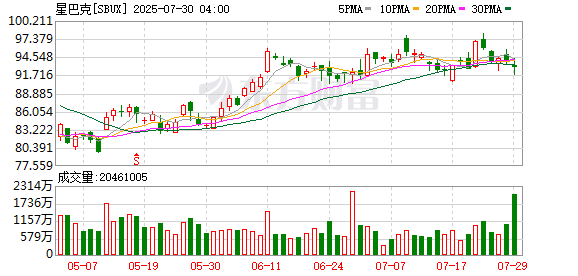
Core Insights - Starbucks reported third-quarter earnings that fell short of market expectations, with same-store sales and profits declining, yet the CEO highlighted progress in the company's revitalization plan and growth in the Chinese market for the first time in 2023, leading to a post-market stock price increase of 4.6% [2][6]. Financial Performance - Revenue for the third quarter was $9.5 billion, exceeding analyst expectations of $9.31 billion [2]. - Same-store sales decreased by 2%, worse than the expected decline of 1.3% [2]. - Net profit for the quarter was $558.3 million, or $0.49 per share, significantly down from $1.05 billion or $0.93 per share in the same period last year [2]. - Adjusted earnings per share were $0.50, below the analyst forecast of $0.65 [2]. Market and Operational Developments - Despite the decline in same-store sales globally for six consecutive quarters, the Chinese market showed signs of recovery with a 2% increase in same-store sales and a 6% rise in transaction volume [7]. - The CEO mentioned that the company has reduced store construction costs by 30% and is implementing new projects to enhance customer service and sales [6][8]. - The company is focusing on improving the customer experience by increasing staff and prioritizing in-store and drive-thru orders [6]. Future Outlook and Strategic Initiatives - Starbucks plans to invest $500 million in human resources for U.S. company-operated stores over the next year [8]. - The company is adopting a cautious approach for the remainder of the fiscal year due to uncertainties in the consumer market [8]. - Looking ahead to fiscal 2026, Starbucks intends to launch several new products and services, including a revamped app and a refreshed loyalty program [8].
Starbucks Still Needs More Time
The Motley Fool· 2025-07-29 21:22
Core Viewpoint - Starbucks' fiscal third-quarter results were mixed, with revenue growth but significant declines in earnings per share and comparable sales in North America [1][4]. Financial Performance - Total revenue for Q3 FY 2024 was $9.11 billion, increasing to $9.46 billion in Q3 FY 2025, representing a 4% growth and beating expectations [2]. - Adjusted earnings per share fell from $0.93 to $0.50, a decline of 46%, which missed expectations [2]. - North America comparable sales remained unchanged at -2%, while international comparable sales improved by 7 percentage points, moving from -7% to 0% [2]. Business Insights - The company reported a 4% global revenue increase, with a 2% rise in North America and a 9% increase in the international segment [4]. - Despite the revenue growth, global comparable sales decreased by 2%, driven by a 2% drop in North America, while international sales remained flat [4]. - CEO Brian Niccol expressed confidence in the company's turnaround, stating that significant progress has been made and a "wave of innovation" is expected next year [5]. Market Reaction - Following the quarterly release, Starbucks' stock rose by 5% in after-hours trading, indicating investor acceptance of the CEO's optimistic outlook despite the earnings miss [6]. Regional Performance - China showed positive signs with comparable sales increasing by 2% year over year, reversing a previous decline, and the company opened over 500 new locations in China in the past 12 months [7].