Snowflake(SNOW)

Search documents
Sigma Launches New Process Effectiveness Solution with Snowflake to Power AI-Driven Energy Operations
Businesswire· 2026-01-27 14:05
Core Viewpoint - Sigma has announced a collaboration with Snowflake to support the launch of Snowflake's new Energy Solutions, aimed at helping energy organizations utilize data and AI more effectively across their operations [1] Group 1: Collaboration Details - The partnership between Sigma and Snowflake is focused on empowering oil and gas, power, and utilities providers [1] - The collaboration aims to modernize infrastructure and improve efficiency within the energy sector [1] - The initiative is expected to accelerate progress in the energy industry through enhanced data and AI applications [1]



Snowflake Launches Energy Solutions for the AI Data Cloud to Accelerate Shift to a Lower-Carbon Future
Businesswire· 2026-01-27 14:01
Core Insights - Snowflake has launched new Energy Solutions aimed at unifying IT, OT, and business data to support predictive maintenance, grid optimization, and emissions reduction in the energy sector [1][2] - The solutions are designed to help power, utilities, and oil and gas companies modernize their operations and improve efficiency while moving towards a lower-carbon future [1][2] - Industry leaders such as ExxonMobil, Siemens, and PG&E are already utilizing Snowflake's platform to enhance operational resilience and navigate market volatility [1][2] Company Developments - Snowflake's Energy Solutions integrate governance capabilities, partner-developed solutions, and critical datasets into a single offering tailored for the energy sector [1] - The company has introduced over 30 new partner-built solutions that run natively on the AI Data Cloud, enhancing capabilities in areas like geospatial analysis and grid planning [1][2] - Snowflake's partnership with SAP allows energy companies to combine finance and supply chain data with operational data, improving insights for grid operations and asset planning [1] Industry Impact - The new solutions support critical energy use cases such as grid planning, asset health, and operational forecasting, indicating strong momentum in the energy sector [1][2] - Snowflake's platform enables energy companies to unify data and apply AI across various operations, leading to faster decision-making and improved sustainability outcomes [1][2] - The integration of advanced analytics and AI capabilities is seen as essential for energy companies to manage decentralized assets and optimize energy production [2]

全球软件:2026 年初步展望及我们关注的软件标的-Global Software_ Initial thoughts for 2026 and our software names
2026-01-26 02:49
Summary of Global Software Conference Call Industry Overview - The software industry is experiencing a significant shift in focus from macroeconomic concerns to the disruptive rise of AI, with investor discussions centered around whether an AI bubble exists and the potential impact of AI on enterprise software [1][11][15]. Key Themes for 2026 - **Valuation Reset**: Software valuations have halved over the past year, creating opportunities to acquire high-quality stocks at discounted prices [14][31]. - **IT Spending Outlook**: Recent CIO surveys indicate one of the strongest IT spending outlooks since 2018, with expectations for a stable macro environment and lower interest rates supporting demand, particularly among small and medium-sized businesses (SMBs) [3][13][23]. - **Generative AI Impact**: While Generative AI is a major topic, its revenue impact on most software companies is still limited. The expectation is that significant revenue generation from AI will not materialize until 2027 or later [6][19][22]. Company-Specific Insights - **Top Picks**: Recommended stocks include Oracle, Microsoft, SAP, and HubSpot, all rated as Outperform. MongoDB is also favored for its long-term potential and near-term momentum [4][7][25][26]. - **Cautionary Stocks**: Salesforce is expected to underperform due to concerns over AI disruption and market saturation. Snowflake is rated as Market-Perform, with long-term growth prospects viewed as uncertain [4][7][29][30]. Financial Metrics - **Valuation Comparisons**: - Adobe (ADBE): Current price $296.12, target $506.00, adjusted P/E 12.0 for 2026E. - Microsoft (MSFT): Current price $459.86, target $645.00, adjusted P/E 27.5 for 2026E. - Oracle (ORCL): Current price $191.09, target $339.00, adjusted P/E 25.9 for 2026E. - Salesforce (CRM): Current price $227.11, target $223.00, adjusted P/E 19.2 for 2026E [5][8]. Investment Implications - **SMB vs. Enterprise**: SMB-focused software companies may see earlier revenue recovery compared to enterprise-focused firms, as SMBs typically rebound faster in improving economic conditions [6][23]. - **AI Revenue Generation**: The expectation is that while AI will contribute to revenue growth, it will be limited in 2026, with only a few companies likely to see a significant positive impact [19][20]. Macro Considerations - **Economic Stability**: The macroeconomic environment is expected to remain stable, with potential benefits from deregulation and tax cuts in the U.S. [3][23]. - **Geopolitical Risks**: Ongoing global conflicts and geopolitical tensions may continue to impact market sentiment and investment strategies [21][23]. Conclusion - The software sector is at a pivotal moment, with significant opportunities arising from valuation resets and a favorable IT spending outlook. However, the impact of Generative AI remains uncertain, and investors are advised to focus on company-specific fundamentals while being cautious of potential disruptions in the market.




Snowflake (NYSE: SNOW) Price Prediction and Forecast 2026–2030 (February 2026)
247Wallst· 2026-01-23 12:00
Core Viewpoint - Snowflake Inc. has shown resilience in its stock performance despite recent declines, with significant growth potential driven by the expanding cloud computing market and strong financial fundamentals [1][5]. Company Performance - Snowflake's stock has decreased by 6.93% over the past month, following declines of 6.26% and 5.34% in the previous two months, but has increased nearly 62% since its one-year low on April 4 [1]. - The company reported FY 2025 Q3 earnings on November 20, 2025, with an EPS of 20 cents, surpassing expectations of 15 cents, and revenue of $942.1 million, exceeding the forecast of $898.5 million [1]. - The stock has dropped more than 46% since its all-time high in November 2021, but the market cap currently stands at $71.10 billion [3][5]. Industry Overview - The global cloud computing market is projected to grow at a CAGR of 21.2% from 2024 to 2030, with the U.S. market expected to grow at a CAGR of 20.3% during the same period [2][9]. - Snowflake is positioned to capitalize on the $602.31 billion industry, facing competition from major players like Google and Amazon but leveraging its unique offerings [2][9]. Financial Metrics - Snowflake's revenue has shown significant growth, with projections indicating a rise from $2.81 billion in 2024 to $10.512 billion by 2030 [11]. - The company has a negative P/E ratio of -50.8, but its total assets of $8.22 billion exceed total liabilities of $3.03 billion, indicating strong underlying fundamentals [6]. Key Drivers of Growth - Collaboration with NVIDIA to implement AI Enterprise software enhances Snowflake's capabilities in building customized AI data applications, tapping into dual demand for cloud storage and AI solutions [7]. - The company boasts a revenue retention rate of 127%, indicating strong customer loyalty across a diverse client base, including major corporations and public entities [8]. - The rise of hybrid and multi-cloud solutions, along with increased cloud adoption, positions Snowflake favorably in a growing market [9]. Price Predictions - Analysts have a consensus "Strong Buy" rating for Snowflake, with a median one-year price target of $284.35, representing a 34.68% upside potential from current levels [10]. - By 2030, the stock is projected to reach $472.65, suggesting a potential upside of 108.36% based on anticipated revenue growth and earnings per share [11][12].

SNOW Expands Cloud Infrastructure Reach: A Sign for More Upside?
ZACKS· 2026-01-22 18:45
Core Insights - Snowflake (SNOW) is experiencing significant growth due to its expansion in cloud infrastructure and focus on AI capabilities, with product revenue increasing by 29% year-over-year to $1.16 billion in Q3 FY26 [1][10] - The company has remaining performance obligations of $7.88 billion, reflecting a 37% year-over-year growth [1][10] Growth Drivers - Collaboration with major cloud providers like AWS and Google Cloud has been pivotal, with Snowflake surpassing $2 billion in sales through AWS Marketplace in a single calendar year and receiving 14 AWS Partner awards [2] - The partnership with Google Cloud to integrate Gemini models into Snowflake's AI offerings enhances customer access to advanced AI capabilities [2] AI Focus - Snowflake achieved a $100 million AI revenue run rate one quarter earlier than expected, driven by the adoption of Snowflake Intelligence and Cortex AI [3] - AI is influencing 50% of bookings signed in Q3 FY26, with 28% of all deployed use cases incorporating AI, solidifying Snowflake's position in enterprise AI [3] Future Projections - For Q4 FY26, Snowflake expects product revenues to be in the range of $1.195 billion to $1.2 billion, indicating a year-over-year growth of 27% [4] Competitive Landscape - Snowflake faces competition from Alphabet (GOOGL) and MongoDB (MDB), both expanding in the cloud analytics space [5] - Google Cloud's revenues increased by 33.5% year-over-year to $15.16 billion in Q3 FY25, indicating strong growth in the cloud market [6] - MongoDB's Atlas platform has shown a year-over-year growth of 30% in Q3 FY26, now representing 75% of its total revenue [7] Stock Performance and Valuation - Snowflake shares have decreased by 2.7% over the past 12 months, underperforming the Zacks Computer & Technology sector's return of 13.6% [8] - The stock is trading at a forward Price/Sales ratio of 12.42X, significantly higher than the Internet Software industry's 4.34X [11] - The Zacks Consensus Estimate for SNOW's fiscal 2026 earnings is $1.20 per share, indicating a 44.58% year-over-year increase [13]

2026 年数据与人工智能的 7 项预测
3 6 Ke· 2026-01-22 05:52
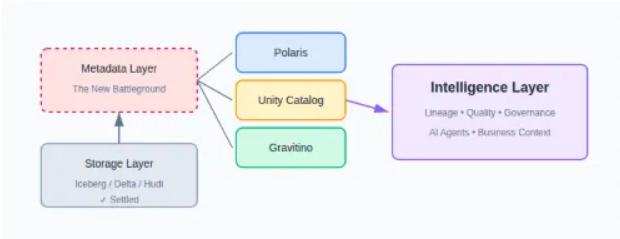
Core Insights - The infrastructure supporting artificial intelligence is undergoing a significant transformation, driven by the convergence of open formats, AI capabilities, and the unsustainable costs of integrating numerous tools [1][2]. Group 1: Importance of Fundamentals - Basic skills remain crucial as architecture changes can disrupt pipelines, and data quality issues continue to plague organizations, costing an average of $12.9 million annually due to poor data quality [2][11]. - The key challenge by 2026 will not be the existence of these issues but the speed and method of their detection and resolution [2]. Group 2: Metadata Layer as a Battleground - The storage layer competition has concluded with Iceberg, Delta Lake, and Hudi emerging as winners, while Parquet has become the common language for data storage [3][6]. - The focus is shifting upstream to the metadata layer, which is becoming the operational backbone of data management, encompassing data lineage, quality rules, access policies, and business context [6][20]. Group 3: Simplification of Data Stacks - Organizations are experiencing tool fatigue, managing an average of 15 to 30 different tools across various data functions, which is unsustainable [7][9]. - By 2026, the integration process will accelerate, with platforms like Snowflake and Databricks consolidating functionalities to streamline data operations [10]. Group 4: Data Quality as a Business Function - Data quality metrics will shift from engineering-focused indicators to business outcomes, with organizations increasingly linking data pipeline failures to revenue impacts [11][12]. - By 2026, 80% of organizations are expected to deploy AI/ML-driven data quality solutions, emphasizing the need for accountability through data contracts between producers and consumers [12]. Group 5: AI Agents Replacing Dashboards - The traditional model of data observability through dashboards is becoming obsolete, with AI agents expected to take over operational responsibilities by 2026 [13][15]. - These AI agents will be capable of understanding business context, automatically tracing issues, and applying fixes, fundamentally changing the approach to data observability [15]. Group 6: AI Reshaping Data Infrastructure - The initial design of data stacks was for dashboard services, not AI workloads, but AI is now a primary user of data [16]. - By 2026, two types of companies will emerge: AI-native architectures designed for AI workloads and traditional stacks with AI capabilities added later [16]. Group 7: The Rise of Semantic Layers - Semantic layers, previously seen as optional, are becoming essential for AI applications, providing necessary context for data interpretation and ensuring data quality [17]. - These layers serve as a bridge between technical data and business meaning, crucial for AI agents to function effectively [17]. Group 8: Common Theme - A common theme across the predictions is the shift from passive to proactive data infrastructure, where systems will not only store and visualize data but also understand, reason, and act based on interactions [18][19].
2 Software Stocks to Buy Now to Profit from the Fourth Industrial Revolution
Yahoo Finance· 2026-01-21 12:30
The artificial intelligence (AI) revolution is entering a critical phase, and two software companies are positioned to capitalize on what analysts are calling a once-in-a-generation opportunity. Wedbush analyst Dan Ives believes the upcoming tech earnings season will validate the massive AI buildout. Ives expects Q4 results will be led by Big Tech and backed by field checks, indicating robust enterprise AI demand. More News from Barchart Ives projects that AI spending will reach $3 trillion over the n ...

Zinnia collaborates with Snowflake on real-time insurance analytics and AI
Yahoo Finance· 2026-01-21 11:00
Core Insights - Zinnia has partnered with Snowflake to integrate its insurance platform with Snowflake's AI data cloud, enhancing machine learning and AI-driven applications [1][2] - The collaboration aims to provide insurers with real-time business metrics and analytical tools, supporting digital transformation efforts [2][3] Group 1: Integration and Implementation - Zinnia will serve as an implementation partner for insurers adopting Snowflake's AI data cloud, leveraging its expertise in the insurance sector [2] - The integration is designed to ensure enterprise-level security and scalability for insurance companies [2] Group 2: Data Utilization and Analytics - Zinnia's chief data officer highlighted that many insurance companies struggle to unlock the potential of their vast data, and the partnership with Snowflake aims to change that [3] - The combined platform will support predictive analytics, risk modeling, and automated decision-making through embedded machine learning and AI capabilities [3] Group 3: Application Development and Client Use - The integration will enable the development of self-hosted applications using Streamlit and scalable cloud data warehousing [4] - Security Benefit, a client of Zinnia, is already utilizing the data and AI capabilities from the integration, allowing for secure information exchange and faster decision-making [4][5]
全球软件 2026 年初步展望及重点标的-Global Software Initial thoughts for 2026 and our software names
2026-01-21 02:58
Summary of Global Software Conference Call Industry Overview - The software industry is experiencing a significant shift in focus from macroeconomic concerns to the disruptive rise of AI, with investor discussions centered around whether an AI bubble exists and the potential impact of AI on enterprise software [1][11][15]. Key Themes for 2026 - **Valuation Reset**: Software valuations have halved over the past year, creating opportunities for investors to acquire high-quality stocks at discounted prices [14][31]. - **IT Spending Outlook**: Recent CIO surveys indicate one of the strongest IT spending outlooks since 2018, with expectations for a stable macro environment and lower interest rates supporting demand, particularly among small and medium-sized businesses (SMBs) [3][13][23]. - **Generative AI Impact**: While Generative AI is a major topic, its actual revenue impact on software companies is still limited. Most companies are not yet seeing significant revenue from AI, and the focus is shifting towards company-specific opportunities [6][15][19]. Company Recommendations - **Buy Recommendations**: - **Oracle (ORCL)**: Strong core business with significant cloud transition and market share gains in IaaS/PaaS, driven by unique offerings [4][27]. - **Microsoft (MSFT)**: Durable business with multiple growth levers and a reset valuation, positioned well for AI monetization [4][27]. - **SAP (SAP)**: Consistent double-digit revenue growth and margin improvement, despite AI cycle noise [4][27]. - **HubSpot (HUBS)**: Attractive entry point with strong SMB market positioning and potential benefits from AI adoption [4][27]. - **Cautionary Recommendations**: - **Salesforce (CRM)**: Concerns over underperformance and potential reliance on acquisitions to drive growth [4][29]. - **Snowflake (SNOW)**: Long-term growth concerns due to market saturation and competitive pressures [4][30]. - **Workday (WDAY)**: Growth deceleration and investor skepticism regarding AI's impact on its business model [4][28]. Financial Metrics - **Valuation Comparisons**: - Adobe (ADBE): Adjusted P/E ratios have decreased significantly, with a current valuation of 12.0x for 2026E [5][32]. - Microsoft (MSFT): Current P/E at 27.5x for 2026E, reflecting a reset from previous highs [5][32]. - Oracle (ORCL): Trading at a 0.9x PEG ratio, down from 1.4x a year ago, indicating a significant valuation adjustment [32]. Macro Considerations - **Economic Environment**: The macroeconomic landscape is expected to stabilize, with potential benefits from deregulation and tax cuts in the U.S. impacting SMB spending positively [6][23]. - **AI Adoption Timeline**: Enterprise adoption of AI is anticipated to take longer than expected, with significant visibility likely not occurring until 2027 or 2028 [22][23]. Conclusion - The software sector is at a pivotal moment, with significant valuation resets providing investment opportunities. However, the actual impact of AI on revenue generation remains uncertain, necessitating a cautious approach to investment in this space. The focus should be on companies with strong fundamentals and clear growth trajectories amidst the evolving landscape of AI and macroeconomic conditions [1][14][19].

MDB vs. SNOW: Which Data Platform Stock is the Better Buy Now?
ZACKS· 2026-01-20 16:55
Core Insights - MongoDB (MDB) and Snowflake (SNOW) are leading cloud-based data platform providers, with MongoDB focusing on flexible database solutions and Snowflake on enterprise data warehousing and analytics [2] - The database market is projected to grow from $171.36 billion in 2026 to $329.05 billion by 2031, at a CAGR of 13.95%, driven by generative AI adoption, data-sovereignty regulations, and IoT data streams [3] MongoDB (MDB) Highlights - MongoDB's growth is supported by product innovation and strong adoption of its cloud platform, MongoDB Atlas, which accounts for over 75% of total revenues [4] - The company is enhancing its capabilities for analytics and AI applications, integrating features like vector search and text search into its core database [5] - MongoDB has a robust partner ecosystem and serves over 70% of the Fortune 100, with a customer base exceeding 62,500 [6] - The Zacks Consensus Estimate for MDB's fiscal 2026 EPS is $4.79, indicating a year-over-year growth of 30.87% [7] Snowflake (SNOW) Highlights - Snowflake's business model focuses on a cloud data warehouse platform that consolidates structured and semi-structured data, with product revenue reaching $1.16 billion in the fiscal third quarter, reflecting 29% year-over-year growth [8] - The company has launched Snowflake Intelligence, an AI platform that quickly gained 1,200 customers and a $100 million annual run rate [10] - The Zacks Consensus Estimate for SNOW's fiscal 2026 EPS is $1.2, suggesting a year-over-year growth of 44.58% [11] Price Performance and Valuation - Over the past six months, MongoDB's shares have increased by 79.9%, while Snowflake's shares have declined by 2.5% [12] - MongoDB trades at a forward price-to-sales ratio of 11.4x, compared to Snowflake's 12.66x, indicating a favorable valuation for MongoDB despite its stronger performance [14] Conclusion - Both MongoDB and Snowflake are well-positioned to benefit from the expanding database market, but MongoDB's growth profile appears more compelling due to its accelerating Atlas momentum and efficient customer acquisition [16][19] - MongoDB holds a Zacks Rank 1 (Strong Buy), while Snowflake has a Zacks Rank 3 (Hold), suggesting a more favorable investment outlook for MongoDB [20]